Teaching the Digital HumanitiesRafael C. Alvarado, Ph.D.Associate Director of SHANTIUniversity of Virginia
What are the “digital humanities”?See  http://bit.ly/ci7Tuy
Features of DHA set of methods and practices, not a humanities discipline per seApplied to traditional humanities disciplinesThe humanities as those disciplines concerned with interpreting the "records left by man [sic]“ (Panofsky)Focusing on (1) the use of digital media to represent both primary and secondary sourcesEspecially texts and imagesand (2) to engage in scholarly communicationBut to a lesser degree
Features of DHWith a specific historyOutgrowth of “humanities computing”Use of TEI, emphasis on graph theory, GISClosely related to (and merging with) fields ofMedia StudiesInstructional TechnologyNew Media And in productive tension with more recent developments Digital storytellingEdupunk
Representation is the key term in this definitionSpecifically a practical and critical understanding of the uses and effects of digital representation in a pervasively networked medium (the web)The digital humanities is therefore also about what happens to scholarship when text and image become digital?
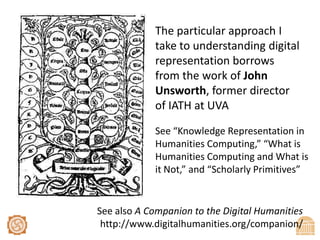
The particular approach I take to understanding digital representation borrows from the work of John Unsworth, former director of IATH at UVA See “Knowledge Representation in Humanities Computing,” “What is Humanities Computing and What is it Not,” and “Scholarly Primitives”See also A Companion to the Digital Humanitieshttp://www.digitalhumanities.org/companion/
Undergraduate Curricular CoursesArt History and TechnologyFreshman Seminar (1990, 2001)Art History at Princeton (as Assoc Dir of Educational Tech Ctr)Introduction to the Digital Liberal Arts3000 and 7000 level courseMedia Studies at UVA (Spring and Fall 2010)Part of SHANTI’s effort to create a Digital Humanities minor“digital liberal arts” thought to be more inclusive than DHDataestheticsFollow-up course to IntroTo be taught next semester (so won’t cover today)Theory and practice of database-driven web applications
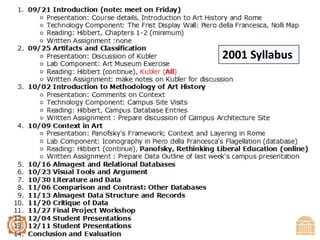
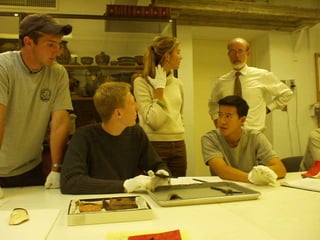
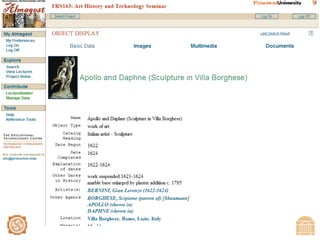
Art History and TechnologyFRS113 and FRS163ContentRoman Art and Archaeology (Professor John Pinto)ThemesConnected art historical classification to database design and useConnected Panofsky (Iconology) and Kubler (Shape of Time) to data modeling and SQLActivitiesStudents engaged in hands-on classification exercisesStudents built out a complete record in AlmagestStudents presented an argument based on their workExemplary work on Bernini’s Apollo and Daphne
2001 Syllabus
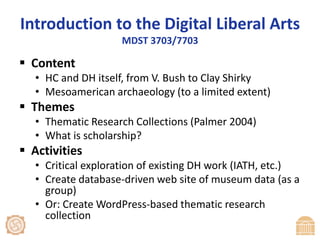
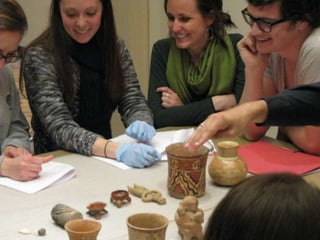
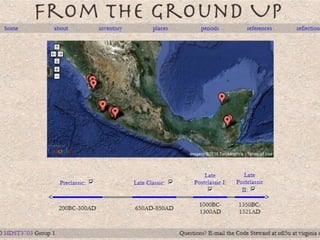
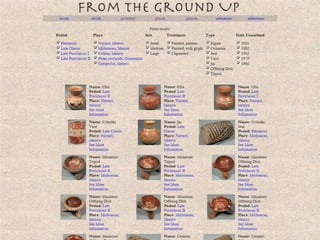
Introduction to the Digital Liberal ArtsMDST 3703/7703ContentHC and DH itself, from V. Bush to Clay ShirkyMesoamerican archaeology (to a limited extent)ThemesThematic Research Collections (Palmer 2004)What is scholarship?ActivitiesCritical exploration of existing DH work (IATH, etc.)Create database-driven web site of museum data (as a group)Or: Create WordPress-based thematic research collection
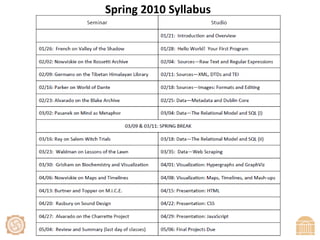
Spring 2010 Syllabus
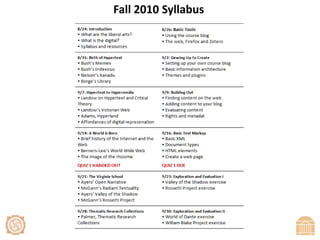
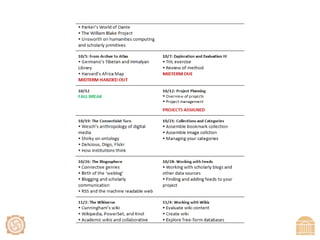
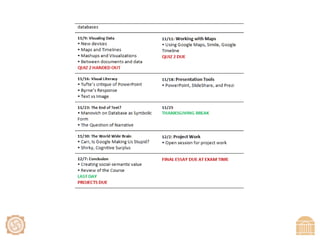
Fall 2010 Syllabus
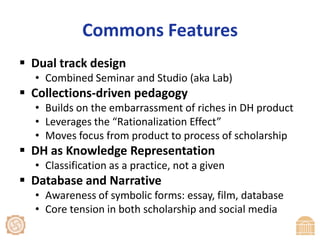
Commons FeaturesDual track designCombined Seminar and Studio (aka Lab)Collections-driven pedagogyBuilds on the embarrassment of riches in DH productLeverages the “Rationalization Effect”Moves focus from product to process of scholarshipDH as Knowledge RepresentationClassification as a practice, not a givenDatabase and NarrativeAwareness of symbolic forms: essay, film, databaseCore tension in both scholarship and social media
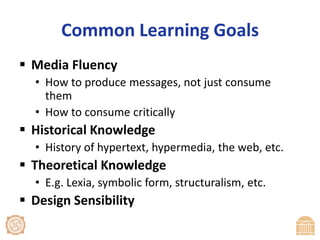
Common Learning GoalsMedia FluencyHow to produce messages, not just consume themHow to consume criticallyHistorical KnowledgeHistory of hypertext, hypermedia, the web, etc.Theoretical KnowledgeE.g. Lexia, symbolic form, structuralism, etc.Design Sensibility
“The main goal of this course is to give you the opportunity to become a new kind of scholar, one who is able to use digital media to effectively present ideas and arguments in the academic field of your choice, either for your own work or as part of a faculty-led project.”
Issues ArisingWhat are we producing? Scholars, technologists, both?We want hybrids sure, but the reality is differentTopic focused?Degree and kind of technology training in the course?Basal technological literacyShould everyone know how to edit video?  Program? (Campbell vs. Ramsay)Team teach?Practical vs. Critical approaches
ObservationsDon’t try to cram a curriculum into a courseLess is moreHands-on is keyDon’t do everything by computerUse theory, but don’t overwhelmConnect to content (e.g. history of the web followed by HTML)
Teaching the Digital Humanities

Teaching the Digital Humanities

  • 1.
    Teaching the DigitalHumanitiesRafael C. Alvarado, Ph.D.Associate Director of SHANTIUniversity of Virginia
  • 2.
    What are the“digital humanities”?See http://bit.ly/ci7Tuy
  • 3.
    Features of DHAset of methods and practices, not a humanities discipline per seApplied to traditional humanities disciplinesThe humanities as those disciplines concerned with interpreting the "records left by man [sic]“ (Panofsky)Focusing on (1) the use of digital media to represent both primary and secondary sourcesEspecially texts and imagesand (2) to engage in scholarly communicationBut to a lesser degree
  • 4.
    Features of DHWitha specific historyOutgrowth of “humanities computing”Use of TEI, emphasis on graph theory, GISClosely related to (and merging with) fields ofMedia StudiesInstructional TechnologyNew Media And in productive tension with more recent developments Digital storytellingEdupunk
  • 5.
    Representation is thekey term in this definitionSpecifically a practical and critical understanding of the uses and effects of digital representation in a pervasively networked medium (the web)The digital humanities is therefore also about what happens to scholarship when text and image become digital?
  • 6.
    The particular approachI take to understanding digital representation borrows from the work of John Unsworth, former director of IATH at UVA See “Knowledge Representation in Humanities Computing,” “What is Humanities Computing and What is it Not,” and “Scholarly Primitives”See also A Companion to the Digital Humanitieshttp://www.digitalhumanities.org/companion/
  • 7.
    Undergraduate Curricular CoursesArtHistory and TechnologyFreshman Seminar (1990, 2001)Art History at Princeton (as Assoc Dir of Educational Tech Ctr)Introduction to the Digital Liberal Arts3000 and 7000 level courseMedia Studies at UVA (Spring and Fall 2010)Part of SHANTI’s effort to create a Digital Humanities minor“digital liberal arts” thought to be more inclusive than DHDataestheticsFollow-up course to IntroTo be taught next semester (so won’t cover today)Theory and practice of database-driven web applications
  • 8.
    Art History andTechnologyFRS113 and FRS163ContentRoman Art and Archaeology (Professor John Pinto)ThemesConnected art historical classification to database design and useConnected Panofsky (Iconology) and Kubler (Shape of Time) to data modeling and SQLActivitiesStudents engaged in hands-on classification exercisesStudents built out a complete record in AlmagestStudents presented an argument based on their workExemplary work on Bernini’s Apollo and Daphne
  • 9.
  • 12.
    Introduction to theDigital Liberal ArtsMDST 3703/7703ContentHC and DH itself, from V. Bush to Clay ShirkyMesoamerican archaeology (to a limited extent)ThemesThematic Research Collections (Palmer 2004)What is scholarship?ActivitiesCritical exploration of existing DH work (IATH, etc.)Create database-driven web site of museum data (as a group)Or: Create WordPress-based thematic research collection
  • 13.
  • 14.
  • 20.
    Commons FeaturesDual trackdesignCombined Seminar and Studio (aka Lab)Collections-driven pedagogyBuilds on the embarrassment of riches in DH productLeverages the “Rationalization Effect”Moves focus from product to process of scholarshipDH as Knowledge RepresentationClassification as a practice, not a givenDatabase and NarrativeAwareness of symbolic forms: essay, film, databaseCore tension in both scholarship and social media
  • 21.
    Common Learning GoalsMediaFluencyHow to produce messages, not just consume themHow to consume criticallyHistorical KnowledgeHistory of hypertext, hypermedia, the web, etc.Theoretical KnowledgeE.g. Lexia, symbolic form, structuralism, etc.Design Sensibility
  • 22.
    “The main goalof this course is to give you the opportunity to become a new kind of scholar, one who is able to use digital media to effectively present ideas and arguments in the academic field of your choice, either for your own work or as part of a faculty-led project.”
  • 23.
    Issues ArisingWhat arewe producing? Scholars, technologists, both?We want hybrids sure, but the reality is differentTopic focused?Degree and kind of technology training in the course?Basal technological literacyShould everyone know how to edit video? Program? (Campbell vs. Ramsay)Team teach?Practical vs. Critical approaches
  • 24.
    ObservationsDon’t try tocram a curriculum into a courseLess is moreHands-on is keyDon’t do everything by computerUse theory, but don’t overwhelmConnect to content (e.g. history of the web followed by HTML)

Editor's Notes

  • #3 I’d like to frame my presentation by raising the question …There are as many answers to this question as there are people who call themselves “digital humanists”For example, see the wiki page on this topic that was create fro Geoff Rockwell’s Day of Digital Humanities projectI actually have an answer to this question that I have subscribed to, implicitly and explicitly, which forms that foundation …
  • #7 The courses I’ve taught were designed from this perspective