Data Analytics in Digital Humanities Hai-Jew
download
https://textbookfull.com/product/data-analytics-in-digital-
humanities-hai-jew/
Download more ebook from https://textbookfull.com
We believe these products will be a great fit for you. Click
the link to download now, or visit textbookfull.com
to discover even more!
Data Analytics in Digital Humanities 1st Edition Shalin
Hai-Jew (Eds.)
https://textbookfull.com/product/data-analytics-in-digital-
humanities-1st-edition-shalin-hai-jew-eds/
Common Visual Art in a Social Digital Age 1st Edition
Shalin Hai-Jew.
https://textbookfull.com/product/common-visual-art-in-a-social-
digital-age-1st-edition-shalin-hai-jew/
Digital Analytics Data Driven Decision Making in
Digital World 1st Edition Jumin Kamki
https://textbookfull.com/product/digital-analytics-data-driven-
decision-making-in-digital-world-1st-edition-jumin-kamki/
Business Models: Innovation, Digital Transformation,
and Analytics (Data Analytics Applications) 1st Edition
Iwona Otola (Editor)
https://textbookfull.com/product/business-models-innovation-
digital-transformation-and-analytics-data-analytics-
applications-1st-edition-iwona-otola-editor/
New Digital Worlds Postcolonial Digital Humanities in
Theory Praxis and Pedagogy Roopika Risam
https://textbookfull.com/product/new-digital-worlds-postcolonial-
digital-humanities-in-theory-praxis-and-pedagogy-roopika-risam/
Data Analytics and Management in Data Intensive Domains
Leonid Kalinichenko
https://textbookfull.com/product/data-analytics-and-management-
in-data-intensive-domains-leonid-kalinichenko/
Big Data Analytics and Computing for Digital Forensic
Investigations 1st Edition Suneeta Satpathy (Editor)
https://textbookfull.com/product/big-data-analytics-and-
computing-for-digital-forensic-investigations-1st-edition-
suneeta-satpathy-editor/
Computation and the Humanities Towards an Oral History
of Digital Humanities 1st Edition Julianne Nyhan
https://textbookfull.com/product/computation-and-the-humanities-
towards-an-oral-history-of-digital-humanities-1st-edition-
julianne-nyhan/
Big Data Analytics in Cybersecurity First Edition Deng
https://textbookfull.com/product/big-data-analytics-in-
cybersecurity-first-edition-deng/
Multimedia Systems and Applications
Shalin Hai-Jew Editor
Data
Analytics
in Digital
Humanities
Multimedia Systems and Applications
Series editor
Borko Furht, Florida Atlantic University, Boca Raton, USA
More information about this series at http://www.springer.com/series/6298
Shalin Hai-Jew
Editor
Data Analytics in Digital
Humanities
123
Editor
Shalin Hai-Jew
Kansas State University
Manhattan, KS, USA
Multimedia Systems and Applications
ISBN 978-3-319-54498-4 ISBN 978-3-319-54499-1 (eBook)
DOI 10.1007/978-3-319-54499-1
Library of Congress Control Number: 2017935738
© Springer International Publishing AG 2017
This work is subject to copyright. All rights are reserved by the Publisher, whether the whole or part of
the material is concerned, specifically the rights of translation, reprinting, reuse of illustrations, recitation,
broadcasting, reproduction on microfilms or in any other physical way, and transmission or information
storage and retrieval, electronic adaptation, computer software, or by similar or dissimilar methodology
now known or hereafter developed.
The use of general descriptive names, registered names, trademarks, service marks, etc. in this publication
does not imply, even in the absence of a specific statement, that such names are exempt from the relevant
protective laws and regulations and therefore free for general use.
The publisher, the authors and the editors are safe to assume that the advice and information in this book
are believed to be true and accurate at the date of publication. Neither the publisher nor the authors or
the editors give a warranty, express or implied, with respect to the material contained herein or for any
errors or omissions that may have been made. The publisher remains neutral with regard to jurisdictional
claims in published maps and institutional affiliations.
Printed on acid-free paper
This Springer imprint is published by Springer Nature
The registered company is Springer International Publishing AG
The registered company address is: Gewerbestrasse 11, 6330 Cham, Switzerland
This book is for R. Max.
Preface
The digital humanities, putatively the intersection between the humanities disci-
plines and computation, was popularized in the early 1990s. In the intervening
decades, the “digital humanities” has not yet settled on a defined self-identity. One
indicator of this is that of the dozens of “DH” manifestos on the Web; they all have
differing and competing visions for the field. Another indicator is the rich variety
of work being done under these auspices that does not fall into simple summaries
and descriptions. The Digital Humanities Manifesto 2.0, which originated from nine
seminars co-taught by Jeffrey Schnapp and Todd Presner, and was released by the
UCLA Mellon Seminar in Digital Humanities, reads in part:
Digital Humanities is not a unified field but an array of convergent practices that explore
a universe in which: (a) print is no longer the exclusive or the normative medium in
which knowledge is produced and/or disseminated; instead, print finds itself absorbed into
new, multimedia configurations; and (b) digital tools, techniques, and media have altered
the production and dissemination of knowledge in the arts, human and social sciences.
The Digital Humanities seeks to play an inaugural role with respect to a world in which
universities—no longer the sole producers, stewards, and disseminators of knowledge or
culture—are called upon to shape natively digital models of scholarly discourse for the
newly emergent public spheres of the present era (the www, the blogosphere, digital
libraries, etc.), to model excellence and innovation in these domains, and to facilitate the
formation of networks of knowledge production, exchange, and dissemination that are, at
once, global and local” (“The Digital Humanities Manifesto 2.0,” 2009).
DH work is additive and contributes to learning and methods in a range of extant
fields. It is about hybrid mash-ups that pull from analog and digital sources and
that give back digitally. There are combinations of research and analytical methods,
drawing from quantitative and qualitative methods, going Web scale and small scale,
employing a range of frameworks, and combining various disciplines, often through
collaborative and distributed teams.
vii
viii Preface
Deconstructing “DH”
The “digital” part of the “digital humanities” involves a range of technologies:
the Web and Internet, mobile devices, social media, databases, digital curation
platforms, geographical mapping tools, social mapping tools, linguistic analysis
software programs, data analytics tools, and others. The “humanities” focus points
to a combination of fields: the classics, literature, philosophy, religious studies,
psychology, modern and ancient languages, culture studies, art, history, music, phi-
losophy, theater, film, political science, geography, anthropology, linguistics, social
work, communications, and others. For all the technological focuses, the DH work is
about people and for people through the ages and for the ages. Every work, no matter
how technological, contains the human touch and is conceptualized for human
benefit. The works are human-readable, in general, and are packaged as stories
and understandings. The works are often aesthetically dazzling: think interactive
webscapes, data visualizations, 3D virtual immersive spaces, and network diagrams.
Likewise, one can ask what “data” in the digital humanities is. Well, the general
opinion is that everything has some informational value. The world is informatized,
and DH researchers themselves are not only researchers and elicitors of insights, but
they are in-world participants making the world and information simultaneously.
The information is viewed through a subjective and interpretive lens, but that
interpretation is backed up by more traditionally quantitative (statistical) and
computational (machine learning) methods. The work is not seen as neutral nor
theory-free not independent of its contributors.
The challenge is in how to turn a “thing” in the world into something with infor-
mational and social value. This data may seem at once a range of contradictions:
ephemeral and fragile and yet permanent and perpetual, subjective and objective,
created for the local but also the global, inclusive of machine-scale distant reading
methods as well as close human reading.
The Spirit of DH
Often, the spirit of the digital humanities is countercultural; it fights against extant
power structures and norms. The DH is often value-informed and socially active, in
the pursuit of social justice. DH practitioners take a questioning stance because the
world is never quite as it seems. There are elusive and latent interpreted truths to be
discovered or (co)created.
While its core spirit is of changing the current order, at the same time, DH work
requires ever higher levels of expertise in content fields and technological methods.
The work is anti-Establishment but requires some of the expertise of Establishment
and accrued skills from years of development. Virtuosity in the digital humanities
simultaneously requires the fiery rebel spirit and the iciness of acquired expertise.
The work is often inclusive of nonexperts and the online crowds, who are sourced
Preface ix
for their contributions and voices and concerns in rich ways. It seems fitting that in
this hypersocial age that such broadscale collaborations exist.
The spirit of DH is of experimentation along the entire work chain: theorizing and
conceptualization, research, data collection, content curation, data processing, data
analytics, and often open publishing (of digital corpora and collections, of virtual-
ized experiences, of publications, and of multimedial presentations). The order of
the work is not necessarily linear but recursive; for some projects, conceptually and
somewhat practically, the work is continuous, ongoing, and perpetual. While some
methods and technologies are borrowed from a range of fields, digital humanists
have applied experimental means to every step of the process as well, with new
technological platforms and tools and fresh methods. Problem-solving is achieved
on-the-fly, often with the direct support and help of Web developers, coders, server
administrators, data scientists, computer scientists, and librarians. This is about an
artist and artisan sensibility with code.
If one asks practitioners what the digital humanities is, there is a range of
answers. A common response is to go to the work, to explore it in depth, and
to acquire a more inductive sense of the answer. Certainly, as DH rose from a
groundswell of practice and self-definition, it may be best to understand it from a
bottom-up instead of a top-down way. While practitioners are aware of each other’s
work, the focus is not on conformance to common practice but rather diversity. The
general consensus is that DH is still emerging as an approach. The feeling is that the
work is exploratory and provisional and open to re-interpretations and re-visionings.
About This Book
Data Analytics in Digital Humanities was over a year in the making, with various
individuals and authoring teams conducting their research and writing it up, going
through double-blind peer reviews, revising, and finalizing their work. Here, the
respective authors describe their data analytics work in the digital humanities.
The book is comprised of six parts:
Part I: Design of Representational Systems
Part II: Text Capture and Textual Exploration
Part III: Engaging Social Data
Part IV: Applied Technologies for Data Analytics
Part V: Sense-Making in the World
Part VI: Support for Digital Humanities Work
The book is not comprehensive by any means. There are so many live projects
and endeavors that each author and team really only have a limited perspective on
the whole.
In Part I, “Design of Representational Systems,” there are two works that
describe data labeling. In “Semantic Web for Cultural Heritage Valorization,” a
research team proposes a set of ontology modules (Cultural-ON) to model the
x Preface
classification of cultural heritage data, given the heterogeneous nature of cultural
artifacts, both analog and digital, tangible and intangible. The authors of Chap. 1
include Dr. Giorgia Lodi, Luigi Asprino, Andrea Giovanni Nuzzolese, Dr. Valentina
Presutti, Dr. Aldo Gangemi, Dr. Diego Reforgiato Recupero, Chiara Veninata, and
Annarita Orsini.
Dr. Gian Piero Zarri offers an in-depth description of Narrative Knowledge
Representation Language (NKRL) and its use to describe narratives as logical
associations based on “elementary events.” The careful specifications enable its
use conceptually and computationally to capture and represent the elements that
comprise narratives. Zarri’s chapter is titled “Using the Formal Representations
of ‘Elementary Events’ to Set Up Computational Models of Full ‘Narratives’”
(Chap. 2).
The second part, “Text Capture and Textual Exploration,” features two works
related to text analytics. Joshua L. Weese, Dr. William H. Hsu, Dr. Jessica C.
Murphy, and Dr. Kim Brillante Knight describe a machine learning-based classifier
they developed to identify parody, an elusive challenge. Their work is titled “Parody
Detection: An Annotation, Feature Construction, and Classification Approach to the
Web of Parody” (Chap. 3).
Dr. Michael Percillier, in Chap. 4 “Creating and Analyzing Literary Corpora,”
describes a methodical process using Python and other tools to collect and process
literary corpora based around a particular topic. He includes Python code to
demonstrate efficient automated means to build text corpora.
Part III, “Engaging Social Data,” offers two works summarizing “social” data.
The first is about information from online social networks, and the second about the
social aspects of learning.
Davide Di Fatta and Roberto Musotto apply integrated sentiment analysis (iSA)
to online social networks in Chap. 5, “Content and Sentiment Analysis on Online
Social Networks (OSNs).” They consider various ways to apply their research
insights to practical applications, like marketing through social media.
In Chap. 6: “The Role of Data in Evaluating the Effectiveness of Networked
Learning: An Auto-Ethnographic Evaluation of Four Experiential Learning
Projects,” Jonathan Bishop employs a light auto-ethnographic approach to study the
role of data in evaluating networked learning across four experiential learning
projects. One central question is whether there are more effective designed
electronic stand-ins for educator-learner interactions to promote learning.
In the fourth part, “Applied Technologies for Data Analytics,” one work focuses
on computational linguistic analysis based on psychological features in texts.
Another focuses on capturing research insights from related tags networks.
In Chap. 7, “Psychological Text Analysis in the Digital Humanities,” Ryan L.
Boyd describes insightful uses of the Linguistic Inquiry and Word Count (LIWC)
tool for text analysis. His long-term uses of LIWC and direct contributions to the
tool’s co-development (in LIWC2015) make him a singularly appropriate author
for this excellent work. Boyd argues that computational linguistic exploration of
psychological aspects in language is an untapped and highly promising area of
research.
Preface xi
In “Parsing Related Tags Networks from Flickr to Explore Crowd-Sourced
Keyword Associations” (Chap. 8), Dr. Shalin Hai-Jew describes how crowd-based
folk tags applied to digital imagery on a content-sharing site may be used for
creating collective mental models of large-scale phenomena.
Part V is about “Sense-Making in the World.” In this part, Dr. Cobi Smith
describes the use of technological methods to harness crowd-sourced imagery
during natural disasters. The methods and tools described in this chapter, “A Case
Study of Crowdsourcing Imagery Coding in Natural Disasters” (Chap. 9), may have
broad applications in the digital humanities.
Dr. Glenda Alicia Leung’s “YouTube Comments as Metalanguage Data on
Non-standard Languages: The Case of Trinidadian Creole English in Soca Music”
(Chap. 10) suggests new analytical applications of interaction comment data related
to shared, social videos. This work captures the energy and power of nonstandard
lived language in connecting people on Google’s global video-sharing platform.
Chapter 11 is about “Creating Inheritable Digital Codebooks for Qualitative
Research Data Analysis.” Here, Dr. Hai-Jew describes the research importance
of sharing digital codebooks, particularly with the popularization of Computer
Assisted Qualitative Data AnalysiS (CAQDAS) tools, and she offers firsthand
insights on effective processes for developing and sharing such digital codebooks.
If researchers are to leave a legacy of their unique coding “fists,” then computational
means may offer a more convenient and efficient way of transfer.
In Part VI, “Support for Digital Humanities Work,” one author highlights
supports for DH work. Hannah Lee, in “Is it Worth It? The Library and Information
Science Degree in the Digital Humanities” (Chap. 12), argues for the importance of
library and information sciences (LIS) to practically support the work in the digital
humanities.
So what is the state of data analytics in the digital humanities? Based on these
collected works, it is a rich and evolving one, driven by local research needs
and some global ones. DH practitioners harness technologies to complement and
augment the human abilities of perception, expression, analysis, and memory. The
technologies used range from open-source and free to closed-source and proprietary,
and these tools are cobbled in creative and complex sequences for understanding and
analysis. The skill comes not only in the applied techniques but also in the insights
surfaced and the sharing of the applied and innovative techniques. While some data
analytics results are “reproducible” and “repeatable” based on computational means,
the assumptions underlying the DH research and data analytics are very much drawn
from qualitative data analytics:
that all human phenomena have potential informational value, depending on
researcher perspective and context (and vision and skill);
that human researchers are wrapped in their own subjectivities, for better and for
worse, and benefit from deeper self-understandings through practiced reflection;
that all data are filtered through subjective lenses and self-informed understandings;
that data “measures” are limited, imprecise, conditional, and contested (and yet still
are insightful);
xii Preface
that the researchers are part and parcel of the research and inform the research and
the data findings and their applications;
that the communal context for the humanities is a critical part of the work (as
research participants, data consumers, and researchers);
that DH research is subsumed to human needs, interests, and values;
and that social justice and practitioner ethics apply to every context.
There are inherent digital humanities truisms about data as well. For example,
writings considered classically “fictional” contain the seeds of truth, and tradition-
ally non-fictional works may not have as much truth as advertised. In this light, there
are critical interrogations to be made, to understand the multihued shades between
truths. Data are extracted in fresh ways, with manuscripts tagged and mapped for
patterns (linguistic, spatial, psychological, cultural, and others), dialogs mined for
insights, genders explored, and cultural practices probed, across and through time.
All human residua contain substance that may be interpreted and informatized for
new ways of seeing, feeling, and being.
DH cartographers describing data analytics in the digital humanities are in the
early phases of defining and mapping this space. In theory and in practice, there are
numerous other potentials that have yet to be explored, applied, and shared.
Data Analytics in Digital Humanities offers an early look at this topic, with hand-
sketched DH data analytics “maps” of fine granular detail for particular defined
needs but which does not yet have the cardinal directions defined or accepted
compass roses.
Manhattan, KS, USA Shalin Hai-Jew
Acknowledgments
Data Analytics in Digital Humanities would not exist were it not for the work of
the respective authors. I owe each one a deep debt of gratitude. Also, thanks to
Joelle Pitts, Dr. Brian Rosenblum, Nancy Hays, Dr. Bryan Alexander, Dr. Glenda
Alicia Leung, and others for their help in publicizing the original “call for chapters”
through their respective professional and social networks. There is a lot to be
said for sharing social networks, especially for such a “big ask” as writing a
chapter. At Springer, Susan Lagerstrom-Fife was seminal in the acceptance of the
initial book proposal, and Jennifer Malat and others on the Springer team were
critical in ensuring that this work came together. Thanks to all! Their support has
enhanced the quality of the text and ultimately made this work possible. Mr. Dinesh
Shanmugam and Ms. Sarumathi Hemachandirane both provided very important
support in bringing the book to final published form.
xiii
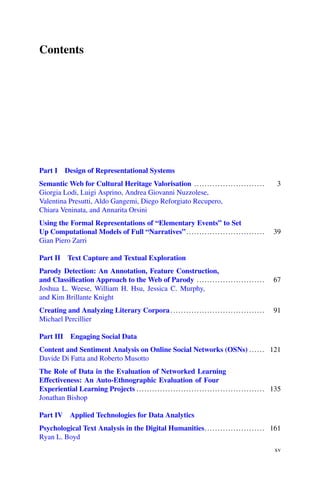
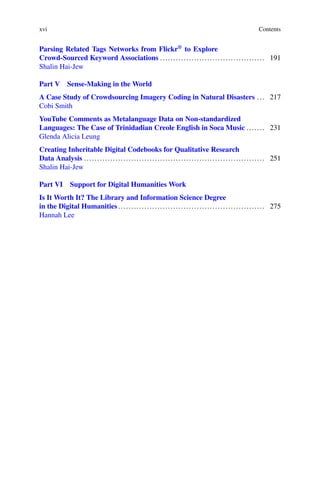
Contents
Part I Design of Representational Systems
Semantic Web for Cultural Heritage Valorisation ........................... 3
Giorgia Lodi, Luigi Asprino, Andrea Giovanni Nuzzolese,
Valentina Presutti, Aldo Gangemi, Diego Reforgiato Recupero,
Chiara Veninata, and Annarita Orsini
Using the Formal Representations of “Elementary Events” to Set
Up Computational Models of Full “Narratives”.............................. 39
Gian Piero Zarri
Part II Text Capture and Textual Exploration
Parody Detection: An Annotation, Feature Construction,
and Classification Approach to the Web of Parody .......................... 67
Joshua L. Weese, William H. Hsu, Jessica C. Murphy,
and Kim Brillante Knight
Creating and Analyzing Literary Corpora.................................... 91
Michael Percillier
Part III Engaging Social Data
Content and Sentiment Analysis on Online Social Networks (OSNs) ...... 121
Davide Di Fatta and Roberto Musotto
The Role of Data in the Evaluation of Networked Learning
Effectiveness: An Auto-Ethnographic Evaluation of Four
Experiential Learning Projects ................................................. 135
Jonathan Bishop
Part IV Applied Technologies for Data Analytics
Psychological Text Analysis in the Digital Humanities....................... 161
Ryan L. Boyd
xv
xvi Contents
Parsing Related Tags Networks from Flickr®
to Explore
Crowd-Sourced Keyword Associations ........................................ 191
Shalin Hai-Jew
Part V Sense-Making in the World
A Case Study of Crowdsourcing Imagery Coding in Natural Disasters ... 217
Cobi Smith
YouTube Comments as Metalanguage Data on Non-standardized
Languages: The Case of Trinidadian Creole English in Soca Music ....... 231
Glenda Alicia Leung
Creating Inheritable Digital Codebooks for Qualitative Research
Data Analysis ..................................................................... 251
Shalin Hai-Jew
Part VI Support for Digital Humanities Work
Is It Worth It? The Library and Information Science Degree
in the Digital Humanities........................................................ 275
Hannah Lee
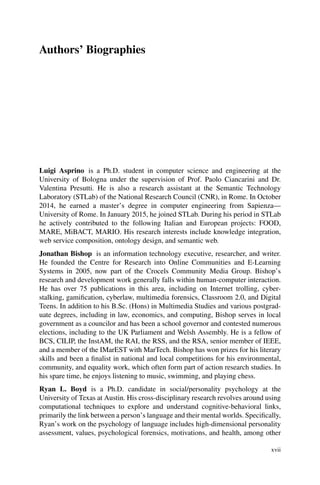
Authors’ Biographies
Luigi Asprino is a Ph.D. student in computer science and engineering at the
University of Bologna under the supervision of Prof. Paolo Ciancarini and Dr.
Valentina Presutti. He is also a research assistant at the Semantic Technology
Laboratory (STLab) of the National Research Council (CNR), in Rome. In October
2014, he earned a master’s degree in computer engineering from Sapienza—
University of Rome. In January 2015, he joined STLab. During his period in STLab
he actively contributed to the following Italian and European projects: FOOD,
MARE, MiBACT, MARIO. His research interests include knowledge integration,
web service composition, ontology design, and semantic web.
Jonathan Bishop is an information technology executive, researcher, and writer.
He founded the Centre for Research into Online Communities and E-Learning
Systems in 2005, now part of the Crocels Community Media Group. Bishop’s
research and development work generally falls within human-computer interaction.
He has over 75 publications in this area, including on Internet trolling, cyber-
stalking, gamification, cyberlaw, multimedia forensics, Classroom 2.0, and Digital
Teens. In addition to his B.Sc. (Hons) in Multimedia Studies and various postgrad-
uate degrees, including in law, economics, and computing, Bishop serves in local
government as a councilor and has been a school governor and contested numerous
elections, including to the UK Parliament and Welsh Assembly. He is a fellow of
BCS, CILIP, the InstAM, the RAI, the RSS, and the RSA, senior member of IEEE,
and a member of the IMarEST with MarTech. Bishop has won prizes for his literary
skills and been a finalist in national and local competitions for his environmental,
community, and equality work, which often form part of action research studies. In
his spare time, he enjoys listening to music, swimming, and playing chess.
Ryan L. Boyd is a Ph.D. candidate in social/personality psychology at the
University of Texas at Austin. His cross-disciplinary research revolves around using
computational techniques to explore and understand cognitive-behavioral links,
primarily the link between a person’s language and their mental worlds. Specifically,
Ryan’s work on the psychology of language includes high-dimensional personality
assessment, values, psychological forensics, motivations, and health, among other
xvii
xviii Authors’ Biographies
topics. Ryan has taught multiple workshops on machine learning, data mining, and
language analytics and is considered a leading expert on the psychology of language.
He is the chief data scientist at Receptiviti and is the creator of several language
analysis programs, including the Meaning Extraction Helper. Ryan is also the co-
creator of LIWC2015, one of the most widely used psychological language analysis
tools in the field of text analysis.
Davide Di Fatta is a Ph.D. student in economics and management at the University
of Messina (Italy). He collaborates with the SEAS Department at the Polytechnic
School of the University of Palermo (Italy). His main research fields are, on the one
hand, e-commerce, e-marketing, digital marketing, and social media marketing; on
the other hand, business systems, systems thinking, and social networks. Davide is
editorial assistant for many international journals such as Kybernetes and IJMABS
(in systemic field); IJEMR and IJMS (in marketing field). He is also Junior Member
Manager for the Business System Laboratory (BS Lab), a nonprofit organization
for the promotion of research and collaboration between the universities and the
enterprise systems.
Aldo Gangemi is professor at Paris 13 University, and researcher at CNR, Rome.
He has founded and directed the Semantic Technology Lab (STLab) of ISTC-CNR.
His research focuses on Semantic Technologies as an integration of methods from
Knowledge Engineering, the Semantic Web, Linked Data, Natural Language Pro-
cessing, and Cognitive Science. Publications: https://scholar.google.com/citations?
user=-iVGcoAAAAAJ. Software: http://wit.istc.cnr.it/stlab-tools.
Shalin Hai-Jew has worked on a number of digital humanities projects over the
years, each harnessing a variety of methods and technologies. She has B.A.s in
English and psychology and an M.A. in English from the University of Washington
(Seattle), and an Ed.D. from Seattle University (2005). At the University of
Washington, she received the Hugh Paradise Scholarship; at Seattle University, she
was a Morford Scholar. She worked for The Boeing Company as a Faculty Fellow
for two summers. She lived and worked in the People’s Republic of China from
1988 to 1990 and 1992 to 1994, the latter 2 years with the United Nations Volunteer
Programme of the United Nations Development Programme (UNDP). She works
as an instructional designer at Kansas State University. She has published several
authored texts and edited a number of technology-related texts. She reviews for
a half-dozen academic publishers. Her research interests include online learning,
computational research methods, and social media.
William H. Hsu is an associate professor of Computer Science at Kansas State
University. He received a B.S. in mathematical sciences and computer science and
an M.S. Eng. in computer science from Johns Hopkins University in 1993, and a
Ph.D. in computer science from the University of Illinois at Urbana-Champaign
in 1998. He has conducted research in digital humanities since 1998, where at the
National Center for Supercomputing Applications (NCSA) he was a co-recipient
of an Industrial Grand Challenge Award for visual analytics of text corpora and
unsupervised learning for topic modeling. His research interests include machine
Authors’ Biographies xix
learning, probabilistic reasoning, and information visualization, with applications to
digital humanities, cybersecurity, education, geoinformatics, health informatics, and
medical informatics. Published applications of his research include spatiotemporal
event detection for veterinary epidemiology, crime mapping, and opinion mining;
structured information extraction; and analysis of heterogeneous information net-
works. Current work in his lab deals with geospatial data science and analytics, data
mining, and visualization in education research; graphical models of probability and
utility for information security; and domain-adaptive models of natural language
corpora and social media for text mining, link mining, sentiment analysis, and
recommender systems. Dr. Hsu has over 100 publications in conferences, journals,
and books.
Kim Brillante Knight is an associate professor of emerging media and com-
munication at the University of Texas at Dallas. Her research focuses on digital
culture, negotiations of power and the formation of identity, particularly in relation
to marginalized groups. In her book, Viral Structures in Literature and Digital
Media: Networked Counterpublics and Participatory Capitalism (forthcoming from
Routledge), Dr. Knight addresses the role of digital media as it circulates outside of
broadcast paradigms and empowers or oppresses subjects in network society. Her
latest book, Fashioning Makers and Counterpublics: Critical Making and Public
Humanities, is under advance contract with the University of Iowa Press. Her
public work can be found at kimknight.com, thespiraldance.wordpress.com, and
fashioningcircuits.com. More information may be accessed at: https://www.utdallas.
edu/ah/events/detail.html?id=1220419626
Hannah Lee is a double alumni of UCLA, obtaining her B.A. in English and
MLIS. A doctoral student at Fielding Graduate University in Santa Barbara, the
University of California, Los Angeles (UCLA), she is focusing on specializing in
the future developments of information systems and technology in the library and
information sciences field. Her dissertation examines an organizational approach to
the book publishing industry in the United States. She works as a librarian, research
analyst, and informationist in the Los Angeles area. Some of her interests include
copyright, intellectual property, book arts, mentoring, and volunteering for nonprofit
organizations.
Glenda Alicia Leung is an independent researcher and sociolinguist from Trinidad
and Tobago. She received her B.A. in English from the University of Florida
and her M.A. in applied linguistics from Ball State University before earning her
doctorate in English linguistics at the University of Freiburg, Germany, in 2013. Her
doctoral thesis “A Synchronic Study of Monophthongs in Trinidadian English” was
a quantitative acoustic and sociophonetic study that reported on vowel distribution in
contemporary Trinidadian English. Her articles have appeared in World Englishes,
Multilingua, and Journal of Bilingual Education Research and Instruction, as well
as in the Varieties of English Around the World Series from John Benjamins.
Her research interests include creole language in performance, English language
learning, and language acquisition.
xx Authors’ Biographies
Giorgia Lodi is currently a research assistant at the Institute of Cognitive
Sciences and Technologies (ISTC) of the National Council of Research (CNR)—
Semantic Technology Laboratory (STLab) and a consultant at “Agenzia per l’Italia
Digitale”—AgID. She works in such areas as open government data, Linked
Open Data, Semantic Web Technologies, Distributed Systems, Big Data, and smart
communities. She received a Ph.D. in computer science from the University of
Bologna (Italy) in 2006. Publications: https://scholar.google.com/citations?user=
W6gWCGUAAAAJ
Jessica C. Murphy is Associate Professor of Literary Studies at the University of
Texas at Dallas. Her research focuses on early modern literature, culture, gender
studies, and digital humanities. Murphy’s publications include a book, Virtuous
Necessity: Conduct Literature and the Making of the Virtuous Woman in Early
Modern England, published by the University of Michigan Press in 2015; journal
articles; solo-authored and co-written book chapters; and a co-edited collection.
Roberto Musotto is an Italian Barrister who works on commercial and property
law, trusts, and organized crime. He is a Ph.D. student in economics at the University
of Messina and a research and teaching assistant at the University of Palermo in
Political Economy. His fields of research interest include spatial and social network
analysis, organized crime, commercial law, and game theory.
Andrea Giovanni Nuzzolese is a Postdoctoral Researcher at the Semantic Tech-
nology Laboratory (STLab) of the National Research Council (CNR) in Rome, Italy.
He received a Ph.D. in computer science in 2014 from the University of Bologna
(Italy). His research interests include Knowledge Extraction, Ontology Design
Patterns, Linked Data, and Semantic Web. He has been a researcher in the EU-
funded project IKS (Interactive Knowledge Stack) and a main developer of Apache
Stanbol software stack (reusable components for semantic content management).
He has published scientific papers in international journals and conferences.
Annarita Orsini with a master’s degree in law, is an employee of the Italian
Ministry for Heritage and Cultural Activities and Tourism currently working in
the specific domain of the tourism for the definition of common standard data
models for key data such as point of interests, accommodations, and tourist guides.
In recent years she was head of unit of the Directorate General Organization of
the Italian Ministry for Heritage and Cultural Activities and Tourism working in
such domains as Open Data, Linked Open Data, technical interoperability for public
administrations, to cite a few.
Michael Percillier is a postdoctoral researcher at the University of Mannheim,
Germany. His areas of specialization include corpus linguistics, World Englishes,
literary linguistics, and historical linguistics. His research has covered the compar-
ative study of institutionalized and learner varieties of English in Southeast Asia,
the representation of nonstandardized varieties of English in literary texts, and the
contact effects of Old French on Middle English in the medieval period.
Authors’ Biographies xxi
Valentina Presutti is a researcher at the Semantic Technology Laboratory of the
National Research Council (CNR) in Rome, and she is associated with LIPN
(University Paris 13 and CNRS). She received her Ph.D. in computer science in
2006 at the University of Bologna (Italy). She has been the scientific coordinator for
CNR in the EU-funded project IKS (Interactive Knowledge Stack—A framework
for Semantic CMS that bring semantics at the interaction level), and she has
been one of the main researchers in the EU-funded projects NeOn (Networked
Ontologies—methods and tool for design of networked ontologies). She has more
than 50 publications in international journals/conferences/workshops on topics such
as Semantic Web, knowledge extraction, and ontology design.
Diego Reforgiato Recupero has been an Associate Professor at the Department
of Mathematics and Computer Science of the University of Cagliari, Italy, since
December 2015. He is a programmer, software developer, automation and ICT
expert. He holds a double bachelor from the University of Catania in computer
science and a doctoral degree from the Department of Computer Science of the
University of Naples Federico II. In 2013 he won a Postdoctoral Researcher position
within the Semantic Technology Laboratory (STLAB) of the Institute of Cognitive
Sciences and Technologies (ISTC) of the National Research Council (CNR) where
he worked on Semantic Web and Linked Open Data; he is still an associated
researcher at STLAB where he collaborates. He is co-founder of R2M Solution
S.R.L. (Italian company), R2M Solution Ltd. (UK company), and Sentimetrix Inc.
(US company).
Cobi Smith has a doctorate in science communication at Australian National
University. She worked as a UN consultant based inside CERN on the EU-funded
Citizen Cyberlab project. She currently works in state government in Australia, in
emergency services information management and disaster risk reduction. After a
degree in Cultural Heritage Preservation, she took a master’s degree for qualified
researcher in archival/documental analysis through the use of information tech-
nology and formal model (XML, XSL, XSLT, RDF). For more than 10 years she
worked at the Rome Research Consortium and she gained expertise in the field
of formal languages, markup languages, and ontologies. From 2010 to 2014 she
worked at “Archivio Centrale dello Stato” in Rome. Since November 2014 she
works at Directorate General Organization of the Italian Ministry for Heritage and
Cultural Activities and Tourism.
Chiara Veninata after a degree in Cultural Heritage Preservation, took a master’s
degree for qualified researcher in archival/documental analysis through the use of
information technology and formal model (XML, XSL, XSLT, RDF). For more than
10 years she worked at the Rome Research Consortium, and she gained expertise
in the field of formal languages, markup languages, and ontologies. From 2010 to
2014 she worked at “Archivio Centrale dello Stato” in Rome. Since November 2014
she works at Directorate General Organization of the Italian Ministry for Heritage
and Cultural Activities and Tourism.
xxii Authors’ Biographies
Joshua L. Weese is a Ph.D. candidate focusing on CS education research. His
education experience comes from work as a graduate teaching assistant as well as
time spent as a NSF GK-12 fellow. Josh’s research focuses on operationalizing
computational thinking as well as assessing computational thinking, in outreach
programs aimed toward enriching K-12 students’ experience in STEM. Apart from
CS education, Josh is highly active in developing data analytic tools for the physics
education research community.
Gian Piero Zarri has been awarded an M.Sc. in electronic engineering (University
of Bologna, Italy) and a Ph.D. in computer science (University of Paris XI-Orsay,
France). After more than 30 years spent as Research Director at the French National
Centre for Scientific Research (CNRS), he cooperates now with the STIH Labora-
tory of the Paris-Sorbonne University as a senior associated researcher. Professor
Zarri is known internationally for having defined and developed NKRL (“Narrative
Knowledge Representation Language”), a representation tool used in several EC-
funded projects and characterized by the addition of an “ontology of events” to the
usual “ontology of concepts.” He is the author of about 200 refereed papers con-
cerning Artificial Intelligence, Computational Linguistics, Information Retrieval,
Intelligence and Global Security, etc., and is the editor, co-author, and author of
several books on Expert Systems, Intelligent Databases, and Representation and
Management of Narrative Information. Professor Zarri has co-operated intensively
with industry and has worked with international organizations like the European
Commission, UNESCO, and Eureka-Eurostar and with national research-funding
agencies in France, Italy, Austria, Portugal, the Netherlands, etc.
Part I
Design of Representational Systems
Semantic Web for Cultural Heritage
Valorisation
Giorgia Lodi, Luigi Asprino, Andrea Giovanni Nuzzolese, Valentina Presutti,
Aldo Gangemi, Diego Reforgiato Recupero, Chiara Veninata,
and Annarita Orsini
Abstract Cultural heritage consists of heterogeneous resources: archaeological
artefacts, monuments, sites, landscapes, paintings, photos, books and expressions
of human creativity, often enjoyed in different forms: tangible, intangible or digital.
Each resource is usually documented, conserved and managed by cultural institutes
like museums, libraries or holders of archives. These institutes make available a
detailed description of the objects as catalog records. In this context, the chapter
proposes both a classification of cultural heritage data types and a process for
cultural heritage valorisation through the well-known Linked Open Data paradigm.
The classification and process have been defined in the context of a collaboration
between the Semantic Technology Laboratory of the National Research Council
(STLab) and the Italian Ministry of Cultural Heritage and Activities and Tourism
(MIBACT) that the chapter describes, although we claim they are sufficiently
general to be adopted in every cultural heritage scenario. In particular, the chapter
introduces both a suite of ontology modules named Cultural-ON to model the
principal elements identified in the cultural heritage data type classification, and
the process we employed for data valorisation purposes. To this end, semantic
technologies are exploited; that is, technologies that allow us to conceptualise
and describe the meaning of data forming the cultural heritage and including
such entities as places, institutions, cultural heritage events, availability, etc. These
entities have special characteristics and are connected with each other in a profound
way. The result is a knowledge base consisting of semantic interconnections with
also other data available in the Web to be exploited according to different tasks
G. Lodi () • L. Asprino • A.G. Nuzzolese • D. Reforgiato Recupero
STLab, ISTC-CNR, Via San Martino della Battaglia 44, Rome, Italy
e-mail: giorgia.lodi@istc.cnr.it; giorgia.lodi@gmail.com; luigi.asprino@istc.cnr.it;
andrea.nuzzolese@istc.cnr.it; diego.reforgiato@istc.cnr.it
V. Presutti • A. Gangemi
STLab, ISTC-CNR, Via Gaifami 18, Catania, Italy
e-mail: valentina.presutti@cnr.it; aldo.gangemi@cnr.it
C. Veninata • A. Orsini
Ministry of Cultural Heritage and Activities and Tourism, Via del Collegio Romano 27,
Rome, Italy
e-mail: chiara.veninata@beniculturali.it; aorsini@beniculturali.it
© Springer International Publishing AG 2017
S. Hai-Jew (ed.), Data Analytics in Digital Humanities, Multimedia Systems
and Applications, DOI 10.1007/978-3-319-54499-1_1
3
4 G. Lodi et al.
and users preferences. By navigating the semantic relationships between the various
objects of the knowledge base, new semantic paths can be revealed and utilised with
the aim to develop innovative services and applications. The process is compliant
with Linked Open Data and W3C Semantic Web best practices so that to enable a
wider promotion of cultural heritage, and of sharing and reuse of cultural heritage
data in the Web. The chapter concludes presenting a number of methodological
principles and lessons learnt from the STLab/MIBACT collaboration that are
applicable to any cultural heritage context and, in some cases, also to other domains.
Introduction and Motivation
Cultural heritage—both tangible and intangible—is a driving force for economic
growth and societal development, an irreplaceable means for building a population’s
identity and culture, an inspiration for creative industry, and a primary reference for
the touristic market. It has been formed by a multitude of local cultures and stories
determined by the inhabitants of countries and different territories. This entailed
that, over time, cultural heritage has been enriched with a highly heterogeneous set
of resources that are diverse in their nature and in the way they are managed by each
local culture.
Despite this diversity, cultural heritage’s elements are semantically intercon-
nected with each other as the result of contaminations of the different cultures.
However, these elements are still mostly managed separately like silos, typically
by different organisations (e.g., museums, libraries, holders of archives, etc.) that
may also use various classifications, definitions and approaches to describe the same
elements. An example is the Italian case where, within the same Ministry of Cultural
Heritage and Activities and Tourism (MIBACT), two separate institutes define the
concept of “cultural site” in two different ways within the data bases they own,
respectively. Overall, this led to a scenario of dispersed data, both at national and
international level, that cannot be fully and smartly exploited for such an economic
growth and development of the touristic market that cultural heritage can potentially
boost.
In the last two decades, web technologies and social networks became perva-
sively present in our daily life, providing a powerful means for sharing personal
knowledge and experiences. Potentially, these technologies are the perfect tools
for creating a vast interconnected digital cultural heritage that could be open to
anyone so as to promote and improve the social cohesion and economic growth.
The advent of new paradigms for data management based on these technologies
can also support the involvement of citizens for identifying what is relevant as
territorial cultural heritage, enhancing its distinctiveness, and cross-border sharing
of local traditions and knowledge. This is key for supporting social integration and
recognition, and sense of belonging. In particular, in the cultural domain the Open
Data movement and the application of Linked Open Data (LOD) as the main data
integration paradigm are emerging as new frontiers to valorise a vast amount of
Semantic Web for Cultural Heritage Valorisation 5
public cultural heritage. However, a diversified scenario where isolated islands of
data are available on the Web is still observable. This is the case for instance of the
Italian scenario: a number of LOD projects carried out by MIBACT were born but
they still struggle to be part of an overall strategy that can guide towards a significant
valorisation of one of the largest heritage of the cultural sector.
This chapter describes the work conducted in the context of a collaboration
between STLab and MIBACT. The work aims at defining an overall framework for
cultural data analysis and valorisation, this latter pursued through the construction
of an open knowledge base of Italian cultural data. The knowledge base is meant to
be publicly available on the Web, using semantic web standards and technologies,
for the reuse by anyone willing to exploit it for the development of innovative and
creative applications and services. In computer science, the term “semantic web”
refers to W3C’s vision of an extension of the Web for dealing with interconnected
data that is stored, modelled and handled using so-called semantic web standards
and technologies (e.g., Resource Description Framework (RDF), SPARQL query
language for RDF (SPARQL), Ontology Web Language (OWL), etc.) The frame-
work we present provides a classification of the cultural data landscape, identified
within the collaboration, and a common and standard-based data model that can be
used as shared interoperability profile for interconnecting different, even available
LOD, datasets managed by various institutes of the Ministry. The model consists of
a suite of ontology modules for the cultural domain named Cultural-ON, which are
defined following a specific methodology. The methodology has been delineated so
as to guarantee sustainability, usability and semantic interoperability requirements,
with the application of ontology design patterns. The chapter focuses on the module
of the suite that represents “cultural institutes and sites” and “cultural events”, which
are connected to each other. The process we employed to create LOD datasets of the
cultural institutes and of the events, aligned with the defined ontology module, is
introduced. In particular, we highlight how to integrate it in a real business process
and information system managed by the Ministry, and how to link the datasets to
others available in the Web of Data. We claim that our model is sufficiently general
to be applied in any organisation working in the cultural sector with such data types
as cultural sites and events. We then highlight general methodology principles and
best practices that can be replicated in other cultural data management processes
and, in some cases, also in other domains.
This chapter is structured as follows. Section “State of the Art” provides a state of
the art on projects, ontologies and LOD approaches in the cultural heritage domain.
Section “A Cultural Heritage Data Framework: The Case of the Italian Ministry of
Cultural Heritage” introduces a cultural data landscape analysis and the objectives of
the collaboration we carried out with MIBACT. Section “Cultural-ON: The Cultural
ONtologies” describes the methodology we followed to define an ontology for
cultural institutes and sites and cultural events, detailing the main modelling choices
and the design patterns that we reused for supporting semantic interoperability.
Section “The Produced Linked Open Data” provides a detailed description of
the process we employed for producing LOD datasets, aligned with the ontology
and linked to other data in the Web, and a running example with real data
6 G. Lodi et al.
coming from an information system available at MIBACT. Additional methodology
principles we learnt from this experience are discussed in section “Lesson Learnt
(On Methodological Principles)”. Finally, section “Concluding Remark” provides
concluding remarks and future directions of the work.
State of the Art
Semantic technologies, and in particular Linked Open Data, have been widely and
successfully exploited within the cultural heritage field to improve the access to
cultural assets, to enhance the experience of citizens in exploring cultural heritage,
to facilitate artworks discoverability, to integrate and enrich data about cultural
heritage (Isaac and Haslhofer 2013; de Boer et al. 2013; Szekely et al. 2013;
Ruotsalo et al. 2013; Aart et al. 2010). Semantic Web technologies have been used
to disclose, in a scalable way, the vast amount of interesting and useful information
on cultural heritage. In recent years, several institutions put considerable effort
into developing and standardising methods and vocabularies for indexing objects.
Semantic Web technologies have given the opportunity of easing these processes
and achieving results in a collaborative environment. The collaborative development
of ontologies [e.g. CIDOC-CRM (Doerr 2003)] has strengthened the collaboration
between organisations so that semantic interoperability requirements could be met
within their systems. In addition, the use of common ontologies facilitated the data
exchange and the creation of huge digital libraries [e.g. (Isaac and Haslhofer 2013)].
In the context of Semantic Web technologies, the Linked Open Data (LOD)
paradigm paved the way to the valorisation of cultural assets. In fact, the LOD
paradigm has been used to connect data from different cultural institutions, thus
increasing the possibility of reaching cultural data available in the Web of Data. The
interlinking of contents of collaborating organisations also contributed to enrich
the information in a cost effective manner (Hyvönen 2009). The result has been
the creation of a knowledge base that can be reused in different applications.
Semantic annotation of cultural objects has been employed to support indexing
and searching within large virtual collections (Schreiber et al. 2008). The indexing
of collections has benefited of crowdsourcing techniques where large community
of users were invited to assist in the selection, cataloguing, contextualisation,
and curation of collections (Oomen and Aroyo 2011; Ridge 2013). Furthermore,
semantic technologies allowed going beyond traditional free text search (e.g.
Google), providing users with “intelligent” facilities based on ontological reasoning
such as semantic search, semantic autocompletion or semantic recommendation of
contents (Hyvönen 2009; Ruotsalo et al. 2013; Wang et al. 2007).
Semantic Web for Cultural Heritage Valorisation 7
Ontologies and Other Knowledge Organisation Systems
In the context of cultural heritage and Semantic Web technologies a lot of ontologies
and knowledge organisation systems (KOS) have been developed. We describe
here a representative sample of them, which have influenced the design and the
methodology we propose in this chapter. In general, we noticed that the most
important and used ontologies of the cultural sector are principally focused on
modelling cultural heritage objects; that is, movable objects hosted/located in
cultural sites.
CIDOC-CRM
CIDOC-CRM (Conceptual Reference Model)1
(Doerr 2003) is a formal and
standard ontology intended to enable information integration for cultural heritage
data. Its shared usage can contribute to meet semantic interoperability requirements
among heterogeneous sources of cultural heritage information. CIDOC-CRM is
the result of a long-term interdisciplinary work and an agreement between the
International Committee for Documentation (CIDOC) of the International Council
of Museums (ICOM) and a non-governmental organism. Since September 2006
it has been considered for standardisation by the ISO standard body that defined
the ISO 21127. CIDOC-CRM has a rich taxonomy of classes and properties that
describe Space-Time, Events, Material and Immaterial Things for the cultural
domain. This makes the model very useful for building query services (queries can
be formulated at various granularities) and eases the extension of the model to other
domains, reducing the risk of over-generalisation.
The ontology proposed in this paper has points of convergence and divergence
with CIDOC-CRM. On the one hand, the convergences between the models
can be found in the way of modelling the material things (such as places and
physical objects), collections and catalogues (in CIDOC, E31 Document). Both the
ontologies model information about places, such as place names, addresses, spatial
coordinates, geometries. In fact, the classes representing places in our proposal
aligned to CIDOC-CRM’s (cf. section “Methodology”). Since the intent of CIDOC
is to document objects collected and displayed by museums and related institutions,
it provides a finer description of individual items and collections than Cultural-ON.
However, the Cultural Heritage Objects defined in Cultural-ON can be used as a
hook to vocabularies more focusing on the description of artworks (such as CIDOC).
On the other hand, CIDOC lacks of a finer conceptualisation of the access
to cultural sites (e.g. opening hours specifications, ticketing information, access
conditions) and about organisational structures behind a cultural site, which is
addressed by Cultural-ON.
1
http://cidoc-crm.org/.
8 G. Lodi et al.
Europeana Data Model (EDM)
The Europeana Data Model (EDM)2
(Isaac and Haslhofer 2013) is a data model
used in the Europeana project3
for integrating, collecting and enriching data on
cultural heritage provided by the different and distributed content providers. EDM
reuses and extends a set of well-known vocabularies: OAI ORE (Open Archives
Initiative Object Reuse and Exchange) for organising objects’ metadata and digital
representation(s); Dublin Core for descriptive metadata; SKOS (Simple Knowledge
Organisation System) for conceptual vocabulary representation and CIDOC-CRM
for the representation of events and relationships between objects. The model
distinguishes between cultural heritage objects, web resources and aggregations.
Aggregations are used to model a data provider’s contribution to Europeana on a
cultural heritage object. A contribution, in turn, consists of more web resources
(i.e., metadata) provided for the object.
As well as CIDOC-CRM, the main focus of the Europeana Data Model is on
the description of Cultural Heritage Objects. The information modelled by EDM
is orthogonal to the conceptualisation provided by Cultural-ON. Therefore, the
data modelled with Cultural-ON enriches the information about Cultural Heritage
Objects, collected by Europeana.
Getty Vocabularies
The Getty vocabularies4
is a suite of KOS developed by the Getty Research Institute,
consisting in four controlled vocabularies, i.e. The Art and Architecture Thesaurus
(AAT) containing generic terms used for describing items of art, architecture
and cultural heritage objects; The Getty Thesaurus of Geographic Names (TGN)
including names descriptions of historical cities, empires and archaeological sites;
The Cultural Objects Name Authority (CONA) containing titles, attributions,
depicted subjects about works of several art, architecture, and other elements of the
cultural heritage; The Union List of Artist Names (ULAN) including information
about artists. AAT, CONA and ULAN are orthogonal to Cultural-ON. They can
be exploited by data providers for enriching their datasets with information about
authoritative research institutes. Users of Cultural-ON can take advantage of TGN
by reusing its terms to provide a site with its historical nomenclature. Besides
providing coordinates of places (also modelled in Cultural-ON), CONA provides a
finer conceptualisation of the name attribute by modelling different name types (e.g.
Official, Vernacular, Provisional, etc.). Cultural-ON models three types of names:
institutional, preferred and alternative.
2
http://pro.europeana.eu/edm-documentation.
3
http://pro.europeana.eu/.
4
http://www.getty.edu/research/tools/vocabularies/index.html.
Semantic Web for Cultural Heritage Valorisation 9
Projects
The above mentioned ontologies and KOS were successfully used in a number of
projects, carried out by cultural public organisations. In this section we report some
of them, which we have reused as guidelines for our work.
Europeana
Europeana3
(Isaac and Haslhofer 2013) is a project co-funded by the European
Union with the ambition of “unifying” Europe through culture and making cultural
heritage available for all. Europeana Foundation promotes and co-founds within
it several projects, such as Europeana Vx, Europeana Creative, Europeana Space,
Europeana Food and Drink. Among these, Europeana Vx (the last project of the
series is Europeana V3.0) aims at both creating and coordinating a network of
contributing institutions that act as data providers, and managing the collected
data through the development of a service infrastructure that enables an ease data
discoverability and access. In October 2012, a subset of the Europeana dataset was
released in linked open data, under the license Creative Commons CC0. The dataset
was modelled using the earlier mentioned Europeana Data Model (EDM) and then
made available in data.europeana.eu. The overall repository currently contains over
40 millions of RDF (Resource Description Framework) cultural data. The data
that will be modelled through Cultural-ON will be able to enrich the Europeana
knowledge base. In fact, Europeana mainly focuses on description and aggregation
of metadata about cultural objects, whereas Cultural-ON is able to model the
information for accessing them.
Smartmuseum
SMARTMUSEUM5
(Ruotsalo et al. 2013) is a research project funded under
the European Commission’s 7th Framework Programme. The project aims at
developing a mobile ubiquitous recommender system that uses the Web of Data to
provide tourists with recommendations for cultural heritage. The system delivers
the right content to the users by taking as input users’ informational needs
and contextual information (such as sensors data captured from mobile devices).
Semantic technologies are employed to deal with the heterogeneity of data, which
may include content descriptions, sensor inputs and user profiles. For modelling
users, the project relies on the General User Model Ontology (GUMO). The
content are annotated using the Dublin Core metadata standard which is properly
extended for the cultural heritage domain including such metadata as material,
5
http://www.smartmuseum.eu.
Another Random Scribd Document
with Unrelated Content
great sorrow for the amount of blood he had caused to be shed.
One could see that this gave the General food for reflection.
But, save that all these people urged, in the main, the practice of
purity and piety, it was unanimously demonstrated that Johannes
and the countess were the ones from whose co-operation the
greatest results were to be expected. They would have to study up
these matters, and apply themselves to automatic writing.
Then Johannes had to sit beside the countess and hold her hand,
and thus, together, write down the communications of the spirits.
This was a bitter-sweet experience for Johannes. Would Markus
come now?
But Markus did not come, nor any news of poor Heléne, nor of her
father.
Yet a spirit disclosed itself who treated this ideal society in a very
impolite, bearish manner. He called himself Thomas, and would not
reply when Bommeldoos asked him if he was Thomas the Apostle, or
Thomas Aquinas, or Thomas à Kempis, or Thomas Morus.
Do you know us? asked the Privy Counselor.
Yes, you are heathen and malefactors.
Will you help us?
Confess, pray, and do penance, said Thomas.
Will you tell us something of the hereafter? asked Countess
Dolores, paling somewhat.
Hell, if you go on this way, said Thomas.
Then what must I do? asked Dolores, almost trembling.
Be converted, was the reply.
That is all well and good, said Bommeldoos, but I know at least
twelve religions, and twice as many systems of philosophy. To which
of them must we be converted?
Be still, you heretic, was the parting shot.
Such treatment as that was a bit too much for the learned Professor,
and he declared he had had enough of it, and could better employ
his time.
The society was of one mind—that the manifestations this evening
had not been propitious. The medium ascribed this to her own
indisposition. She had suffered the entire day with a headache, and,
moreover, there were—she was certain of it—unfavorable influences
present. Saying this, she cast a reproachful glance at the Professor.
Oh, it was much more lively the last time, said the Honorable Lady.
Was it not truly extraordinary, General?
Phenomena cannot be forced, replied the General. One has to
practise patience. We would better stop, for the present.
So the session ended, and after the medium, with many obsequious
airs, had taken her leave, they partook of a delicious supper.
Johannes retained his place beside the hostess, and the
remembrance of the soft, warm hand that he had been able to hold
in his own for so long a time made him very happy. He was not
disappointed. Oh, no, he was elated—his excellent friend was so
nice, so good, and so kind to him.
A new Dutch waitress in black and wearing a snow-white cap with
long strings was in attendance. Johannes paid no attention to her,
but noticed that Van Lieverlee looked at her repeatedly.
Did you not think it a remarkable evening? asked the countess,
after the guests were gone and they were alone together.
I thought it splendid, replied Johannes, with sincerity.
They called it a failure, said the countess, but it impressed me
quite otherwise. I feel greatly moved.
I too, said Johannes.
Do you? That makes me happy. So you, also, feel that we need to
be converted?
I do not think that, said Johannes, but you have been so good to
me.
Countess Dolores made no reply, but she smiled and pressed his
hand kindly. Johannes retained her hand, while he looked into her
eyes with passionate devotion.
The waitress had been standing at the buffet, placing silver in the
drawer. At this moment she turned round, and when Johannes in
some confusion looked at her to see if she had paid any attention to
his all-too-tender airs and words, he suddenly found himself gazing
into a pair of well-known, light-grey eyes.
They were Marjon's eyes, and they wore a look of unutterable
anguish and sorrow.
It seemed to Johannes as if his heart had stopped beating. He sat
like one paralyzed, until his friend's hand slipped from his clasp. He
appeared to wish to rise—to say something....
But Marjon put her finger to her lips, and went quietly on with her
work.
IX
Among the visitors at Villa Dolores was a Roman prelate—a friend of
Dolores' deceased husband. He was heavy of build and always
cheerful, and never talked on religious subjects. Sometimes he came
sociably, as a table guest, and besides a fund of anecdotes he also
had much to say that was instructive, to which Johannes listened
eagerly.
He was a far more amiable person than Dominie Kraalboom, and
Johannes liked him much better. He understood all about flowers
and animals, about poetry, paintings, and music; and of special
interest were his observations on beautiful Italy and holy Rome,
where he had traveled and studied.
Of course he did not belong to the Pleiades; and if by rare exception
the circle was referred to in his presence, he, being both cautious
and courteous, remained silent.
Yet, after that first meeting of which I have told you in the preceding
chapter, Johannes observed that he came oftener than before, and
also at unconventional hours; and when Johannes came into the
room he noticed that the conversation between the countess and
the priest was suddenly broken off. He saw, also, that his hostess
had more color in her cheeks, as if she had been speaking of
weighty matters.
Your Mahatma does not come, said Dolores once, when, after such
a time as this, the priest had just taken his leave. He has turned his
back upon us.
Yes, Mevrouw, Johannes was forced to admit.
I think myself very fortunate in having found a wise man who can
help me.
Do you mean Father Canisius?
Yes. Do you know what he says? That we are on a dangerous road
in the pursuit of our object. It is all the work of the devil, he
declares. And everything he says agrees with what we heard that
evening. Would you not like to have a chat with him?
But Johannes hesitated. He had not yet spoken to Marjon, and was
hoping to hear from her something concerning his brother.
Marjon evaded him, and he had not found an opportunity to meet
her alone. Every morning he went to his room with a beating heart,
hoping to find her there busied in putting it to rights; but generally it
was already in order, and he found merely the traces of her care: his
clothing brushed and folded, his linen looked over and nicely placed
in the linen-press, and fresh flowers in the little vase on his table. He
observed everything, and was deeply touched by it.
But she seemed careful to be always in company with the other
servants, and to bear herself as stiffly and coldly as the most pert,
demure, and well-trained chambermaid possibly could. Not a word
nor a look nor a sign betrayed her acquaintance with Johannes; and
he often heard the countess declare to her visitors that she had
never before found so quickly a good Dutch servant.
Neither had Van Lieverlee recognized her, but was simply struck with
her peculiar, somewhat alien manner, which led him to ask the lady
of the house if she knew the origin of the girl.
No, said the countess; she was recommended to me by an old
friend, and apparently she deserves all that was said of her.
But Johannes' yearning for Markus grew stronger every day. He both
dreaded and longed for his coming, and he wished that in some way
he might be delivered from his uncertainty.
Therefore he was ever on the alert to seize an opportunity for
speaking with Marjon alone. One evening he detained her in the hall
under the pretense of inquiring about his shoes.
Where did you leave Keesje? he asked in a low voice.
You know very well, replied Marjon, curtly, and in the same low
tone.
Johannes did indeed know, and for that very reason he had asked
the question.
Yes, but where is he who has Keesje?
I do not know; and even if I did, I would not tell you. He knows his
time.
At that moment Countess Dolores passed by.
Johannes, said she, I am having a talk with Father Canisius. If
you wish you may come, too.
Johannes questioned Marjon with a look; but there fell before her
eyes that impenetrable veil which always completely hid her inmost
self from every stranger.
Father Canisius was in the parlor, seated in a low chair. His black
soutane fitted tightly over his robust body, and his heavy feet in their
buckled shoes were planted wide apart. He was polishing his
spectacles with a handkerchief, and as Johannes entered the room
he put them quickly in place, and turned his large eyes, full of
interest, toward the door.
When Johannes came forward he took his hand in a kindly way and
drew him nearer. Johannes looked into the broad, smooth-shaven
face with its flat nose and sagacious eyes.
Have you never had good guidance, my boy? Without it life is
difficult and dangerous.
I have indeed had good guidance, Mijnheer, said Johannes, but I
have more than once preferred to go my own way; and then I
disregarded my guidance.
But was it good guidance? asked the priest.
I had a good father; later, I found a dear, good friend. But I left
them both.
Why did you do that? Were you not satisfied with what they taught
you? What was it that took you from them?
Johannes hesitated.
Were they too strict?
Johannes shook his head.
Then what was lacking that you found elsewhere but not with
them?
I do not know, Mijnheer, what to call it. It is not pleasure, for I am
willing to endure much suffering. And yet again it is the most
glorious thing I know. I think it is what is meant by 'the beautiful.'
On saying this, he bethought himself that it was not merely the
beautiful for which he had left his father, and that the emotion
which had led him away from Markus, and which he had felt for the
two little girls, might indeed be called love.
Perhaps it is also called love, said he.
Father Canisius considered a moment, and throwing a glance at the
countess, he said:
Then did you not find the love of that good father and the good
friend enough for you?
Oh, yes, yes, said Johannes, with spirit. But it was from them I
had learned that I ought to follow what seemed to me, in all
sincerity, the most beautiful, and to do what I truly thought best.
The priest dropped Johannes' hand, and pressed his own fleshy
palms together, while he slowly and sorrowfully shook his great
head, gave a deep sigh, and continued to look at Countess Dolores
with a very serious face.
Poor boy! said he then. Poor, poor boy!
Then, lifting his head and looking Johannes straight in the eyes, he
said: No, Johannes, they were not good guides. I do not know
them, and I shall not judge them, but I assure you positively that
with such teaching, such guidance, you are bound to be lost unless
granted extraordinary grace.
A long silence ensued. Johannes was touched, and even startled.
What do you mean? he finally stammered with trembling lips.
Listen, Johannes, said Countess Dolores. Father Canisius is very
wise—a man of large experience in life.
Do you believe in God, Johannes? asked the priest.
I know that I have a Father who understands me, said Johannes,
slowly.
Do you mean a heavenly Father? Very well; so far, so good. But you
must have observed also that there is an evil one—Satan—who goes
about deceiving us.
Yes, said Johannes, promptly, thinking of his many
disappointments. That is so. I have observed it.
Well, then, Satan is always lying in wait for us, like a wolf lurking
near the sheep. One who trusts only in his own powers and his own
opinion is like a sheep that strays from the fold. The wolf surely
waits his opportunity, and, unless God perform a miracle, that sheep
is lost.
Johannes felt the fear strike to his heart, and he could not speak.
We first notice the approach of this wolf by a terrible sensation.
That is God's warning to us. That feeling is doubt. Have you ever
known what it was to doubt, Johannes?
Johannes, with clenched fists and compressed lips, nodded in quick
and utter dismay. Yes, yes, yes! He had known what it was to doubt.
I thought so, said Father Canisius, calmly. It is a fearful feeling, is
it not? Raising his voice, he proceeded: It is like the sound of
howling wolves in the distance—to the wandering sheep. Let it not
be in vain that you are warned, Johannes.
After a pause he continued:
Doubt itself is a sin. He who doubts is on an inclined plane that
slopes toward a fall. Have you ever heard of the hideous octopus,
Johannes—that soft sea-monster with the huge eyes, and eight long
arms full of suckers which, one by one, he winds around the limbs of
a swimmer, before dragging him down to the deeps? You have? Well,
Satan is such an octopus. Unnoticed, he reaches out his long arms,
and twines them about your limbs—holding them fast with his
suckers until he can stab his sharp beak into your heart. Doubt is not
only a warning but positive proof that Satan has already gripped
you. It is the beginning of his power. The end is everlasting pain and
damnation.
Johannes raised his head and looked at the priest, who was
watching the effect of his words.
In spite of his distress there was suddenly aroused in Johannes a
feeling of resistance. He felt that an effort was being made to
frighten him; and even if he was but a stripling he would not allow
that.
My Father does not condemn those who err in good faith, said he.
Father Canisius observed that by bearing on too hard he had
awakened a rebellious spirit. He therefore became more cautious,
and resumed gently:
Certainly, Johannes. God is infinitely good and merciful. But have
you not remarked that there is a justice from which you cannot
escape? And do you believe that one who has been led astray can
plead, 'I am not guilty, for I was deceived'? No, Johannes, you take
this matter too lightly. Punishment attends sin. That is God's
inexorable law. And only if He had failed to warn us—only if He had
not accurately revealed to us His will, could you call that cruel and
unjust. But we are warned—are instructed—and may follow good
guidance. If then we continue to stray, it is our own fault and we
must not complain.
You mean the Bible, do you not, Mijnheer?
The Bible and the Church, said the Father, not pleased at the tone
of this question. I very well comprehend, my boy, that you, with
your poetic temperament and your craving for the beautiful, have
not found peace in the cold, barren, and barbarous creed of
Protestantism. But the Church gives you everything—beauty,
warmth, love, and exalted poetry. In the Church alone can you find
peace and perfect security. You know, however, do you not, that the
flock has need of a Shepherd? And you know also who that
Shepherd is?
Do you mean the Pope?
I mean Christ, Johannes—our Redeemer, of whom the Pope is
merely a human representative. Do you know this Shepherd? Do you
not know Jesus Christ?
No, Mijnheer, replied Johannes, in all simplicity, I do not know him
at all.
I thought as much; and that is why I said to you, 'Poor boy.' But if
you wish to learn to know him, I will gladly help you. Do you wish
me to?
Why not, Mijnheer? said Johannes.
Very well. Begin, then, by accompanying the countess to the church
she has promised me to attend—Have you, indeed, arranged to go?
Yes, Father, replied the countess. Oh, I am so happy that you take
such an interest in us! Johannes will surely always be grateful to
you.
Father Canisius pressed very cordially the hands of both of his new
disciples, and, with an expression of calm satisfaction on his face, he
took his leave.
The children came in, and nothing further was said that day between
Johannes and his friend concerning the matter; but the countess
was much more animated than usual, and wonderfully kind toward
Johannes. She even kissed him again when they said good-night, as
once before she had done —when with her children.
Johannes could not sleep. He was full of anxiety, and in a state of
high nervous tension. When the house grew still, and the lonely,
mysterious night had come, came also fear and doubt and faint-
heartedness. He doubted that he doubted, and feared the doubt of
the doubt. He heard the howling of the wolf that lay in wait for the
wandering sheep; he felt the slippery, slimy, crawling grasp of those
terrible arms, that unnoticed, had fastened their suckers everywhere
to his limbs; he saw the great yellow eyes of the octopus, with the
narrow, slit-shaped pupil; and he felt the mouth searching and
feeling about his body for his heart, that it might stab it with the
sharp, parrot-like beak. With chattering teeth he lay wide awake
between the sheets—shivering and shaking, while the perspiration
poured from him.
Then he heard a faint, creaking sound on the stairs, followed by a
light footfall at the doorway. His door was opened, and a slim, dark
form came cautiously up to the bed.
He felt a soft, warm hand on his clammy forehead, and heard
Marjon's voice whispering:
You must be faithful, Jo, and not let them make you afraid. The
Father likes brave and loyal children.
Yes, Marjon, said Johannes; and the shivering ceased, while a
gentle warmth stole over and through his entire body. He dropped
asleep so soon that he did not notice when she left the room.
X
Jump out! cried Wistik, excitedly, swinging his little red cap. Come
on—jump!
Johannes saw no way of doing so. The window was high and quite
too small. Perhaps by climbing still higher he might find a way out. A
flight of stairs, and another garret. Still another narrow passage, and
another stairway. Then he caught another glimpse of Wistik, astride
a large eagle.
Come on, Johannes! cried he. You must dare to—then nothing
can happen.
Johannes was ready to venture, but he could not do it. The little
window was again out of reach. Back again. Empty garrets, steep
stairs—stairs without end. And there was the octopus! He knew it.
Again and again he saw one of the long arms with its hundreds of
suckers. Sometimes one of them lay stretched along the garret floor,
so that he had to step over it. Sometimes one meandered over the
stairs that Johannes was obliged to mount. The whole house was full
of them.
And out-of-doors the sun was shining, and the blue air was clear and
bright. Wistik was circling around the house, seated on the great
eagle—the very same eagle they had come across before, in
Phrygia.
Out-of-doors also rang the voice of Marjon. Hark! She was singing.
She, too, was in the open air. She seemed to have made a little
song, herself—words and melody—for Johannes had never before
heard either of them.
Nightly there come to me,
White as the snow,
Wings that I know to be
Strange, here below.
Up into ether blue,
Pure and so high,
Mounting on pinions true,
Singing, I fly.
Sea-gull like then I soar—
Not light more swift—
So near to Heaven's door
To rock and drift!
Alas! Johannes could not yet do that. He had no wings. He did,
indeed, see rays of light at times, and here and there a bit of blue
sky. But he could not get to it—he could not get out! And on he
went again—upstairs, downstairs, through doorways, halls, and
great garrets. And the terrible arms lay everywhere.
Again Marjon sang:
Marvelous, matchless blue
I cleave in flight.
The spheres are not so fleet
As my winged feet.
World after world speed by
Under my hand,
New ones I ever espy,
Countless as sand.
Blue of the skies!
Blue of the deep!
Now make me wise—No
more to weep.
Johannes also heard the blue calling him; but what the magic word
was he could not guess. He was on his knees now, before a small,
garret window through which he could barely thrust his arm. Behind
him he could hear a shuffling and sliding. It was the long arm again!
It's a shame! said Wistik again, his little face red with anger, the
way they have maligned me! I ought to be hail-fellow with the Evil
One for not letting you be. What a rascal he is! Do you want to be
rid of me, Johannes?
No, Wistik. I believe that you are good even if you have often
disappointed me and made me very restless. You have shown me so
much that is beautiful. But why do you not help me now? If you call
me you ought to help me.
No, said Wistik; you must help yourself. You must act, you
understand? Act! You know that It is behind you, do you not?
Yes, yes! shrieked Johannes.
But, boy, do not shriek at me! Shriek at It. It is much more afraid of
you than you are of It. Try!
That was an idea. Johannes set his teeth, clenched his fists, turned
round and shouted:
Out, I say! Out with you—you ugly, miserable wretch!
I even believe he used a swear-word. But one ought to forgive him,
because it was from sudden excitement. When he saw that the long
arms shriveled and drew away, and that it grew still in the house—
when he felt his distress abating and saw the sunlight burst out,
revealing a spacious deep-blue sky—then his anger calmed down,
and he felt rather ashamed of having been so vehement.
That is good! said Wistik. But do not be unmannerly—do not
scold. That is hateful. But nevertheless, act, and learn compassion.
Johannes was now no longer afraid; he shouted for joy. Yes, he was
bathed in tears of thankfulness and relief. Oh, the glorious blue sky!
Now you know it, once for all, said Wistik.
Marjon's voice again in song. But this time very different—the air of
one of her old songs merely hummed: a customary calling sound—a
soft suppressed little tune. And thereupon followed a tap, tap, tap,
at his chamber door, to tell him that it was half-past eight and time
to get up.
Fresh energy, a feeling of high spirits and courage, filled Johannes
that day. At last he was going to act—to do something to end his
difficulties.
First, he sought an opportunity to speak with Van Lieverlee. He went
to brave him in his own rooms where he had never yet been. There
he saw a confused medley of dissimilar things: some rare old pieces
of furniture, and oriental rugs; a large collection of pipes and
weapons; a few modern books; on the wall some picture-studies of
which Johannes could not glean the meaning; some French posters
picturing frivolous girls. With the same glance he saw mediæval
prints of saints in ecstasy, and plaster casts of wanton women, and
the heads of emaciated monks. There were images of Christ in
hideous nakedness, and lithographs and casts so blood-curdling,
crazy, and bizarre that they made Johannes think of his most
frightful dreams.
What are you here for? asked Van Lieverlee tot Endegeest who,
with an empty pipe in his mouth and a face full of displeasure, lay
stretched out languidly on the floor.
I have come to ask something, said Johannes, not exactly knowing
how to begin.
Not in the mood for it, drawled Van Lieverlee.
The day before, Johannes would have wilted. Not so to-day. He
seated himself, and thought of what Wistik had said—Act!
I will not wait any longer, he began again. I have waited too long
already.
The big priest has had you in hand, has he not? said Van Lieverlee,
with a little more interest.
Yes, replied Johannes; did you know it? What do you think of
him?
Van Lieverlee gaped, nodded, and said: A knowing one! Just let him
alone. Biceps! you know—biceps! All physique and intellectuality.
Representative of his entire organization. Can't help respecting it,
Johannes. How those fellows can thunder at the masses! One can't
help taking off his hat to them. The whole lot of the Reformed aren't
in it with them! Theirs is only half-work; they are irresolute in
everything they give or take; krita-krita, as we say in Sanscrit.
Whether you do good or do ill, aways do it wholly, not by halves;
otherwise you yourself become the dupe. If you would keep the
people down, hold them down completely. To establish a church, and
at the same time talk of liberty of conscience, as do the Protestants
—that is stuff and nonsense —nothing comes of it. You may see that
from the results. Every dozen Protestants have their own church
with its own dogmas, with its own little faith which alone can save,
and with its little coterie of the elect! No, compared with them the
Roman Church is at least a respectable piece of work—a formidable
concern.
Do you believe in it? asked Johannes.
Van Lieverlee shrugged his shoulders.
I shall have to think it over a while longer. If I think it agreeable to
believe in it, then I shall do so. But it will be in the genuine old
Church, with Adam and Eve, and the sun which circles around the
earth; not in that modernized, up-to-date Church, altered according
to the advancement of science—with electric light and the doctrine
of heredity. How disgusting! No, I must have the church of Dante,
with a real hell full of fire and brimstone, right here under our earth,
and Galileo inside of it.
But I did not come to inquire about that, said Johannes, sticking to
his point. I am not content, and you ought to help me. What I have
heard in the Pleiades, and from Father Canisius does not satisfy me.
I am sure, also, that it is not in this way I shall find my friend again;
and now I am determined to find him.
Where, then, do you wish to look for him?
I believe, said Johannes, that if he is to be found anywhere, it is
among the poor—the laborers.
Ah! Would you take part in the labor agitation? Well, you can do so,
but I do not agree to go with you. You know what I think about that.
Socialism has got to come, but I am not going to concern myself
with it. It smells too much of the proletariat. I am very glad of the
birth of a new society, but a birth is always an unsavory incident. I
leave that to the midwife. I'll wait until the infant is thoroughly
washed and tidy before making its acquaintance.
But I wish to look for my friend.
Van Lieverlee stood up and stretched himself.
You bore me, said he, with that eternal chatter about your friend.
Act! thought Johannes, and he went on:
You promised to show me the way to what I am seeking, and to
give an explanation of my experiences. But I know no more than I
knew before.
Your own fault, my friend. Result of pride and self-seeking. Why
have you had so little to do with me? You kept yourself with those
two little girls. Did they enlighten you?
Quite as much as you did, replied Johannes.
Van Lieverlee looked up in surprise. That was insubordination—open
resistance. However, he thought it better to take no notice, so he
said:
But since you will join the labor movement, then you must find out
for yourself. I won't hold you back. Go, then, and look for your
Mahatma!
But how am I to begin? You have so many friends—do you know
some one who can help me?
Van Lieverlee thought about it while looking steadily at Johannes.
Then he said, deliberately:
Very well. I know of one who is in the middle of it. Would you like
to go to him?
Yes, at once, if you please.
Good, said Van Lieverlee. Together they set out. The friend
referred to was the editor of a journal—a Doctor of Laws. Felbeck
was his name.
His office was far from luxurious in appearance. The steps were
worn, and the door-mat was trodden to shreds. It was a dreary and
sombre place. Large posters and caricatures were pasted on the
walls, and on the table, lay many pamphlets and papers. Also there
were writing-desks, letter-boxes, and rush-bottomed chairs. Two
clerks sat there writing, and a few men, with hats on and cigars in
their mouths, were talking. There was a continual running to and fro
of people—printers' devils, and men in slouch hats.
Dr. Felbeck himself had a pale, thin face, square jaws, bristling hair,
and a black goatee and moustache. His eyes were deep-set, and
they looked at Johannes keenly, in a manner not fitted to put him
into a restful and confiding state of mind.
This young person, said Van Lieverlee, wishes, as you express it,
to turn his back upon his bourgeois status, and to swell the ranks of
the struggling proletariat. Is that what you call it?
Well! said Dr. Felbeck. He need not be ashamed of it, and you
might follow his example, Van Lieverlee.
Who knows what I may yet do, said Van Lieverlee, when the
proletariat shall have learned to wash itself?
What! said Felbeck. Would you, a poet, have washed and combed
proletarians, with collars and silk hats? No, my friend; with their vile
and callous fists they will smash your refined and coddled
civilization, like an etagère of bric-à-brac in a parlor! Dr. Felbeck
vented his feelings in a blow at the imaginary etagère. The attention
of a clerk on the other side of the room was arrested, and he
stopped his work. Van Lieverlee, too, looked somewhat interested.
A revolution appeals to me, said Van Lieverlee. With barricades,
and fellows on them with red flags, straggling hair, and bloodshot
eyes. That isn't bad. But you people of the Society of the Future!—
Heaven preserve us from that tedious and kill-joy crowd! I would ten
times over prefer an obese, over-rich banker with his jeweled rings,
who, waxing fat through the misfortunes of simpletons, builds a villa
in Corfu, to your future citizen.
You do not at all understand it yet, said Felbeck, with a slighting
laugh. You are bound to have such notions because you belong to
the bourgeois class of which you are an efflorescence. You are
obliged to talk like a bourgeois, and versify like one. You cannot do
otherwise. You cannot possibly comprehend the proletarian
civilization of the future. It is to be evolved from the proletarian class
to which we belong, and with which your young friend wishes to
connect himself, as I perceive with pleasure.
The clerk across the room came nearer, to listen to the speech of his
chief. He was an under-sized young man whose pomaded black hair
was parted in the middle. He had a crooked nose straddled by eye-
glasses, and thick lips from between which dangled a cigar—even
while he spoke. He wore a well-fitting suit, and pointed shoes with
gaiters.
May I introduce myself, said he. I am Kaas—fellow-partner
Isadore Kaas.
Pleased to meet you, said Van Lieverlee. And Johannes also
received a handshake.
Have you come to register yourself? the partner asked.
In what? asked Johannes, who had not yet exactly gotten the idea
of things. In the proletarian class?
As a member of the party, said Kaas.
What does that imply? asked Johannes, hesitating.
It implies, said Felbeck, that you renounce the privileges of the
class to which you are native, and that you range yourself, under the
red flag, in the ranks of the International Workingmen's Party—with
the struggling proletariat—the party of the future.
Then what have I to do?
Sign your name, make a small contribution, attend the meetings,
read our paper, spread our doctrines, and vote for our candidates in
the elections.
Nothing else? asked Johannes.
Well, is not that enough?
Did you not speak of privileges I must renounce?
There, there! said partner Kaas, do not make too much of that, to
begin with. Don't be frightened. For the present, nothing further is
required of you.
Oh, I was not afraid, said Johannes, a trifle vexed that he should
have been misunderstood. I was even hoping that I might be able
to do more.
So much the better! So much the better! said Kaas, stepping
hurriedly over to his desk again, and eagerly hunting for a pen.
That settles it. Your name, if you please.
But Johannes was not, for the time being, in a very compliant mood.
Since he had dared the octopus he had found that he had more than
one string to his bow.
No, I came for something else. I have a dear friend who lives and
works for the poor and oppressed. I am looking for him. I saw him
last, at the great strike of the miners, in Germany. Since that time I
have heard nothing from him, but I know, surely, that he is with the
working people. Mijnheer van Lieverlee has told me that you were in
the midst of the labor movement. Could you not help me?
What's his name? asked Dr. Felbeck.
They know him as Markus, replied Johannes, although it cost him
an effort to speak the dear name in that place.
Markus? repeated the gentleman, considering. Markus only?
Markus Vis, said Johannes, with yet more reluctance.
Oh! He! exclaimed partner Kaas.
Markus Vis? said Felbeck, turning round to the others in the office.
Is that—?
Welcome to our website – the ideal destination for book lovers and
knowledge seekers. With a mission to inspire endlessly, we offer a
vast collection of books, ranging from classic literary works to
specialized publications, self-development books, and children's
literature. Each book is a new journey of discovery, expanding
knowledge and enriching the soul of the reade
Our website is not just a platform for buying books, but a bridge
connecting readers to the timeless values of culture and wisdom. With
an elegant, user-friendly interface and an intelligent search system,
we are committed to providing a quick and convenient shopping
experience. Additionally, our special promotions and home delivery
services ensure that you save time and fully enjoy the joy of reading.
Let us accompany you on the journey of exploring knowledge and
personal growth!
textbookfull.com

Data Analytics in Digital Humanities Hai-Jew

  • 1.
    Data Analytics inDigital Humanities Hai-Jew download https://textbookfull.com/product/data-analytics-in-digital- humanities-hai-jew/ Download more ebook from https://textbookfull.com
  • 2.
    We believe theseproducts will be a great fit for you. Click the link to download now, or visit textbookfull.com to discover even more! Data Analytics in Digital Humanities 1st Edition Shalin Hai-Jew (Eds.) https://textbookfull.com/product/data-analytics-in-digital- humanities-1st-edition-shalin-hai-jew-eds/ Common Visual Art in a Social Digital Age 1st Edition Shalin Hai-Jew. https://textbookfull.com/product/common-visual-art-in-a-social- digital-age-1st-edition-shalin-hai-jew/ Digital Analytics Data Driven Decision Making in Digital World 1st Edition Jumin Kamki https://textbookfull.com/product/digital-analytics-data-driven- decision-making-in-digital-world-1st-edition-jumin-kamki/ Business Models: Innovation, Digital Transformation, and Analytics (Data Analytics Applications) 1st Edition Iwona Otola (Editor) https://textbookfull.com/product/business-models-innovation- digital-transformation-and-analytics-data-analytics- applications-1st-edition-iwona-otola-editor/
  • 3.
    New Digital WorldsPostcolonial Digital Humanities in Theory Praxis and Pedagogy Roopika Risam https://textbookfull.com/product/new-digital-worlds-postcolonial- digital-humanities-in-theory-praxis-and-pedagogy-roopika-risam/ Data Analytics and Management in Data Intensive Domains Leonid Kalinichenko https://textbookfull.com/product/data-analytics-and-management- in-data-intensive-domains-leonid-kalinichenko/ Big Data Analytics and Computing for Digital Forensic Investigations 1st Edition Suneeta Satpathy (Editor) https://textbookfull.com/product/big-data-analytics-and- computing-for-digital-forensic-investigations-1st-edition- suneeta-satpathy-editor/ Computation and the Humanities Towards an Oral History of Digital Humanities 1st Edition Julianne Nyhan https://textbookfull.com/product/computation-and-the-humanities- towards-an-oral-history-of-digital-humanities-1st-edition- julianne-nyhan/ Big Data Analytics in Cybersecurity First Edition Deng https://textbookfull.com/product/big-data-analytics-in- cybersecurity-first-edition-deng/
  • 4.
    Multimedia Systems andApplications Shalin Hai-Jew Editor Data Analytics in Digital Humanities
  • 5.
    Multimedia Systems andApplications Series editor Borko Furht, Florida Atlantic University, Boca Raton, USA
  • 6.
    More information aboutthis series at http://www.springer.com/series/6298
  • 7.
    Shalin Hai-Jew Editor Data Analyticsin Digital Humanities 123
  • 8.
    Editor Shalin Hai-Jew Kansas StateUniversity Manhattan, KS, USA Multimedia Systems and Applications ISBN 978-3-319-54498-4 ISBN 978-3-319-54499-1 (eBook) DOI 10.1007/978-3-319-54499-1 Library of Congress Control Number: 2017935738 © Springer International Publishing AG 2017 This work is subject to copyright. All rights are reserved by the Publisher, whether the whole or part of the material is concerned, specifically the rights of translation, reprinting, reuse of illustrations, recitation, broadcasting, reproduction on microfilms or in any other physical way, and transmission or information storage and retrieval, electronic adaptation, computer software, or by similar or dissimilar methodology now known or hereafter developed. The use of general descriptive names, registered names, trademarks, service marks, etc. in this publication does not imply, even in the absence of a specific statement, that such names are exempt from the relevant protective laws and regulations and therefore free for general use. The publisher, the authors and the editors are safe to assume that the advice and information in this book are believed to be true and accurate at the date of publication. Neither the publisher nor the authors or the editors give a warranty, express or implied, with respect to the material contained herein or for any errors or omissions that may have been made. The publisher remains neutral with regard to jurisdictional claims in published maps and institutional affiliations. Printed on acid-free paper This Springer imprint is published by Springer Nature The registered company is Springer International Publishing AG The registered company address is: Gewerbestrasse 11, 6330 Cham, Switzerland
  • 9.
    This book isfor R. Max.
  • 10.
    Preface The digital humanities,putatively the intersection between the humanities disci- plines and computation, was popularized in the early 1990s. In the intervening decades, the “digital humanities” has not yet settled on a defined self-identity. One indicator of this is that of the dozens of “DH” manifestos on the Web; they all have differing and competing visions for the field. Another indicator is the rich variety of work being done under these auspices that does not fall into simple summaries and descriptions. The Digital Humanities Manifesto 2.0, which originated from nine seminars co-taught by Jeffrey Schnapp and Todd Presner, and was released by the UCLA Mellon Seminar in Digital Humanities, reads in part: Digital Humanities is not a unified field but an array of convergent practices that explore a universe in which: (a) print is no longer the exclusive or the normative medium in which knowledge is produced and/or disseminated; instead, print finds itself absorbed into new, multimedia configurations; and (b) digital tools, techniques, and media have altered the production and dissemination of knowledge in the arts, human and social sciences. The Digital Humanities seeks to play an inaugural role with respect to a world in which universities—no longer the sole producers, stewards, and disseminators of knowledge or culture—are called upon to shape natively digital models of scholarly discourse for the newly emergent public spheres of the present era (the www, the blogosphere, digital libraries, etc.), to model excellence and innovation in these domains, and to facilitate the formation of networks of knowledge production, exchange, and dissemination that are, at once, global and local” (“The Digital Humanities Manifesto 2.0,” 2009). DH work is additive and contributes to learning and methods in a range of extant fields. It is about hybrid mash-ups that pull from analog and digital sources and that give back digitally. There are combinations of research and analytical methods, drawing from quantitative and qualitative methods, going Web scale and small scale, employing a range of frameworks, and combining various disciplines, often through collaborative and distributed teams. vii
  • 11.
    viii Preface Deconstructing “DH” The“digital” part of the “digital humanities” involves a range of technologies: the Web and Internet, mobile devices, social media, databases, digital curation platforms, geographical mapping tools, social mapping tools, linguistic analysis software programs, data analytics tools, and others. The “humanities” focus points to a combination of fields: the classics, literature, philosophy, religious studies, psychology, modern and ancient languages, culture studies, art, history, music, phi- losophy, theater, film, political science, geography, anthropology, linguistics, social work, communications, and others. For all the technological focuses, the DH work is about people and for people through the ages and for the ages. Every work, no matter how technological, contains the human touch and is conceptualized for human benefit. The works are human-readable, in general, and are packaged as stories and understandings. The works are often aesthetically dazzling: think interactive webscapes, data visualizations, 3D virtual immersive spaces, and network diagrams. Likewise, one can ask what “data” in the digital humanities is. Well, the general opinion is that everything has some informational value. The world is informatized, and DH researchers themselves are not only researchers and elicitors of insights, but they are in-world participants making the world and information simultaneously. The information is viewed through a subjective and interpretive lens, but that interpretation is backed up by more traditionally quantitative (statistical) and computational (machine learning) methods. The work is not seen as neutral nor theory-free not independent of its contributors. The challenge is in how to turn a “thing” in the world into something with infor- mational and social value. This data may seem at once a range of contradictions: ephemeral and fragile and yet permanent and perpetual, subjective and objective, created for the local but also the global, inclusive of machine-scale distant reading methods as well as close human reading. The Spirit of DH Often, the spirit of the digital humanities is countercultural; it fights against extant power structures and norms. The DH is often value-informed and socially active, in the pursuit of social justice. DH practitioners take a questioning stance because the world is never quite as it seems. There are elusive and latent interpreted truths to be discovered or (co)created. While its core spirit is of changing the current order, at the same time, DH work requires ever higher levels of expertise in content fields and technological methods. The work is anti-Establishment but requires some of the expertise of Establishment and accrued skills from years of development. Virtuosity in the digital humanities simultaneously requires the fiery rebel spirit and the iciness of acquired expertise. The work is often inclusive of nonexperts and the online crowds, who are sourced
  • 12.
    Preface ix for theircontributions and voices and concerns in rich ways. It seems fitting that in this hypersocial age that such broadscale collaborations exist. The spirit of DH is of experimentation along the entire work chain: theorizing and conceptualization, research, data collection, content curation, data processing, data analytics, and often open publishing (of digital corpora and collections, of virtual- ized experiences, of publications, and of multimedial presentations). The order of the work is not necessarily linear but recursive; for some projects, conceptually and somewhat practically, the work is continuous, ongoing, and perpetual. While some methods and technologies are borrowed from a range of fields, digital humanists have applied experimental means to every step of the process as well, with new technological platforms and tools and fresh methods. Problem-solving is achieved on-the-fly, often with the direct support and help of Web developers, coders, server administrators, data scientists, computer scientists, and librarians. This is about an artist and artisan sensibility with code. If one asks practitioners what the digital humanities is, there is a range of answers. A common response is to go to the work, to explore it in depth, and to acquire a more inductive sense of the answer. Certainly, as DH rose from a groundswell of practice and self-definition, it may be best to understand it from a bottom-up instead of a top-down way. While practitioners are aware of each other’s work, the focus is not on conformance to common practice but rather diversity. The general consensus is that DH is still emerging as an approach. The feeling is that the work is exploratory and provisional and open to re-interpretations and re-visionings. About This Book Data Analytics in Digital Humanities was over a year in the making, with various individuals and authoring teams conducting their research and writing it up, going through double-blind peer reviews, revising, and finalizing their work. Here, the respective authors describe their data analytics work in the digital humanities. The book is comprised of six parts: Part I: Design of Representational Systems Part II: Text Capture and Textual Exploration Part III: Engaging Social Data Part IV: Applied Technologies for Data Analytics Part V: Sense-Making in the World Part VI: Support for Digital Humanities Work The book is not comprehensive by any means. There are so many live projects and endeavors that each author and team really only have a limited perspective on the whole. In Part I, “Design of Representational Systems,” there are two works that describe data labeling. In “Semantic Web for Cultural Heritage Valorization,” a research team proposes a set of ontology modules (Cultural-ON) to model the
  • 13.
    x Preface classification ofcultural heritage data, given the heterogeneous nature of cultural artifacts, both analog and digital, tangible and intangible. The authors of Chap. 1 include Dr. Giorgia Lodi, Luigi Asprino, Andrea Giovanni Nuzzolese, Dr. Valentina Presutti, Dr. Aldo Gangemi, Dr. Diego Reforgiato Recupero, Chiara Veninata, and Annarita Orsini. Dr. Gian Piero Zarri offers an in-depth description of Narrative Knowledge Representation Language (NKRL) and its use to describe narratives as logical associations based on “elementary events.” The careful specifications enable its use conceptually and computationally to capture and represent the elements that comprise narratives. Zarri’s chapter is titled “Using the Formal Representations of ‘Elementary Events’ to Set Up Computational Models of Full ‘Narratives’” (Chap. 2). The second part, “Text Capture and Textual Exploration,” features two works related to text analytics. Joshua L. Weese, Dr. William H. Hsu, Dr. Jessica C. Murphy, and Dr. Kim Brillante Knight describe a machine learning-based classifier they developed to identify parody, an elusive challenge. Their work is titled “Parody Detection: An Annotation, Feature Construction, and Classification Approach to the Web of Parody” (Chap. 3). Dr. Michael Percillier, in Chap. 4 “Creating and Analyzing Literary Corpora,” describes a methodical process using Python and other tools to collect and process literary corpora based around a particular topic. He includes Python code to demonstrate efficient automated means to build text corpora. Part III, “Engaging Social Data,” offers two works summarizing “social” data. The first is about information from online social networks, and the second about the social aspects of learning. Davide Di Fatta and Roberto Musotto apply integrated sentiment analysis (iSA) to online social networks in Chap. 5, “Content and Sentiment Analysis on Online Social Networks (OSNs).” They consider various ways to apply their research insights to practical applications, like marketing through social media. In Chap. 6: “The Role of Data in Evaluating the Effectiveness of Networked Learning: An Auto-Ethnographic Evaluation of Four Experiential Learning Projects,” Jonathan Bishop employs a light auto-ethnographic approach to study the role of data in evaluating networked learning across four experiential learning projects. One central question is whether there are more effective designed electronic stand-ins for educator-learner interactions to promote learning. In the fourth part, “Applied Technologies for Data Analytics,” one work focuses on computational linguistic analysis based on psychological features in texts. Another focuses on capturing research insights from related tags networks. In Chap. 7, “Psychological Text Analysis in the Digital Humanities,” Ryan L. Boyd describes insightful uses of the Linguistic Inquiry and Word Count (LIWC) tool for text analysis. His long-term uses of LIWC and direct contributions to the tool’s co-development (in LIWC2015) make him a singularly appropriate author for this excellent work. Boyd argues that computational linguistic exploration of psychological aspects in language is an untapped and highly promising area of research.
  • 14.
    Preface xi In “ParsingRelated Tags Networks from Flickr to Explore Crowd-Sourced Keyword Associations” (Chap. 8), Dr. Shalin Hai-Jew describes how crowd-based folk tags applied to digital imagery on a content-sharing site may be used for creating collective mental models of large-scale phenomena. Part V is about “Sense-Making in the World.” In this part, Dr. Cobi Smith describes the use of technological methods to harness crowd-sourced imagery during natural disasters. The methods and tools described in this chapter, “A Case Study of Crowdsourcing Imagery Coding in Natural Disasters” (Chap. 9), may have broad applications in the digital humanities. Dr. Glenda Alicia Leung’s “YouTube Comments as Metalanguage Data on Non-standard Languages: The Case of Trinidadian Creole English in Soca Music” (Chap. 10) suggests new analytical applications of interaction comment data related to shared, social videos. This work captures the energy and power of nonstandard lived language in connecting people on Google’s global video-sharing platform. Chapter 11 is about “Creating Inheritable Digital Codebooks for Qualitative Research Data Analysis.” Here, Dr. Hai-Jew describes the research importance of sharing digital codebooks, particularly with the popularization of Computer Assisted Qualitative Data AnalysiS (CAQDAS) tools, and she offers firsthand insights on effective processes for developing and sharing such digital codebooks. If researchers are to leave a legacy of their unique coding “fists,” then computational means may offer a more convenient and efficient way of transfer. In Part VI, “Support for Digital Humanities Work,” one author highlights supports for DH work. Hannah Lee, in “Is it Worth It? The Library and Information Science Degree in the Digital Humanities” (Chap. 12), argues for the importance of library and information sciences (LIS) to practically support the work in the digital humanities. So what is the state of data analytics in the digital humanities? Based on these collected works, it is a rich and evolving one, driven by local research needs and some global ones. DH practitioners harness technologies to complement and augment the human abilities of perception, expression, analysis, and memory. The technologies used range from open-source and free to closed-source and proprietary, and these tools are cobbled in creative and complex sequences for understanding and analysis. The skill comes not only in the applied techniques but also in the insights surfaced and the sharing of the applied and innovative techniques. While some data analytics results are “reproducible” and “repeatable” based on computational means, the assumptions underlying the DH research and data analytics are very much drawn from qualitative data analytics: that all human phenomena have potential informational value, depending on researcher perspective and context (and vision and skill); that human researchers are wrapped in their own subjectivities, for better and for worse, and benefit from deeper self-understandings through practiced reflection; that all data are filtered through subjective lenses and self-informed understandings; that data “measures” are limited, imprecise, conditional, and contested (and yet still are insightful);
  • 15.
    xii Preface that theresearchers are part and parcel of the research and inform the research and the data findings and their applications; that the communal context for the humanities is a critical part of the work (as research participants, data consumers, and researchers); that DH research is subsumed to human needs, interests, and values; and that social justice and practitioner ethics apply to every context. There are inherent digital humanities truisms about data as well. For example, writings considered classically “fictional” contain the seeds of truth, and tradition- ally non-fictional works may not have as much truth as advertised. In this light, there are critical interrogations to be made, to understand the multihued shades between truths. Data are extracted in fresh ways, with manuscripts tagged and mapped for patterns (linguistic, spatial, psychological, cultural, and others), dialogs mined for insights, genders explored, and cultural practices probed, across and through time. All human residua contain substance that may be interpreted and informatized for new ways of seeing, feeling, and being. DH cartographers describing data analytics in the digital humanities are in the early phases of defining and mapping this space. In theory and in practice, there are numerous other potentials that have yet to be explored, applied, and shared. Data Analytics in Digital Humanities offers an early look at this topic, with hand- sketched DH data analytics “maps” of fine granular detail for particular defined needs but which does not yet have the cardinal directions defined or accepted compass roses. Manhattan, KS, USA Shalin Hai-Jew
  • 16.
    Acknowledgments Data Analytics inDigital Humanities would not exist were it not for the work of the respective authors. I owe each one a deep debt of gratitude. Also, thanks to Joelle Pitts, Dr. Brian Rosenblum, Nancy Hays, Dr. Bryan Alexander, Dr. Glenda Alicia Leung, and others for their help in publicizing the original “call for chapters” through their respective professional and social networks. There is a lot to be said for sharing social networks, especially for such a “big ask” as writing a chapter. At Springer, Susan Lagerstrom-Fife was seminal in the acceptance of the initial book proposal, and Jennifer Malat and others on the Springer team were critical in ensuring that this work came together. Thanks to all! Their support has enhanced the quality of the text and ultimately made this work possible. Mr. Dinesh Shanmugam and Ms. Sarumathi Hemachandirane both provided very important support in bringing the book to final published form. xiii
  • 17.
    Contents Part I Designof Representational Systems Semantic Web for Cultural Heritage Valorisation ........................... 3 Giorgia Lodi, Luigi Asprino, Andrea Giovanni Nuzzolese, Valentina Presutti, Aldo Gangemi, Diego Reforgiato Recupero, Chiara Veninata, and Annarita Orsini Using the Formal Representations of “Elementary Events” to Set Up Computational Models of Full “Narratives”.............................. 39 Gian Piero Zarri Part II Text Capture and Textual Exploration Parody Detection: An Annotation, Feature Construction, and Classification Approach to the Web of Parody .......................... 67 Joshua L. Weese, William H. Hsu, Jessica C. Murphy, and Kim Brillante Knight Creating and Analyzing Literary Corpora.................................... 91 Michael Percillier Part III Engaging Social Data Content and Sentiment Analysis on Online Social Networks (OSNs) ...... 121 Davide Di Fatta and Roberto Musotto The Role of Data in the Evaluation of Networked Learning Effectiveness: An Auto-Ethnographic Evaluation of Four Experiential Learning Projects ................................................. 135 Jonathan Bishop Part IV Applied Technologies for Data Analytics Psychological Text Analysis in the Digital Humanities....................... 161 Ryan L. Boyd xv
  • 18.
    xvi Contents Parsing RelatedTags Networks from Flickr® to Explore Crowd-Sourced Keyword Associations ........................................ 191 Shalin Hai-Jew Part V Sense-Making in the World A Case Study of Crowdsourcing Imagery Coding in Natural Disasters ... 217 Cobi Smith YouTube Comments as Metalanguage Data on Non-standardized Languages: The Case of Trinidadian Creole English in Soca Music ....... 231 Glenda Alicia Leung Creating Inheritable Digital Codebooks for Qualitative Research Data Analysis ..................................................................... 251 Shalin Hai-Jew Part VI Support for Digital Humanities Work Is It Worth It? The Library and Information Science Degree in the Digital Humanities........................................................ 275 Hannah Lee
  • 19.
    Authors’ Biographies Luigi Asprinois a Ph.D. student in computer science and engineering at the University of Bologna under the supervision of Prof. Paolo Ciancarini and Dr. Valentina Presutti. He is also a research assistant at the Semantic Technology Laboratory (STLab) of the National Research Council (CNR), in Rome. In October 2014, he earned a master’s degree in computer engineering from Sapienza— University of Rome. In January 2015, he joined STLab. During his period in STLab he actively contributed to the following Italian and European projects: FOOD, MARE, MiBACT, MARIO. His research interests include knowledge integration, web service composition, ontology design, and semantic web. Jonathan Bishop is an information technology executive, researcher, and writer. He founded the Centre for Research into Online Communities and E-Learning Systems in 2005, now part of the Crocels Community Media Group. Bishop’s research and development work generally falls within human-computer interaction. He has over 75 publications in this area, including on Internet trolling, cyber- stalking, gamification, cyberlaw, multimedia forensics, Classroom 2.0, and Digital Teens. In addition to his B.Sc. (Hons) in Multimedia Studies and various postgrad- uate degrees, including in law, economics, and computing, Bishop serves in local government as a councilor and has been a school governor and contested numerous elections, including to the UK Parliament and Welsh Assembly. He is a fellow of BCS, CILIP, the InstAM, the RAI, the RSS, and the RSA, senior member of IEEE, and a member of the IMarEST with MarTech. Bishop has won prizes for his literary skills and been a finalist in national and local competitions for his environmental, community, and equality work, which often form part of action research studies. In his spare time, he enjoys listening to music, swimming, and playing chess. Ryan L. Boyd is a Ph.D. candidate in social/personality psychology at the University of Texas at Austin. His cross-disciplinary research revolves around using computational techniques to explore and understand cognitive-behavioral links, primarily the link between a person’s language and their mental worlds. Specifically, Ryan’s work on the psychology of language includes high-dimensional personality assessment, values, psychological forensics, motivations, and health, among other xvii
  • 20.
    xviii Authors’ Biographies topics.Ryan has taught multiple workshops on machine learning, data mining, and language analytics and is considered a leading expert on the psychology of language. He is the chief data scientist at Receptiviti and is the creator of several language analysis programs, including the Meaning Extraction Helper. Ryan is also the co- creator of LIWC2015, one of the most widely used psychological language analysis tools in the field of text analysis. Davide Di Fatta is a Ph.D. student in economics and management at the University of Messina (Italy). He collaborates with the SEAS Department at the Polytechnic School of the University of Palermo (Italy). His main research fields are, on the one hand, e-commerce, e-marketing, digital marketing, and social media marketing; on the other hand, business systems, systems thinking, and social networks. Davide is editorial assistant for many international journals such as Kybernetes and IJMABS (in systemic field); IJEMR and IJMS (in marketing field). He is also Junior Member Manager for the Business System Laboratory (BS Lab), a nonprofit organization for the promotion of research and collaboration between the universities and the enterprise systems. Aldo Gangemi is professor at Paris 13 University, and researcher at CNR, Rome. He has founded and directed the Semantic Technology Lab (STLab) of ISTC-CNR. His research focuses on Semantic Technologies as an integration of methods from Knowledge Engineering, the Semantic Web, Linked Data, Natural Language Pro- cessing, and Cognitive Science. Publications: https://scholar.google.com/citations? user=-iVGcoAAAAAJ. Software: http://wit.istc.cnr.it/stlab-tools. Shalin Hai-Jew has worked on a number of digital humanities projects over the years, each harnessing a variety of methods and technologies. She has B.A.s in English and psychology and an M.A. in English from the University of Washington (Seattle), and an Ed.D. from Seattle University (2005). At the University of Washington, she received the Hugh Paradise Scholarship; at Seattle University, she was a Morford Scholar. She worked for The Boeing Company as a Faculty Fellow for two summers. She lived and worked in the People’s Republic of China from 1988 to 1990 and 1992 to 1994, the latter 2 years with the United Nations Volunteer Programme of the United Nations Development Programme (UNDP). She works as an instructional designer at Kansas State University. She has published several authored texts and edited a number of technology-related texts. She reviews for a half-dozen academic publishers. Her research interests include online learning, computational research methods, and social media. William H. Hsu is an associate professor of Computer Science at Kansas State University. He received a B.S. in mathematical sciences and computer science and an M.S. Eng. in computer science from Johns Hopkins University in 1993, and a Ph.D. in computer science from the University of Illinois at Urbana-Champaign in 1998. He has conducted research in digital humanities since 1998, where at the National Center for Supercomputing Applications (NCSA) he was a co-recipient of an Industrial Grand Challenge Award for visual analytics of text corpora and unsupervised learning for topic modeling. His research interests include machine
  • 21.
    Authors’ Biographies xix learning,probabilistic reasoning, and information visualization, with applications to digital humanities, cybersecurity, education, geoinformatics, health informatics, and medical informatics. Published applications of his research include spatiotemporal event detection for veterinary epidemiology, crime mapping, and opinion mining; structured information extraction; and analysis of heterogeneous information net- works. Current work in his lab deals with geospatial data science and analytics, data mining, and visualization in education research; graphical models of probability and utility for information security; and domain-adaptive models of natural language corpora and social media for text mining, link mining, sentiment analysis, and recommender systems. Dr. Hsu has over 100 publications in conferences, journals, and books. Kim Brillante Knight is an associate professor of emerging media and com- munication at the University of Texas at Dallas. Her research focuses on digital culture, negotiations of power and the formation of identity, particularly in relation to marginalized groups. In her book, Viral Structures in Literature and Digital Media: Networked Counterpublics and Participatory Capitalism (forthcoming from Routledge), Dr. Knight addresses the role of digital media as it circulates outside of broadcast paradigms and empowers or oppresses subjects in network society. Her latest book, Fashioning Makers and Counterpublics: Critical Making and Public Humanities, is under advance contract with the University of Iowa Press. Her public work can be found at kimknight.com, thespiraldance.wordpress.com, and fashioningcircuits.com. More information may be accessed at: https://www.utdallas. edu/ah/events/detail.html?id=1220419626 Hannah Lee is a double alumni of UCLA, obtaining her B.A. in English and MLIS. A doctoral student at Fielding Graduate University in Santa Barbara, the University of California, Los Angeles (UCLA), she is focusing on specializing in the future developments of information systems and technology in the library and information sciences field. Her dissertation examines an organizational approach to the book publishing industry in the United States. She works as a librarian, research analyst, and informationist in the Los Angeles area. Some of her interests include copyright, intellectual property, book arts, mentoring, and volunteering for nonprofit organizations. Glenda Alicia Leung is an independent researcher and sociolinguist from Trinidad and Tobago. She received her B.A. in English from the University of Florida and her M.A. in applied linguistics from Ball State University before earning her doctorate in English linguistics at the University of Freiburg, Germany, in 2013. Her doctoral thesis “A Synchronic Study of Monophthongs in Trinidadian English” was a quantitative acoustic and sociophonetic study that reported on vowel distribution in contemporary Trinidadian English. Her articles have appeared in World Englishes, Multilingua, and Journal of Bilingual Education Research and Instruction, as well as in the Varieties of English Around the World Series from John Benjamins. Her research interests include creole language in performance, English language learning, and language acquisition.
  • 22.
    xx Authors’ Biographies GiorgiaLodi is currently a research assistant at the Institute of Cognitive Sciences and Technologies (ISTC) of the National Council of Research (CNR)— Semantic Technology Laboratory (STLab) and a consultant at “Agenzia per l’Italia Digitale”—AgID. She works in such areas as open government data, Linked Open Data, Semantic Web Technologies, Distributed Systems, Big Data, and smart communities. She received a Ph.D. in computer science from the University of Bologna (Italy) in 2006. Publications: https://scholar.google.com/citations?user= W6gWCGUAAAAJ Jessica C. Murphy is Associate Professor of Literary Studies at the University of Texas at Dallas. Her research focuses on early modern literature, culture, gender studies, and digital humanities. Murphy’s publications include a book, Virtuous Necessity: Conduct Literature and the Making of the Virtuous Woman in Early Modern England, published by the University of Michigan Press in 2015; journal articles; solo-authored and co-written book chapters; and a co-edited collection. Roberto Musotto is an Italian Barrister who works on commercial and property law, trusts, and organized crime. He is a Ph.D. student in economics at the University of Messina and a research and teaching assistant at the University of Palermo in Political Economy. His fields of research interest include spatial and social network analysis, organized crime, commercial law, and game theory. Andrea Giovanni Nuzzolese is a Postdoctoral Researcher at the Semantic Tech- nology Laboratory (STLab) of the National Research Council (CNR) in Rome, Italy. He received a Ph.D. in computer science in 2014 from the University of Bologna (Italy). His research interests include Knowledge Extraction, Ontology Design Patterns, Linked Data, and Semantic Web. He has been a researcher in the EU- funded project IKS (Interactive Knowledge Stack) and a main developer of Apache Stanbol software stack (reusable components for semantic content management). He has published scientific papers in international journals and conferences. Annarita Orsini with a master’s degree in law, is an employee of the Italian Ministry for Heritage and Cultural Activities and Tourism currently working in the specific domain of the tourism for the definition of common standard data models for key data such as point of interests, accommodations, and tourist guides. In recent years she was head of unit of the Directorate General Organization of the Italian Ministry for Heritage and Cultural Activities and Tourism working in such domains as Open Data, Linked Open Data, technical interoperability for public administrations, to cite a few. Michael Percillier is a postdoctoral researcher at the University of Mannheim, Germany. His areas of specialization include corpus linguistics, World Englishes, literary linguistics, and historical linguistics. His research has covered the compar- ative study of institutionalized and learner varieties of English in Southeast Asia, the representation of nonstandardized varieties of English in literary texts, and the contact effects of Old French on Middle English in the medieval period.
  • 23.
    Authors’ Biographies xxi ValentinaPresutti is a researcher at the Semantic Technology Laboratory of the National Research Council (CNR) in Rome, and she is associated with LIPN (University Paris 13 and CNRS). She received her Ph.D. in computer science in 2006 at the University of Bologna (Italy). She has been the scientific coordinator for CNR in the EU-funded project IKS (Interactive Knowledge Stack—A framework for Semantic CMS that bring semantics at the interaction level), and she has been one of the main researchers in the EU-funded projects NeOn (Networked Ontologies—methods and tool for design of networked ontologies). She has more than 50 publications in international journals/conferences/workshops on topics such as Semantic Web, knowledge extraction, and ontology design. Diego Reforgiato Recupero has been an Associate Professor at the Department of Mathematics and Computer Science of the University of Cagliari, Italy, since December 2015. He is a programmer, software developer, automation and ICT expert. He holds a double bachelor from the University of Catania in computer science and a doctoral degree from the Department of Computer Science of the University of Naples Federico II. In 2013 he won a Postdoctoral Researcher position within the Semantic Technology Laboratory (STLAB) of the Institute of Cognitive Sciences and Technologies (ISTC) of the National Research Council (CNR) where he worked on Semantic Web and Linked Open Data; he is still an associated researcher at STLAB where he collaborates. He is co-founder of R2M Solution S.R.L. (Italian company), R2M Solution Ltd. (UK company), and Sentimetrix Inc. (US company). Cobi Smith has a doctorate in science communication at Australian National University. She worked as a UN consultant based inside CERN on the EU-funded Citizen Cyberlab project. She currently works in state government in Australia, in emergency services information management and disaster risk reduction. After a degree in Cultural Heritage Preservation, she took a master’s degree for qualified researcher in archival/documental analysis through the use of information tech- nology and formal model (XML, XSL, XSLT, RDF). For more than 10 years she worked at the Rome Research Consortium and she gained expertise in the field of formal languages, markup languages, and ontologies. From 2010 to 2014 she worked at “Archivio Centrale dello Stato” in Rome. Since November 2014 she works at Directorate General Organization of the Italian Ministry for Heritage and Cultural Activities and Tourism. Chiara Veninata after a degree in Cultural Heritage Preservation, took a master’s degree for qualified researcher in archival/documental analysis through the use of information technology and formal model (XML, XSL, XSLT, RDF). For more than 10 years she worked at the Rome Research Consortium, and she gained expertise in the field of formal languages, markup languages, and ontologies. From 2010 to 2014 she worked at “Archivio Centrale dello Stato” in Rome. Since November 2014 she works at Directorate General Organization of the Italian Ministry for Heritage and Cultural Activities and Tourism.
  • 24.
    xxii Authors’ Biographies JoshuaL. Weese is a Ph.D. candidate focusing on CS education research. His education experience comes from work as a graduate teaching assistant as well as time spent as a NSF GK-12 fellow. Josh’s research focuses on operationalizing computational thinking as well as assessing computational thinking, in outreach programs aimed toward enriching K-12 students’ experience in STEM. Apart from CS education, Josh is highly active in developing data analytic tools for the physics education research community. Gian Piero Zarri has been awarded an M.Sc. in electronic engineering (University of Bologna, Italy) and a Ph.D. in computer science (University of Paris XI-Orsay, France). After more than 30 years spent as Research Director at the French National Centre for Scientific Research (CNRS), he cooperates now with the STIH Labora- tory of the Paris-Sorbonne University as a senior associated researcher. Professor Zarri is known internationally for having defined and developed NKRL (“Narrative Knowledge Representation Language”), a representation tool used in several EC- funded projects and characterized by the addition of an “ontology of events” to the usual “ontology of concepts.” He is the author of about 200 refereed papers con- cerning Artificial Intelligence, Computational Linguistics, Information Retrieval, Intelligence and Global Security, etc., and is the editor, co-author, and author of several books on Expert Systems, Intelligent Databases, and Representation and Management of Narrative Information. Professor Zarri has co-operated intensively with industry and has worked with international organizations like the European Commission, UNESCO, and Eureka-Eurostar and with national research-funding agencies in France, Italy, Austria, Portugal, the Netherlands, etc.
  • 25.
    Part I Design ofRepresentational Systems
  • 26.
    Semantic Web forCultural Heritage Valorisation Giorgia Lodi, Luigi Asprino, Andrea Giovanni Nuzzolese, Valentina Presutti, Aldo Gangemi, Diego Reforgiato Recupero, Chiara Veninata, and Annarita Orsini Abstract Cultural heritage consists of heterogeneous resources: archaeological artefacts, monuments, sites, landscapes, paintings, photos, books and expressions of human creativity, often enjoyed in different forms: tangible, intangible or digital. Each resource is usually documented, conserved and managed by cultural institutes like museums, libraries or holders of archives. These institutes make available a detailed description of the objects as catalog records. In this context, the chapter proposes both a classification of cultural heritage data types and a process for cultural heritage valorisation through the well-known Linked Open Data paradigm. The classification and process have been defined in the context of a collaboration between the Semantic Technology Laboratory of the National Research Council (STLab) and the Italian Ministry of Cultural Heritage and Activities and Tourism (MIBACT) that the chapter describes, although we claim they are sufficiently general to be adopted in every cultural heritage scenario. In particular, the chapter introduces both a suite of ontology modules named Cultural-ON to model the principal elements identified in the cultural heritage data type classification, and the process we employed for data valorisation purposes. To this end, semantic technologies are exploited; that is, technologies that allow us to conceptualise and describe the meaning of data forming the cultural heritage and including such entities as places, institutions, cultural heritage events, availability, etc. These entities have special characteristics and are connected with each other in a profound way. The result is a knowledge base consisting of semantic interconnections with also other data available in the Web to be exploited according to different tasks G. Lodi () • L. Asprino • A.G. Nuzzolese • D. Reforgiato Recupero STLab, ISTC-CNR, Via San Martino della Battaglia 44, Rome, Italy e-mail: giorgia.lodi@istc.cnr.it; giorgia.lodi@gmail.com; luigi.asprino@istc.cnr.it; andrea.nuzzolese@istc.cnr.it; diego.reforgiato@istc.cnr.it V. Presutti • A. Gangemi STLab, ISTC-CNR, Via Gaifami 18, Catania, Italy e-mail: valentina.presutti@cnr.it; aldo.gangemi@cnr.it C. Veninata • A. Orsini Ministry of Cultural Heritage and Activities and Tourism, Via del Collegio Romano 27, Rome, Italy e-mail: chiara.veninata@beniculturali.it; aorsini@beniculturali.it © Springer International Publishing AG 2017 S. Hai-Jew (ed.), Data Analytics in Digital Humanities, Multimedia Systems and Applications, DOI 10.1007/978-3-319-54499-1_1 3
  • 27.
    4 G. Lodiet al. and users preferences. By navigating the semantic relationships between the various objects of the knowledge base, new semantic paths can be revealed and utilised with the aim to develop innovative services and applications. The process is compliant with Linked Open Data and W3C Semantic Web best practices so that to enable a wider promotion of cultural heritage, and of sharing and reuse of cultural heritage data in the Web. The chapter concludes presenting a number of methodological principles and lessons learnt from the STLab/MIBACT collaboration that are applicable to any cultural heritage context and, in some cases, also to other domains. Introduction and Motivation Cultural heritage—both tangible and intangible—is a driving force for economic growth and societal development, an irreplaceable means for building a population’s identity and culture, an inspiration for creative industry, and a primary reference for the touristic market. It has been formed by a multitude of local cultures and stories determined by the inhabitants of countries and different territories. This entailed that, over time, cultural heritage has been enriched with a highly heterogeneous set of resources that are diverse in their nature and in the way they are managed by each local culture. Despite this diversity, cultural heritage’s elements are semantically intercon- nected with each other as the result of contaminations of the different cultures. However, these elements are still mostly managed separately like silos, typically by different organisations (e.g., museums, libraries, holders of archives, etc.) that may also use various classifications, definitions and approaches to describe the same elements. An example is the Italian case where, within the same Ministry of Cultural Heritage and Activities and Tourism (MIBACT), two separate institutes define the concept of “cultural site” in two different ways within the data bases they own, respectively. Overall, this led to a scenario of dispersed data, both at national and international level, that cannot be fully and smartly exploited for such an economic growth and development of the touristic market that cultural heritage can potentially boost. In the last two decades, web technologies and social networks became perva- sively present in our daily life, providing a powerful means for sharing personal knowledge and experiences. Potentially, these technologies are the perfect tools for creating a vast interconnected digital cultural heritage that could be open to anyone so as to promote and improve the social cohesion and economic growth. The advent of new paradigms for data management based on these technologies can also support the involvement of citizens for identifying what is relevant as territorial cultural heritage, enhancing its distinctiveness, and cross-border sharing of local traditions and knowledge. This is key for supporting social integration and recognition, and sense of belonging. In particular, in the cultural domain the Open Data movement and the application of Linked Open Data (LOD) as the main data integration paradigm are emerging as new frontiers to valorise a vast amount of
  • 28.
    Semantic Web forCultural Heritage Valorisation 5 public cultural heritage. However, a diversified scenario where isolated islands of data are available on the Web is still observable. This is the case for instance of the Italian scenario: a number of LOD projects carried out by MIBACT were born but they still struggle to be part of an overall strategy that can guide towards a significant valorisation of one of the largest heritage of the cultural sector. This chapter describes the work conducted in the context of a collaboration between STLab and MIBACT. The work aims at defining an overall framework for cultural data analysis and valorisation, this latter pursued through the construction of an open knowledge base of Italian cultural data. The knowledge base is meant to be publicly available on the Web, using semantic web standards and technologies, for the reuse by anyone willing to exploit it for the development of innovative and creative applications and services. In computer science, the term “semantic web” refers to W3C’s vision of an extension of the Web for dealing with interconnected data that is stored, modelled and handled using so-called semantic web standards and technologies (e.g., Resource Description Framework (RDF), SPARQL query language for RDF (SPARQL), Ontology Web Language (OWL), etc.) The frame- work we present provides a classification of the cultural data landscape, identified within the collaboration, and a common and standard-based data model that can be used as shared interoperability profile for interconnecting different, even available LOD, datasets managed by various institutes of the Ministry. The model consists of a suite of ontology modules for the cultural domain named Cultural-ON, which are defined following a specific methodology. The methodology has been delineated so as to guarantee sustainability, usability and semantic interoperability requirements, with the application of ontology design patterns. The chapter focuses on the module of the suite that represents “cultural institutes and sites” and “cultural events”, which are connected to each other. The process we employed to create LOD datasets of the cultural institutes and of the events, aligned with the defined ontology module, is introduced. In particular, we highlight how to integrate it in a real business process and information system managed by the Ministry, and how to link the datasets to others available in the Web of Data. We claim that our model is sufficiently general to be applied in any organisation working in the cultural sector with such data types as cultural sites and events. We then highlight general methodology principles and best practices that can be replicated in other cultural data management processes and, in some cases, also in other domains. This chapter is structured as follows. Section “State of the Art” provides a state of the art on projects, ontologies and LOD approaches in the cultural heritage domain. Section “A Cultural Heritage Data Framework: The Case of the Italian Ministry of Cultural Heritage” introduces a cultural data landscape analysis and the objectives of the collaboration we carried out with MIBACT. Section “Cultural-ON: The Cultural ONtologies” describes the methodology we followed to define an ontology for cultural institutes and sites and cultural events, detailing the main modelling choices and the design patterns that we reused for supporting semantic interoperability. Section “The Produced Linked Open Data” provides a detailed description of the process we employed for producing LOD datasets, aligned with the ontology and linked to other data in the Web, and a running example with real data
  • 29.
    6 G. Lodiet al. coming from an information system available at MIBACT. Additional methodology principles we learnt from this experience are discussed in section “Lesson Learnt (On Methodological Principles)”. Finally, section “Concluding Remark” provides concluding remarks and future directions of the work. State of the Art Semantic technologies, and in particular Linked Open Data, have been widely and successfully exploited within the cultural heritage field to improve the access to cultural assets, to enhance the experience of citizens in exploring cultural heritage, to facilitate artworks discoverability, to integrate and enrich data about cultural heritage (Isaac and Haslhofer 2013; de Boer et al. 2013; Szekely et al. 2013; Ruotsalo et al. 2013; Aart et al. 2010). Semantic Web technologies have been used to disclose, in a scalable way, the vast amount of interesting and useful information on cultural heritage. In recent years, several institutions put considerable effort into developing and standardising methods and vocabularies for indexing objects. Semantic Web technologies have given the opportunity of easing these processes and achieving results in a collaborative environment. The collaborative development of ontologies [e.g. CIDOC-CRM (Doerr 2003)] has strengthened the collaboration between organisations so that semantic interoperability requirements could be met within their systems. In addition, the use of common ontologies facilitated the data exchange and the creation of huge digital libraries [e.g. (Isaac and Haslhofer 2013)]. In the context of Semantic Web technologies, the Linked Open Data (LOD) paradigm paved the way to the valorisation of cultural assets. In fact, the LOD paradigm has been used to connect data from different cultural institutions, thus increasing the possibility of reaching cultural data available in the Web of Data. The interlinking of contents of collaborating organisations also contributed to enrich the information in a cost effective manner (Hyvönen 2009). The result has been the creation of a knowledge base that can be reused in different applications. Semantic annotation of cultural objects has been employed to support indexing and searching within large virtual collections (Schreiber et al. 2008). The indexing of collections has benefited of crowdsourcing techniques where large community of users were invited to assist in the selection, cataloguing, contextualisation, and curation of collections (Oomen and Aroyo 2011; Ridge 2013). Furthermore, semantic technologies allowed going beyond traditional free text search (e.g. Google), providing users with “intelligent” facilities based on ontological reasoning such as semantic search, semantic autocompletion or semantic recommendation of contents (Hyvönen 2009; Ruotsalo et al. 2013; Wang et al. 2007).
  • 30.
    Semantic Web forCultural Heritage Valorisation 7 Ontologies and Other Knowledge Organisation Systems In the context of cultural heritage and Semantic Web technologies a lot of ontologies and knowledge organisation systems (KOS) have been developed. We describe here a representative sample of them, which have influenced the design and the methodology we propose in this chapter. In general, we noticed that the most important and used ontologies of the cultural sector are principally focused on modelling cultural heritage objects; that is, movable objects hosted/located in cultural sites. CIDOC-CRM CIDOC-CRM (Conceptual Reference Model)1 (Doerr 2003) is a formal and standard ontology intended to enable information integration for cultural heritage data. Its shared usage can contribute to meet semantic interoperability requirements among heterogeneous sources of cultural heritage information. CIDOC-CRM is the result of a long-term interdisciplinary work and an agreement between the International Committee for Documentation (CIDOC) of the International Council of Museums (ICOM) and a non-governmental organism. Since September 2006 it has been considered for standardisation by the ISO standard body that defined the ISO 21127. CIDOC-CRM has a rich taxonomy of classes and properties that describe Space-Time, Events, Material and Immaterial Things for the cultural domain. This makes the model very useful for building query services (queries can be formulated at various granularities) and eases the extension of the model to other domains, reducing the risk of over-generalisation. The ontology proposed in this paper has points of convergence and divergence with CIDOC-CRM. On the one hand, the convergences between the models can be found in the way of modelling the material things (such as places and physical objects), collections and catalogues (in CIDOC, E31 Document). Both the ontologies model information about places, such as place names, addresses, spatial coordinates, geometries. In fact, the classes representing places in our proposal aligned to CIDOC-CRM’s (cf. section “Methodology”). Since the intent of CIDOC is to document objects collected and displayed by museums and related institutions, it provides a finer description of individual items and collections than Cultural-ON. However, the Cultural Heritage Objects defined in Cultural-ON can be used as a hook to vocabularies more focusing on the description of artworks (such as CIDOC). On the other hand, CIDOC lacks of a finer conceptualisation of the access to cultural sites (e.g. opening hours specifications, ticketing information, access conditions) and about organisational structures behind a cultural site, which is addressed by Cultural-ON. 1 http://cidoc-crm.org/.
  • 31.
    8 G. Lodiet al. Europeana Data Model (EDM) The Europeana Data Model (EDM)2 (Isaac and Haslhofer 2013) is a data model used in the Europeana project3 for integrating, collecting and enriching data on cultural heritage provided by the different and distributed content providers. EDM reuses and extends a set of well-known vocabularies: OAI ORE (Open Archives Initiative Object Reuse and Exchange) for organising objects’ metadata and digital representation(s); Dublin Core for descriptive metadata; SKOS (Simple Knowledge Organisation System) for conceptual vocabulary representation and CIDOC-CRM for the representation of events and relationships between objects. The model distinguishes between cultural heritage objects, web resources and aggregations. Aggregations are used to model a data provider’s contribution to Europeana on a cultural heritage object. A contribution, in turn, consists of more web resources (i.e., metadata) provided for the object. As well as CIDOC-CRM, the main focus of the Europeana Data Model is on the description of Cultural Heritage Objects. The information modelled by EDM is orthogonal to the conceptualisation provided by Cultural-ON. Therefore, the data modelled with Cultural-ON enriches the information about Cultural Heritage Objects, collected by Europeana. Getty Vocabularies The Getty vocabularies4 is a suite of KOS developed by the Getty Research Institute, consisting in four controlled vocabularies, i.e. The Art and Architecture Thesaurus (AAT) containing generic terms used for describing items of art, architecture and cultural heritage objects; The Getty Thesaurus of Geographic Names (TGN) including names descriptions of historical cities, empires and archaeological sites; The Cultural Objects Name Authority (CONA) containing titles, attributions, depicted subjects about works of several art, architecture, and other elements of the cultural heritage; The Union List of Artist Names (ULAN) including information about artists. AAT, CONA and ULAN are orthogonal to Cultural-ON. They can be exploited by data providers for enriching their datasets with information about authoritative research institutes. Users of Cultural-ON can take advantage of TGN by reusing its terms to provide a site with its historical nomenclature. Besides providing coordinates of places (also modelled in Cultural-ON), CONA provides a finer conceptualisation of the name attribute by modelling different name types (e.g. Official, Vernacular, Provisional, etc.). Cultural-ON models three types of names: institutional, preferred and alternative. 2 http://pro.europeana.eu/edm-documentation. 3 http://pro.europeana.eu/. 4 http://www.getty.edu/research/tools/vocabularies/index.html.
  • 32.
    Semantic Web forCultural Heritage Valorisation 9 Projects The above mentioned ontologies and KOS were successfully used in a number of projects, carried out by cultural public organisations. In this section we report some of them, which we have reused as guidelines for our work. Europeana Europeana3 (Isaac and Haslhofer 2013) is a project co-funded by the European Union with the ambition of “unifying” Europe through culture and making cultural heritage available for all. Europeana Foundation promotes and co-founds within it several projects, such as Europeana Vx, Europeana Creative, Europeana Space, Europeana Food and Drink. Among these, Europeana Vx (the last project of the series is Europeana V3.0) aims at both creating and coordinating a network of contributing institutions that act as data providers, and managing the collected data through the development of a service infrastructure that enables an ease data discoverability and access. In October 2012, a subset of the Europeana dataset was released in linked open data, under the license Creative Commons CC0. The dataset was modelled using the earlier mentioned Europeana Data Model (EDM) and then made available in data.europeana.eu. The overall repository currently contains over 40 millions of RDF (Resource Description Framework) cultural data. The data that will be modelled through Cultural-ON will be able to enrich the Europeana knowledge base. In fact, Europeana mainly focuses on description and aggregation of metadata about cultural objects, whereas Cultural-ON is able to model the information for accessing them. Smartmuseum SMARTMUSEUM5 (Ruotsalo et al. 2013) is a research project funded under the European Commission’s 7th Framework Programme. The project aims at developing a mobile ubiquitous recommender system that uses the Web of Data to provide tourists with recommendations for cultural heritage. The system delivers the right content to the users by taking as input users’ informational needs and contextual information (such as sensors data captured from mobile devices). Semantic technologies are employed to deal with the heterogeneity of data, which may include content descriptions, sensor inputs and user profiles. For modelling users, the project relies on the General User Model Ontology (GUMO). The content are annotated using the Dublin Core metadata standard which is properly extended for the cultural heritage domain including such metadata as material, 5 http://www.smartmuseum.eu.
  • 33.
    Another Random ScribdDocument with Unrelated Content
  • 34.
    great sorrow forthe amount of blood he had caused to be shed. One could see that this gave the General food for reflection. But, save that all these people urged, in the main, the practice of purity and piety, it was unanimously demonstrated that Johannes and the countess were the ones from whose co-operation the greatest results were to be expected. They would have to study up these matters, and apply themselves to automatic writing. Then Johannes had to sit beside the countess and hold her hand, and thus, together, write down the communications of the spirits. This was a bitter-sweet experience for Johannes. Would Markus come now? But Markus did not come, nor any news of poor Heléne, nor of her father. Yet a spirit disclosed itself who treated this ideal society in a very impolite, bearish manner. He called himself Thomas, and would not reply when Bommeldoos asked him if he was Thomas the Apostle, or Thomas Aquinas, or Thomas à Kempis, or Thomas Morus. Do you know us? asked the Privy Counselor. Yes, you are heathen and malefactors. Will you help us? Confess, pray, and do penance, said Thomas. Will you tell us something of the hereafter? asked Countess Dolores, paling somewhat. Hell, if you go on this way, said Thomas. Then what must I do? asked Dolores, almost trembling. Be converted, was the reply.
  • 35.
    That is allwell and good, said Bommeldoos, but I know at least twelve religions, and twice as many systems of philosophy. To which of them must we be converted? Be still, you heretic, was the parting shot. Such treatment as that was a bit too much for the learned Professor, and he declared he had had enough of it, and could better employ his time. The society was of one mind—that the manifestations this evening had not been propitious. The medium ascribed this to her own indisposition. She had suffered the entire day with a headache, and, moreover, there were—she was certain of it—unfavorable influences present. Saying this, she cast a reproachful glance at the Professor. Oh, it was much more lively the last time, said the Honorable Lady. Was it not truly extraordinary, General? Phenomena cannot be forced, replied the General. One has to practise patience. We would better stop, for the present. So the session ended, and after the medium, with many obsequious airs, had taken her leave, they partook of a delicious supper. Johannes retained his place beside the hostess, and the remembrance of the soft, warm hand that he had been able to hold in his own for so long a time made him very happy. He was not disappointed. Oh, no, he was elated—his excellent friend was so nice, so good, and so kind to him. A new Dutch waitress in black and wearing a snow-white cap with long strings was in attendance. Johannes paid no attention to her, but noticed that Van Lieverlee looked at her repeatedly. Did you not think it a remarkable evening? asked the countess, after the guests were gone and they were alone together. I thought it splendid, replied Johannes, with sincerity.
  • 36.
    They called ita failure, said the countess, but it impressed me quite otherwise. I feel greatly moved. I too, said Johannes. Do you? That makes me happy. So you, also, feel that we need to be converted? I do not think that, said Johannes, but you have been so good to me. Countess Dolores made no reply, but she smiled and pressed his hand kindly. Johannes retained her hand, while he looked into her eyes with passionate devotion. The waitress had been standing at the buffet, placing silver in the drawer. At this moment she turned round, and when Johannes in some confusion looked at her to see if she had paid any attention to his all-too-tender airs and words, he suddenly found himself gazing into a pair of well-known, light-grey eyes. They were Marjon's eyes, and they wore a look of unutterable anguish and sorrow. It seemed to Johannes as if his heart had stopped beating. He sat like one paralyzed, until his friend's hand slipped from his clasp. He appeared to wish to rise—to say something.... But Marjon put her finger to her lips, and went quietly on with her work. IX Among the visitors at Villa Dolores was a Roman prelate—a friend of Dolores' deceased husband. He was heavy of build and always cheerful, and never talked on religious subjects. Sometimes he came
  • 37.
    sociably, as atable guest, and besides a fund of anecdotes he also had much to say that was instructive, to which Johannes listened eagerly. He was a far more amiable person than Dominie Kraalboom, and Johannes liked him much better. He understood all about flowers and animals, about poetry, paintings, and music; and of special interest were his observations on beautiful Italy and holy Rome, where he had traveled and studied. Of course he did not belong to the Pleiades; and if by rare exception the circle was referred to in his presence, he, being both cautious and courteous, remained silent. Yet, after that first meeting of which I have told you in the preceding chapter, Johannes observed that he came oftener than before, and also at unconventional hours; and when Johannes came into the room he noticed that the conversation between the countess and the priest was suddenly broken off. He saw, also, that his hostess had more color in her cheeks, as if she had been speaking of weighty matters. Your Mahatma does not come, said Dolores once, when, after such a time as this, the priest had just taken his leave. He has turned his back upon us. Yes, Mevrouw, Johannes was forced to admit. I think myself very fortunate in having found a wise man who can help me. Do you mean Father Canisius? Yes. Do you know what he says? That we are on a dangerous road in the pursuit of our object. It is all the work of the devil, he declares. And everything he says agrees with what we heard that evening. Would you not like to have a chat with him?
  • 38.
    But Johannes hesitated.He had not yet spoken to Marjon, and was hoping to hear from her something concerning his brother. Marjon evaded him, and he had not found an opportunity to meet her alone. Every morning he went to his room with a beating heart, hoping to find her there busied in putting it to rights; but generally it was already in order, and he found merely the traces of her care: his clothing brushed and folded, his linen looked over and nicely placed in the linen-press, and fresh flowers in the little vase on his table. He observed everything, and was deeply touched by it. But she seemed careful to be always in company with the other servants, and to bear herself as stiffly and coldly as the most pert, demure, and well-trained chambermaid possibly could. Not a word nor a look nor a sign betrayed her acquaintance with Johannes; and he often heard the countess declare to her visitors that she had never before found so quickly a good Dutch servant. Neither had Van Lieverlee recognized her, but was simply struck with her peculiar, somewhat alien manner, which led him to ask the lady of the house if she knew the origin of the girl. No, said the countess; she was recommended to me by an old friend, and apparently she deserves all that was said of her. But Johannes' yearning for Markus grew stronger every day. He both dreaded and longed for his coming, and he wished that in some way he might be delivered from his uncertainty. Therefore he was ever on the alert to seize an opportunity for speaking with Marjon alone. One evening he detained her in the hall under the pretense of inquiring about his shoes. Where did you leave Keesje? he asked in a low voice.
  • 39.
    You know verywell, replied Marjon, curtly, and in the same low tone. Johannes did indeed know, and for that very reason he had asked the question. Yes, but where is he who has Keesje? I do not know; and even if I did, I would not tell you. He knows his time. At that moment Countess Dolores passed by. Johannes, said she, I am having a talk with Father Canisius. If you wish you may come, too. Johannes questioned Marjon with a look; but there fell before her eyes that impenetrable veil which always completely hid her inmost self from every stranger. Father Canisius was in the parlor, seated in a low chair. His black soutane fitted tightly over his robust body, and his heavy feet in their buckled shoes were planted wide apart. He was polishing his spectacles with a handkerchief, and as Johannes entered the room he put them quickly in place, and turned his large eyes, full of interest, toward the door. When Johannes came forward he took his hand in a kindly way and drew him nearer. Johannes looked into the broad, smooth-shaven face with its flat nose and sagacious eyes. Have you never had good guidance, my boy? Without it life is difficult and dangerous. I have indeed had good guidance, Mijnheer, said Johannes, but I have more than once preferred to go my own way; and then I disregarded my guidance. But was it good guidance? asked the priest.
  • 40.
    I had agood father; later, I found a dear, good friend. But I left them both. Why did you do that? Were you not satisfied with what they taught you? What was it that took you from them? Johannes hesitated. Were they too strict? Johannes shook his head. Then what was lacking that you found elsewhere but not with them? I do not know, Mijnheer, what to call it. It is not pleasure, for I am willing to endure much suffering. And yet again it is the most glorious thing I know. I think it is what is meant by 'the beautiful.' On saying this, he bethought himself that it was not merely the beautiful for which he had left his father, and that the emotion which had led him away from Markus, and which he had felt for the two little girls, might indeed be called love. Perhaps it is also called love, said he. Father Canisius considered a moment, and throwing a glance at the countess, he said: Then did you not find the love of that good father and the good friend enough for you? Oh, yes, yes, said Johannes, with spirit. But it was from them I had learned that I ought to follow what seemed to me, in all sincerity, the most beautiful, and to do what I truly thought best. The priest dropped Johannes' hand, and pressed his own fleshy palms together, while he slowly and sorrowfully shook his great head, gave a deep sigh, and continued to look at Countess Dolores with a very serious face.
  • 41.
    Poor boy! saidhe then. Poor, poor boy! Then, lifting his head and looking Johannes straight in the eyes, he said: No, Johannes, they were not good guides. I do not know them, and I shall not judge them, but I assure you positively that with such teaching, such guidance, you are bound to be lost unless granted extraordinary grace. A long silence ensued. Johannes was touched, and even startled. What do you mean? he finally stammered with trembling lips. Listen, Johannes, said Countess Dolores. Father Canisius is very wise—a man of large experience in life. Do you believe in God, Johannes? asked the priest. I know that I have a Father who understands me, said Johannes, slowly. Do you mean a heavenly Father? Very well; so far, so good. But you must have observed also that there is an evil one—Satan—who goes about deceiving us. Yes, said Johannes, promptly, thinking of his many disappointments. That is so. I have observed it. Well, then, Satan is always lying in wait for us, like a wolf lurking near the sheep. One who trusts only in his own powers and his own opinion is like a sheep that strays from the fold. The wolf surely waits his opportunity, and, unless God perform a miracle, that sheep is lost. Johannes felt the fear strike to his heart, and he could not speak. We first notice the approach of this wolf by a terrible sensation. That is God's warning to us. That feeling is doubt. Have you ever known what it was to doubt, Johannes?
  • 42.
    Johannes, with clenchedfists and compressed lips, nodded in quick and utter dismay. Yes, yes, yes! He had known what it was to doubt. I thought so, said Father Canisius, calmly. It is a fearful feeling, is it not? Raising his voice, he proceeded: It is like the sound of howling wolves in the distance—to the wandering sheep. Let it not be in vain that you are warned, Johannes. After a pause he continued: Doubt itself is a sin. He who doubts is on an inclined plane that slopes toward a fall. Have you ever heard of the hideous octopus, Johannes—that soft sea-monster with the huge eyes, and eight long arms full of suckers which, one by one, he winds around the limbs of a swimmer, before dragging him down to the deeps? You have? Well, Satan is such an octopus. Unnoticed, he reaches out his long arms, and twines them about your limbs—holding them fast with his suckers until he can stab his sharp beak into your heart. Doubt is not only a warning but positive proof that Satan has already gripped you. It is the beginning of his power. The end is everlasting pain and damnation. Johannes raised his head and looked at the priest, who was watching the effect of his words. In spite of his distress there was suddenly aroused in Johannes a feeling of resistance. He felt that an effort was being made to frighten him; and even if he was but a stripling he would not allow that. My Father does not condemn those who err in good faith, said he. Father Canisius observed that by bearing on too hard he had awakened a rebellious spirit. He therefore became more cautious, and resumed gently: Certainly, Johannes. God is infinitely good and merciful. But have you not remarked that there is a justice from which you cannot escape? And do you believe that one who has been led astray can
  • 43.
    plead, 'I amnot guilty, for I was deceived'? No, Johannes, you take this matter too lightly. Punishment attends sin. That is God's inexorable law. And only if He had failed to warn us—only if He had not accurately revealed to us His will, could you call that cruel and unjust. But we are warned—are instructed—and may follow good guidance. If then we continue to stray, it is our own fault and we must not complain. You mean the Bible, do you not, Mijnheer? The Bible and the Church, said the Father, not pleased at the tone of this question. I very well comprehend, my boy, that you, with your poetic temperament and your craving for the beautiful, have not found peace in the cold, barren, and barbarous creed of Protestantism. But the Church gives you everything—beauty, warmth, love, and exalted poetry. In the Church alone can you find peace and perfect security. You know, however, do you not, that the flock has need of a Shepherd? And you know also who that Shepherd is? Do you mean the Pope? I mean Christ, Johannes—our Redeemer, of whom the Pope is merely a human representative. Do you know this Shepherd? Do you not know Jesus Christ? No, Mijnheer, replied Johannes, in all simplicity, I do not know him at all. I thought as much; and that is why I said to you, 'Poor boy.' But if you wish to learn to know him, I will gladly help you. Do you wish me to? Why not, Mijnheer? said Johannes. Very well. Begin, then, by accompanying the countess to the church she has promised me to attend—Have you, indeed, arranged to go?
  • 44.
    Yes, Father, repliedthe countess. Oh, I am so happy that you take such an interest in us! Johannes will surely always be grateful to you. Father Canisius pressed very cordially the hands of both of his new disciples, and, with an expression of calm satisfaction on his face, he took his leave. The children came in, and nothing further was said that day between Johannes and his friend concerning the matter; but the countess was much more animated than usual, and wonderfully kind toward Johannes. She even kissed him again when they said good-night, as once before she had done —when with her children. Johannes could not sleep. He was full of anxiety, and in a state of high nervous tension. When the house grew still, and the lonely, mysterious night had come, came also fear and doubt and faint- heartedness. He doubted that he doubted, and feared the doubt of the doubt. He heard the howling of the wolf that lay in wait for the wandering sheep; he felt the slippery, slimy, crawling grasp of those terrible arms, that unnoticed, had fastened their suckers everywhere to his limbs; he saw the great yellow eyes of the octopus, with the narrow, slit-shaped pupil; and he felt the mouth searching and feeling about his body for his heart, that it might stab it with the sharp, parrot-like beak. With chattering teeth he lay wide awake between the sheets—shivering and shaking, while the perspiration poured from him. Then he heard a faint, creaking sound on the stairs, followed by a light footfall at the doorway. His door was opened, and a slim, dark form came cautiously up to the bed. He felt a soft, warm hand on his clammy forehead, and heard Marjon's voice whispering:
  • 45.
    You must befaithful, Jo, and not let them make you afraid. The Father likes brave and loyal children. Yes, Marjon, said Johannes; and the shivering ceased, while a gentle warmth stole over and through his entire body. He dropped asleep so soon that he did not notice when she left the room. X Jump out! cried Wistik, excitedly, swinging his little red cap. Come on—jump! Johannes saw no way of doing so. The window was high and quite too small. Perhaps by climbing still higher he might find a way out. A flight of stairs, and another garret. Still another narrow passage, and another stairway. Then he caught another glimpse of Wistik, astride a large eagle. Come on, Johannes! cried he. You must dare to—then nothing can happen. Johannes was ready to venture, but he could not do it. The little window was again out of reach. Back again. Empty garrets, steep stairs—stairs without end. And there was the octopus! He knew it. Again and again he saw one of the long arms with its hundreds of suckers. Sometimes one of them lay stretched along the garret floor, so that he had to step over it. Sometimes one meandered over the stairs that Johannes was obliged to mount. The whole house was full of them. And out-of-doors the sun was shining, and the blue air was clear and bright. Wistik was circling around the house, seated on the great eagle—the very same eagle they had come across before, in Phrygia.
  • 46.
    Out-of-doors also rangthe voice of Marjon. Hark! She was singing. She, too, was in the open air. She seemed to have made a little song, herself—words and melody—for Johannes had never before heard either of them. Nightly there come to me, White as the snow, Wings that I know to be Strange, here below. Up into ether blue, Pure and so high, Mounting on pinions true, Singing, I fly. Sea-gull like then I soar— Not light more swift— So near to Heaven's door To rock and drift! Alas! Johannes could not yet do that. He had no wings. He did, indeed, see rays of light at times, and here and there a bit of blue sky. But he could not get to it—he could not get out! And on he went again—upstairs, downstairs, through doorways, halls, and great garrets. And the terrible arms lay everywhere. Again Marjon sang: Marvelous, matchless blue I cleave in flight. The spheres are not so fleet As my winged feet. World after world speed by Under my hand, New ones I ever espy, Countless as sand.
  • 47.
    Blue of theskies! Blue of the deep! Now make me wise—No more to weep. Johannes also heard the blue calling him; but what the magic word was he could not guess. He was on his knees now, before a small, garret window through which he could barely thrust his arm. Behind him he could hear a shuffling and sliding. It was the long arm again! It's a shame! said Wistik again, his little face red with anger, the way they have maligned me! I ought to be hail-fellow with the Evil One for not letting you be. What a rascal he is! Do you want to be rid of me, Johannes? No, Wistik. I believe that you are good even if you have often disappointed me and made me very restless. You have shown me so much that is beautiful. But why do you not help me now? If you call me you ought to help me. No, said Wistik; you must help yourself. You must act, you understand? Act! You know that It is behind you, do you not? Yes, yes! shrieked Johannes. But, boy, do not shriek at me! Shriek at It. It is much more afraid of you than you are of It. Try! That was an idea. Johannes set his teeth, clenched his fists, turned round and shouted: Out, I say! Out with you—you ugly, miserable wretch! I even believe he used a swear-word. But one ought to forgive him, because it was from sudden excitement. When he saw that the long arms shriveled and drew away, and that it grew still in the house— when he felt his distress abating and saw the sunlight burst out,
  • 48.
    revealing a spaciousdeep-blue sky—then his anger calmed down, and he felt rather ashamed of having been so vehement. That is good! said Wistik. But do not be unmannerly—do not scold. That is hateful. But nevertheless, act, and learn compassion. Johannes was now no longer afraid; he shouted for joy. Yes, he was bathed in tears of thankfulness and relief. Oh, the glorious blue sky! Now you know it, once for all, said Wistik. Marjon's voice again in song. But this time very different—the air of one of her old songs merely hummed: a customary calling sound—a soft suppressed little tune. And thereupon followed a tap, tap, tap, at his chamber door, to tell him that it was half-past eight and time to get up. Fresh energy, a feeling of high spirits and courage, filled Johannes that day. At last he was going to act—to do something to end his difficulties. First, he sought an opportunity to speak with Van Lieverlee. He went to brave him in his own rooms where he had never yet been. There he saw a confused medley of dissimilar things: some rare old pieces of furniture, and oriental rugs; a large collection of pipes and weapons; a few modern books; on the wall some picture-studies of which Johannes could not glean the meaning; some French posters picturing frivolous girls. With the same glance he saw mediæval prints of saints in ecstasy, and plaster casts of wanton women, and the heads of emaciated monks. There were images of Christ in hideous nakedness, and lithographs and casts so blood-curdling, crazy, and bizarre that they made Johannes think of his most frightful dreams.
  • 49.
    What are youhere for? asked Van Lieverlee tot Endegeest who, with an empty pipe in his mouth and a face full of displeasure, lay stretched out languidly on the floor. I have come to ask something, said Johannes, not exactly knowing how to begin. Not in the mood for it, drawled Van Lieverlee. The day before, Johannes would have wilted. Not so to-day. He seated himself, and thought of what Wistik had said—Act! I will not wait any longer, he began again. I have waited too long already. The big priest has had you in hand, has he not? said Van Lieverlee, with a little more interest. Yes, replied Johannes; did you know it? What do you think of him? Van Lieverlee gaped, nodded, and said: A knowing one! Just let him alone. Biceps! you know—biceps! All physique and intellectuality. Representative of his entire organization. Can't help respecting it, Johannes. How those fellows can thunder at the masses! One can't help taking off his hat to them. The whole lot of the Reformed aren't in it with them! Theirs is only half-work; they are irresolute in everything they give or take; krita-krita, as we say in Sanscrit. Whether you do good or do ill, aways do it wholly, not by halves; otherwise you yourself become the dupe. If you would keep the people down, hold them down completely. To establish a church, and at the same time talk of liberty of conscience, as do the Protestants —that is stuff and nonsense —nothing comes of it. You may see that from the results. Every dozen Protestants have their own church with its own dogmas, with its own little faith which alone can save, and with its little coterie of the elect! No, compared with them the Roman Church is at least a respectable piece of work—a formidable concern.
  • 50.
    Do you believein it? asked Johannes. Van Lieverlee shrugged his shoulders. I shall have to think it over a while longer. If I think it agreeable to believe in it, then I shall do so. But it will be in the genuine old Church, with Adam and Eve, and the sun which circles around the earth; not in that modernized, up-to-date Church, altered according to the advancement of science—with electric light and the doctrine of heredity. How disgusting! No, I must have the church of Dante, with a real hell full of fire and brimstone, right here under our earth, and Galileo inside of it. But I did not come to inquire about that, said Johannes, sticking to his point. I am not content, and you ought to help me. What I have heard in the Pleiades, and from Father Canisius does not satisfy me. I am sure, also, that it is not in this way I shall find my friend again; and now I am determined to find him. Where, then, do you wish to look for him? I believe, said Johannes, that if he is to be found anywhere, it is among the poor—the laborers. Ah! Would you take part in the labor agitation? Well, you can do so, but I do not agree to go with you. You know what I think about that. Socialism has got to come, but I am not going to concern myself with it. It smells too much of the proletariat. I am very glad of the birth of a new society, but a birth is always an unsavory incident. I leave that to the midwife. I'll wait until the infant is thoroughly washed and tidy before making its acquaintance. But I wish to look for my friend. Van Lieverlee stood up and stretched himself. You bore me, said he, with that eternal chatter about your friend. Act! thought Johannes, and he went on:
  • 51.
    You promised toshow me the way to what I am seeking, and to give an explanation of my experiences. But I know no more than I knew before. Your own fault, my friend. Result of pride and self-seeking. Why have you had so little to do with me? You kept yourself with those two little girls. Did they enlighten you? Quite as much as you did, replied Johannes. Van Lieverlee looked up in surprise. That was insubordination—open resistance. However, he thought it better to take no notice, so he said: But since you will join the labor movement, then you must find out for yourself. I won't hold you back. Go, then, and look for your Mahatma! But how am I to begin? You have so many friends—do you know some one who can help me? Van Lieverlee thought about it while looking steadily at Johannes. Then he said, deliberately: Very well. I know of one who is in the middle of it. Would you like to go to him? Yes, at once, if you please. Good, said Van Lieverlee. Together they set out. The friend referred to was the editor of a journal—a Doctor of Laws. Felbeck was his name. His office was far from luxurious in appearance. The steps were worn, and the door-mat was trodden to shreds. It was a dreary and sombre place. Large posters and caricatures were pasted on the walls, and on the table, lay many pamphlets and papers. Also there were writing-desks, letter-boxes, and rush-bottomed chairs. Two clerks sat there writing, and a few men, with hats on and cigars in
  • 52.
    their mouths, weretalking. There was a continual running to and fro of people—printers' devils, and men in slouch hats. Dr. Felbeck himself had a pale, thin face, square jaws, bristling hair, and a black goatee and moustache. His eyes were deep-set, and they looked at Johannes keenly, in a manner not fitted to put him into a restful and confiding state of mind. This young person, said Van Lieverlee, wishes, as you express it, to turn his back upon his bourgeois status, and to swell the ranks of the struggling proletariat. Is that what you call it? Well! said Dr. Felbeck. He need not be ashamed of it, and you might follow his example, Van Lieverlee. Who knows what I may yet do, said Van Lieverlee, when the proletariat shall have learned to wash itself? What! said Felbeck. Would you, a poet, have washed and combed proletarians, with collars and silk hats? No, my friend; with their vile and callous fists they will smash your refined and coddled civilization, like an etagère of bric-à-brac in a parlor! Dr. Felbeck vented his feelings in a blow at the imaginary etagère. The attention of a clerk on the other side of the room was arrested, and he stopped his work. Van Lieverlee, too, looked somewhat interested. A revolution appeals to me, said Van Lieverlee. With barricades, and fellows on them with red flags, straggling hair, and bloodshot eyes. That isn't bad. But you people of the Society of the Future!— Heaven preserve us from that tedious and kill-joy crowd! I would ten times over prefer an obese, over-rich banker with his jeweled rings, who, waxing fat through the misfortunes of simpletons, builds a villa in Corfu, to your future citizen. You do not at all understand it yet, said Felbeck, with a slighting laugh. You are bound to have such notions because you belong to the bourgeois class of which you are an efflorescence. You are obliged to talk like a bourgeois, and versify like one. You cannot do
  • 53.
    otherwise. You cannotpossibly comprehend the proletarian civilization of the future. It is to be evolved from the proletarian class to which we belong, and with which your young friend wishes to connect himself, as I perceive with pleasure. The clerk across the room came nearer, to listen to the speech of his chief. He was an under-sized young man whose pomaded black hair was parted in the middle. He had a crooked nose straddled by eye- glasses, and thick lips from between which dangled a cigar—even while he spoke. He wore a well-fitting suit, and pointed shoes with gaiters. May I introduce myself, said he. I am Kaas—fellow-partner Isadore Kaas. Pleased to meet you, said Van Lieverlee. And Johannes also received a handshake. Have you come to register yourself? the partner asked. In what? asked Johannes, who had not yet exactly gotten the idea of things. In the proletarian class? As a member of the party, said Kaas. What does that imply? asked Johannes, hesitating. It implies, said Felbeck, that you renounce the privileges of the class to which you are native, and that you range yourself, under the red flag, in the ranks of the International Workingmen's Party—with the struggling proletariat—the party of the future. Then what have I to do? Sign your name, make a small contribution, attend the meetings, read our paper, spread our doctrines, and vote for our candidates in the elections. Nothing else? asked Johannes.
  • 54.
    Well, is notthat enough? Did you not speak of privileges I must renounce? There, there! said partner Kaas, do not make too much of that, to begin with. Don't be frightened. For the present, nothing further is required of you. Oh, I was not afraid, said Johannes, a trifle vexed that he should have been misunderstood. I was even hoping that I might be able to do more. So much the better! So much the better! said Kaas, stepping hurriedly over to his desk again, and eagerly hunting for a pen. That settles it. Your name, if you please. But Johannes was not, for the time being, in a very compliant mood. Since he had dared the octopus he had found that he had more than one string to his bow. No, I came for something else. I have a dear friend who lives and works for the poor and oppressed. I am looking for him. I saw him last, at the great strike of the miners, in Germany. Since that time I have heard nothing from him, but I know, surely, that he is with the working people. Mijnheer van Lieverlee has told me that you were in the midst of the labor movement. Could you not help me? What's his name? asked Dr. Felbeck. They know him as Markus, replied Johannes, although it cost him an effort to speak the dear name in that place. Markus? repeated the gentleman, considering. Markus only? Markus Vis, said Johannes, with yet more reluctance. Oh! He! exclaimed partner Kaas. Markus Vis? said Felbeck, turning round to the others in the office. Is that—?
  • 55.
    Welcome to ourwebsite – the ideal destination for book lovers and knowledge seekers. With a mission to inspire endlessly, we offer a vast collection of books, ranging from classic literary works to specialized publications, self-development books, and children's literature. Each book is a new journey of discovery, expanding knowledge and enriching the soul of the reade Our website is not just a platform for buying books, but a bridge connecting readers to the timeless values of culture and wisdom. With an elegant, user-friendly interface and an intelligent search system, we are committed to providing a quick and convenient shopping experience. Additionally, our special promotions and home delivery services ensure that you save time and fully enjoy the joy of reading. Let us accompany you on the journey of exploring knowledge and personal growth! textbookfull.com