MAKING SENSE OF DIGITAL HUMANITIES
- A CONVERSATION STARTER:
Presented by Ingrid Thomson, UCT
Libraries
WHAT IS THIS THING CALLED
DIGITAL HUMANITIES OR DH?
 Various definitions of Digital Humanities
 Previously known as Human Computing
 Umbrella term covering a wide range of activities
from online preservation and digital mapping to data
mining and the use of geographic information
systems.
 There have been scholars and technologists doing DH
work long before DH was a phrase!
QUESTION THAT IS ASKED
 There was a moment of asking “Can I use this
technology to further my research?” or saying “This
is what I want to do” and identifies a technology to
help them do that. (Or in some cases, create a tool to
do that)
DEFINITIONS....
 Day in the Life of Digital Humanities (8 April 2014)
 Some definitions:
http://dayofdh2014.matrix.msu.edu/members/
DH is a cover term for a wide variety of activities that attempt to explore and
expand areas of knowledge typically examined in the Humanities by
developing and/or applying computational tools or methods in ways best
suited for these areas. DH is also a cover term for a supporting community of
practitioners who share a common interest in the tools and methods--and
challenges--generated by the activities DH scholars, as well as potentially
useful activities in fields outside the traditional Humanities. - Scott Kleinman California
State University, Northridge
DEFINITION
We use “digital humanities” as an umbrella term for a number of
different activities that surround technology and humanities
scholarship. Under the digital humanities rubric, I would include
topics like open access to materials, intellectual property rights,
tool development, digital libraries, data mining, born-digital
preservation, multimedia publication, visualization, GIS, digital
reconstruction, study of the impact of technology on numerous
fields, technology for teaching and learning, sustainability
models, and many others
. -Brett Bobley, NEH, United States (2011)
MORE DEFINITIONS
I define the digital humanities as two things. Firstly, I think of it as using
new and emerging technologies to enhance our understanding of our
humanistic fields of inquiry. For me, as a historian, it is learning new
things through technology that we couldn't learn otherwise. Secondly, I
think of it as playing and exploring new methods of scholarly
communication - i.e. putting history online - Ian Milligan, Uni of Waterloo
Broadly construed, digital humanities is the use of
digital media and technology to advance the full
range of thought and practice in the humanities,
from the creation of scholarly resources, to research
on those resources, to the communication of
results to colleagues and students.
Dan Cohen – Executive Director, Digital Public
Library of America
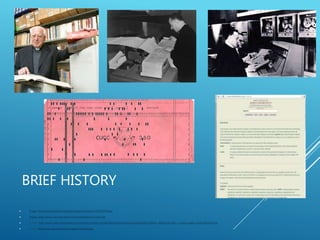
BRIEF HISTORY
 Image: http://vaticaninsider.lastampa.it/typo3temp/pics/7212f0d7fe.jpg
 Image: http://www.columbia.edu/cu/computinghistory/card2.jpg
 Images: http://www.osservatoreromano.va/orportal-portlets-portal/detail/binaries/news/cultura/2011/184q11-lettore-fermati----morto-padre-busa/184q05b.jpg
 Image: http://www.sas-sas.it/Alice/images/Thomis6.jpg
 Other scholars began using mainframe computers to automate tasks like
word-searching, sorting, and counting, which was much faster than
processing information from texts with handwritten or typed index cards
 The first specialized journal in the digital humanities was Computers and
the Humanities, which debuted in 1966. The Association for Literary and
Linguistic Computer (ALLC) and the Association for Computers and the
Humanities (ACH) were then founded in 1977 and 1978, respectively.
 Soon, there was a need for a standardized protocol for tagging digital
texts, and the Text Encoding Initiative (TEI) was developed. The TEI project
was launched in 1987 and published the first full version of the TEI
Guidelines in May 1994
 In the nineties, major digital text and image archives emerged at centres
of humanities computing in the U.S. e.g. the Women Writers Project, the
Rossetti Archive
 1992 – 2004 Library digitization and digital humanities centres
 2004: 1st Publication on DH: The Blackwell Companion to the Digital
Humanities
DIGITAL HUMANITIES TOOLS
NETWORK ANALYSIS
 Explore the relationships between
individuals, places, topics and
more
e.g. Sex, Race and Allegiance in
The Hobbit and Lord of the Rings
http://www.eduhacker.net/digital-humanities/sex-race-allegiance-hobbit-lord-of-the-rings.html
DATA VISUALISATION
 Visualise to tell a story, understand, identify trends, make
connections, see patterns .... With great speed
 A tool called Palladio which was used to do Mapping the Republic
of Letters
http://palladio.designhumanities.org
NGRAM VIEWER (GOOGLE BOOKS)
 Displays a graph showing how those phrases have
occurred in a corpus of books over the selected years
https://books.google.com/ngrams/info
TEXT ANALYSIS
 Studying texts with computers and software to
uncover new patterns, overlooked connections and
deeper meaning
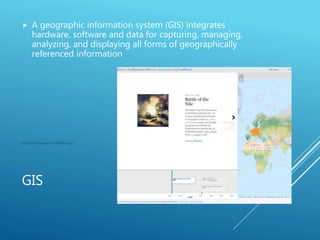
GIS
 A geographic information system (GIS) integrates
hardware, software and data for capturing, managing,
analyzing, and displaying all forms of geographically
referenced information
http://timemapper.okfnlabs.org/
DIGITAL EXHIBITS
SOME SA DH PROJECTS
HISTORICAL PAPERS RESEARCH
ARCHIVE AT WITS
TALBOT MAP COLLECTION AT UCT
LIBRARIES
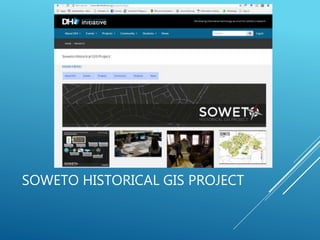
SOWETO HISTORICAL GIS PROJECT
SOME OTHER INTERESTING DH
PROJECTS
CHARLES DARWIN’S LIBRARY
MAPPING THE REPUBLIC OF
LETTERS
FIRST WORLD WAR POETRY
DIGITAL ARCHIVE
SHOAH VISUAL ARCHIVES
TRANS-ATLANTIC SLAVE TRADE
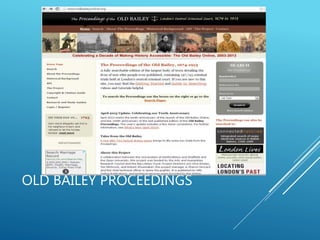
OLD BAILEY PROCEEDINGS
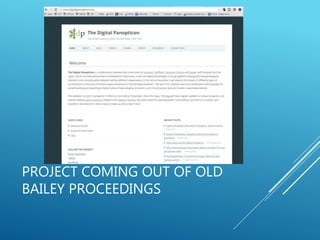
PROJECT COMING OUT OF OLD
BAILEY PROCEEDINGS
DH CENTRES AND
ORGANISATIONS
LIBRARY DIGITIZATION AND
DIGITAL HUMANITIES CENTRES
DEVELOPMENTS IN SOUTH AFRICA
 The South African Centre for Digital Language Resources (SADiLaR)
 Government support, through the Department of Science and Technology, as well as the
combined effort of many South African Academics, made the establishment of SADiLaR
possible.
 SADiLaR runs two programmes:
 A digitisation programme, which entails the systematic creation of relevant digital text,
speech and multi-modal resources related to all official languages of South Africa. The
development of appropriate natural language processing software tools for research and
development purposes are included as part of the digitisation programme.
 A Digital Humanities programme, which facilitates the building of research capacity by
promoting and supporting the use of digital data and innovative methodological
approaches within the Humanities and Social Sciences.
 African Digital Humanities : A call for proposals. The universities of Cape Town,
Pretoria, Stellenbosch, Western Cape and the Witwatersrand have recently been awarded a
generous grant from the Andrew W Mellon Foundation for a Programme in African Digital
Humanities. The Programme will offer R3 million annually over five years in support of
projects of digitisation, course design and research.
SO HOW AND WHY ARE LIBRARIES
INVOLVED?
CAN’T DO DH WITHOUT
LIBRARIES!
 Digitisation
 Preservation and Curation of digitally born artefacts
 Research Data Management
 Text analysis and text encoding
 Provision of tools for text mining, 3D
 Online Exhibition space
 GIS Services (Maps)
 Inclusion of Makerspaces
 Training on hardware and software tools and working with data (e.g. Library
carpentry)
 Provision of dedicated DH Centres or programmes – many of these in different
developmental stages. Staffing of these centres are often confined to a digital
scholarship librarian (who fulfils other roles) and a few IT professionals (many
working on contract or grant funded projects , or have other responsibilities
beyond DH programmes)
 Adam Crymble describes his Digital Humanities Thesis
in two minutes
“Big Data, Old History “
http://www.phdcomics.com/tv/#047
USEFUL READS + LINKS
 ACRL Digital Humanities Interest Group http://connect.ala.org/node/158885
 Schaffner, Jennifer and Erway, Ricky: Does Every Research Library Need a Digital Humanities Center? OCLC
http://oclc.org/research/publications/library/2014/oclcresearch-digital-humanities-center-2014-overview.html
 Response from Beth Nowviskie to the OCLC Report above http://nowviskie.org/2014/asking-for-it/
 Dh+lib: where the Digital Humanities and Librarianship meet http://acrl.ala.org/dh/
 Coble, Zach: Make it New? A dh+lib Mini Series zachcoble.com/dhlib/Make-It-New-A-dhlib-Mini-Series.pdf
 Hubbard, Melanie: Explore Digital Humanities. Syracuse University. http://melaniehubbard.files.wordpress.com/2014/04/exploredh_plan_20141.pdf
 Adams, Jennifer and Gunn, Kevin. Digital Humanities: Where to start. College & Research Libraries News vol. 73 no. 9 536-569 October 2012.
http://crln.acrl.org/content/73/9/536.full
 VandeGrif, Michau: What is digital humanities and what is it doing in the library? http://www.inthelibrarywiththeleadpipe.org/2012/dhandthelib/
 Lease, Eric Morgan: Digital Humanities and Libraries (blog posting on Days in the Life of a Librarian) http://blogs.nd.edu/emorgan/2014/04/dh-and-
libraries/
 Unsworth, John: What’s digital humanities and how did it get here? http://blogs.brandeis.edu/lts/2012/10/09/whats-digital-humanities-and-how-did-it-
get-here/
USEFUL READS + LINKS
BOOKS
 Gold, Matthew: Debates in the Digital Humanities. Minneapolis : University of Minnesota Press, 2012.
Bryson, Tim: Digital Humanities. Washington, DC : Association of Research Libraries, c2011.
EXAMPLES OF DH PROJECTS
 Mapping the Republic of Letters http://www.republicofletters.stanford.edu/
 First World War Poetry Digital Archives http://www.oucs.ox.ac.uk/www1lit/
 Trans-Atlantic Slave Trade http://www.slavevoyages.org/tast/index.faces
 Kindred Britain http://kindred.stanford.edu/#
 Old Bailey Proceedings http://www.oldbaileyonline.org/
 Charles Darwin’s Library http://www.biodiversity.org/collection/darwinlibrary
 Sex, Race and Allegiance in the Hobbit and the Lord of the Rings http://www.eduhacker.net/digital-humanities/sex-race-allegiance-hobbit-lord-of-the-rings.html
 French Revolution Digital Archive https://frda.stanford.edu/
TOOLS TO EXPLORE
 Digital Research Tools http://dirt.projectbamboo.org/
 Voyant http://www.voyant-tools.org
 Tapor http://portal.tapor.ca/portal/portal
 Palladio http://palladio.designhumanities.org
 Library Carpentry http://librarycarpentry.org
ORGANISATIONS
 Alliance of Digital Humanities Organizations http://adho.org/
 That Camps http://thatcamp.org/
 Digital Humanities Association of Southern Africa (DHASA) http://digitalhumanities.org.za/

Dh presentation 2018

  • 1.
    MAKING SENSE OFDIGITAL HUMANITIES - A CONVERSATION STARTER: Presented by Ingrid Thomson, UCT Libraries
  • 2.
    WHAT IS THISTHING CALLED DIGITAL HUMANITIES OR DH?  Various definitions of Digital Humanities  Previously known as Human Computing  Umbrella term covering a wide range of activities from online preservation and digital mapping to data mining and the use of geographic information systems.  There have been scholars and technologists doing DH work long before DH was a phrase!
  • 3.
    QUESTION THAT ISASKED  There was a moment of asking “Can I use this technology to further my research?” or saying “This is what I want to do” and identifies a technology to help them do that. (Or in some cases, create a tool to do that)
  • 4.
    DEFINITIONS....  Day inthe Life of Digital Humanities (8 April 2014)  Some definitions: http://dayofdh2014.matrix.msu.edu/members/ DH is a cover term for a wide variety of activities that attempt to explore and expand areas of knowledge typically examined in the Humanities by developing and/or applying computational tools or methods in ways best suited for these areas. DH is also a cover term for a supporting community of practitioners who share a common interest in the tools and methods--and challenges--generated by the activities DH scholars, as well as potentially useful activities in fields outside the traditional Humanities. - Scott Kleinman California State University, Northridge
  • 5.
    DEFINITION We use “digitalhumanities” as an umbrella term for a number of different activities that surround technology and humanities scholarship. Under the digital humanities rubric, I would include topics like open access to materials, intellectual property rights, tool development, digital libraries, data mining, born-digital preservation, multimedia publication, visualization, GIS, digital reconstruction, study of the impact of technology on numerous fields, technology for teaching and learning, sustainability models, and many others . -Brett Bobley, NEH, United States (2011)
  • 6.
    MORE DEFINITIONS I definethe digital humanities as two things. Firstly, I think of it as using new and emerging technologies to enhance our understanding of our humanistic fields of inquiry. For me, as a historian, it is learning new things through technology that we couldn't learn otherwise. Secondly, I think of it as playing and exploring new methods of scholarly communication - i.e. putting history online - Ian Milligan, Uni of Waterloo
  • 7.
    Broadly construed, digitalhumanities is the use of digital media and technology to advance the full range of thought and practice in the humanities, from the creation of scholarly resources, to research on those resources, to the communication of results to colleagues and students. Dan Cohen – Executive Director, Digital Public Library of America
  • 8.
    BRIEF HISTORY  Image:http://vaticaninsider.lastampa.it/typo3temp/pics/7212f0d7fe.jpg  Image: http://www.columbia.edu/cu/computinghistory/card2.jpg  Images: http://www.osservatoreromano.va/orportal-portlets-portal/detail/binaries/news/cultura/2011/184q11-lettore-fermati----morto-padre-busa/184q05b.jpg  Image: http://www.sas-sas.it/Alice/images/Thomis6.jpg
  • 9.
     Other scholarsbegan using mainframe computers to automate tasks like word-searching, sorting, and counting, which was much faster than processing information from texts with handwritten or typed index cards  The first specialized journal in the digital humanities was Computers and the Humanities, which debuted in 1966. The Association for Literary and Linguistic Computer (ALLC) and the Association for Computers and the Humanities (ACH) were then founded in 1977 and 1978, respectively.  Soon, there was a need for a standardized protocol for tagging digital texts, and the Text Encoding Initiative (TEI) was developed. The TEI project was launched in 1987 and published the first full version of the TEI Guidelines in May 1994  In the nineties, major digital text and image archives emerged at centres of humanities computing in the U.S. e.g. the Women Writers Project, the Rossetti Archive  1992 – 2004 Library digitization and digital humanities centres  2004: 1st Publication on DH: The Blackwell Companion to the Digital Humanities
  • 10.
  • 11.
    NETWORK ANALYSIS  Explorethe relationships between individuals, places, topics and more e.g. Sex, Race and Allegiance in The Hobbit and Lord of the Rings http://www.eduhacker.net/digital-humanities/sex-race-allegiance-hobbit-lord-of-the-rings.html
  • 12.
    DATA VISUALISATION  Visualiseto tell a story, understand, identify trends, make connections, see patterns .... With great speed  A tool called Palladio which was used to do Mapping the Republic of Letters http://palladio.designhumanities.org
  • 13.
    NGRAM VIEWER (GOOGLEBOOKS)  Displays a graph showing how those phrases have occurred in a corpus of books over the selected years https://books.google.com/ngrams/info
  • 14.
    TEXT ANALYSIS  Studyingtexts with computers and software to uncover new patterns, overlooked connections and deeper meaning
  • 15.
    GIS  A geographicinformation system (GIS) integrates hardware, software and data for capturing, managing, analyzing, and displaying all forms of geographically referenced information http://timemapper.okfnlabs.org/
  • 16.
  • 17.
    SOME SA DHPROJECTS
  • 18.
  • 19.
    TALBOT MAP COLLECTIONAT UCT LIBRARIES
  • 20.
  • 21.
  • 22.
  • 23.
  • 24.
    FIRST WORLD WARPOETRY DIGITAL ARCHIVE
  • 25.
  • 26.
  • 27.
  • 28.
    PROJECT COMING OUTOF OLD BAILEY PROCEEDINGS
  • 29.
  • 30.
  • 36.
    DEVELOPMENTS IN SOUTHAFRICA  The South African Centre for Digital Language Resources (SADiLaR)  Government support, through the Department of Science and Technology, as well as the combined effort of many South African Academics, made the establishment of SADiLaR possible.  SADiLaR runs two programmes:  A digitisation programme, which entails the systematic creation of relevant digital text, speech and multi-modal resources related to all official languages of South Africa. The development of appropriate natural language processing software tools for research and development purposes are included as part of the digitisation programme.  A Digital Humanities programme, which facilitates the building of research capacity by promoting and supporting the use of digital data and innovative methodological approaches within the Humanities and Social Sciences.  African Digital Humanities : A call for proposals. The universities of Cape Town, Pretoria, Stellenbosch, Western Cape and the Witwatersrand have recently been awarded a generous grant from the Andrew W Mellon Foundation for a Programme in African Digital Humanities. The Programme will offer R3 million annually over five years in support of projects of digitisation, course design and research.
  • 37.
    SO HOW ANDWHY ARE LIBRARIES INVOLVED?
  • 38.
    CAN’T DO DHWITHOUT LIBRARIES!  Digitisation  Preservation and Curation of digitally born artefacts  Research Data Management  Text analysis and text encoding  Provision of tools for text mining, 3D  Online Exhibition space  GIS Services (Maps)  Inclusion of Makerspaces  Training on hardware and software tools and working with data (e.g. Library carpentry)  Provision of dedicated DH Centres or programmes – many of these in different developmental stages. Staffing of these centres are often confined to a digital scholarship librarian (who fulfils other roles) and a few IT professionals (many working on contract or grant funded projects , or have other responsibilities beyond DH programmes)
  • 39.
     Adam Crymbledescribes his Digital Humanities Thesis in two minutes “Big Data, Old History “ http://www.phdcomics.com/tv/#047
  • 40.
    USEFUL READS +LINKS  ACRL Digital Humanities Interest Group http://connect.ala.org/node/158885  Schaffner, Jennifer and Erway, Ricky: Does Every Research Library Need a Digital Humanities Center? OCLC http://oclc.org/research/publications/library/2014/oclcresearch-digital-humanities-center-2014-overview.html  Response from Beth Nowviskie to the OCLC Report above http://nowviskie.org/2014/asking-for-it/  Dh+lib: where the Digital Humanities and Librarianship meet http://acrl.ala.org/dh/  Coble, Zach: Make it New? A dh+lib Mini Series zachcoble.com/dhlib/Make-It-New-A-dhlib-Mini-Series.pdf  Hubbard, Melanie: Explore Digital Humanities. Syracuse University. http://melaniehubbard.files.wordpress.com/2014/04/exploredh_plan_20141.pdf  Adams, Jennifer and Gunn, Kevin. Digital Humanities: Where to start. College & Research Libraries News vol. 73 no. 9 536-569 October 2012. http://crln.acrl.org/content/73/9/536.full  VandeGrif, Michau: What is digital humanities and what is it doing in the library? http://www.inthelibrarywiththeleadpipe.org/2012/dhandthelib/  Lease, Eric Morgan: Digital Humanities and Libraries (blog posting on Days in the Life of a Librarian) http://blogs.nd.edu/emorgan/2014/04/dh-and- libraries/  Unsworth, John: What’s digital humanities and how did it get here? http://blogs.brandeis.edu/lts/2012/10/09/whats-digital-humanities-and-how-did-it- get-here/
  • 41.
    USEFUL READS +LINKS BOOKS  Gold, Matthew: Debates in the Digital Humanities. Minneapolis : University of Minnesota Press, 2012. Bryson, Tim: Digital Humanities. Washington, DC : Association of Research Libraries, c2011. EXAMPLES OF DH PROJECTS  Mapping the Republic of Letters http://www.republicofletters.stanford.edu/  First World War Poetry Digital Archives http://www.oucs.ox.ac.uk/www1lit/  Trans-Atlantic Slave Trade http://www.slavevoyages.org/tast/index.faces  Kindred Britain http://kindred.stanford.edu/#  Old Bailey Proceedings http://www.oldbaileyonline.org/  Charles Darwin’s Library http://www.biodiversity.org/collection/darwinlibrary  Sex, Race and Allegiance in the Hobbit and the Lord of the Rings http://www.eduhacker.net/digital-humanities/sex-race-allegiance-hobbit-lord-of-the-rings.html  French Revolution Digital Archive https://frda.stanford.edu/ TOOLS TO EXPLORE  Digital Research Tools http://dirt.projectbamboo.org/  Voyant http://www.voyant-tools.org  Tapor http://portal.tapor.ca/portal/portal  Palladio http://palladio.designhumanities.org  Library Carpentry http://librarycarpentry.org ORGANISATIONS  Alliance of Digital Humanities Organizations http://adho.org/  That Camps http://thatcamp.org/  Digital Humanities Association of Southern Africa (DHASA) http://digitalhumanities.org.za/

Editor's Notes

  • #16 Timemapper
  • #28 Can use tools like Voyant, and Zotero to do data mining. Called with Criminal Intent Project.