Teaching technology:
Assessment
Dr Naresh T Chauhan
Objective
• To define evaluation and identify the steps of evaluation
• Enumerate the aims of evaluation
• Enumerate the characteristics of evaluation tools
• Understands the role of essay type questions, short answer questions
and multiple choice question as evaluation tools
• Formulate the above three evaluation tools
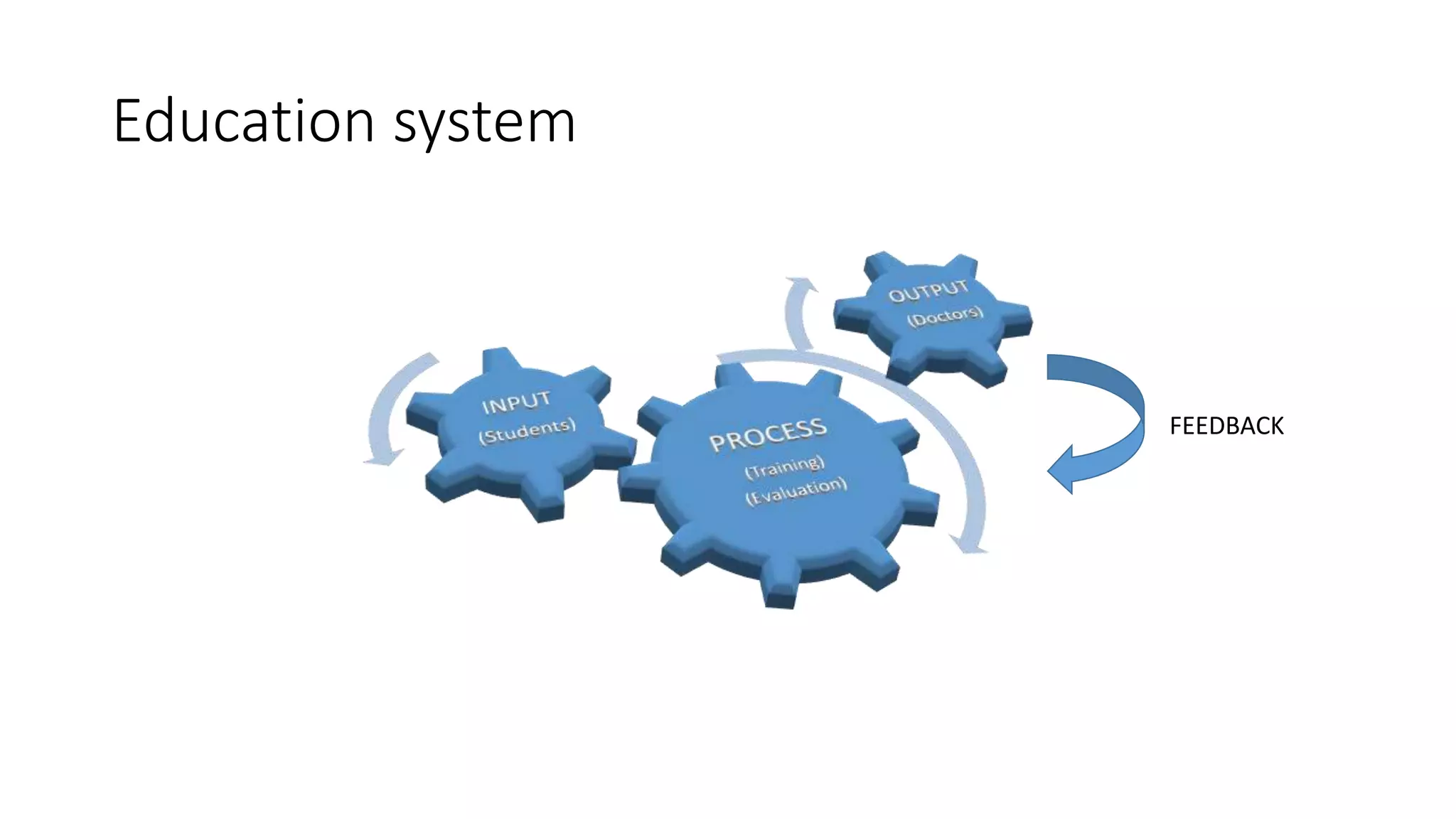
Education system
FEEDBACK
WHAT IS EDUCATION ?
• Education is process of bringing changes in behavioral pattern of the
learner in the desired direction
• Such changes can be at level of
• Thinking (cognitive)
• Feeling (affective)
• Acting (psychomotor) can be brought about by
• Specifying educational objectives
• Providing suitable learning experiences to the learners
• Evaluation of learner
What is evaluation ?
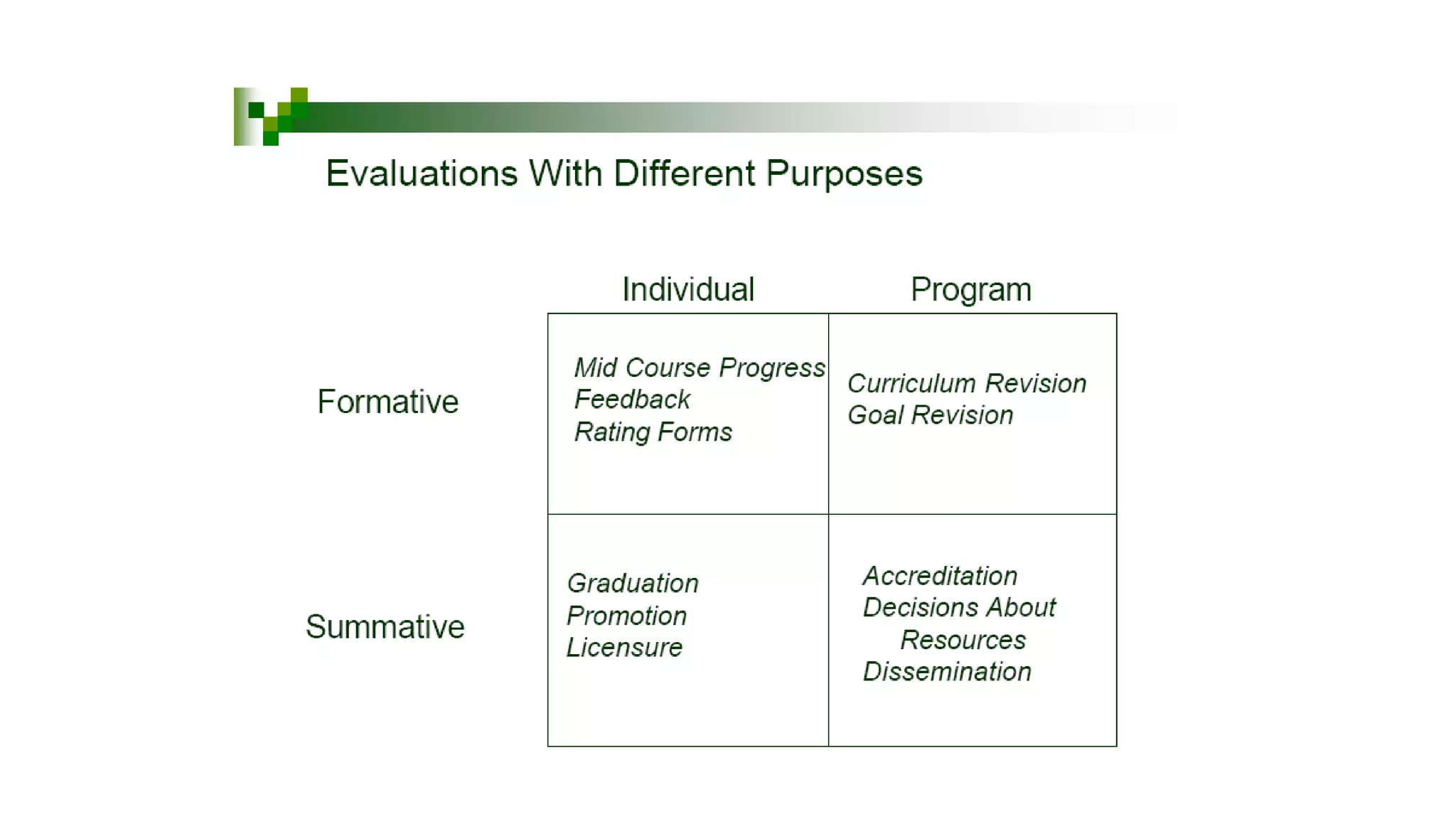
• Evaluation is the process of determining whether predetermined
educational objectives has been achieved
Aims
• For selection of a few students from large no of students
• Preassessment of need of a learner (pre-test)
• For continued monitoring of learning activities for giving a feedback
( formative evaluation)
For competence to complete a course (summative evaluation)
Characteristics of evaluation
• Relevance:
• Validity:
• Objectivity:
• Feasibility :
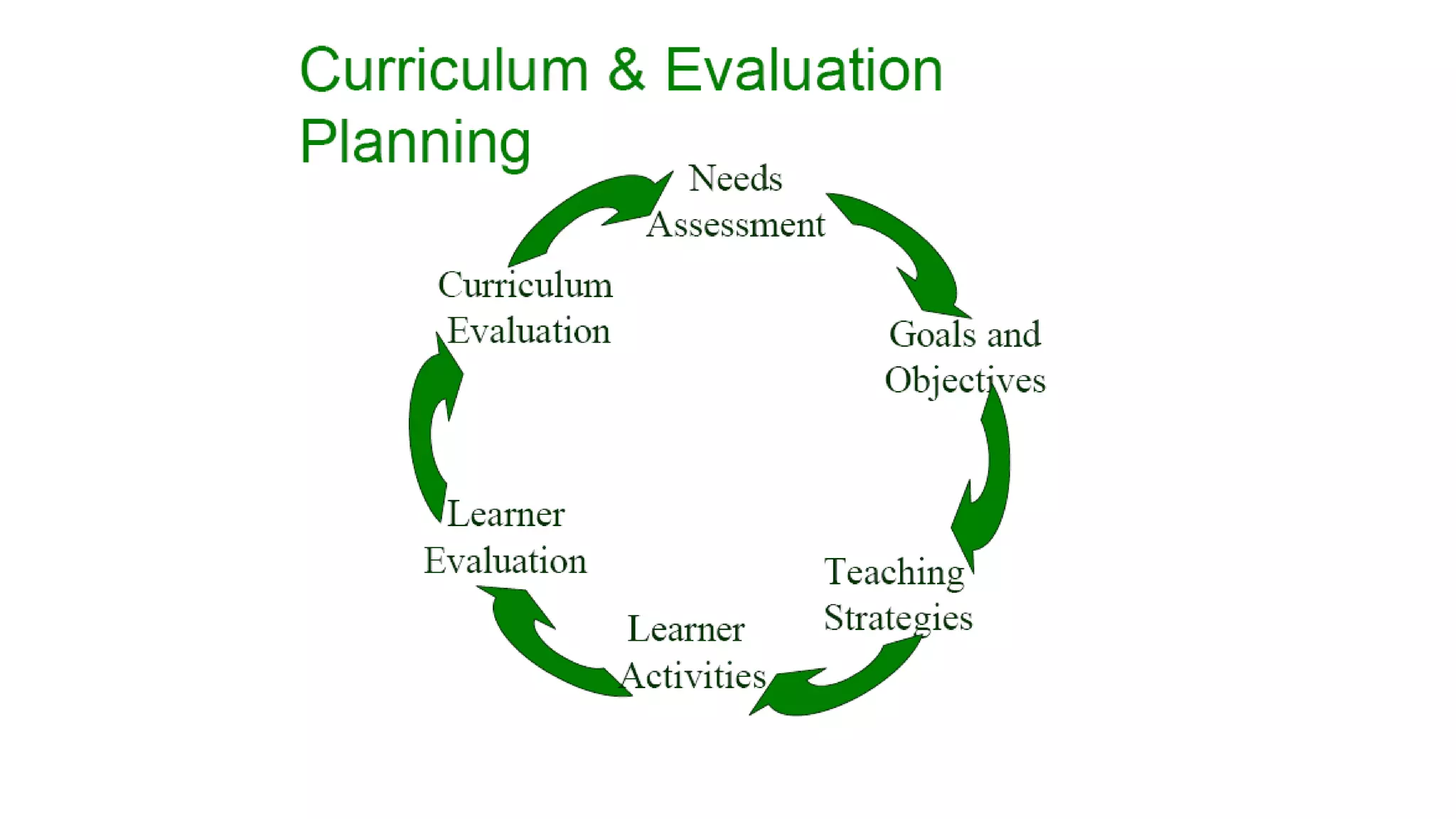
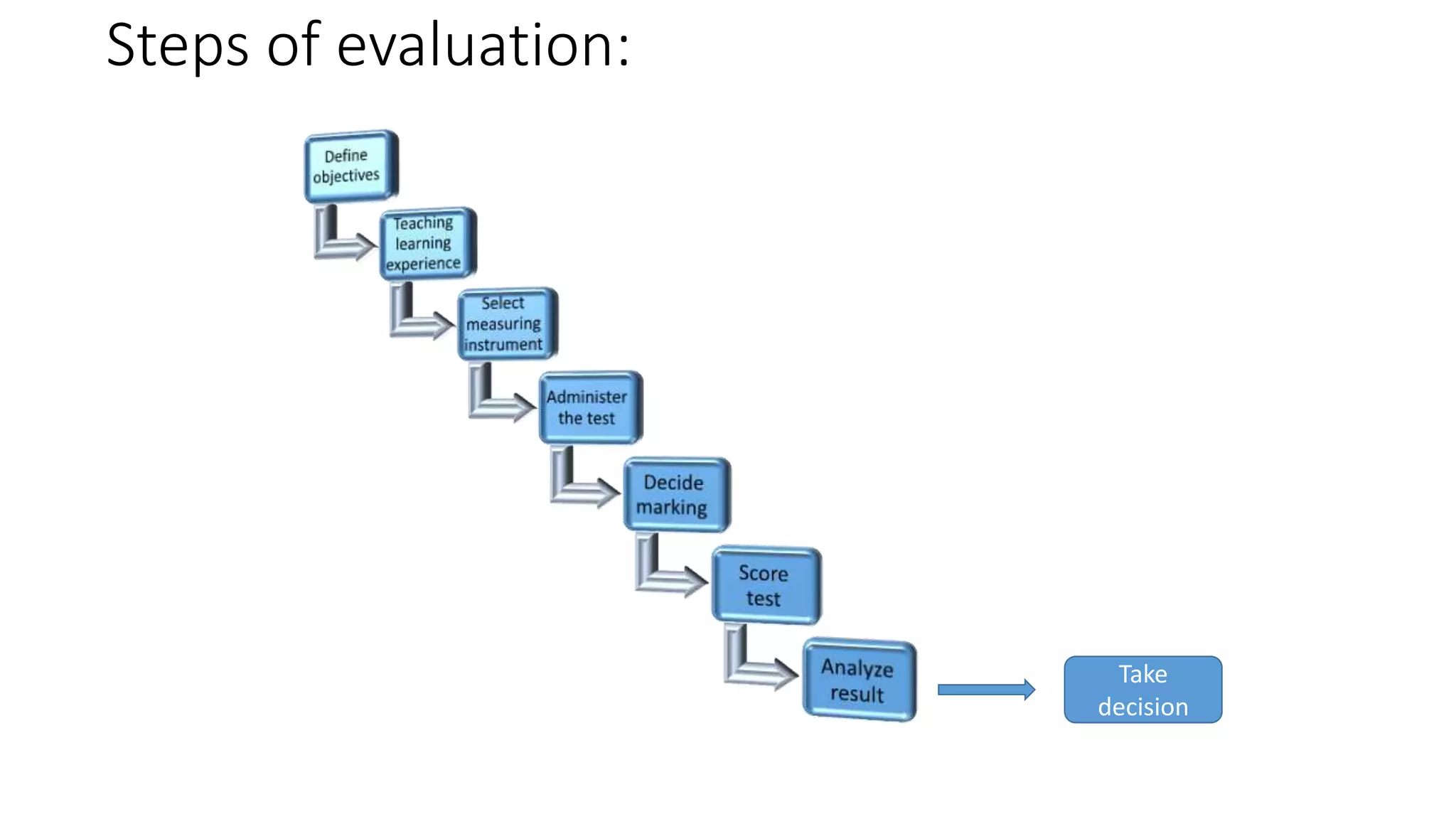
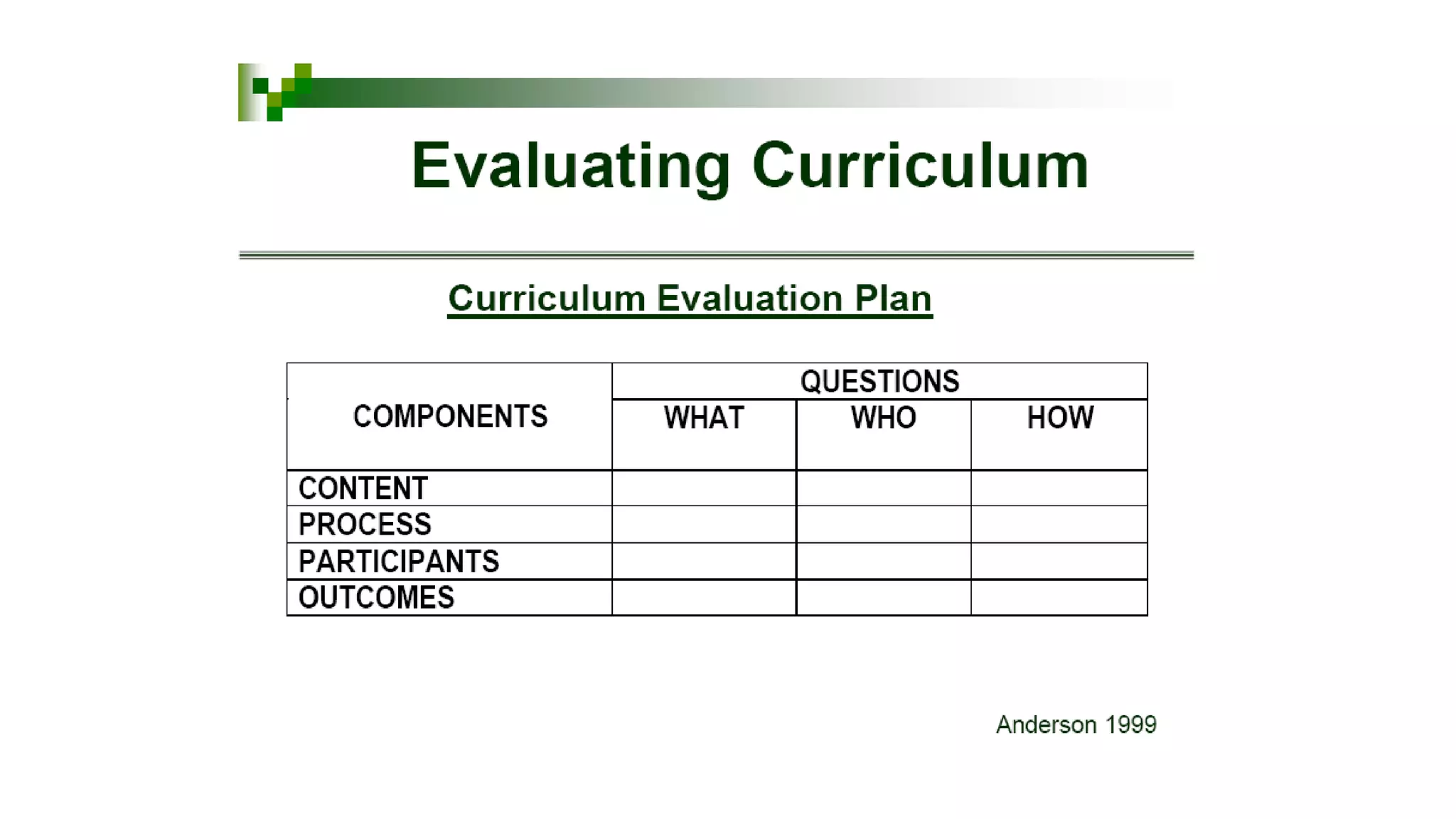
Steps of evaluation:
Take
decision
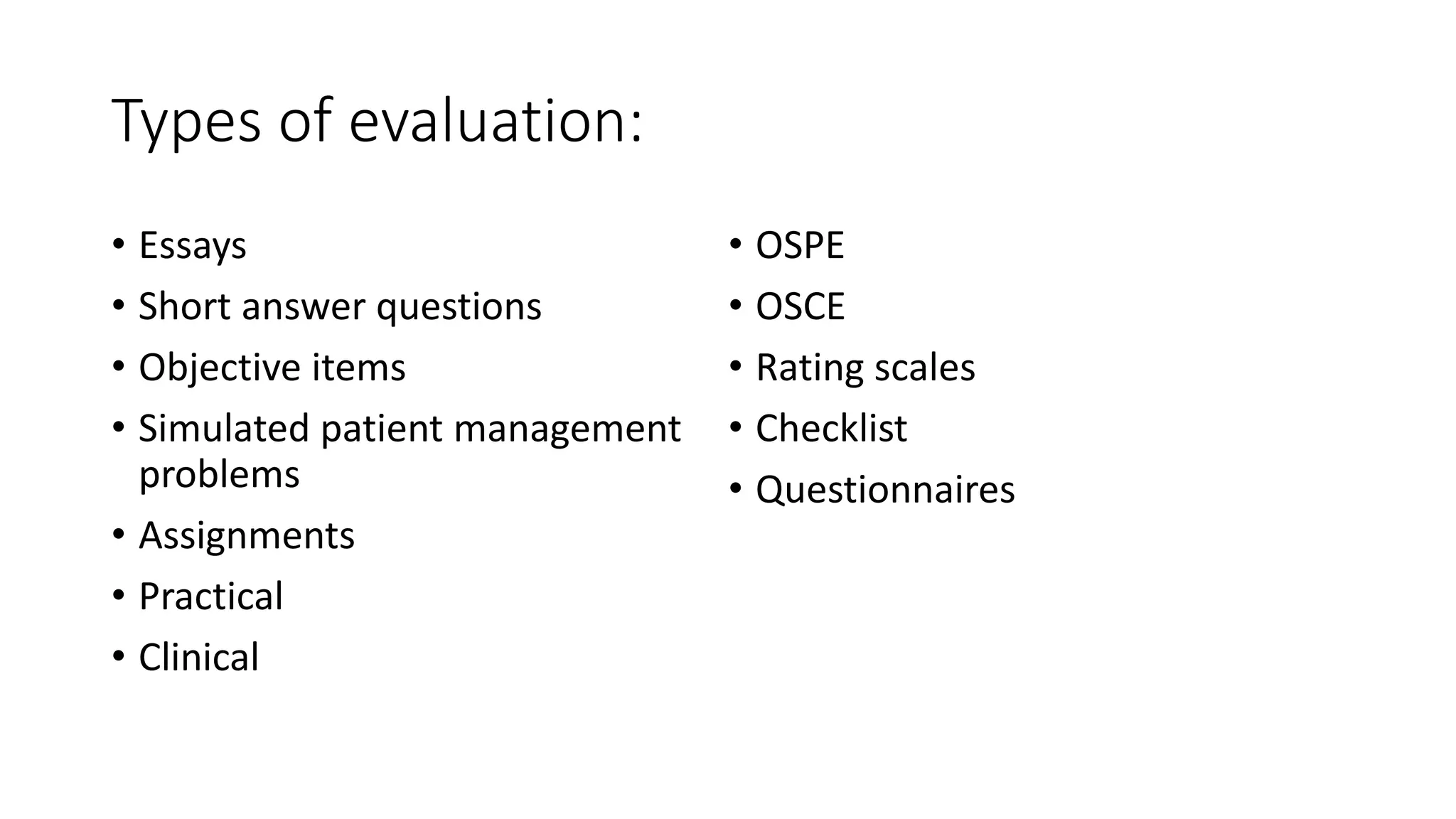
Types of evaluation:
• Essays
• Short answer questions
• Objective items
• Simulated patient management
problems
• Assignments
• Practical
• Clinical
• OSPE
• OSCE
• Rating scales
• Checklist
• Questionnaires
Essay type questions
• “A test item which requires a response composed by the examinee,
usually in the form of one or more sentences, of a nature that no
single response or pattern of responses can be listed as correct and
the accuracy and quality of which can be judged subjectively only by
skilled or informed in the subject”
-- John M Stalnaker (1951)
• Permits the examinee to write in his own words a free and extended
response to the problem presented and thus reveals information
regarding the students mental process
• EQ evaluate mainly the cognitive domains
• It measures the students ability not only to recall knowledge but also
to use appropriate expression to record it and further his ability to
analyze, synthesize and apply the knowledge to solve the problem
presented
Advantages EQ
• Free and effective expression
• Test their knowledge
• Test ability to recognize ideas
• Minimize guess work
• Easy to frame
Disadvantage
• Lack objectivity
• Limited curriculum tested
• Grading is inconsistent, difficult and time consuming
• No feedback to teachers
• Advantage to those with better expression power
• Student may interpret it differently from the examiner
Guidelines for framing good EQ
• Question should be clear and specific and exact limit should be set
• Avoid what do you think ?
what is in your opinion ?
Discuss, Describe ? (Use specific)
• Instead use : enlist, enumerate, define,
compare and contrast, state your reasons
• Question should be in language familiar to students
• Do not economize on words at the cost of clarity
• No option as better comparison but if option are given, they should be
from same topic and of similar difficulty level
Example:-
• A 18 year old boy complains of fever with rigors since 3 days, body ache
and headache. Physical examination shows temp. 102 °F. (2+4+6)
a) What is the most likely diagnosis of this patient ?
b) Enlist the investigation which should be advised ?
c) How will you manage this patient ?
Evaluation of EQ
How to evaluate EQ ?
• Prepare model answers / elements of good answer
• Subdivide scores
• Scoring of each subdivision before checking second to avoid carry
over effect
• Sample a few questions before start marking
• Have adequate time and proper place for evaluation
• Mark one question in all paper at a time
• When grading decision is crucial, have two or more reader score the
essay independently
Modified essay question
• Each candidate is presented with progressive bit of information on
clinical problem, in a predetermined sequence. At successive stages
candidate responds to information and is asked to make decisions
and to explain and /or justify them. Answer are not suggested.
• example
Criteria for EQ
• Validity
• Reliability
• Objectivity
• Feasibility
• Credibility
• Importance
Short answer questions
• Short answer question are a system of evaluation where the response
is by writing in one word/ one phrase/ one sentence
• Advantages :
• Precisely framed
• Covers wide subject area
• No guess-like MCQ
• Less cumbersome to attempt
• Scoring is specific
Disadvantages
• Not suitable for testing complex learning outcome
• Time consuming as compared to MCQ
• Marking manually only
Types
• Completion type
• Unique answer type
• Open ended questions
Completion type
• Incomplete statement
• Missing words
• Fill in the blanks
• Labelling diagrams
• Completing diagrams
• Example:
• _________heart of biomedical waste management
• Acronym DOTS mean_____
• Delivery before _________weeks gestation is called preterm delivery
• Ice berg phenomenon diagram ( identify)
Unique answer questions
• Interpretation of data
• Simple e.g what is the DOC in Amoebic dysentery ?
Open ended short answer question
• Similar to unique answer question but one or two lined
• Solve variation in the nature of answer
• What is limiting amino acid ?
• What is supplementary action of protein ?
• What is placebo ?
Guidelines to frame SAQs
• Determine purpose and content of the item
• Write stem
• Choose the style
• Use simple language
• Be concise
• Clear cut instruction and value of item- marks
Some clues:
• Word each item in specific terms with clear meanings so that the
intended answer is the only one possible
• Word each item so that the blank or answer space is towards the end
of the sentence
• Avoid copying sentence verbatim from text or classroom materials
• Omit important rather than trivial words
• Avoid butchered or mutilated sentences
Thank you for your kind attention !
Tell me and I forget
Teach me and I remember
Involve me and I learn

Teaching technology

  • 1.
  • 2.
    Objective • To defineevaluation and identify the steps of evaluation • Enumerate the aims of evaluation • Enumerate the characteristics of evaluation tools • Understands the role of essay type questions, short answer questions and multiple choice question as evaluation tools • Formulate the above three evaluation tools
  • 3.
  • 4.
    WHAT IS EDUCATION? • Education is process of bringing changes in behavioral pattern of the learner in the desired direction • Such changes can be at level of • Thinking (cognitive) • Feeling (affective) • Acting (psychomotor) can be brought about by • Specifying educational objectives • Providing suitable learning experiences to the learners • Evaluation of learner
  • 5.
    What is evaluation? • Evaluation is the process of determining whether predetermined educational objectives has been achieved
  • 7.
    Aims • For selectionof a few students from large no of students • Preassessment of need of a learner (pre-test) • For continued monitoring of learning activities for giving a feedback ( formative evaluation) For competence to complete a course (summative evaluation)
  • 11.
    Characteristics of evaluation •Relevance: • Validity: • Objectivity: • Feasibility :
  • 12.
  • 15.
    Types of evaluation: •Essays • Short answer questions • Objective items • Simulated patient management problems • Assignments • Practical • Clinical • OSPE • OSCE • Rating scales • Checklist • Questionnaires
  • 16.
    Essay type questions •“A test item which requires a response composed by the examinee, usually in the form of one or more sentences, of a nature that no single response or pattern of responses can be listed as correct and the accuracy and quality of which can be judged subjectively only by skilled or informed in the subject” -- John M Stalnaker (1951)
  • 17.
    • Permits theexaminee to write in his own words a free and extended response to the problem presented and thus reveals information regarding the students mental process • EQ evaluate mainly the cognitive domains • It measures the students ability not only to recall knowledge but also to use appropriate expression to record it and further his ability to analyze, synthesize and apply the knowledge to solve the problem presented
  • 18.
    Advantages EQ • Freeand effective expression • Test their knowledge • Test ability to recognize ideas • Minimize guess work • Easy to frame
  • 19.
    Disadvantage • Lack objectivity •Limited curriculum tested • Grading is inconsistent, difficult and time consuming • No feedback to teachers • Advantage to those with better expression power • Student may interpret it differently from the examiner
  • 20.
    Guidelines for framinggood EQ • Question should be clear and specific and exact limit should be set • Avoid what do you think ? what is in your opinion ? Discuss, Describe ? (Use specific) • Instead use : enlist, enumerate, define, compare and contrast, state your reasons • Question should be in language familiar to students • Do not economize on words at the cost of clarity • No option as better comparison but if option are given, they should be from same topic and of similar difficulty level
  • 21.
    Example:- • A 18year old boy complains of fever with rigors since 3 days, body ache and headache. Physical examination shows temp. 102 °F. (2+4+6) a) What is the most likely diagnosis of this patient ? b) Enlist the investigation which should be advised ? c) How will you manage this patient ?
  • 22.
  • 23.
    How to evaluateEQ ? • Prepare model answers / elements of good answer • Subdivide scores • Scoring of each subdivision before checking second to avoid carry over effect • Sample a few questions before start marking • Have adequate time and proper place for evaluation • Mark one question in all paper at a time • When grading decision is crucial, have two or more reader score the essay independently
  • 24.
    Modified essay question •Each candidate is presented with progressive bit of information on clinical problem, in a predetermined sequence. At successive stages candidate responds to information and is asked to make decisions and to explain and /or justify them. Answer are not suggested. • example
  • 25.
    Criteria for EQ •Validity • Reliability • Objectivity • Feasibility • Credibility • Importance
  • 26.
    Short answer questions •Short answer question are a system of evaluation where the response is by writing in one word/ one phrase/ one sentence • Advantages : • Precisely framed • Covers wide subject area • No guess-like MCQ • Less cumbersome to attempt • Scoring is specific
  • 27.
    Disadvantages • Not suitablefor testing complex learning outcome • Time consuming as compared to MCQ • Marking manually only
  • 28.
    Types • Completion type •Unique answer type • Open ended questions
  • 29.
    Completion type • Incompletestatement • Missing words • Fill in the blanks • Labelling diagrams • Completing diagrams • Example: • _________heart of biomedical waste management • Acronym DOTS mean_____ • Delivery before _________weeks gestation is called preterm delivery • Ice berg phenomenon diagram ( identify)
  • 30.
    Unique answer questions •Interpretation of data • Simple e.g what is the DOC in Amoebic dysentery ?
  • 31.
    Open ended shortanswer question • Similar to unique answer question but one or two lined • Solve variation in the nature of answer • What is limiting amino acid ? • What is supplementary action of protein ? • What is placebo ?
  • 32.
    Guidelines to frameSAQs • Determine purpose and content of the item • Write stem • Choose the style • Use simple language • Be concise • Clear cut instruction and value of item- marks
  • 33.
    Some clues: • Wordeach item in specific terms with clear meanings so that the intended answer is the only one possible • Word each item so that the blank or answer space is towards the end of the sentence • Avoid copying sentence verbatim from text or classroom materials • Omit important rather than trivial words • Avoid butchered or mutilated sentences
  • 35.
    Thank you foryour kind attention ! Tell me and I forget Teach me and I remember Involve me and I learn