Presented by
FARHANA KHALIQ
Master of education(M.Ed)
Semester 11
Department of school of education
Central University of kashmir
contents
 Introduction.
 Defnition.
 Why hold a classroom dialogue?
 How to schedule and prepare for a classroom dialogue.
 Principles of dialogue method.
 What does dialogue method look like in practice?
 Curriculum.
 Methods of teaching.
 Place of teacher.
 Ways of evaluation.
 Significance of dialogue method.
 Current status of dialogue based learning.
introduction
 A dialogue is a form that draws participants from as many parts of the community as
possible to exchange information face to face, share personal stories and experiences
honestly, express perspectives, clarify viewpoints,and develop solutions to
community concerns.
 The word dialogue means “The word between us”.
 Dialogue method means using talk most effectively for carrying out teaching and
learning. Dialogic teaching involves ongoing talk between teacher and students, not
just…..teacher presentation.
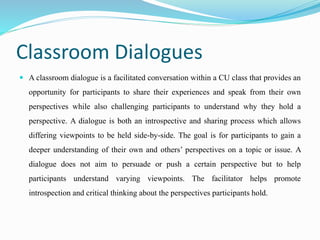
Classroom Dialogues
 A classroom dialogue is a facilitated conversation within a CU class that provides an
opportunity for participants to share their experiences and speak from their own
perspectives while also challenging participants to understand why they hold a
perspective. A dialogue is both an introspective and sharing process which allows
differing viewpoints to be held side-by-side. The goal is for participants to gain a
deeper understanding of their own and others’ perspectives on a topic or issue. A
dialogue does not aim to persuade or push a certain perspective but to help
participants understand varying viewpoints. The facilitator helps promote
introspection and critical thinking about the perspectives participants hold.
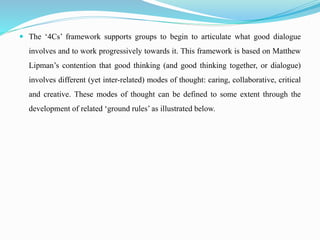
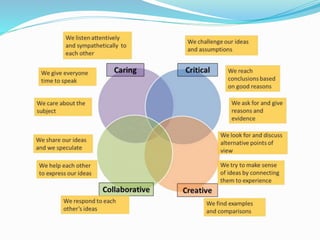
 The ‘4Cs’ framework supports groups to begin to articulate what good dialogue
involves and to work progressively towards it. This framework is based on Matthew
Lipman’s contention that good thinking (and good thinking together, or dialogue)
involves different (yet inter-related) modes of thought: caring, collaborative, critical
and creative. These modes of thought can be defined to some extent through the
development of related ‘ground rules’ as illustrated below.
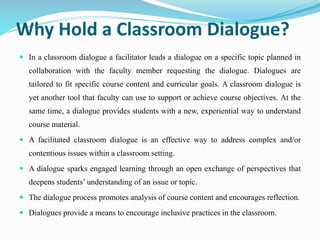
Why Hold a Classroom Dialogue?
 In a classroom dialogue a facilitator leads a dialogue on a specific topic planned in
collaboration with the faculty member requesting the dialogue. Dialogues are
tailored to fit specific course content and curricular goals. A classroom dialogue is
yet another tool that faculty can use to support or achieve course objectives. At the
same time, a dialogue provides students with a new, experiential way to understand
course material.
 A facilitated classroom dialogue is an effective way to address complex and/or
contentious issues within a classroom setting.
 A dialogue sparks engaged learning through an open exchange of perspectives that
deepens students’ understanding of an issue or topic.
 The dialogue process promotes analysis of course content and encourages reflection.
 Dialogues provide a means to encourage inclusive practices in the classroom.
How to Schedule and Prepare for a Classroom Dialogue
 Identify a topic based on your course content and fill out a Dialogue Request Form.
 A Dialogues Program facilitator will contact you to arrange a brief consultation in person
or by phone. The pre-dialogue consultation gives you an opportunity to discuss your
learning objectives with the facilitator and identify specific questions you want the
dialogue to address.
 Prepare your students for the dialogue. Students benefit most when a pre-dialogue
reading, class discussion, or assignment connects to the topic/questions the dialogue will
address. Plan to share ideas for preparing your students with the facilitator during the pre-
dialogue consultation. Facilitators will use this information to help build a “road map” for
your dialogue.
 Keep in mind that the facilitator will guide the conversation during the dialogue. In a
dialogue, faculty members drop the “teacher/expert” role. All dialogue community
participants act as co-learners/teachers.
Principles of dialogue method
 Collective:-participants address learning tasks together.
 Reciprocal:-participants listen to each other, share ideas and consider alternative
viewpoints.
 Supportive:- pupils express their ideas freely,without fear of embarassment over
wrong answers and they help each other to reach common understanding.
 Cumulative:- participants build on answers and other oral contributions and chain
them into coherent lines of thinking and understanding.
 Purposefull:-classroom talk, though open and dialogic,is also planned and
structured with specific learning goals in view.
What does dialogic method look likein practise?
 In dialogic classrooms children doesn’t just provide brief factual answers to test or
recall questions, or merely spot the answer which they think the teacher wants to
hear. Instead they learn and are encouraged to :-~Narrate – explain-analyse-
spectulate-imagine-explore-evaluate-discuss-argue-justify-ask questions of their
own.
 To facillate the different kinds of learning talk,children in dialogic classrooms also:-
Listen
Think about what they hear.
Give others time to think.
Respect alternative viewpoints.
Curriculum under dialogic method
 Curriculum is dynamic.
 Curriculum views listing of subjects to be taught.
 Curriculum is a learning experiences of individuals.
Methods of teaching
 Lecture method:-builds existing knowledge.
 Discussion method:-contribute ideas or personal opinions.
 Demonstration method:-coach weak and slow trainees.
 Buzz groups:-to form groups and exchange ideas.
 Brainstorming:-ideas are discussed and evaluated.
 Role plays:-encourages creativity in learning.
 Tutorial method:-promotes safety.
Place of teacher
 Facilitator
 Rolemodel.
 Information provider.
 Resource developer.
 Planner.
 Assessor.
 Good coordinated.
Ways of evaluation
 Day to day observation.
 Oral work(question answer,loud reading,conversation,role play etc)
 Practical/experiments.
 Activity(individual,group,self study)
 Projects.
 Tests(open booktest,written test).
 Homework/classwork(essay,descriotive,report,stories,letter,dialogue).
significance
 Effective way to resolve issues that threaten social stability and peace.
 It helps to respect and accept diverse views.
 It promotes understanding by exploring the roots of various cricis,
 It reveals the incoherence in our own thoughts.
 Dialogue allows us as teachers, leaders or support staff to intervene in the learning
process by giving instant feedback, guidance and challenge to our students.
Current status of dialogue method
 It helps us to give brief description.
 It adds to the readers present knowledge .
 It helps to eliminate the routine exchanges of ordinary conversation.
 It helps to convey a sense of spontaniety.
 It helps to keep the story moving forward.
 It helps to be revelatory of the speakers character.
 It helps to show the relationship among the people.
Total Budget Estimate:

Dialogue method

  • 1.
    Presented by FARHANA KHALIQ Masterof education(M.Ed) Semester 11 Department of school of education Central University of kashmir
  • 2.
    contents  Introduction.  Defnition. Why hold a classroom dialogue?  How to schedule and prepare for a classroom dialogue.  Principles of dialogue method.  What does dialogue method look like in practice?  Curriculum.  Methods of teaching.  Place of teacher.  Ways of evaluation.  Significance of dialogue method.  Current status of dialogue based learning.
  • 3.
    introduction  A dialogueis a form that draws participants from as many parts of the community as possible to exchange information face to face, share personal stories and experiences honestly, express perspectives, clarify viewpoints,and develop solutions to community concerns.  The word dialogue means “The word between us”.  Dialogue method means using talk most effectively for carrying out teaching and learning. Dialogic teaching involves ongoing talk between teacher and students, not just…..teacher presentation.
  • 4.
    Classroom Dialogues  Aclassroom dialogue is a facilitated conversation within a CU class that provides an opportunity for participants to share their experiences and speak from their own perspectives while also challenging participants to understand why they hold a perspective. A dialogue is both an introspective and sharing process which allows differing viewpoints to be held side-by-side. The goal is for participants to gain a deeper understanding of their own and others’ perspectives on a topic or issue. A dialogue does not aim to persuade or push a certain perspective but to help participants understand varying viewpoints. The facilitator helps promote introspection and critical thinking about the perspectives participants hold.
  • 5.
     The ‘4Cs’framework supports groups to begin to articulate what good dialogue involves and to work progressively towards it. This framework is based on Matthew Lipman’s contention that good thinking (and good thinking together, or dialogue) involves different (yet inter-related) modes of thought: caring, collaborative, critical and creative. These modes of thought can be defined to some extent through the development of related ‘ground rules’ as illustrated below.
  • 7.
    Why Hold aClassroom Dialogue?  In a classroom dialogue a facilitator leads a dialogue on a specific topic planned in collaboration with the faculty member requesting the dialogue. Dialogues are tailored to fit specific course content and curricular goals. A classroom dialogue is yet another tool that faculty can use to support or achieve course objectives. At the same time, a dialogue provides students with a new, experiential way to understand course material.  A facilitated classroom dialogue is an effective way to address complex and/or contentious issues within a classroom setting.  A dialogue sparks engaged learning through an open exchange of perspectives that deepens students’ understanding of an issue or topic.  The dialogue process promotes analysis of course content and encourages reflection.  Dialogues provide a means to encourage inclusive practices in the classroom.
  • 8.
    How to Scheduleand Prepare for a Classroom Dialogue  Identify a topic based on your course content and fill out a Dialogue Request Form.  A Dialogues Program facilitator will contact you to arrange a brief consultation in person or by phone. The pre-dialogue consultation gives you an opportunity to discuss your learning objectives with the facilitator and identify specific questions you want the dialogue to address.  Prepare your students for the dialogue. Students benefit most when a pre-dialogue reading, class discussion, or assignment connects to the topic/questions the dialogue will address. Plan to share ideas for preparing your students with the facilitator during the pre- dialogue consultation. Facilitators will use this information to help build a “road map” for your dialogue.  Keep in mind that the facilitator will guide the conversation during the dialogue. In a dialogue, faculty members drop the “teacher/expert” role. All dialogue community participants act as co-learners/teachers.
  • 9.
    Principles of dialoguemethod  Collective:-participants address learning tasks together.  Reciprocal:-participants listen to each other, share ideas and consider alternative viewpoints.  Supportive:- pupils express their ideas freely,without fear of embarassment over wrong answers and they help each other to reach common understanding.  Cumulative:- participants build on answers and other oral contributions and chain them into coherent lines of thinking and understanding.  Purposefull:-classroom talk, though open and dialogic,is also planned and structured with specific learning goals in view.
  • 10.
    What does dialogicmethod look likein practise?  In dialogic classrooms children doesn’t just provide brief factual answers to test or recall questions, or merely spot the answer which they think the teacher wants to hear. Instead they learn and are encouraged to :-~Narrate – explain-analyse- spectulate-imagine-explore-evaluate-discuss-argue-justify-ask questions of their own.  To facillate the different kinds of learning talk,children in dialogic classrooms also:- Listen Think about what they hear. Give others time to think. Respect alternative viewpoints.
  • 11.
    Curriculum under dialogicmethod  Curriculum is dynamic.  Curriculum views listing of subjects to be taught.  Curriculum is a learning experiences of individuals.
  • 12.
    Methods of teaching Lecture method:-builds existing knowledge.  Discussion method:-contribute ideas or personal opinions.  Demonstration method:-coach weak and slow trainees.  Buzz groups:-to form groups and exchange ideas.  Brainstorming:-ideas are discussed and evaluated.  Role plays:-encourages creativity in learning.  Tutorial method:-promotes safety.
  • 13.
    Place of teacher Facilitator  Rolemodel.  Information provider.  Resource developer.  Planner.  Assessor.  Good coordinated.
  • 14.
    Ways of evaluation Day to day observation.  Oral work(question answer,loud reading,conversation,role play etc)  Practical/experiments.  Activity(individual,group,self study)  Projects.  Tests(open booktest,written test).  Homework/classwork(essay,descriotive,report,stories,letter,dialogue).
  • 15.
    significance  Effective wayto resolve issues that threaten social stability and peace.  It helps to respect and accept diverse views.  It promotes understanding by exploring the roots of various cricis,  It reveals the incoherence in our own thoughts.  Dialogue allows us as teachers, leaders or support staff to intervene in the learning process by giving instant feedback, guidance and challenge to our students.
  • 16.
    Current status ofdialogue method  It helps us to give brief description.  It adds to the readers present knowledge .  It helps to eliminate the routine exchanges of ordinary conversation.  It helps to convey a sense of spontaniety.  It helps to keep the story moving forward.  It helps to be revelatory of the speakers character.  It helps to show the relationship among the people.
  • 17.