Group Members:
Cartagena Diana
Cedeño Gina
Coronel Estefania
Molina Carla
Olmedo Samantha
Umaquinga Alex
TEACHING
METHODS
GRAMMAR TRANSLATION METHOD
WHAT IS IT?
Makes use of translation and grammar study as the
main teaching and learning activities
HISTORY
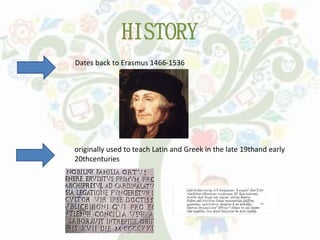
Dates back to Erasmus 1466-1536
originally used to teach Latin and Greek in the late 19thand early
20thcenturies
CHARACTERISTICS
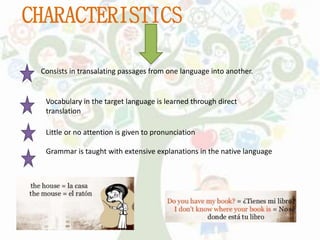
Consists in transalating passages from one language into another.
Vocabulary in the target language is learned through direct
translation
Little or no attention is given to pronunciation
Grammar is taught with extensive explanations in the native language
TECHNIQUES
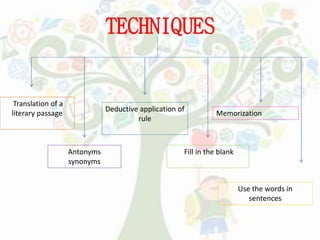
Translation of a
literary passage
Antonyms
synonyms
Deductive application of
rule
Fill in the blank
Memorization
Use the words in
sentences
.
ADVANTAGES
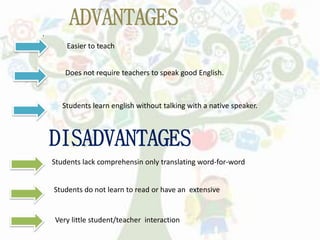
Easier to teach
Does not require teachers to speak good English.
Students learn english without talking with a native speaker.
DISADVANTAGES
Students lack comprehensin only translating word-for-word
Students do not learn to read or have an extensive
Very little student/teacher interaction
STUDENTS ROLE
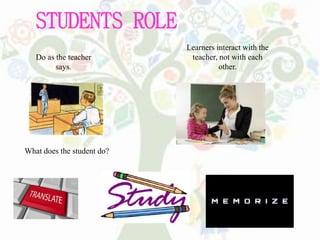
Do as the teacher
says.
Learners interact with the
teacher, not with each
other.
What does the student do?
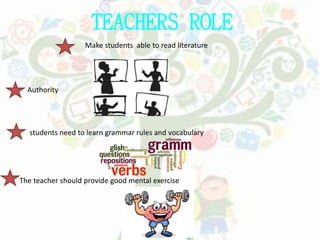
TEACHERS ROLE
Make students able to read literature
Authority
students need to learn grammar rules and vocabulary
The teacher should provide good mental exercise
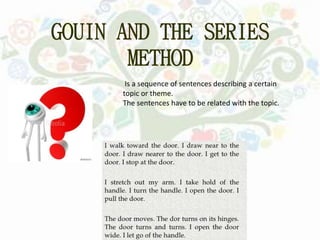
GOUIN AND THE SERIES
METHOD
Is a sequence of sentences describing a certain
topic or theme.
The sentences have to be related with the topic.
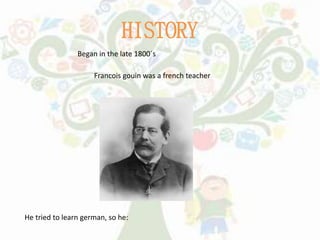
HISTORY
Began in the late 1800´s
Francois gouin was a french teacher
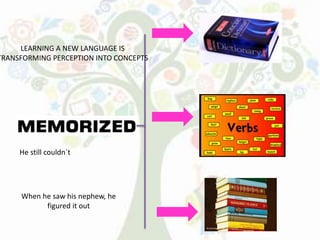
He tried to learn german, so he:
He still couldn´t
LEARNING A NEW LANGUAGE IS
TRANSFORMING PERCEPTION INTO CONCEPTS
When he saw his nephew, he
figured it out
CHARACTERISTICS
Teaches directly
it's more important to learn sentences to speak than words
Verbs are the key elements in LEARNING:
No more than 6-8 sentences with a Leghth of 7-8 sillables
NO TRANSLATION NO GRAMMAR NO GRAMMAR EXPLANATIONS
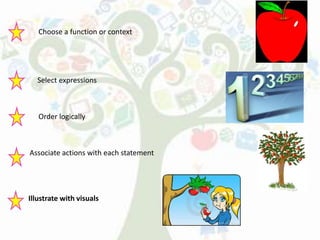
Choose a function or context
Select expressions
Order logically
Associate actions with each statement
Illustrate with visuals
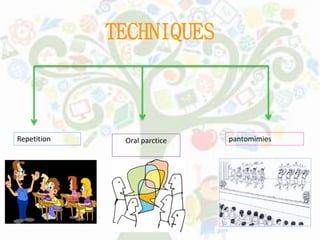
TECHNIQUES
Repetition Oral parctice pantomimies
ADVANTAGES
No complication in teaching grammar
The topics learn are easy do to the facility it most be to learn.
DISADVANTAGES
When it comes to forming new sentences,not always will it be easy to
structure because of the lak od grammnar they have.
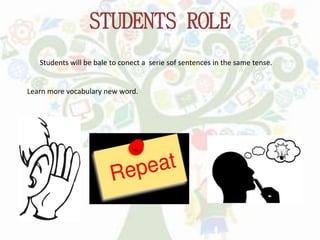
STUDENTS ROLE
Students will be bale to conect a serie sof sentences in the same tense.
Learn more vocabulary new word.
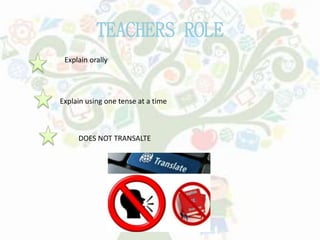
TEACHERS ROLE
Explain orally
Explain using one tense at a time
DOES NOT TRANSALTE
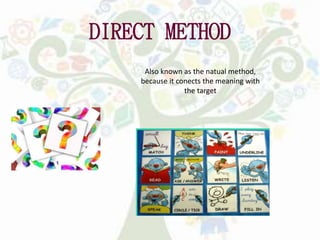
DIRECT METHOD
Also known as the natual method,
because it conects the meaning with
the target
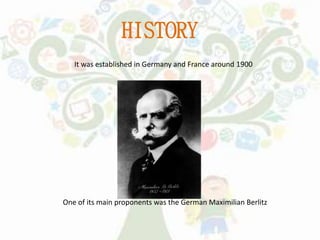
HISTORY
It was established in Germany and France around 1900
One of its main proponents was the German Maximilian Berlitz
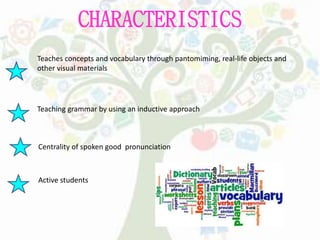
CHARACTERISTICS
Teaches concepts and vocabulary through pantomiming, real-life objects and
other visual materials
Teaching grammar by using an inductive approach
Centrality of spoken good pronunciation
Active students
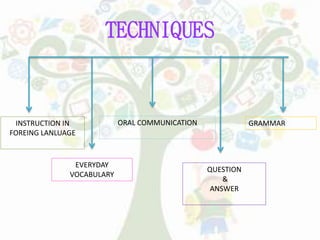
TECHNIQUES
INSTRUCTION IN
FOREING LANLUAGE
EVERYDAY
VOCABULARY
ORAL COMMUNICATION
QUESTION
&
ANSWER
GRAMMAR
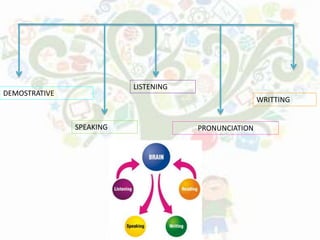
DEMOSTRATIVE
SPEAKING
LISTENING
PRONUNCIATION
WRITTING
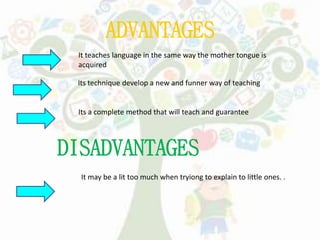
ADVANTAGES
It teaches language in the same way the mother tongue is
acquired
Its technique develop a new and funner way of teaching
DISADVANTAGES
It may be a lit too much when tryiong to explain to little ones. .
Its a complete method that will teach and guarantee
STUDENTS ROLE
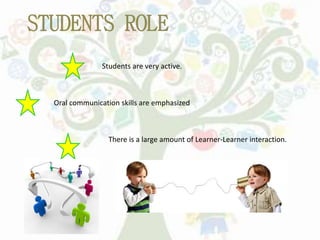
Students are very active.
Oral communication skills are emphasized
There is a large amount of Learner-Learner interaction.
TEACHERS ROLE
Direct class activities
Encourage students to participate in class and corrects their mistakes
immediately
students and teacher are partners in the learning process.
Give confidence to students so that they can ask if they dont
undersatnd something.
Uses various techniques, tries to get students to self-correct
AUDIOLINGUAL METHOD
Emphasizes the teaching of listening and speaking
before reading and writing. It uses dialogues as the
main form of language presentation.
HISTORY
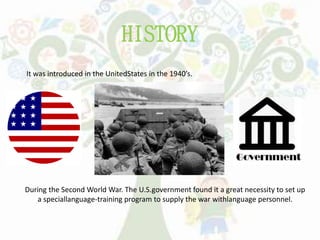
It was introduced in the UnitedStates in the 1940’s.
During the Second World War. The U.S.government found it a great necessity to set up
a speciallanguage-training program to supply the war withlanguage personnel.
CHARACTERISTICS
New vocabulary and structural patterns are presented through dialogues.
The dialogs are learned through imitation and repetition
Grammar is induced from the examples given
Explicit grammar rules are not provided
Students’ reading and written work is based upon the oral work they did earlier.
ADVANTAGES
It aims at developing listening and speaking skills
It´s easy to teach even in big class group
The students can imitate the way of native speaker in pronounce
DISADVANTAGES
The failure to teach long-term communicative proficiency.
Memorizing and drilling also only create the students’ habits not their competences
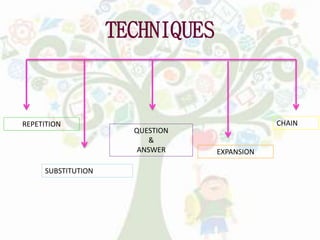
TECHNIQUES
REPETITION
SUBSTITUTION
QUESTION
&
ANSWER EXPANSION
CHAIN
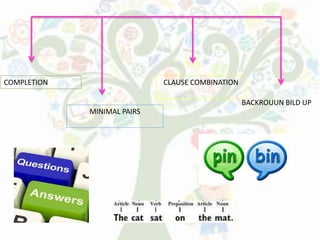
COMPLETION
MINIMAL PAIRS
CLAUSE COMBINATION
BACKROUUN BILD UP
STUDENTS ROLE
Listen to the teacher, imitating, responding, performing controlled tasks
Students play a reactive role by responding stimuli
Students have little control over the content
TEACHERS ROLE
Teacher-dominate the method
Teachers control the direction and place of learning Monitors
Instruct the students the right way.
COGNITIVE CODE LEARNING
Cognitive-code learning refers to a theory of second language
teaching and learning developed in
1960s
There are two Theoretical models:
HISTORY
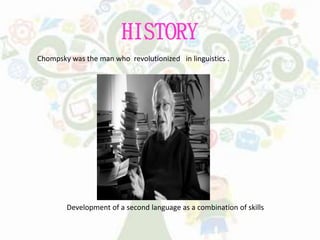
Chompsky was the man who revolutionized in linguistics .
Development of a second language as a combination of skills
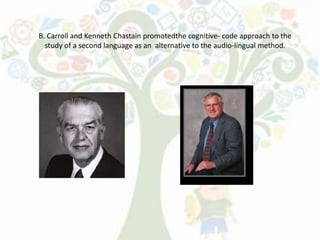
B. Carroll and Kenneth Chastain promotedthe cognitive- code approach to the
study of a second language as an alternative to the audio-lingual method.
ADVANTAGES
A good foundation for elementary level
So whatever the teacher knowS that's the only things the students can learn.
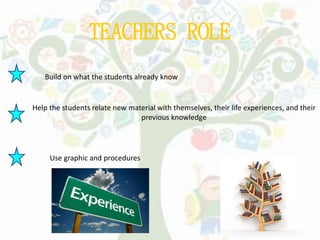
TEACHERS ROLE
Build on what the students already know
Help the students relate new material with themselves, their life experiences, and their
previous knowledge
Use graphic and procedures
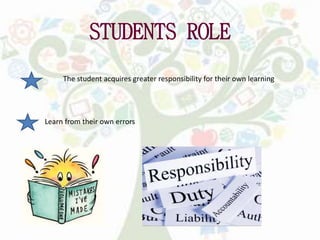
STUDENTS ROLE
The student acquires greater responsibility for their own learning
Learn from their own errors

Teaching Methods

  • 1.
    Group Members: Cartagena Diana CedeñoGina Coronel Estefania Molina Carla Olmedo Samantha Umaquinga Alex TEACHING METHODS
  • 2.
    GRAMMAR TRANSLATION METHOD WHATIS IT? Makes use of translation and grammar study as the main teaching and learning activities
  • 3.
    HISTORY Dates back toErasmus 1466-1536 originally used to teach Latin and Greek in the late 19thand early 20thcenturies
  • 4.
    CHARACTERISTICS Consists in transalatingpassages from one language into another. Vocabulary in the target language is learned through direct translation Little or no attention is given to pronunciation Grammar is taught with extensive explanations in the native language
  • 5.
    TECHNIQUES Translation of a literarypassage Antonyms synonyms Deductive application of rule Fill in the blank Memorization Use the words in sentences
  • 6.
    . ADVANTAGES Easier to teach Doesnot require teachers to speak good English. Students learn english without talking with a native speaker. DISADVANTAGES Students lack comprehensin only translating word-for-word Students do not learn to read or have an extensive Very little student/teacher interaction
  • 7.
    STUDENTS ROLE Do asthe teacher says. Learners interact with the teacher, not with each other. What does the student do?
  • 8.
    TEACHERS ROLE Make studentsable to read literature Authority students need to learn grammar rules and vocabulary The teacher should provide good mental exercise
  • 9.
    GOUIN AND THESERIES METHOD Is a sequence of sentences describing a certain topic or theme. The sentences have to be related with the topic.
  • 10.
    HISTORY Began in thelate 1800´s Francois gouin was a french teacher He tried to learn german, so he:
  • 11.
    He still couldn´t LEARNINGA NEW LANGUAGE IS TRANSFORMING PERCEPTION INTO CONCEPTS When he saw his nephew, he figured it out
  • 12.
    CHARACTERISTICS Teaches directly it's moreimportant to learn sentences to speak than words Verbs are the key elements in LEARNING: No more than 6-8 sentences with a Leghth of 7-8 sillables NO TRANSLATION NO GRAMMAR NO GRAMMAR EXPLANATIONS
  • 13.
    Choose a functionor context Select expressions Order logically Associate actions with each statement Illustrate with visuals
  • 14.
  • 15.
    ADVANTAGES No complication inteaching grammar The topics learn are easy do to the facility it most be to learn. DISADVANTAGES When it comes to forming new sentences,not always will it be easy to structure because of the lak od grammnar they have.
  • 16.
    STUDENTS ROLE Students willbe bale to conect a serie sof sentences in the same tense. Learn more vocabulary new word.
  • 17.
    TEACHERS ROLE Explain orally Explainusing one tense at a time DOES NOT TRANSALTE
  • 18.
    DIRECT METHOD Also knownas the natual method, because it conects the meaning with the target
  • 19.
    HISTORY It was establishedin Germany and France around 1900 One of its main proponents was the German Maximilian Berlitz
  • 20.
    CHARACTERISTICS Teaches concepts andvocabulary through pantomiming, real-life objects and other visual materials Teaching grammar by using an inductive approach Centrality of spoken good pronunciation Active students
  • 21.
  • 22.
  • 23.
    ADVANTAGES It teaches languagein the same way the mother tongue is acquired Its technique develop a new and funner way of teaching DISADVANTAGES It may be a lit too much when tryiong to explain to little ones. . Its a complete method that will teach and guarantee
  • 24.
    STUDENTS ROLE Students arevery active. Oral communication skills are emphasized There is a large amount of Learner-Learner interaction.
  • 25.
    TEACHERS ROLE Direct classactivities Encourage students to participate in class and corrects their mistakes immediately students and teacher are partners in the learning process. Give confidence to students so that they can ask if they dont undersatnd something. Uses various techniques, tries to get students to self-correct
  • 26.
    AUDIOLINGUAL METHOD Emphasizes theteaching of listening and speaking before reading and writing. It uses dialogues as the main form of language presentation.
  • 27.
    HISTORY It was introducedin the UnitedStates in the 1940’s. During the Second World War. The U.S.government found it a great necessity to set up a speciallanguage-training program to supply the war withlanguage personnel.
  • 28.
    CHARACTERISTICS New vocabulary andstructural patterns are presented through dialogues. The dialogs are learned through imitation and repetition Grammar is induced from the examples given Explicit grammar rules are not provided Students’ reading and written work is based upon the oral work they did earlier.
  • 29.
    ADVANTAGES It aims atdeveloping listening and speaking skills It´s easy to teach even in big class group The students can imitate the way of native speaker in pronounce DISADVANTAGES The failure to teach long-term communicative proficiency. Memorizing and drilling also only create the students’ habits not their competences
  • 30.
  • 31.
  • 32.
    STUDENTS ROLE Listen tothe teacher, imitating, responding, performing controlled tasks Students play a reactive role by responding stimuli Students have little control over the content
  • 33.
    TEACHERS ROLE Teacher-dominate themethod Teachers control the direction and place of learning Monitors Instruct the students the right way.
  • 34.
    COGNITIVE CODE LEARNING Cognitive-codelearning refers to a theory of second language teaching and learning developed in 1960s There are two Theoretical models:
  • 35.
    HISTORY Chompsky was theman who revolutionized in linguistics . Development of a second language as a combination of skills
  • 36.
    B. Carroll andKenneth Chastain promotedthe cognitive- code approach to the study of a second language as an alternative to the audio-lingual method.
  • 37.
    ADVANTAGES A good foundationfor elementary level So whatever the teacher knowS that's the only things the students can learn.
  • 38.
    TEACHERS ROLE Build onwhat the students already know Help the students relate new material with themselves, their life experiences, and their previous knowledge Use graphic and procedures
  • 39.
    STUDENTS ROLE The studentacquires greater responsibility for their own learning Learn from their own errors