A "METHODICAL"
HISTORY OF
LANGUAGE
TEACHING
Sindhu Rhineksha Mukti-
20108810004
APPROACH,
METHOD,
AND
TECHNIQUE
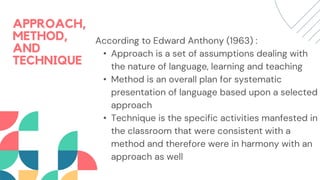
According to Edward Anthony (1963) :
• Approach is a set of assumptions dealing with
the nature of language, learning and teaching
• Method is an overall plan for systematic
presentation of language based upon a selected
approach
• Technique is the specific activities manfested in
the classroom that were consistent with a
method and therefore were in harmony with an
approach as well
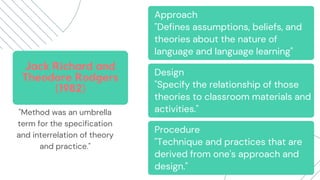
Jack Richard and
Theodore Rodgers
(1982)
"Method was an umbrella
term for the specification
and interrelation of theory
and practice."
Approach
"Defines assumptions, beliefs, and
theories about the nature of
language and language learning"
Lorem ipsum dolor sit amet,
consectetur adipiscing elit.
Donec quis erat et quam iaculis
faucibus at sit amet nibh.
Design
"Specify the relationship of those
theories to classroom materials and
activities."
Procedure
"Technique and practices that are
derived from one's approach and
design."
Changing Winds
and Shifting Sands
"Albert Marckwardt (1972) saw these "changing
winds and shifting sands" as a cyclical pattern in
whch a new method emerged about every quarter of
century. Each new method broke from the old but
took with it some of the positive aspects."
THE GRAMMAR TRANSLATION METHOD
Grammar translation method (formerly known as
classical method) is a language teaching method
that focus on grammatical rules, memorization of
vocabulary and of various deciensions and
conjugations, translation of texts, and doing written
exercise.
THE GRAMMAR TRANSLATION METHOD
Major characteristics od Grammar Translation according to
Prator and Celce-Murcia (1979:3) are:
• Classes are taught in the mother tongue, with little active use
of the target language.
• Much vocabulary is taught in the form of lists of isolated
words.
• Long, elaborate explanations of the intricacies of grammar are
given.
• Grammar provide the rules for putting words together, and
instruction often focuses on the form and inflection of words.
THE GRAMMAR TRANSLATION METHOD
Major characteristics od Grammar Translation according to
Prator and Celce-Murcia (1979:3) are:
• Reading of difficult classical text in begun early.
• Little attention is paid to the content of text, which are
treated as exercises in grammatical analysis.
• Often the drills are exercises in translating disconnected
sentence from the target language into the mother tongue.
• Little or no attention is given to pronunciation.
THE GRAMMAR TRANSLATION METHOD
Disadvantage of this method :
• It does not virtually enhance a student's
communicative ability in the language
• It requires few specialized skills on the part of
teachers.
• Test of grammar rules and of translations are easy to
construct and can be objectively scored.
The Series Method was a method that taught
learners directly (without translation) and
conceptually (without grammatical rules and
explanations) a series of connected sentences
that are easy to perceive.
GOUIN AND THE SERIES METHOD
The first lesson of a foreign language would thus teach
the following series of fifteen sentences:
I walk toward the door. I draw near to the door. I draw
nearer to the door. I get to the door. I stop at the door.
I stretch out my arm. I take hold of the handle. I turn
the handle. I open the door. I pull the door.
The door moves. The door turns on its hinges. The door
turns and turns. I open the door wide. I let go of the
handle.
GOUIN AND THE SERIES METHOD
Direct method is similar with Gouin's Series Method
that second language learning should be more like first
language learning:
• lots of oral interaction
• spontaneous use of the language
• no translation between first and second languages
• little or no analysis of grammatical rules
THE DIRECT METHOD
The principles of the Direct Method according to Richards and Rodgers (1986;9-
10) :
• Classroom instruction was conducted exclusively in the target language.
• Only everyday vocabulary and sentences were taught.
• Oral communication skill was built up in a carefully traded progression
organized around question-and answer exchanges between teacher and
students in small, intensive classes.
• Grammar was taught inductively.
• New teaching points were taught through modeling and practice.
• Concrete vocabulary was taught through demonstration, objects, and
pictures, abstract vocabulary was taught by association of ideas.
• Both speech and listening comprehension were taught.
• Correct pronunciation and grammar were emphasized.
THE DIRECT METHOD
• The Direct Method did not take well in public
education, where the constraints of budget,
classroom size, time, and teacher background made
such a method difficult to use.
• Weak theoritical foundations.
• It did not take hold in the United States.
THE DIRECT METHOD
DISADVANTAGE
• In the 1930s and
1940s the schools
returned to
Grammar
Translation Method
• The World War II
heightened the
need for Americans
to become orally
proficient in the
language of both
their allies and their
enemies.
THE AUDIOLINGUAL METHOD • Army Specialized Training
Program (ASTP): special, intensive
language courses focused on
aural/oral skills.
• A great deal of oral activity -
pronunciation and conversation
practice - with virtually none of
the grammar and translation
found in traditional classes
• In all its variations and adaptations,
the Army Method came to be known
as the Audiolingual Method.
• New material is presented in dialogue form,
• There is dependence on mimicry, memorization of set phrases, and
overlearning,
• Structures are sequenced by means of contrastive analysis and
taught one at a time,
• Structural patterns are taught using repetitive drills,
• There is little or grammatical explanation,
• Vocabulary is strictly limited and learned in context,
• Great importance is attached to pronounciation,
• Very little use of the mother tongue,
• Successful responses are immediately reinforced,
• There is a great effort to get students to produce error free
utterances,
• There is a tendency to manipulate language and disregard content.
THE AUDIOLINGUAL METHOD
CHARACTER
ISTIC
• It failed to teach long-term communicative
proficiency
• .Language is not really acquired through a
process of habit formation and overlearning,
that errors were not necessaily to be avoided
at all cost, and that structural linguistics did
not tell us everything about language we
needed to know
THE AUDIOLINGUAL METHOD
DISADVANT
AGES
COGNITIVE CODE
LEARNING
Cognitive code learning was not so
much method as it was an approach
that emphasized a conscious
awareness of rules and their
applications to second language
learning.
"DESIGNER"
METHODS OF
THE SPIRITED
1970S
COMMUNITY LANGUAGE LEARNING
(CLL)
• Charles Curran (1972) created a classic example of an
affectively based method, what he called the Counseling-
Learning.
• "The social dynamics of such a group were of primary
importance"
Methodology:
• "the group of clients (students), having first established in their
native language an interpersonal relationship and trust, were
seated in a circle with the teacher on the outside of the circle
• As they talked the teacher translated the dialogue in the
second language (English). The learner repeated that English
sentence as accurately as possible
SUGGESTOPEDIA
• Georgi Lozaniv (1979)-bulgarian psychologist;
• He believed that "the human brain could process great
quantities of material if given the right condition for
learning-which are a state of relaxation and giving over
of control to the teacher"
THE SILENT WAY
• Caleb Gattegno (1972);
• "Learning is facilitated if the learner discovers or
creates rather than remembers and repeats what is to
be learned"
• "Learning is facilitated by accompanying (mediating)
physical objects"
• Learning is facilitated by problem solving involving the
material to be learned
TOTAL PHYSICAL RESPONSE (TPR)
• James Asher (1977);
• "The instructor is the director of a stage play in which
the students are the actors"
• Students did a deal of listening and acting. The teacher
was very directive in orchestrating a performance;
• Imperative mood was utilized to teach even into more
advanced levels; introduced by humor to make the
atmosphere comfortable enough for learning process.
THE NATURAL APPROACH
• Stephen Krashen (1982, 1997);
• The teacher should provide the basic "comprehensible
input", communication skill for everyday language
situations.
• Learners do not allowed to say during this "silent
period" untill they feel ready to do so;
• The teachers is the source of the learners' input,
stimulating variety of classroom activities, games, skills,
commands and the like.
THANK YOU
www.reallygreatsite.com

A Methodical History of Language Teaching.pptx

  • 1.
  • 2.
    APPROACH, METHOD, AND TECHNIQUE According to EdwardAnthony (1963) : • Approach is a set of assumptions dealing with the nature of language, learning and teaching • Method is an overall plan for systematic presentation of language based upon a selected approach • Technique is the specific activities manfested in the classroom that were consistent with a method and therefore were in harmony with an approach as well
  • 3.
    Jack Richard and TheodoreRodgers (1982) "Method was an umbrella term for the specification and interrelation of theory and practice." Approach "Defines assumptions, beliefs, and theories about the nature of language and language learning" Lorem ipsum dolor sit amet, consectetur adipiscing elit. Donec quis erat et quam iaculis faucibus at sit amet nibh. Design "Specify the relationship of those theories to classroom materials and activities." Procedure "Technique and practices that are derived from one's approach and design."
  • 4.
    Changing Winds and ShiftingSands "Albert Marckwardt (1972) saw these "changing winds and shifting sands" as a cyclical pattern in whch a new method emerged about every quarter of century. Each new method broke from the old but took with it some of the positive aspects."
  • 5.
    THE GRAMMAR TRANSLATIONMETHOD Grammar translation method (formerly known as classical method) is a language teaching method that focus on grammatical rules, memorization of vocabulary and of various deciensions and conjugations, translation of texts, and doing written exercise.
  • 6.
    THE GRAMMAR TRANSLATIONMETHOD Major characteristics od Grammar Translation according to Prator and Celce-Murcia (1979:3) are: • Classes are taught in the mother tongue, with little active use of the target language. • Much vocabulary is taught in the form of lists of isolated words. • Long, elaborate explanations of the intricacies of grammar are given. • Grammar provide the rules for putting words together, and instruction often focuses on the form and inflection of words.
  • 7.
    THE GRAMMAR TRANSLATIONMETHOD Major characteristics od Grammar Translation according to Prator and Celce-Murcia (1979:3) are: • Reading of difficult classical text in begun early. • Little attention is paid to the content of text, which are treated as exercises in grammatical analysis. • Often the drills are exercises in translating disconnected sentence from the target language into the mother tongue. • Little or no attention is given to pronunciation.
  • 8.
    THE GRAMMAR TRANSLATIONMETHOD Disadvantage of this method : • It does not virtually enhance a student's communicative ability in the language • It requires few specialized skills on the part of teachers. • Test of grammar rules and of translations are easy to construct and can be objectively scored.
  • 9.
    The Series Methodwas a method that taught learners directly (without translation) and conceptually (without grammatical rules and explanations) a series of connected sentences that are easy to perceive. GOUIN AND THE SERIES METHOD
  • 10.
    The first lessonof a foreign language would thus teach the following series of fifteen sentences: I walk toward the door. I draw near to the door. I draw nearer to the door. I get to the door. I stop at the door. I stretch out my arm. I take hold of the handle. I turn the handle. I open the door. I pull the door. The door moves. The door turns on its hinges. The door turns and turns. I open the door wide. I let go of the handle. GOUIN AND THE SERIES METHOD
  • 11.
    Direct method issimilar with Gouin's Series Method that second language learning should be more like first language learning: • lots of oral interaction • spontaneous use of the language • no translation between first and second languages • little or no analysis of grammatical rules THE DIRECT METHOD
  • 12.
    The principles ofthe Direct Method according to Richards and Rodgers (1986;9- 10) : • Classroom instruction was conducted exclusively in the target language. • Only everyday vocabulary and sentences were taught. • Oral communication skill was built up in a carefully traded progression organized around question-and answer exchanges between teacher and students in small, intensive classes. • Grammar was taught inductively. • New teaching points were taught through modeling and practice. • Concrete vocabulary was taught through demonstration, objects, and pictures, abstract vocabulary was taught by association of ideas. • Both speech and listening comprehension were taught. • Correct pronunciation and grammar were emphasized. THE DIRECT METHOD
  • 13.
    • The DirectMethod did not take well in public education, where the constraints of budget, classroom size, time, and teacher background made such a method difficult to use. • Weak theoritical foundations. • It did not take hold in the United States. THE DIRECT METHOD DISADVANTAGE
  • 14.
    • In the1930s and 1940s the schools returned to Grammar Translation Method • The World War II heightened the need for Americans to become orally proficient in the language of both their allies and their enemies. THE AUDIOLINGUAL METHOD • Army Specialized Training Program (ASTP): special, intensive language courses focused on aural/oral skills. • A great deal of oral activity - pronunciation and conversation practice - with virtually none of the grammar and translation found in traditional classes • In all its variations and adaptations, the Army Method came to be known as the Audiolingual Method.
  • 15.
    • New materialis presented in dialogue form, • There is dependence on mimicry, memorization of set phrases, and overlearning, • Structures are sequenced by means of contrastive analysis and taught one at a time, • Structural patterns are taught using repetitive drills, • There is little or grammatical explanation, • Vocabulary is strictly limited and learned in context, • Great importance is attached to pronounciation, • Very little use of the mother tongue, • Successful responses are immediately reinforced, • There is a great effort to get students to produce error free utterances, • There is a tendency to manipulate language and disregard content. THE AUDIOLINGUAL METHOD CHARACTER ISTIC
  • 16.
    • It failedto teach long-term communicative proficiency • .Language is not really acquired through a process of habit formation and overlearning, that errors were not necessaily to be avoided at all cost, and that structural linguistics did not tell us everything about language we needed to know THE AUDIOLINGUAL METHOD DISADVANT AGES
  • 17.
    COGNITIVE CODE LEARNING Cognitive codelearning was not so much method as it was an approach that emphasized a conscious awareness of rules and their applications to second language learning.
  • 18.
  • 19.
    COMMUNITY LANGUAGE LEARNING (CLL) •Charles Curran (1972) created a classic example of an affectively based method, what he called the Counseling- Learning. • "The social dynamics of such a group were of primary importance" Methodology: • "the group of clients (students), having first established in their native language an interpersonal relationship and trust, were seated in a circle with the teacher on the outside of the circle • As they talked the teacher translated the dialogue in the second language (English). The learner repeated that English sentence as accurately as possible
  • 20.
    SUGGESTOPEDIA • Georgi Lozaniv(1979)-bulgarian psychologist; • He believed that "the human brain could process great quantities of material if given the right condition for learning-which are a state of relaxation and giving over of control to the teacher"
  • 21.
    THE SILENT WAY •Caleb Gattegno (1972); • "Learning is facilitated if the learner discovers or creates rather than remembers and repeats what is to be learned" • "Learning is facilitated by accompanying (mediating) physical objects" • Learning is facilitated by problem solving involving the material to be learned
  • 22.
    TOTAL PHYSICAL RESPONSE(TPR) • James Asher (1977); • "The instructor is the director of a stage play in which the students are the actors" • Students did a deal of listening and acting. The teacher was very directive in orchestrating a performance; • Imperative mood was utilized to teach even into more advanced levels; introduced by humor to make the atmosphere comfortable enough for learning process.
  • 23.
    THE NATURAL APPROACH •Stephen Krashen (1982, 1997); • The teacher should provide the basic "comprehensible input", communication skill for everyday language situations. • Learners do not allowed to say during this "silent period" untill they feel ready to do so; • The teachers is the source of the learners' input, stimulating variety of classroom activities, games, skills, commands and the like.
  • 24.