Challenges in Teaching Media  in a Changing Global Scenario Dr. Mrinal Chatterjee Professor Indian Institute of Mass Communication (IIMC) Sanchar Marg, Dhenkanal 759 001, Orissa
We live in a world  where media are omnipresent. - UNESCO Declaration on  Media Education, 1982, Grunwald, Germany
A brief history of Communications 60,000 years ago People started to speak 5,000 years ago People started to write 600 years ago  People started to publish 110 years ago Radio was invented 80 years ago Television was invented 45 years ago Internet was born 30 years ago Mobile telephone was  given patent right
A brief history of  Mass media in India 1780 First newspaper was published  1924 Radio was introduced 1959 Television was introduced 1990 Internet was introduced 1995 Mobile telephone was introduced
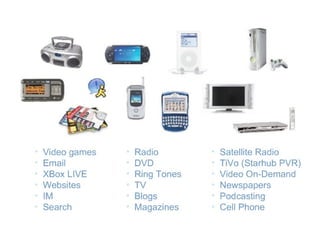
Media use in India 1940s Newspaper, radio, cinema, theatre 1960s Newspaper, radio, cinema, theatre, TV 1990s Newspaper, radio, cinema, theatre, TV, Satellite TV, VCR, Internet  2000- Newspaper, radio, cinema, theatre, TV, Satellite TV, VCR, Mobile phone, DVD, E mail, Webcam, blog, podcasting. CONVERGENCE
 
 
Mass media in India now 62, 000+ publications 18 crore copies of newspapers are circulated daily 300+ radio stations Footprints of 500+ television channels 32 lakh internet connection 2.5 crore mobile handsets in use
A brief history of   Media Teaching in India First systematic journalism course was introduced in National University at Adyar in Madras (now Chennai) in early 30s Source: Dr. Nadig Kishna Murthy former Professor of Journalism at Mysore University,   1938 Aligarh Muslim University  1941 Punjab University, Lahore 1947 Madras University  1950 Calcutta University
Status of Media Education in India 100+ universities offer PG courses in Mass communication- Journalism: print, television, radio, web; public relations, advertising, etc. Besides there are several private institutions providing short and medium term courses.  There are several media-related courses, with more emphasis on practical applicability e.g. media management, media relations, event management, etc. More such courses are being introduced.
Challenges in Teaching Media  in a Changing Global Scenario Growth: Vertical, horizontal and spatial  Change: Content, presentation, technology Approach: Media tends to be simultaneously global and ultra local Industry-Academics synergy Infrastructure and Logistics
Challenges in Teaching Media   g r o w t h Media is an umbrella term. It encompasses  entertainment,  education,  information It has grown over the years with invention of new technologies. With the advent of each new technology existing media dynamics changes. Change affects all existing media.
 
Challenges in Teaching Media   cha nge From news media to entertainment –the only constant thing is –change.
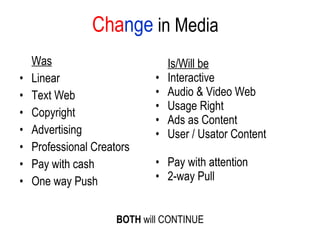
Cha nge  in Media Was Linear Text Web Copyright Advertising Professional Creators Pay with cash One way Push Is/Will be Interactive Audio & Video Web Usage Right Ads as Content User / Usator Content Pay with attention 2-way Pull BOTH  will CONTINUE
Challenges in Teaching Media   Change in C  ntent The content of media is changing with new situations, new developments, new problems, new opportunities and new needs (actual and/or perceived).
Challenges in Teaching Media   Change in Presen tation With change in audience profile and technology, the presentation is changing.  News on television is more ‘in your face’ now. Average length of stories in newspaper and magazines are shortening. Web is creating a new medium of communication- combining reading, listening and viewing experience.
Challenges in Teaching Media   Specia l isation Growth in media and audience demand/warrant specialisation- in content and form.
Challenges in Teaching Media   Industry-Academics s y nerg y Industry expects academia to deliver industry-ready person with right skill and attitude. Academics is heavily biased towards imparting theoretical input. Often there is mismatch /disconnect/ disharmony
Challenges in Teaching Media   I nfrastructure and  L ogistics Most of the media teaching institutes of India lack right kind of infrastructure to teach technology-driven modern media. There are logistical problems thanks to typical bureaucratic  red tapeism .
Can we meet the challenges?
Y E S We can.
It’ll require efforts by the Teachers and the Management of Media Teaching Institutes.
Some suggestions   For the Teachers
 
Some suggestions   For the Teachers Update Work hands on Engage with media Familiarize yourself with technology Use internet and web resources
Some suggestions   For the Teachers Use more visuals. Use info graphics, videos, etc. The technology is simple. Class Room teaching is also performance. Prepare.
Some suggestions   For the Media Institutions Be clear: theoretical input is as important as skill training. Provide infrastructure and logistics for hands on work experience. You never learn unless you do. Provide learning and growth opportunity for the faculty.
Some ideas for teaching media   We do these in Indian Institute of Mass Communication (IIMC), Dhenkanal, Orissa.
Daily News on Television Students present 10 minute live bulletin in English and Oriya at 9.30 a.m.. News selection is done by them. Analysis and discussion on the news follow.
Daily Newspaper Students produce daily newspaper in English and Oriya. Deadline: 5.30 p.m. Analysis and discussion on the news follow.
Daily News for Radio Students present 5 minute news bulletin in English and Oriya at 5.50 p.m.. News selection is done by them. Analysis and discussion on the news follow.
Daily Presentation Students are required to deliver presentation on a socially relevant subject (assigned about a week before). It is followed by QA session.
Periodicals Students produce lab journals in print (18 issues; 4 pages in tabloid size) and web format.
Live Projects Students are engaged in live projects like publishing bulletin for the local Book fair committee and festival for differently able children.  Students are engaged in live media research
Engagement with media Students are encouraged to write articles, features, even letters to the editor and send them for publication Students are encouraged to write blogs Students are encouraged to write in citizen journalism sites E.g. merinews.com, youthejournalist.com, ohmynews.com
Engagement with technology Reading materials are provided through group mail Students are encouraged to submit assignments online Students are encouraged to research online and do  computer assisted reporting
Some more suggestions
Update Syllabus Curricula should be updated periodically and also reviewed by a board of studies, which should include academics and media industry professionals. There should be attempt to initiate and support comprehensive media education programmes- from school to university.
Forge  stronger  academics-industry interface There should be industry input in preparation of syllabus Persons from industry should be invited to interact with and teach/train students There should be cross movement between industry and academics.
Mid career refresher for teachers Mid career refresher and orientation programmes should be organised. A few well equipped institutions like say IIMC could be identified for this purpose.
Networking of academicians  There should networking of academicians and research scholars on a continuous basis for sharing of ideas and information.  Training and related material could be distributed through this network. This could be done cost effectively through internet.
Encourage teachers to engage  productively with media Teachers should be encouraged to engage productively with media For example: Teachers should be permitted to work in media houses, say for a couple of months every two years.
Useful Books Communication Education and Media needs in India: A study conducted by AMIC; 2002 Teaching the Media: Len Masterman, Comedia Publishing Group, London, 1985
Useful Websites www.mediafuturist.com www.thehoot.org
Sources for Web resources Education-Specific Search Tools TekMom.com :  A one stop shop for searching. Contains a variety of search fields that allow students/teachers to search for a wide range of topics both in general search tools and subject specific ones.  Bluewebn.com:  A site that features many resources for teachers categorized by subject and activity type.
Sources for Web resources Teacherlingo.com  is a great website for teachers to write helpful articles for each other. Teachervision.com  This website saves time for teachers and provides free resources. Teachertube.com  is a great resource for educational videos. Some social networking sites for teachers are  Nextgenteachers.com Crowdvine.com  ning.com
Thank You. [email_address]

Teaching Media

  • 1.
    Challenges in TeachingMedia in a Changing Global Scenario Dr. Mrinal Chatterjee Professor Indian Institute of Mass Communication (IIMC) Sanchar Marg, Dhenkanal 759 001, Orissa
  • 2.
    We live ina world where media are omnipresent. - UNESCO Declaration on Media Education, 1982, Grunwald, Germany
  • 3.
    A brief historyof Communications 60,000 years ago People started to speak 5,000 years ago People started to write 600 years ago People started to publish 110 years ago Radio was invented 80 years ago Television was invented 45 years ago Internet was born 30 years ago Mobile telephone was given patent right
  • 4.
    A brief historyof Mass media in India 1780 First newspaper was published 1924 Radio was introduced 1959 Television was introduced 1990 Internet was introduced 1995 Mobile telephone was introduced
  • 5.
    Media use inIndia 1940s Newspaper, radio, cinema, theatre 1960s Newspaper, radio, cinema, theatre, TV 1990s Newspaper, radio, cinema, theatre, TV, Satellite TV, VCR, Internet 2000- Newspaper, radio, cinema, theatre, TV, Satellite TV, VCR, Mobile phone, DVD, E mail, Webcam, blog, podcasting. CONVERGENCE
  • 6.
  • 7.
  • 8.
    Mass media inIndia now 62, 000+ publications 18 crore copies of newspapers are circulated daily 300+ radio stations Footprints of 500+ television channels 32 lakh internet connection 2.5 crore mobile handsets in use
  • 9.
    A brief historyof Media Teaching in India First systematic journalism course was introduced in National University at Adyar in Madras (now Chennai) in early 30s Source: Dr. Nadig Kishna Murthy former Professor of Journalism at Mysore University, 1938 Aligarh Muslim University 1941 Punjab University, Lahore 1947 Madras University 1950 Calcutta University
  • 10.
    Status of MediaEducation in India 100+ universities offer PG courses in Mass communication- Journalism: print, television, radio, web; public relations, advertising, etc. Besides there are several private institutions providing short and medium term courses. There are several media-related courses, with more emphasis on practical applicability e.g. media management, media relations, event management, etc. More such courses are being introduced.
  • 11.
    Challenges in TeachingMedia in a Changing Global Scenario Growth: Vertical, horizontal and spatial Change: Content, presentation, technology Approach: Media tends to be simultaneously global and ultra local Industry-Academics synergy Infrastructure and Logistics
  • 12.
    Challenges in TeachingMedia g r o w t h Media is an umbrella term. It encompasses entertainment, education, information It has grown over the years with invention of new technologies. With the advent of each new technology existing media dynamics changes. Change affects all existing media.
  • 13.
  • 14.
    Challenges in TeachingMedia cha nge From news media to entertainment –the only constant thing is –change.
  • 15.
    Cha nge in Media Was Linear Text Web Copyright Advertising Professional Creators Pay with cash One way Push Is/Will be Interactive Audio & Video Web Usage Right Ads as Content User / Usator Content Pay with attention 2-way Pull BOTH will CONTINUE
  • 16.
    Challenges in TeachingMedia Change in C ntent The content of media is changing with new situations, new developments, new problems, new opportunities and new needs (actual and/or perceived).
  • 17.
    Challenges in TeachingMedia Change in Presen tation With change in audience profile and technology, the presentation is changing. News on television is more ‘in your face’ now. Average length of stories in newspaper and magazines are shortening. Web is creating a new medium of communication- combining reading, listening and viewing experience.
  • 18.
    Challenges in TeachingMedia Specia l isation Growth in media and audience demand/warrant specialisation- in content and form.
  • 19.
    Challenges in TeachingMedia Industry-Academics s y nerg y Industry expects academia to deliver industry-ready person with right skill and attitude. Academics is heavily biased towards imparting theoretical input. Often there is mismatch /disconnect/ disharmony
  • 20.
    Challenges in TeachingMedia I nfrastructure and L ogistics Most of the media teaching institutes of India lack right kind of infrastructure to teach technology-driven modern media. There are logistical problems thanks to typical bureaucratic red tapeism .
  • 21.
    Can we meetthe challenges?
  • 22.
    Y E SWe can.
  • 23.
    It’ll require effortsby the Teachers and the Management of Media Teaching Institutes.
  • 24.
    Some suggestions For the Teachers
  • 25.
  • 26.
    Some suggestions For the Teachers Update Work hands on Engage with media Familiarize yourself with technology Use internet and web resources
  • 27.
    Some suggestions For the Teachers Use more visuals. Use info graphics, videos, etc. The technology is simple. Class Room teaching is also performance. Prepare.
  • 28.
    Some suggestions For the Media Institutions Be clear: theoretical input is as important as skill training. Provide infrastructure and logistics for hands on work experience. You never learn unless you do. Provide learning and growth opportunity for the faculty.
  • 29.
    Some ideas forteaching media We do these in Indian Institute of Mass Communication (IIMC), Dhenkanal, Orissa.
  • 30.
    Daily News onTelevision Students present 10 minute live bulletin in English and Oriya at 9.30 a.m.. News selection is done by them. Analysis and discussion on the news follow.
  • 31.
    Daily Newspaper Studentsproduce daily newspaper in English and Oriya. Deadline: 5.30 p.m. Analysis and discussion on the news follow.
  • 32.
    Daily News forRadio Students present 5 minute news bulletin in English and Oriya at 5.50 p.m.. News selection is done by them. Analysis and discussion on the news follow.
  • 33.
    Daily Presentation Studentsare required to deliver presentation on a socially relevant subject (assigned about a week before). It is followed by QA session.
  • 34.
    Periodicals Students producelab journals in print (18 issues; 4 pages in tabloid size) and web format.
  • 35.
    Live Projects Studentsare engaged in live projects like publishing bulletin for the local Book fair committee and festival for differently able children. Students are engaged in live media research
  • 36.
    Engagement with mediaStudents are encouraged to write articles, features, even letters to the editor and send them for publication Students are encouraged to write blogs Students are encouraged to write in citizen journalism sites E.g. merinews.com, youthejournalist.com, ohmynews.com
  • 37.
    Engagement with technologyReading materials are provided through group mail Students are encouraged to submit assignments online Students are encouraged to research online and do computer assisted reporting
  • 38.
  • 39.
    Update Syllabus Curriculashould be updated periodically and also reviewed by a board of studies, which should include academics and media industry professionals. There should be attempt to initiate and support comprehensive media education programmes- from school to university.
  • 40.
    Forge stronger academics-industry interface There should be industry input in preparation of syllabus Persons from industry should be invited to interact with and teach/train students There should be cross movement between industry and academics.
  • 41.
    Mid career refresherfor teachers Mid career refresher and orientation programmes should be organised. A few well equipped institutions like say IIMC could be identified for this purpose.
  • 42.
    Networking of academicians There should networking of academicians and research scholars on a continuous basis for sharing of ideas and information. Training and related material could be distributed through this network. This could be done cost effectively through internet.
  • 43.
    Encourage teachers toengage productively with media Teachers should be encouraged to engage productively with media For example: Teachers should be permitted to work in media houses, say for a couple of months every two years.
  • 44.
    Useful Books CommunicationEducation and Media needs in India: A study conducted by AMIC; 2002 Teaching the Media: Len Masterman, Comedia Publishing Group, London, 1985
  • 45.
  • 46.
    Sources for Webresources Education-Specific Search Tools TekMom.com : A one stop shop for searching. Contains a variety of search fields that allow students/teachers to search for a wide range of topics both in general search tools and subject specific ones. Bluewebn.com: A site that features many resources for teachers categorized by subject and activity type.
  • 47.
    Sources for Webresources Teacherlingo.com is a great website for teachers to write helpful articles for each other. Teachervision.com This website saves time for teachers and provides free resources. Teachertube.com is a great resource for educational videos. Some social networking sites for teachers are Nextgenteachers.com Crowdvine.com ning.com
  • 48.