
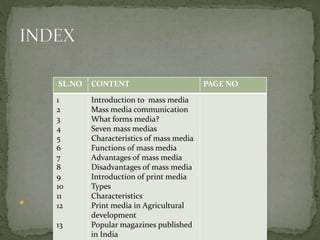
SL.NO CONTENT PAGE NO
1
2
3
4
5
6
7
8
9
10
11
12
13
Introduction to mass media
Mass media communication
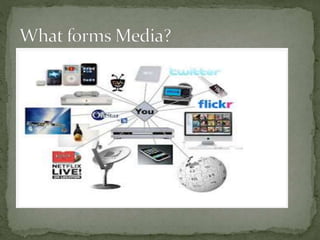
What forms media?
Seven mass medias
Characteristics of mass media
Functions of mass media
Advantages of mass media
Disadvantages of mass media
Introduction of print media
Types
Characteristics
Print media in Agricultural
development
Popular magazines published
in India
 Every academic year a new group of prospective teachers
enrolls in courses that are designed to help them become
good mathematics teachers. Before teacher training these
students have had many experiences that are linked to
mathematics and its teaching and learning. These
experiences have shaped their views of mathematics and
thus influence their receptivity to new knowledge during
their studies. In addition, their views of mathematics affect
their teaching at school in the future and ultimately also
their pupils views of mathematics teacher are discussed.
 I thank Mrs. Sahera Begum madam for helping me to get
the up-to-date information and gave inputs from her
wherever necessary for completing topic “Professional
growth of mathematical teacher.’’
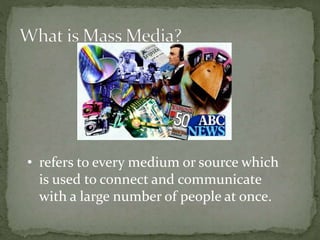
• refers to every medium or source which
is used to connect and communicate
with a large number of people at once.
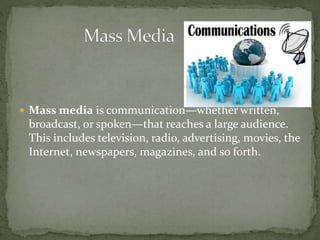
 Mass media is communication—whether written,
broadcast, or spoken—that reaches a large audience.
This includes television, radio, advertising, movies, the
Internet, newspapers, magazines, and so forth.
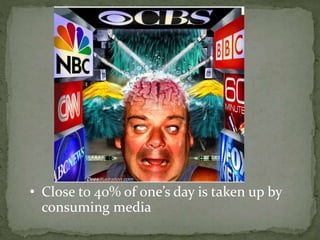
• Close to 40% of one’s day is taken up by
consuming media
• “The mass media are becoming
more and more pervasive and
significant in terms of our social
perceptions and interactions with
our surroundings” (Lev, Emi 2006,
p. 1).
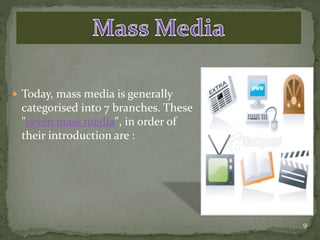
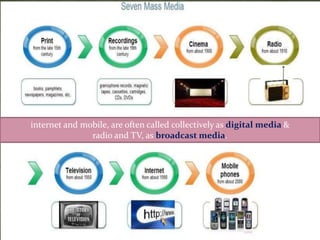
 Today, mass media is generally
categorised into 7 branches. These
"seven mass media", in order of
their introduction are :
9
internet and mobile, are often called collectively as digital media &
radio and TV, as broadcast media.
 Communication is mostly one way
 Audience has great deal of choice
 Reach large & vast audience
 Aim messages to attract largest
audience possible
 Influence society & are in
turn influenced by society
 Information
 Consensus
 Entertainment
 Symbolic Function
 Advertising
 Development
 Development communication that
focuses on the needs of the
underprivileged & oppressed & their
socio-economic & cultural interests
& needs.
 Reaches many people quickly
 Low cost per person reached
Can be used to
 Tell people about new ideas & services
 Agenda setting & advocacy
 Created favourable climate of opinion
 Difficult to make specific to local community
 Fixed message
 Can be easily misunderstood
 Access often difficult
 Lacks feedback
Less appropriate for :
 Changing behaviours rooted in culture or reinforced by social
norms
 Promoting empowerment
 Learning practical skills
 Developing skills of informed decision making
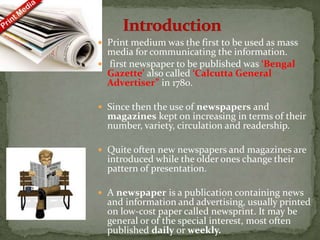
 Print medium was the first to be used as mass
media for communicating the information.
 first newspaper to be published was ‘Bengal
Gazette’ also called ‘Calcutta General
Advertiser” in 1780.
 Since then the use of newspapers and
magazines kept on increasing in terms of their
number, variety, circulation and readership.
 Quite often new newspapers and magazines are
introduced while the older ones change their
pattern of presentation.
 A newspaper is a publication containing news
and information and advertising, usually printed
on low-cost paper called newsprint. It may be
general or of the special interest, most often
published daily or weekly.
 News paper
 Magazine ( general & public interest)
 Journals
 Books
 Other: are leaflets, circular letters,
news letters, folders, banners, wall news
papers.
 Gives extensive coverage to a
large no. of items of interest
 Can be read by literate
audience.
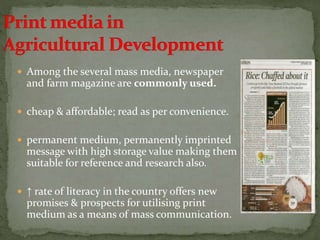
 Among the several mass media, newspaper
and farm magazine are commonly used.
 cheap & affordable; read as per convenience.
 permanent medium, permanently imprinted
message with high storage value making them
suitable for reference and research also.
 ↑ rate of literacy in the country offers new
promises & prospects for utilising print
medium as a means of mass communication.
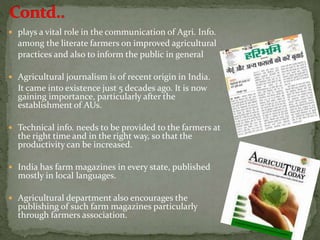
 plays a vital role in the communication of Agri. Info.
among the literate farmers on improved agricultural
practices and also to inform the public in general
 Agricultural journalism is of recent origin in India.
It came into existence just 5 decades ago. It is now
gaining importance, particularly after the
establishment of AUs.
 Technical info. needs to be provided to the farmers at
the right time and in the right way, so that the
productivity can be increased.
 India has farm magazines in every state, published
mostly in local languages.
 Agricultural department also encourages the
publishing of such farm magazines particularly
through farmers association.
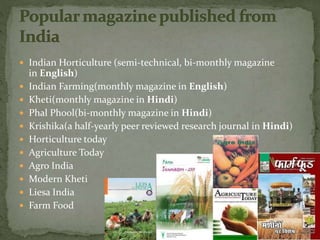
 Indian Horticulture (semi-technical, bi-monthly magazine
in English)
 Indian Farming(monthly magazine in English)
 Kheti(monthly magazine in Hindi)
 Phal Phool(bi-monthly magazine in Hindi)
 Krishika(a half-yearly peer reviewed research journal in Hindi)
 Horticulture today
 Agriculture Today
 Agro India
 Modern Kheti
 Liesa India
 Farm Food
 ICAR Reporter, English,
Quarterly
 ICAR News, English, Quarterly
 ARIS News, English, Quarterly
 Krishi Chayanika, Hindi,
Quarterly
Tamil
 Pasumai Vikatan, Fortnightly
 Naveena Velaanmai, Monthly
Telulgu
 ANNADATA, Monthly
Kannada
 KRISHIK BANDHU, Monthly
 Adike Patrike, Monthly
 Sahaja Samrudha
 Siri Samruddhi
 Sujatha Sanchike, Monthly
 Sahaja Saaguvali, Bi-Monthly
 Krishi Mithra, Monthly
Malayalam
 Bhoomi,
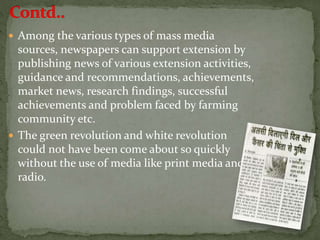
 Among the various types of mass media
sources, newspapers can support extension by
publishing news of various extension activities,
guidance and recommendations, achievements,
market news, research findings, successful
achievements and problem faced by farming
community etc.
 The green revolution and white revolution
could not have been come about so quickly
without the use of media like print media and
radio.
Television can be used:
• to demonstrate processes or physical skills
• to show movement
• for those lacking reading skills
• to make distance learning more personalized
• to make teaching and learning more attractive and dynamic
• it is primarily a one-way communication medium
• both production and transmission of programmes are costly
• the production process is very lengthy
Disadvantages of Television
• The best Time consuming device
• Effects on Children Education
•Effects on health
•False news and False Advertisement
•In appropriate contents
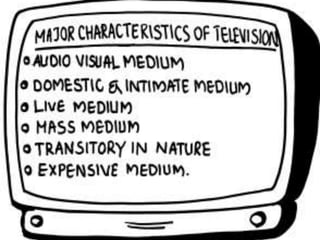
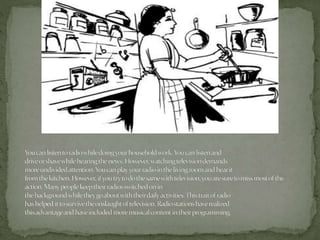
Radio is an aural medium where as print relies just on
visual content. The tremendous success of television as
a mass medium has its roots in its ability to incorporate
both visual and aural content. It combines compelling
visuals with the personal immediacy of radio. This audio
visual character gives it great power in conveying realism and this keeps the viewer
emotionally involved.
Do you own a television set as well as a radio? What kind of programmes do you listen
to in your radio set? Does your favourite radio channel broadcast more music
oriented programmes? This is because the aural nature of radio makes it an excellent
medium for transmitting music and speech.
Television, on the other hand is a better medium for conveying documentary
information. Would you prefer watching news on television or listening to it on
radio? The visual content of television news makes it more appealing than radio
news. This is because radio cannot outsmart television in providing the experience of
physical reality. Imagine watching a tennis match between Sania Mirza and Venus
Williams on your TV set. Wouldn’t it convey a more “real” experience of the match
than hearing a radio commentary?
RADIO
 Political talk shows
 Sports talk shows
 Types of Radio
Satellite radio
Internet/streaming radio
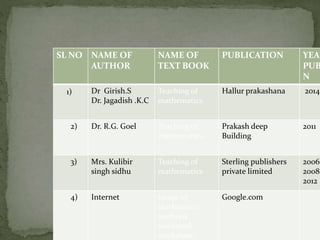
SL NO NAME OF
AUTHOR
NAME OF
TEXT BOOK
PUBLICATION YEAR
PUB
N
1) Dr Girish.S
Dr. Jagadish .K.C
Teaching of
mathematics
Hallur prakashana 2014
2) Dr. R.G. Goel Teaching of
mathematics
Prakash deep
Building
2011
3) Mrs. Kulibir
singh sidhu
Teaching of
mathematics
Sterling publishers
private limited
2006,
2008,
2012
4) Internet Image of
mathematic
textbook,
workbook,
worksheet
Google.com
A properly evaluated, a wisely selected and correctly prescribed mass
media – news paper, radio, and TV.
Teaching is an exciting and challenging career, full of personal rewards
and a chance to encourage and support others to achieve their
maximum potential. In addition to the necessary academic
requirements involved in becoming a teacher, students also need to
develop the skills required to effectively teach and become outstanding
teachers.
The teacher is an integral part of the process of education. He imparts
education and teaches his pupil the subject matter prescribed for
them. He has to perform a difficult job.
Good teachers are likely made up of a combination of hundreds of
qualities that allow them do their job effectively. There is no denying
that all teachers have their own unique blend of these qualities. Each
teacher is different, but virtually, adaptability, caring, compassionate,
and co-operative.

Mass media

  • 2.
     SL.NO CONTENT PAGENO 1 2 3 4 5 6 7 8 9 10 11 12 13 Introduction to mass media Mass media communication What forms media? Seven mass medias Characteristics of mass media Functions of mass media Advantages of mass media Disadvantages of mass media Introduction of print media Types Characteristics Print media in Agricultural development Popular magazines published in India
  • 3.
     Every academicyear a new group of prospective teachers enrolls in courses that are designed to help them become good mathematics teachers. Before teacher training these students have had many experiences that are linked to mathematics and its teaching and learning. These experiences have shaped their views of mathematics and thus influence their receptivity to new knowledge during their studies. In addition, their views of mathematics affect their teaching at school in the future and ultimately also their pupils views of mathematics teacher are discussed.  I thank Mrs. Sahera Begum madam for helping me to get the up-to-date information and gave inputs from her wherever necessary for completing topic “Professional growth of mathematical teacher.’’
  • 4.
    • refers toevery medium or source which is used to connect and communicate with a large number of people at once.
  • 5.
     Mass mediais communication—whether written, broadcast, or spoken—that reaches a large audience. This includes television, radio, advertising, movies, the Internet, newspapers, magazines, and so forth.
  • 7.
    • Close to40% of one’s day is taken up by consuming media
  • 8.
    • “The massmedia are becoming more and more pervasive and significant in terms of our social perceptions and interactions with our surroundings” (Lev, Emi 2006, p. 1).
  • 9.
     Today, massmedia is generally categorised into 7 branches. These "seven mass media", in order of their introduction are : 9
  • 10.
    internet and mobile,are often called collectively as digital media & radio and TV, as broadcast media.
  • 11.
     Communication ismostly one way  Audience has great deal of choice  Reach large & vast audience  Aim messages to attract largest audience possible  Influence society & are in turn influenced by society
  • 12.
     Information  Consensus Entertainment  Symbolic Function  Advertising  Development  Development communication that focuses on the needs of the underprivileged & oppressed & their socio-economic & cultural interests & needs.
  • 13.
     Reaches manypeople quickly  Low cost per person reached Can be used to  Tell people about new ideas & services  Agenda setting & advocacy  Created favourable climate of opinion
  • 14.
     Difficult tomake specific to local community  Fixed message  Can be easily misunderstood  Access often difficult  Lacks feedback Less appropriate for :  Changing behaviours rooted in culture or reinforced by social norms  Promoting empowerment  Learning practical skills  Developing skills of informed decision making
  • 15.
     Print mediumwas the first to be used as mass media for communicating the information.  first newspaper to be published was ‘Bengal Gazette’ also called ‘Calcutta General Advertiser” in 1780.  Since then the use of newspapers and magazines kept on increasing in terms of their number, variety, circulation and readership.  Quite often new newspapers and magazines are introduced while the older ones change their pattern of presentation.  A newspaper is a publication containing news and information and advertising, usually printed on low-cost paper called newsprint. It may be general or of the special interest, most often published daily or weekly.
  • 16.
     News paper Magazine ( general & public interest)  Journals  Books  Other: are leaflets, circular letters, news letters, folders, banners, wall news papers.
  • 17.
     Gives extensivecoverage to a large no. of items of interest  Can be read by literate audience.
  • 18.
     Among theseveral mass media, newspaper and farm magazine are commonly used.  cheap & affordable; read as per convenience.  permanent medium, permanently imprinted message with high storage value making them suitable for reference and research also.  ↑ rate of literacy in the country offers new promises & prospects for utilising print medium as a means of mass communication.
  • 19.
     plays avital role in the communication of Agri. Info. among the literate farmers on improved agricultural practices and also to inform the public in general  Agricultural journalism is of recent origin in India. It came into existence just 5 decades ago. It is now gaining importance, particularly after the establishment of AUs.  Technical info. needs to be provided to the farmers at the right time and in the right way, so that the productivity can be increased.  India has farm magazines in every state, published mostly in local languages.  Agricultural department also encourages the publishing of such farm magazines particularly through farmers association.
  • 20.
     Indian Horticulture(semi-technical, bi-monthly magazine in English)  Indian Farming(monthly magazine in English)  Kheti(monthly magazine in Hindi)  Phal Phool(bi-monthly magazine in Hindi)  Krishika(a half-yearly peer reviewed research journal in Hindi)  Horticulture today  Agriculture Today  Agro India  Modern Kheti  Liesa India  Farm Food
  • 21.
     ICAR Reporter,English, Quarterly  ICAR News, English, Quarterly  ARIS News, English, Quarterly  Krishi Chayanika, Hindi, Quarterly Tamil  Pasumai Vikatan, Fortnightly  Naveena Velaanmai, Monthly Telulgu  ANNADATA, Monthly Kannada  KRISHIK BANDHU, Monthly  Adike Patrike, Monthly  Sahaja Samrudha  Siri Samruddhi  Sujatha Sanchike, Monthly  Sahaja Saaguvali, Bi-Monthly  Krishi Mithra, Monthly Malayalam  Bhoomi,
  • 22.
     Among thevarious types of mass media sources, newspapers can support extension by publishing news of various extension activities, guidance and recommendations, achievements, market news, research findings, successful achievements and problem faced by farming community etc.  The green revolution and white revolution could not have been come about so quickly without the use of media like print media and radio.
  • 25.
    Television can beused: • to demonstrate processes or physical skills • to show movement • for those lacking reading skills • to make distance learning more personalized • to make teaching and learning more attractive and dynamic • it is primarily a one-way communication medium • both production and transmission of programmes are costly • the production process is very lengthy Disadvantages of Television • The best Time consuming device • Effects on Children Education •Effects on health •False news and False Advertisement •In appropriate contents
  • 26.
    Radio is anaural medium where as print relies just on visual content. The tremendous success of television as a mass medium has its roots in its ability to incorporate both visual and aural content. It combines compelling visuals with the personal immediacy of radio. This audio visual character gives it great power in conveying realism and this keeps the viewer emotionally involved. Do you own a television set as well as a radio? What kind of programmes do you listen to in your radio set? Does your favourite radio channel broadcast more music oriented programmes? This is because the aural nature of radio makes it an excellent medium for transmitting music and speech. Television, on the other hand is a better medium for conveying documentary information. Would you prefer watching news on television or listening to it on radio? The visual content of television news makes it more appealing than radio news. This is because radio cannot outsmart television in providing the experience of physical reality. Imagine watching a tennis match between Sania Mirza and Venus Williams on your TV set. Wouldn’t it convey a more “real” experience of the match than hearing a radio commentary? RADIO

  • 28.
     Political talkshows  Sports talk shows  Types of Radio Satellite radio Internet/streaming radio
  • 31.
    SL NO NAMEOF AUTHOR NAME OF TEXT BOOK PUBLICATION YEAR PUB N 1) Dr Girish.S Dr. Jagadish .K.C Teaching of mathematics Hallur prakashana 2014 2) Dr. R.G. Goel Teaching of mathematics Prakash deep Building 2011 3) Mrs. Kulibir singh sidhu Teaching of mathematics Sterling publishers private limited 2006, 2008, 2012 4) Internet Image of mathematic textbook, workbook, worksheet Google.com
  • 32.
    A properly evaluated,a wisely selected and correctly prescribed mass media – news paper, radio, and TV. Teaching is an exciting and challenging career, full of personal rewards and a chance to encourage and support others to achieve their maximum potential. In addition to the necessary academic requirements involved in becoming a teacher, students also need to develop the skills required to effectively teach and become outstanding teachers. The teacher is an integral part of the process of education. He imparts education and teaches his pupil the subject matter prescribed for them. He has to perform a difficult job. Good teachers are likely made up of a combination of hundreds of qualities that allow them do their job effectively. There is no denying that all teachers have their own unique blend of these qualities. Each teacher is different, but virtually, adaptability, caring, compassionate, and co-operative.