Media LiteracyAn Essential Approach to Learning
“The illiterate of the 21st century are not those that cannot read or write, but those that cannot learn, unlearn, and relearn.”  Alvin Toffler”“We are currently preparing students for jobs that don’t yet exist … using technologies that haven’t yet been invented … in order to solve problems we don’t even know are problems yet.”  Richard Riley, Secretary of Education under Clinton
Partnership for 21st Century SkillsDid You Know?
21st Century SkillsCritical Learning Skills and InnovationCritical thinking and Problem SolvingCommunication and CollaborationCreativity and InnovationDigital Literacy SkillsResearch and Information FluencyMedia LiteracyInformation and  Communication TechnologiesDigital Citizenship
21st Century SkillsCareer  and Life SkillsFlexibility & AdaptabilityInitiative and Self-directionSocial and Cross Cultural InteractionProductivity and Accountability
Digital Literacy SkillsResearch and Information FluencyAccess and evaluate informationUse and manage informationMedia LiteracyAnalyze mediaCreate media productsInformation and  Communication TechnologiesApply technology effectivelyDigital CitizenshipExercise responsible use of technology
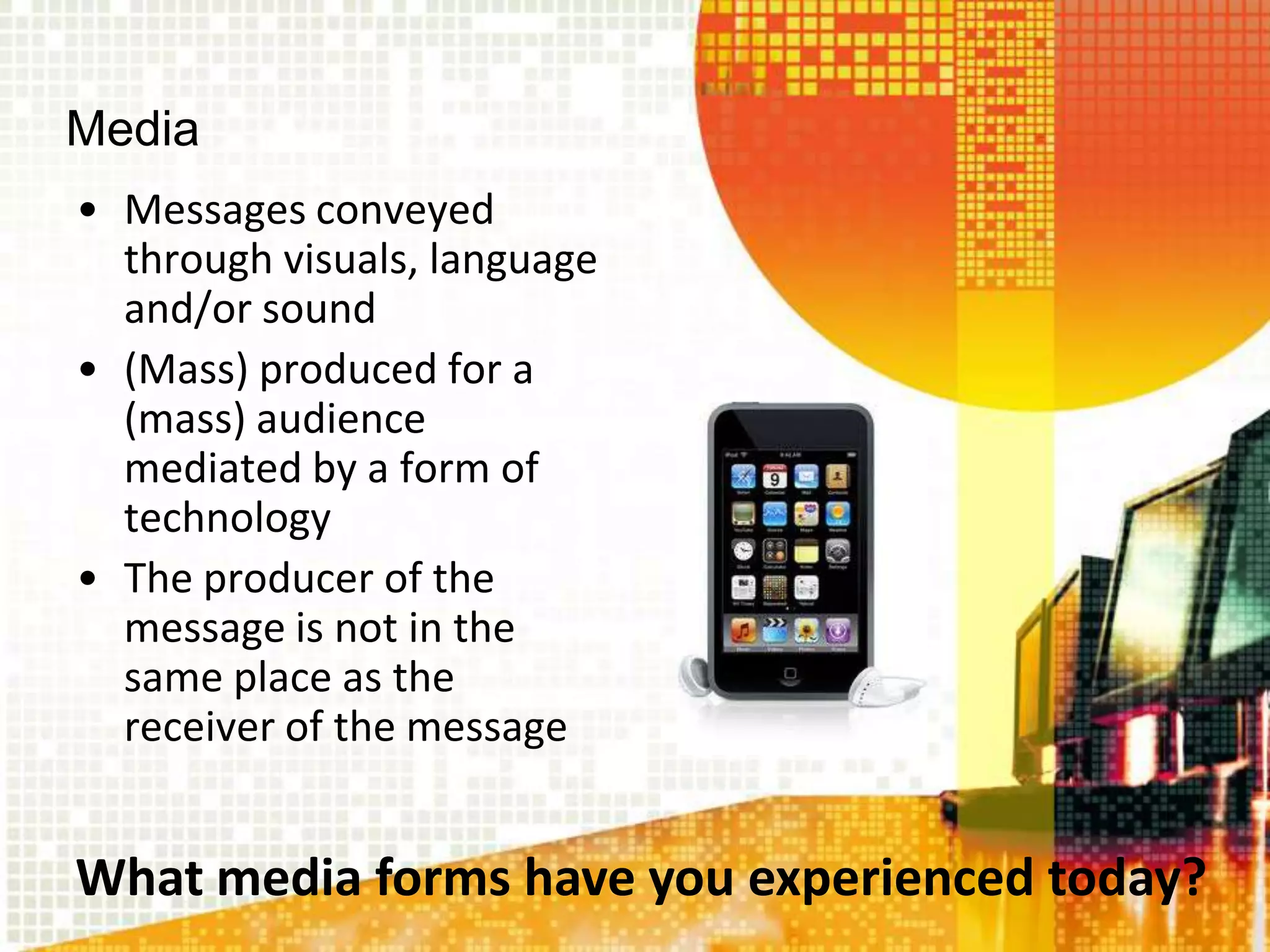
MediaMessages conveyed through visuals, language and/or sound(Mass) produced for a (mass) audience mediated by a form of technologyThe producer of the message is not in the same place as the receiver of the messageWhat media forms have you experienced today?
Are books media?Messages conveyed through visuals, language and/or sound(Mass) produced for a (mass) audience mediated by a form of technologyThe producer of the message is not in the same place as the receiver of the messageWhat are other sources of messages thatwe might not think of as “media”?
Types of MediaRadio
Television
Newspapers, Magazines
 Internet
 Advertising in all forms
 Videos, DVDs, Films
 Computer & Video Games
 Recorded Music
 Posters, maps
 Cell Phones
Media LiteracyMedia Literacy is the ability to access, analyze, evaluate, and produce communication in a variety of forms. It is similar to information literacy and involves many components of technology literacy as well.
Media Literacy InvolvesCritical thinkingAnalytical skillsAbility to express oneself in different waysWise & effective use of mediaAbility to judge credibility of informationReading skillsWriting skills
Media Literacy QuestionsWhat are the messages of this media and how are they communicated?Who produced this and for what purpose?When was this produced and for what purpose?Who was the target audience?Is this an accurate and credible representation?How does this reflect the perspective or bias of the creator?What information or perspective is left out of this message?How might different people interpret this message differently?Who might benefit from and who might be harmed by this message?
Effective Media AnalysisKnowledge that:All media messages are “constructed.”Each medium has different characteristics, strengths, and a unique “language” of construction.Media messages contain embedded values and points of view.People use their individual skills, beliefs and experiences to construct their own meanings from media messages.Media and media messages can influence beliefs, attitudes, values, behaviors, and the democratic process.
Media Literacy EducationRequires active inquiry and critical thinking about the messages we receive and createExpands the concepts of literacy (reading , writing, speaking, listening) to include all forms of mediaBuilds and reinforces skills for learners of all ages; those skills necessitate integrated, interactive and repeated practiceDevelops informed, reflective and engaged participants essential for a democratic societyRecognizes that media are a part of culture and function as agents of socializationAffirms that people use their individual skills, beliefs and experiences to construct their own meanings from media messages.
Why Construct Media in the Classroom?Motivate students
Enhance instructional methods – it is constructivist/inquiry based learning

Media literacy

  • 1.
    Media LiteracyAn EssentialApproach to Learning
  • 2.
    “The illiterate ofthe 21st century are not those that cannot read or write, but those that cannot learn, unlearn, and relearn.” Alvin Toffler”“We are currently preparing students for jobs that don’t yet exist … using technologies that haven’t yet been invented … in order to solve problems we don’t even know are problems yet.” Richard Riley, Secretary of Education under Clinton
  • 3.
    Partnership for 21stCentury SkillsDid You Know?
  • 4.
    21st Century SkillsCriticalLearning Skills and InnovationCritical thinking and Problem SolvingCommunication and CollaborationCreativity and InnovationDigital Literacy SkillsResearch and Information FluencyMedia LiteracyInformation and Communication TechnologiesDigital Citizenship
  • 5.
    21st Century SkillsCareer and Life SkillsFlexibility & AdaptabilityInitiative and Self-directionSocial and Cross Cultural InteractionProductivity and Accountability
  • 6.
    Digital Literacy SkillsResearchand Information FluencyAccess and evaluate informationUse and manage informationMedia LiteracyAnalyze mediaCreate media productsInformation and Communication TechnologiesApply technology effectivelyDigital CitizenshipExercise responsible use of technology
  • 7.
    MediaMessages conveyed throughvisuals, language and/or sound(Mass) produced for a (mass) audience mediated by a form of technologyThe producer of the message is not in the same place as the receiver of the messageWhat media forms have you experienced today?
  • 8.
    Are books media?Messagesconveyed through visuals, language and/or sound(Mass) produced for a (mass) audience mediated by a form of technologyThe producer of the message is not in the same place as the receiver of the messageWhat are other sources of messages thatwe might not think of as “media”?
  • 9.
  • 10.
  • 11.
  • 12.
  • 13.
  • 14.
  • 15.
    Computer &Video Games
  • 16.
  • 17.
  • 18.
  • 19.
    Media LiteracyMedia Literacyis the ability to access, analyze, evaluate, and produce communication in a variety of forms. It is similar to information literacy and involves many components of technology literacy as well.
  • 20.
    Media Literacy InvolvesCriticalthinkingAnalytical skillsAbility to express oneself in different waysWise & effective use of mediaAbility to judge credibility of informationReading skillsWriting skills
  • 21.
    Media Literacy QuestionsWhatare the messages of this media and how are they communicated?Who produced this and for what purpose?When was this produced and for what purpose?Who was the target audience?Is this an accurate and credible representation?How does this reflect the perspective or bias of the creator?What information or perspective is left out of this message?How might different people interpret this message differently?Who might benefit from and who might be harmed by this message?
  • 22.
    Effective Media AnalysisKnowledgethat:All media messages are “constructed.”Each medium has different characteristics, strengths, and a unique “language” of construction.Media messages contain embedded values and points of view.People use their individual skills, beliefs and experiences to construct their own meanings from media messages.Media and media messages can influence beliefs, attitudes, values, behaviors, and the democratic process.
  • 23.
    Media Literacy EducationRequiresactive inquiry and critical thinking about the messages we receive and createExpands the concepts of literacy (reading , writing, speaking, listening) to include all forms of mediaBuilds and reinforces skills for learners of all ages; those skills necessitate integrated, interactive and repeated practiceDevelops informed, reflective and engaged participants essential for a democratic societyRecognizes that media are a part of culture and function as agents of socializationAffirms that people use their individual skills, beliefs and experiences to construct their own meanings from media messages.
  • 24.
    Why Construct Mediain the Classroom?Motivate students
  • 25.
    Enhance instructional methods– it is constructivist/inquiry based learning
  • 26.
  • 27.
    Develop 21st CenturySkills and technologically integrate them into every day learning
  • 28.
    To prepare ourstudents to take their places in the global communityConstructivist /Inquire-based Media Construction and AnalysisConcepts to be learned are abstract and complex; hands-on, visual activities are essential to see how concepts apply to real world problems.Teachers encourage collaboration and/or allow alternative ways of learning and showing competence.There is time to allow unstructured exploration to motivate students and help them discover their own interests.I Love School!
  • 29.
    Copyright and ResponsibleUseThe Cost of Copyright Confusion for Media Literacy
  • 30.
    Copyright and FairUseThe fair use provision of the Copyright Act is written broadly, not narrowly, because it is designed to apply to a wide range of creative works and the people who use them.
  • 31.
    Fair use isa part of the law that belongs to everyone, especially to working educators.
  • 32.
    Educators know bestwhat they need to use of existing copyrighted culture to construct their own lessons and materials. Copyright and Fair UseDespite longstanding myths, there are no cut-and-dried rules.Fair use is situational, and context is critical.
  • 33.
    Because it isa tool to balance the rights of users with the rights of owners, educators need to apply reason to reach a decision.
  • 34.
    The principles andlimitations are designed to guide your reasoning and to help you guide the reasoning of others.Is it protected by copyright?ALA Office for Information Technology PolicyCopyright 101 for Teachers
  • 35.
    Creative Commons isa nonprofit organization that develops, supports, and stewards legal and technical infrastructure that maximizes digital creativity, sharing, and innovation.http://creativecommons.org
  • 36.
    Teacher GuidelinesTeachers mayinclude portions of copyrighted works when producing their own multimedia project for their teaching in support of curriculum-based instructional activities at educational institutions. Teachers may use their project for: assignments for student self-study for remote instruction provided the network is secure and is designed to prevent unlawful copying for conferences, presentations, or workshops for their professional portfolio Time RestrictionsThe fair use of copyrighted material in multimedia projects lasts for two years only. After two years, obtain permission before using the project again.
  • 37.
    Teacher GuidelinesTypes ofmedia and permissible amounts Motion media: Up to 10 percent of the total or three minutes, whichever is lessText material: Up to 10 percent of the total or 1,000 words, whichever is less. An entire poem of less than 250 words may be used, but no more than three poems by one poet or five poems by different authors in an anthology. For poems exceeding 250 words, 250 words should be used but no more than three excerpts from one poet or five excerpts from different poets in the same work
  • 38.
    Teacher GuidelinesMusic, lyrics,and music video: up to 10 percent of the work but no more than 30 seconds of the music or lyrics from an individual musical work. Illustrations or photographs: no more than five images from one artist or photographer. no more than 10% or 15 images, whichever is less, from a collection. Numerical data sets: up to 10 percent or 2,500 fields or cell entries, whichever is less, from a copyrighted database or data table. Copying of a multimedia project: no more than two copies may be made of a project.

Editor's Notes

  • #4 The Partnership for 21st Century Skills is a national organization that advocates for 21st century readiness for every student. As the United States continues to compete in a global economy that demands innovation, P21 and its members provide tools and resources to help the U.S. education system keep up by fusing the three Rs and four Cs (critical thinking and problem solving, communication, collaboration, and creativity and innovation). While leading districts and schools are already doing this, P21 advocates for local, state and federal policies that support this approach for every school.Framework for 21st Century Learning The Framework presents a holistic view of 21st century teaching and learning that combines a discrete focus on 21st century student outcomes(a blending of specific skills, content knowledge, expertise and literacies) with innovative support systems to help students master the multi-dimensional abilities required of them in the 21st century. The graphic represents both 21st century skillsstudent outcomes - as represented by the arches of the rainbow 21st century skills support systems - as represented by the pools at the bottom.
  • #7 Research and Information FluencyAccess and evaluate informationAccess information efficiently and effectivelyEvaluate information critically and competentlyUse and manage informationUse information accurately and creatively for the issue or problem at handManage the flow of information from a wide variety of sourcesMedia LiteracyAnalyze mediaUnderstand both how and why media messages are constructed and for what purposeExamine how individuals interpret messagesCreate media productsUnderstand and utilize the most appropriate media creation tools, characteristics, conventionsUnderstand & effectively utilize the most appropriate expressions and interpretations in diverse environmentsInformation and Communication TechnologiesApply technology effectivelyUse technology as a tool to research, organize, evaluate and communicate informationUse digital technologies to access, manage, integrate, evaluate, and create information to function in a knowledge economyDigital CitizenshipExercise responsible use of technologyApply fundamental understanding of the ethical/legal issues surrounding the access and use of information