SESSION ON
Teaching Learners with
Difficulty in Communication
(Communication Disorders)
Republic of the Philippines
Department of Education
SOCCSKSARGEN REGION
JESIE OCLARIT KALAW, MaEd.
Teacher II
SCHOOLS DIVISION OFFICE OF COTABATO
SOCCSKSARGEN REGION
OBJECTIVES:
After the session, the participants will be
able to:
1. Identify different difficulties in
communication (communication
disorders)
2. Apply accommodations and strategies
being used in teaching learners with
difficulty in communication.
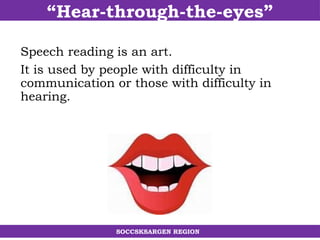
“Hear-through-the-eyes”
SOCCSKSARGEN REGION
Speech reading is an art.
It is used by people with difficulty in
communication or those with difficulty in
hearing.
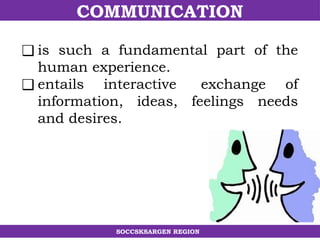
COMMUNICATION
SOCCSKSARGEN REGION
❑ is such a fundamental part of the
human experience.
❑ entails interactive exchange of
information, ideas, feelings needs
and desires.
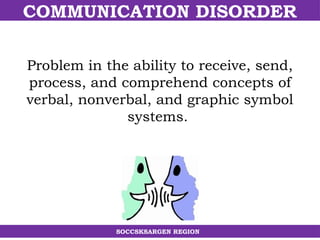
COMMUNICATION DISORDER
SOCCSKSARGEN REGION
Problem in the ability to receive, send,
process, and comprehend concepts of
verbal, nonverbal, and graphic symbol
systems.
SOCCSKSARGEN REGION
1. Language Disorders
⮚Receptive
⮚Expressive
⮚Aphasia
Types of Communication Disorders
2. Speech Disorders
⮚Stuttering
⮚Articulation
SOCCSKSARGEN REGION
3. Fluency
⮚Delayed speech
Types of Communication Disorders
4. Voice
⮚Hypo nasality
⮚Hyper nasality
⮚Hoarness
⮚Breathiness
COMMUNICATION DISORDER
SOCCSKSARGEN REGION
✔affects the delivery of message and the
relationship among other people
✔may result in a primary disability or it
may be secondary to other disabilities.
COMMUNICATION DISORDER
SOCCSKSARGEN REGION
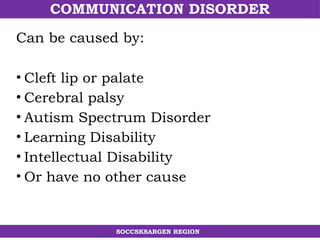
• Cleft lip or palate
• Cerebral palsy
• Autism Spectrum Disorder
• Learning Disability
• Intellectual Disability
• Or have no other cause
Can be caused by:
COMMUNICATION DISORDER
SOCCSKSARGEN REGION
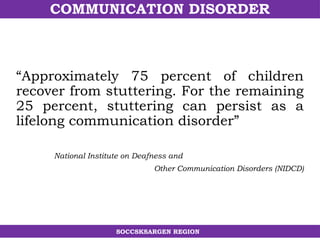
“Approximately 75 percent of children
recover from stuttering. For the remaining
25 percent, stuttering can persist as a
lifelong communication disorder”
National Institute on Deafness and
Other Communication Disorders (NIDCD)
TEACHING STRATEGIES
SOCCSKSARGEN REGION
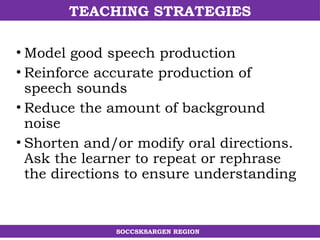
• Model good speech production
• Reinforce accurate production of
speech sounds
• Reduce the amount of background
noise
• Shorten and/or modify oral directions.
Ask the learner to repeat or rephrase
the directions to ensure understanding
TEACHING STRATEGIES
SOCCSKSARGEN REGION
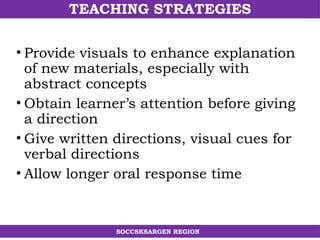
• Provide visuals to enhance explanation
of new materials, especially with
abstract concepts
• Obtain learner’s attention before giving
a direction
• Give written directions, visual cues for
verbal directions
• Allow longer oral response time
ACCOMMODATIONS (Assistive Devices)
SOCCSKSARGEN REGION
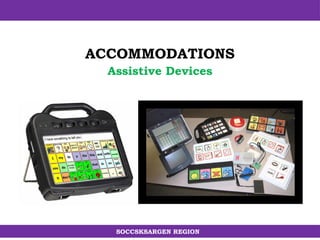
• Learners with difficulty in
communication may use augmentative
communication devices which may
serve as an alternative way to
communicate their basic needs
• It includes sign language, symbols,
aids, strategies, techniques and
various communication boards, both
manual and electronic to enhance the
communication process.
SOCCSKSARGEN REGION
ACCOMMODATIONS
Assistive Devices
PARTNERING with PARENTS or
LEARNING FACILITATORS at HOME
SOCCSKSARGEN REGION
• Provide a relaxed home environment
that allows many opportunities for the
child to speak
• Listen attentively when the child
speaks and focus on the content of the
message, rather than responding to
how it is said or interrupting the child
SOCCSKSARGEN REGION
Ways to ASSIST CHILDREN
WITH LANGUAGE DISORDER
Ways to Assist Children with Language Disorder
SOCCSKSARGEN REGION
1. Conversation opportunities
2. Reading
3. Being with friends and family
4. Understanding changes
10 Ways to Assist Children with Language Disorder
SOCCSKSARGEN REGION
5. Creativity
6. Physical Activity
7. Humor
8. Organizing
9. Augmentative and Alternative
Communication (ACC)
SOCCSKSARGEN REGION
SOCCSKSARGEN REGION

teaching learners with Difficulty-in-Communication

  • 1.
    SESSION ON Teaching Learnerswith Difficulty in Communication (Communication Disorders) Republic of the Philippines Department of Education SOCCSKSARGEN REGION JESIE OCLARIT KALAW, MaEd. Teacher II SCHOOLS DIVISION OFFICE OF COTABATO
  • 2.
    SOCCSKSARGEN REGION OBJECTIVES: After thesession, the participants will be able to: 1. Identify different difficulties in communication (communication disorders) 2. Apply accommodations and strategies being used in teaching learners with difficulty in communication.
  • 3.
    “Hear-through-the-eyes” SOCCSKSARGEN REGION Speech readingis an art. It is used by people with difficulty in communication or those with difficulty in hearing.
  • 4.
    COMMUNICATION SOCCSKSARGEN REGION ❑ issuch a fundamental part of the human experience. ❑ entails interactive exchange of information, ideas, feelings needs and desires.
  • 5.
    COMMUNICATION DISORDER SOCCSKSARGEN REGION Problemin the ability to receive, send, process, and comprehend concepts of verbal, nonverbal, and graphic symbol systems.
  • 6.
    SOCCSKSARGEN REGION 1. LanguageDisorders ⮚Receptive ⮚Expressive ⮚Aphasia Types of Communication Disorders 2. Speech Disorders ⮚Stuttering ⮚Articulation
  • 7.
    SOCCSKSARGEN REGION 3. Fluency ⮚Delayedspeech Types of Communication Disorders 4. Voice ⮚Hypo nasality ⮚Hyper nasality ⮚Hoarness ⮚Breathiness
  • 8.
    COMMUNICATION DISORDER SOCCSKSARGEN REGION ✔affectsthe delivery of message and the relationship among other people ✔may result in a primary disability or it may be secondary to other disabilities.
  • 9.
    COMMUNICATION DISORDER SOCCSKSARGEN REGION •Cleft lip or palate • Cerebral palsy • Autism Spectrum Disorder • Learning Disability • Intellectual Disability • Or have no other cause Can be caused by:
  • 10.
    COMMUNICATION DISORDER SOCCSKSARGEN REGION “Approximately75 percent of children recover from stuttering. For the remaining 25 percent, stuttering can persist as a lifelong communication disorder” National Institute on Deafness and Other Communication Disorders (NIDCD)
  • 11.
    TEACHING STRATEGIES SOCCSKSARGEN REGION •Model good speech production • Reinforce accurate production of speech sounds • Reduce the amount of background noise • Shorten and/or modify oral directions. Ask the learner to repeat or rephrase the directions to ensure understanding
  • 12.
    TEACHING STRATEGIES SOCCSKSARGEN REGION •Provide visuals to enhance explanation of new materials, especially with abstract concepts • Obtain learner’s attention before giving a direction • Give written directions, visual cues for verbal directions • Allow longer oral response time
  • 13.
    ACCOMMODATIONS (Assistive Devices) SOCCSKSARGENREGION • Learners with difficulty in communication may use augmentative communication devices which may serve as an alternative way to communicate their basic needs • It includes sign language, symbols, aids, strategies, techniques and various communication boards, both manual and electronic to enhance the communication process.
  • 14.
  • 15.
    PARTNERING with PARENTSor LEARNING FACILITATORS at HOME SOCCSKSARGEN REGION • Provide a relaxed home environment that allows many opportunities for the child to speak • Listen attentively when the child speaks and focus on the content of the message, rather than responding to how it is said or interrupting the child
  • 16.
    SOCCSKSARGEN REGION Ways toASSIST CHILDREN WITH LANGUAGE DISORDER
  • 17.
    Ways to AssistChildren with Language Disorder SOCCSKSARGEN REGION 1. Conversation opportunities 2. Reading 3. Being with friends and family 4. Understanding changes
  • 18.
    10 Ways toAssist Children with Language Disorder SOCCSKSARGEN REGION 5. Creativity 6. Physical Activity 7. Humor 8. Organizing 9. Augmentative and Alternative Communication (ACC)
  • 19.
  • 20.

Editor's Notes

  • #1  Why am I in SPEd?