Table of Contents:
• Introduction
• Characteristics
• Key Poets & their Works
• Influence
• Contribution
• Criticism
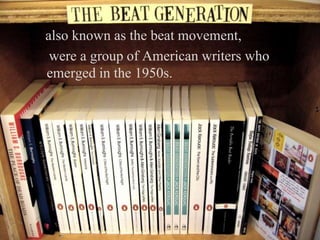
also known as the beat movement,
were a group of American writers who
emerged in the 1950s.
Introduction
• The Beat Movement was considered a response to World War II.
• People rejected the prevailing American middle-class values and
materialism of modern society, throwing out the old rules of literature,
music, taboos and religion.
• Originality and individuality came with uniform style of seedy dress,
manners, and “hip” vocabulary borrowed from jazz musicians, with no
perfection of style.
Most Influential Members of Beat
Generation:
Characteristics
• Beat refers to pure and beautiful, or exhausted and trodden down. The
original coinage of “Beat” was meant to imply a people beaten down and
walked over.
• They advocated personal release, purification, and illumination through
drugs, jazz, or the disciplines of Zen Buddhism.
• Politics also factored into much of Beat poetry.
Characteristics
• Literature became more bold, straightforward, and expressive than anything
before.
• They sought to bring poetry “back to the streets” to the people.
• The verse was frequently free, chaotic and unstructured, liberally sprinkled with
obscenities, in a spontaneous, creative style.
• They believed in composition in which the writer put down his thoughts and
feelings without plan or revision - to convey the immediacy of individual
experience.
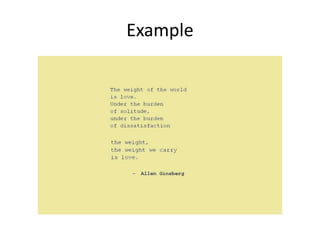
Example
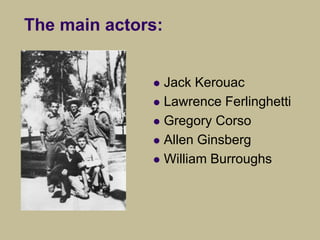
 Jack Kerouac
 Lawrence Ferlinghetti
 Gregory Corso
 Allen Ginsberg
 William Burroughs
The main actors:
Key Poets of Beat Movement:
• Allen Ginsberg (Howl-1956)
• Gary Synder (Riprap- 1959)
• Gregory Corso (Bomb- 1958)
• Lawrence Ferlinghetti ( I Am Waiting)
The primary focus of these poets were on specific issues of
contemporary social and political interest.
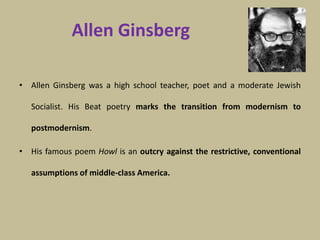
Allen Ginsberg
• Allen Ginsberg was a high school teacher, poet and a moderate Jewish
Socialist. His Beat poetry marks the transition from modernism to
postmodernism.
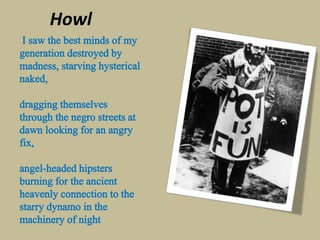
• His famous poem Howl is an outcry against the restrictive, conventional
assumptions of middle-class America.
Howl
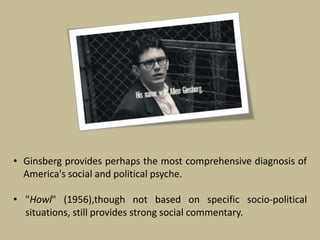
• Ginsberg provides perhaps the most comprehensive diagnosis of
America's social and political psyche.
• "Howl" (1956),though not based on specific socio-political
situations, still provides strong social commentary.
Gary Synder
• Bruce Cook said it well:
“If Ginsberg is the Beat movement's Walt
Whitman, Gary Snyder is the Henry David
Thoreau.”
• His Beat poetry is marked as a clear
resistance against cultural authority.
• In Riprap, Japan becomes a symbol of
poet’s belief in society that isn’t consumer-
obsessed as America.
Gregory Corso
• Corso’s "anarchic style (is) similar to Ginsberg's, though
his favorite poet is Shelley, a Romantic poet who was
much too flowery for most Beats.”
• Corso equates the Bomb with various incarnations of the
godhead, speaking of it in religious terms and assigning it
cosmic powers of creation and destruction.
• Corso also deplores war as man's deadliest enemy, and
he considers the abuse of power as an egregious offense.
• Corso's vision of a pure, unstained America, and his faith
in a re-awakening of consciousness are the hall- marks of
his remarkable Beat poetry.
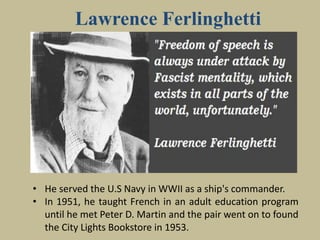
Lawrence Ferlinghetti
• He served the U.S Navy in WWII as a ship's commander.
• In 1951, he taught French in an adult education program
until he met Peter D. Martin and the pair went on to found
the City Lights Bookstore in 1953.
• His Beat poetry is often concerned with politics and social issues
and it is deeply infused in the tradition.
• Although, his poetry is autobiographical but it is not excessively
self-contained.
Influence on The Beat Generation
• Romantic poets were major influences on the Beat aesthetics, especially Percy
Bysshe Shelley, William Blake, Walt Whitman and Henry David Thoreau.
• The Beats were closely connected with poets of the San Francisco Renaissance
Movement, such as Kenneth Rexroth and Robert Duncan.
• They were also influenced by jazz music, which was still seen as somewhat
outrageous.
• Buddhism particularly was significant to many of the Beat poets and it figured into
much of their work.
CONTRIBUTION OF BEAT POETS
• The Beat Generation made a long-term impact on the composition of
contemporary American society.
• The Beats propelled thought of conservationism and environmentalism
into the mainstream.
• The Beat Generation also encouraged the Black Mountain poets, so
named as they wrote for the Black Mountain Review.
CRITICISM
• Mainstream America was shocked by their invented sexual deviancy and
illegal drug use.
• The academic community derided the Beats as anti-intellectual and
unrefined.
• Established poets and novelists looked down upon the carefree attitude of
Beat literature.
• Hence, the Beat Generation faded from view as quickly as it appeared.
Thank You

The beats generation slides(1)

  • 3.
    Table of Contents: •Introduction • Characteristics • Key Poets & their Works • Influence • Contribution • Criticism
  • 4.
    also known asthe beat movement, were a group of American writers who emerged in the 1950s.
  • 5.
    Introduction • The BeatMovement was considered a response to World War II. • People rejected the prevailing American middle-class values and materialism of modern society, throwing out the old rules of literature, music, taboos and religion. • Originality and individuality came with uniform style of seedy dress, manners, and “hip” vocabulary borrowed from jazz musicians, with no perfection of style.
  • 6.
    Most Influential Membersof Beat Generation:
  • 7.
    Characteristics • Beat refersto pure and beautiful, or exhausted and trodden down. The original coinage of “Beat” was meant to imply a people beaten down and walked over. • They advocated personal release, purification, and illumination through drugs, jazz, or the disciplines of Zen Buddhism. • Politics also factored into much of Beat poetry.
  • 8.
    Characteristics • Literature becamemore bold, straightforward, and expressive than anything before. • They sought to bring poetry “back to the streets” to the people. • The verse was frequently free, chaotic and unstructured, liberally sprinkled with obscenities, in a spontaneous, creative style. • They believed in composition in which the writer put down his thoughts and feelings without plan or revision - to convey the immediacy of individual experience.
  • 9.
  • 10.
     Jack Kerouac Lawrence Ferlinghetti  Gregory Corso  Allen Ginsberg  William Burroughs The main actors:
  • 11.
    Key Poets ofBeat Movement: • Allen Ginsberg (Howl-1956) • Gary Synder (Riprap- 1959) • Gregory Corso (Bomb- 1958) • Lawrence Ferlinghetti ( I Am Waiting) The primary focus of these poets were on specific issues of contemporary social and political interest.
  • 12.
    Allen Ginsberg • AllenGinsberg was a high school teacher, poet and a moderate Jewish Socialist. His Beat poetry marks the transition from modernism to postmodernism. • His famous poem Howl is an outcry against the restrictive, conventional assumptions of middle-class America.
  • 13.
  • 14.
    • Ginsberg providesperhaps the most comprehensive diagnosis of America's social and political psyche. • "Howl" (1956),though not based on specific socio-political situations, still provides strong social commentary.
  • 15.
    Gary Synder • BruceCook said it well: “If Ginsberg is the Beat movement's Walt Whitman, Gary Snyder is the Henry David Thoreau.” • His Beat poetry is marked as a clear resistance against cultural authority. • In Riprap, Japan becomes a symbol of poet’s belief in society that isn’t consumer- obsessed as America.
  • 17.
    Gregory Corso • Corso’s"anarchic style (is) similar to Ginsberg's, though his favorite poet is Shelley, a Romantic poet who was much too flowery for most Beats.” • Corso equates the Bomb with various incarnations of the godhead, speaking of it in religious terms and assigning it cosmic powers of creation and destruction. • Corso also deplores war as man's deadliest enemy, and he considers the abuse of power as an egregious offense. • Corso's vision of a pure, unstained America, and his faith in a re-awakening of consciousness are the hall- marks of his remarkable Beat poetry.
  • 19.
    Lawrence Ferlinghetti • Heserved the U.S Navy in WWII as a ship's commander. • In 1951, he taught French in an adult education program until he met Peter D. Martin and the pair went on to found the City Lights Bookstore in 1953.
  • 20.
    • His Beatpoetry is often concerned with politics and social issues and it is deeply infused in the tradition. • Although, his poetry is autobiographical but it is not excessively self-contained.
  • 22.
    Influence on TheBeat Generation • Romantic poets were major influences on the Beat aesthetics, especially Percy Bysshe Shelley, William Blake, Walt Whitman and Henry David Thoreau. • The Beats were closely connected with poets of the San Francisco Renaissance Movement, such as Kenneth Rexroth and Robert Duncan. • They were also influenced by jazz music, which was still seen as somewhat outrageous. • Buddhism particularly was significant to many of the Beat poets and it figured into much of their work.
  • 23.
    CONTRIBUTION OF BEATPOETS • The Beat Generation made a long-term impact on the composition of contemporary American society. • The Beats propelled thought of conservationism and environmentalism into the mainstream. • The Beat Generation also encouraged the Black Mountain poets, so named as they wrote for the Black Mountain Review.
  • 24.
    CRITICISM • Mainstream Americawas shocked by their invented sexual deviancy and illegal drug use. • The academic community derided the Beats as anti-intellectual and unrefined. • Established poets and novelists looked down upon the carefree attitude of Beat literature. • Hence, the Beat Generation faded from view as quickly as it appeared.
  • 25.