PPP? TBLT? What’s the difference?
and why it matters
Shona Whyte
2017
PPP versus TBLT
• What are the main differences in the two approaches?
• What is your view of the arguments presented in favour
of each?
• What do you see around you in your school - more PPP
or more TBLT?
PPP: presentation,
practice, production
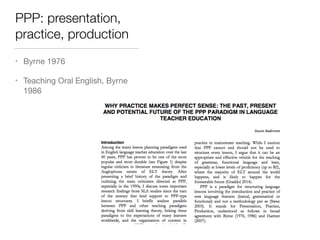
• Byrne 1976

• Teaching Oral English, Byrne
1986
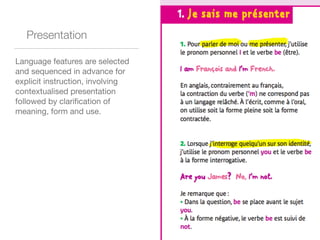
Presentation
Language features are selected
and sequenced in advance for
explicit instruction, involving
contextualised presentation
followed by clarification of
meaning, form and use.
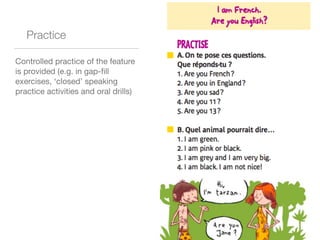
Practice
Controlled practice of the feature
is provided (e.g. in gap-fill
exercises, ‘closed’ speaking
practice activities and oral drills)
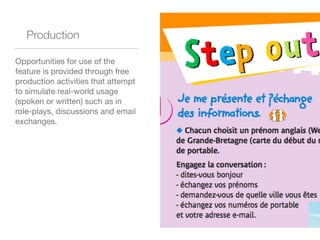
Production
Opportunities for use of the
feature is provided through free
production activities that attempt
to simulate real-world usage
(spoken or written) such as in
role-plays, discussions and email
exchanges.
Criticisms
	 1.	 The synthetically-sequenced, isolated
focus on form of PPP does not reflect how
languages are learnt (e.g. Ellis 1993a;
Lewis 1993; Willis 1994; Skehan 1998);
	 2.	 PPP focuses on teaching to the
detriment of learning, making it incompatible
with learner-centred approaches to
education (e.g. Lewis 1996; Scrivener 1996);
	 3.	 It is prescriptive and inflexible,
describing only one of many possible types of
lesson (e.g. Scrivener 1996). 

it has
continued to
remain popular
as a paradigm
for initial
teacher training
courses such
as the
Cambridge
CELTA and the
Trinity
CertTESOL
Ellis and Shintani 2013 (1)
research . . . suggests that
there is merit in teaching explicit
knowledge of grammar as an end
in itself and in supporting this with
teaching some metalanguage. It
casts doubt on the value of the
second P (controlled practice) in
the PPP sequence
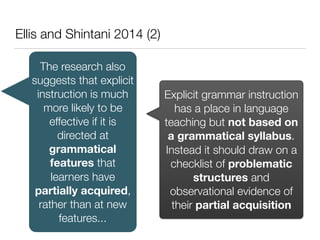
Ellis and Shintani 2014 (2)
The research also
suggests that explicit
instruction is much
more likely to be
effective if it is
directed at
grammatical
features that
learners have
partially acquired,
rather than at new
features...
Explicit grammar instruction
has a place in language
teaching but not based on
a grammatical syllabus.
Instead it should draw on a
checklist of problematic
structures and
observational evidence of
their partial acquisition
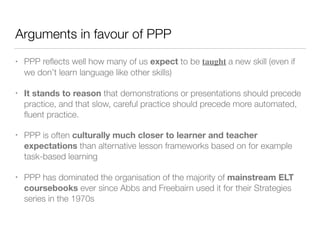
Arguments in favour of PPP
• PPP reflects well how many of us expect to be taught a new skill (even if
we don’t learn language like other skills)
• It stands to reason that demonstrations or presentations should precede
practice, and that slow, careful practice should precede more automated,
fluent practice.
• PPP is often culturally much closer to learner and teacher
expectations than alternative lesson frameworks based on for example
task-based learning
• PPP has dominated the organisation of the majority of mainstream ELT
coursebooks ever since Abbs and Freebairn used it for their Strategies
series in the 1970s
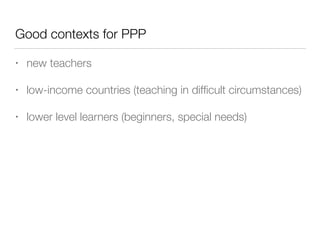
Good contexts for PPP
• new teachers
• low-income countries (teaching in difficult circumstances)
• lower level learners (beginners, special needs)
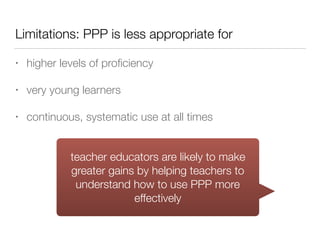
Limitations: PPP is less appropriate for
• higher levels of proficiency
• very young learners
• continuous, systematic use at all times
teacher educators are likely to make
greater gains by helping teachers to
understand how to use PPP more
effectively
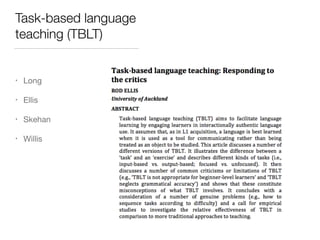
Task-based language
teaching (TBLT)
• Long

• Ellis

• Skehan

• Willis
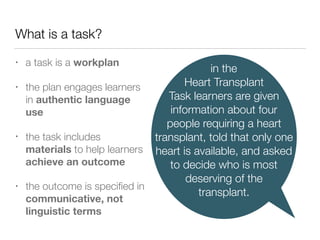
What is a task?
• a task is a workplan
• the plan engages learners
in authentic language
use
• the task includes
materials to help learners
achieve an outcome
• the outcome is specified in
communicative, not
linguistic terms
in the
Heart Transplant
Task learners are given
information about four
people requiring a heart
transplant, told that only one
heart is available, and asked
to decide who is most
deserving of the
transplant.
Second language acquisition research suggests
• language learning is best achieved not by treating language
as an ‘object’ to be dissected into bits and learned [..],
but as a ‘tool’ for accomplishing a communicative purpose.
• ‘learning’ does not need to precede ‘use’, but rather
occurs through the efforts that learners make to understand
and be understood in achieving a communicative goal.
• the interactions resulting from the performance of tasks in
a classroom resemble - in many respects - those found in
child language acquisition in the home
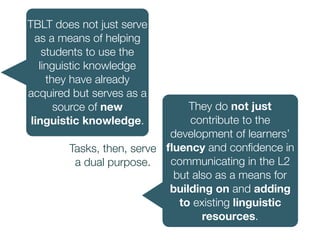
TBLT does not just serve
as a means of helping
students to use the
linguistic knowledge
they have already
acquired but serves as a
source of new
linguistic knowledge.
They do not just
contribute to the
development of learners’
fluency and confidence in
communicating in the L2
but also as a means for
building on and adding
to existing linguistic
resources.
Tasks, then, serve
a dual purpose.
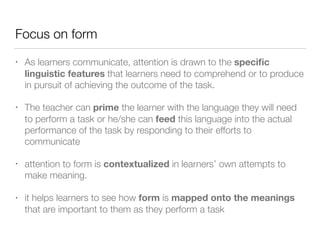
Focus on form
• As learners communicate, attention is drawn to the specific
linguistic features that learners need to comprehend or to produce
in pursuit of achieving the outcome of the task.
• The teacher can prime the learner with the language they will need
to perform a task or he/she can feed this language into the actual
performance of the task by responding to their efforts to
communicate
• attention to form is contextualized in learners’ own attempts to
make meaning.
• it helps learners to see how form is mapped onto the meanings
that are important to them as they perform a task
Task-supported language teaching
• tasks serve as a means of providing opportunities for
practising pre-determined linguistic items.
• tasks will by necessity be of the ‘focused’ kind.
• rather than serving as stand-alone activities they fit into
the ‘production’ phase of a traditional present-practice-
produce (PPP) methodology
input versus output-based tasks
• input tasks: listening or reading
• output (production) tasks: speaking or writing
since TBLT constitutes a
radical departure from
traditional approaches to
language teaching based
on a linguistic syllabus, it
has aroused considerable
criticism
Misconceptions
about TBLT
• it is not suited to beginners

• it neglects grammatical
accuracy

• it requires extensive use of
groupwork

• it requires avoidance of L1 and
is not suited to foreign
language contexts (i.e.,
learning English in France)
tasks can be used at
low levels of proficiency,
for grammar, without
group work, and with
L1 use
Potential problems
• teachers do not always have a clear understanding of what a ‘task’ is and as a
result the tasks end up as ‘practice’ rather than affording opportunities for
genuine communication
• there may be tension between the need to get the students talking and the
need to maintain class discipline
• teachers’ lack of confidence in their own L2 oral ability and the fear that
TBLT places too much emphasis on oral communication
• teachers are also wary of adopting TBLT in situations where they need to
prepare students for high-stakes tests that emphasize grammatical accuracy
rather than communicative effectiveness
• TBLT threatens the established role of teachers by re-positioning them as
co-communicators rather than as sources of knowledge about the L2
PPP versus TBLT
• What are the main differences in the two approaches?
• What is your view of the arguments presented in favour
of each?
• What do you see around you in your school - more PPP
or more TBLT?
• Anderson, J. (2016). Why practice makes perfect sense:
The past, present and future potential of the PPP paradigm
in language teacher education. ELTED, 19: 14-21.
• Edwards, C., & Willis, J. R. (Eds.). (2005). Teachers
exploring tasks in English language teaching. Basingstoke:
Palgrave Macmillan.
• Ellis, R. (2013). Task-based language teaching:
Responding to the critics. University of Sydney Papers in
TESOL, 8(1), 1-27.
• Ellis, R., & Shintani, N. (2013). Exploring language
pedagogy through second language acquisition research.
Routledge.

PPP or TBLT?

  • 1.
    PPP? TBLT? What’sthe difference? and why it matters Shona Whyte 2017
  • 2.
    PPP versus TBLT •What are the main differences in the two approaches? • What is your view of the arguments presented in favour of each? • What do you see around you in your school - more PPP or more TBLT?
  • 3.
    PPP: presentation, practice, production •Byrne 1976 • Teaching Oral English, Byrne 1986
  • 4.
    Presentation Language features areselected and sequenced in advance for explicit instruction, involving contextualised presentation followed by clarification of meaning, form and use.
  • 5.
    Practice Controlled practice ofthe feature is provided (e.g. in gap-fill exercises, ‘closed’ speaking practice activities and oral drills)
  • 6.
    Production Opportunities for useof the feature is provided through free production activities that attempt to simulate real-world usage (spoken or written) such as in role-plays, discussions and email exchanges.
  • 7.
    Criticisms 1. Thesynthetically-sequenced, isolated focus on form of PPP does not reflect how languages are learnt (e.g. Ellis 1993a; Lewis 1993; Willis 1994; Skehan 1998); 2. PPP focuses on teaching to the detriment of learning, making it incompatible with learner-centred approaches to education (e.g. Lewis 1996; Scrivener 1996); 3. It is prescriptive and inflexible, describing only one of many possible types of lesson (e.g. Scrivener 1996). 
 it has continued to remain popular as a paradigm for initial teacher training courses such as the Cambridge CELTA and the Trinity CertTESOL
  • 8.
    Ellis and Shintani2013 (1) research . . . suggests that there is merit in teaching explicit knowledge of grammar as an end in itself and in supporting this with teaching some metalanguage. It casts doubt on the value of the second P (controlled practice) in the PPP sequence
  • 9.
    Ellis and Shintani2014 (2) The research also suggests that explicit instruction is much more likely to be effective if it is directed at grammatical features that learners have partially acquired, rather than at new features... Explicit grammar instruction has a place in language teaching but not based on a grammatical syllabus. Instead it should draw on a checklist of problematic structures and observational evidence of their partial acquisition
  • 10.
    Arguments in favourof PPP • PPP reflects well how many of us expect to be taught a new skill (even if we don’t learn language like other skills) • It stands to reason that demonstrations or presentations should precede practice, and that slow, careful practice should precede more automated, fluent practice. • PPP is often culturally much closer to learner and teacher expectations than alternative lesson frameworks based on for example task-based learning • PPP has dominated the organisation of the majority of mainstream ELT coursebooks ever since Abbs and Freebairn used it for their Strategies series in the 1970s
  • 11.
    Good contexts forPPP • new teachers • low-income countries (teaching in difficult circumstances) • lower level learners (beginners, special needs)
  • 12.
    Limitations: PPP isless appropriate for • higher levels of proficiency • very young learners • continuous, systematic use at all times teacher educators are likely to make greater gains by helping teachers to understand how to use PPP more effectively
  • 13.
    Task-based language teaching (TBLT) •Long • Ellis • Skehan • Willis
  • 14.
    What is atask? • a task is a workplan • the plan engages learners in authentic language use • the task includes materials to help learners achieve an outcome • the outcome is specified in communicative, not linguistic terms in the Heart Transplant Task learners are given information about four people requiring a heart transplant, told that only one heart is available, and asked to decide who is most deserving of the transplant.
  • 15.
    Second language acquisitionresearch suggests • language learning is best achieved not by treating language as an ‘object’ to be dissected into bits and learned [..], but as a ‘tool’ for accomplishing a communicative purpose. • ‘learning’ does not need to precede ‘use’, but rather occurs through the efforts that learners make to understand and be understood in achieving a communicative goal. • the interactions resulting from the performance of tasks in a classroom resemble - in many respects - those found in child language acquisition in the home
  • 16.
    TBLT does notjust serve as a means of helping students to use the linguistic knowledge they have already acquired but serves as a source of new linguistic knowledge. They do not just contribute to the development of learners’ fluency and confidence in communicating in the L2 but also as a means for building on and adding to existing linguistic resources. Tasks, then, serve a dual purpose.
  • 17.
    Focus on form •As learners communicate, attention is drawn to the specific linguistic features that learners need to comprehend or to produce in pursuit of achieving the outcome of the task. • The teacher can prime the learner with the language they will need to perform a task or he/she can feed this language into the actual performance of the task by responding to their efforts to communicate • attention to form is contextualized in learners’ own attempts to make meaning. • it helps learners to see how form is mapped onto the meanings that are important to them as they perform a task
  • 18.
    Task-supported language teaching •tasks serve as a means of providing opportunities for practising pre-determined linguistic items. • tasks will by necessity be of the ‘focused’ kind. • rather than serving as stand-alone activities they fit into the ‘production’ phase of a traditional present-practice- produce (PPP) methodology
  • 19.
    input versus output-basedtasks • input tasks: listening or reading • output (production) tasks: speaking or writing since TBLT constitutes a radical departure from traditional approaches to language teaching based on a linguistic syllabus, it has aroused considerable criticism
  • 20.
    Misconceptions about TBLT • itis not suited to beginners • it neglects grammatical accuracy • it requires extensive use of groupwork • it requires avoidance of L1 and is not suited to foreign language contexts (i.e., learning English in France) tasks can be used at low levels of proficiency, for grammar, without group work, and with L1 use
  • 21.
    Potential problems • teachersdo not always have a clear understanding of what a ‘task’ is and as a result the tasks end up as ‘practice’ rather than affording opportunities for genuine communication • there may be tension between the need to get the students talking and the need to maintain class discipline • teachers’ lack of confidence in their own L2 oral ability and the fear that TBLT places too much emphasis on oral communication • teachers are also wary of adopting TBLT in situations where they need to prepare students for high-stakes tests that emphasize grammatical accuracy rather than communicative effectiveness • TBLT threatens the established role of teachers by re-positioning them as co-communicators rather than as sources of knowledge about the L2
  • 22.
    PPP versus TBLT •What are the main differences in the two approaches? • What is your view of the arguments presented in favour of each? • What do you see around you in your school - more PPP or more TBLT?
  • 23.
    • Anderson, J.(2016). Why practice makes perfect sense: The past, present and future potential of the PPP paradigm in language teacher education. ELTED, 19: 14-21. • Edwards, C., & Willis, J. R. (Eds.). (2005). Teachers exploring tasks in English language teaching. Basingstoke: Palgrave Macmillan. • Ellis, R. (2013). Task-based language teaching: Responding to the critics. University of Sydney Papers in TESOL, 8(1), 1-27. • Ellis, R., & Shintani, N. (2013). Exploring language pedagogy through second language acquisition research. Routledge.