TRANSDERMAL DRUG
DELIVERY SYSTEM
PRESENTED BY ; R. SHIVA SAI KIRAN
HALL . NO ; 256418881004
B.PHARMASY 4 TH YEAR
WORKED UNDER THE GUIDENCE OF MR.RAJ KUMAR M. PHARM PH. D
ASSISTANT PROFESSOR
MOTHER TERESA COLLEGE OF PHARMACY
CONTENTS
• Introduction
• Drug delivery system
• Transdermal drug delivery
system
• Anatomy and physiology of
skin
• Route of drug permeation
through skin
• Ideal properties of drugs for
TDDS
• Components used in TDDS
• Types of patches
• Recent advancement in TDDS
• Marketed products of TDDS
INTRODUCTION
• The concept of delivering drugs through the skin was first
introdused in the early 1950s
• The first generation ,passive , transdermal patches were designed to
controle nausea, vomiting , angina , however failed to succeed in
the market
• Today transdermal patches are widely used to deliver hormones and
pain management medications.
DRUG DELIVERY SYSTEM
• It refers to formulations , technologies , and systems for
transporting a pharmaceutical compound to a specific site
in the body at certain rate to safely achieve its desired
therapeutic effect.
TRANSDERMAL DRUG DELIVERY SYSTEM (TDDS)
It is defined as the topically administered in self contained , discrete
dosage forms of patches which when applied to the skin deliver the
drug through the skin to systemic circulation at a predetermined and
controled rate over prolonged period of time in order to increase the
the therapeutic efficacy and reduse the side effect of drug .
ADVANTAGES
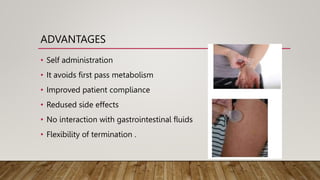
• Self administration
• It avoids first pass metabolism
• Improved patient compliance
• Redused side effects
• No interaction with gastrointestinal fluids
• Flexibility of termination .
DISADVANTAGES
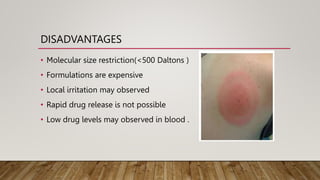
• Molecular size restriction(<500 Daltons )
• Formulations are expensive
• Local irritation may observed
• Rapid drug release is not possible
• Low drug levels may observed in blood .
ANATOMY AND PHYSIOLOGY OF SKIN
• Skin is multi-layered organ composed of many histological layers.
• It covers about 16 % of total body weight in adults.
• Thikness is in range of 0.5mm(on eyelids) to 4.0mm(on sole and
palms).
• The main function of the skin is to provide protection from external
environment , microorganisms UV radiation , chemicals , allergens
and reduses the loss of water .
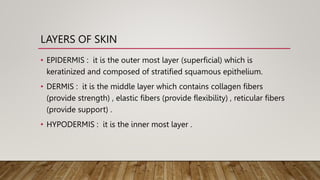
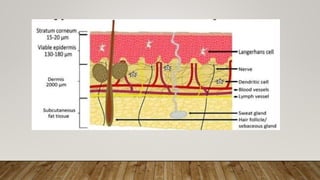
LAYERS OF SKIN
• EPIDERMIS : it is the outer most layer (superficial) which is
keratinized and composed of stratified squamous epithelium.
• DERMIS : it is the middle layer which contains collagen fibers
(provide strength) , elastic fibers (provide flexibility) , reticular fibers
(provide support) .
• HYPODERMIS : it is the inner most layer .
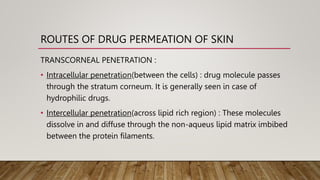
ROUTES OF DRUG PERMEATION OF SKIN
TRANSCORNEAL PENETRATION :
• Intracellular penetration(between the cells) : drug molecule passes
through the stratum corneum. It is generally seen in case of
hydrophilic drugs.
• Intercellular penetration(across lipid rich region) : These molecules
dissolve in and diffuse through the non-aqueus lipid matrix imbibed
between the protein filaments.
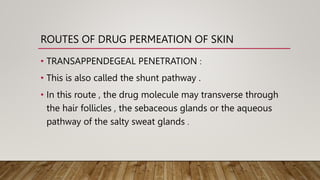
ROUTES OF DRUG PERMEATION OF SKIN
• TRANSAPPENDEGEAL PENETRATION :
• This is also called the shunt pathway .
• In this route , the drug molecule may transverse through
the hair follicles , the sebaceous glands or the aqueous
pathway of the salty sweat glands .
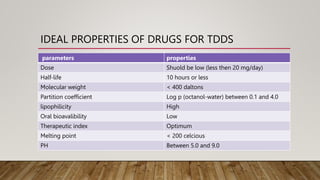
IDEAL PROPERTIES OF DRUGS FOR TDDS
parameters properties
Dose Shuold be low (less then 20 mg/day)
Half-life 10 hours or less
Molecular weight < 400 daltons
Partition coefficient Log p (octanol-water) between 0.1 and 4.0
lipophilicity High
Oral bioavalibility Low
Therapeutic index Optimum
Melting point < 200 celcious
PH Between 5.0 and 9.0
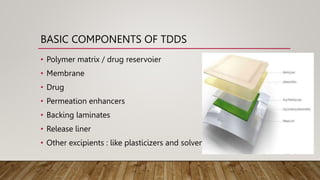
BASIC COMPONENTS OF TDDS
• Polymer matrix / drug reservoier
• Membrane
• Drug
• Permeation enhancers
• Backing laminates
• Release liner
• Other excipients : like plasticizers and solvents
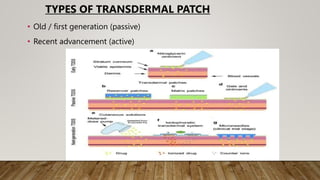
TYPES OF TRANSDERMAL PATCH
• Old / first generation (passive)
• Recent advancement (active)
OLD / FIRST GENERATION (PASSIVE)
• Single-layer Drug-in-Adhesive
• Multi-layer Drug-in-Adhesive
• Reservoir
• Matrix
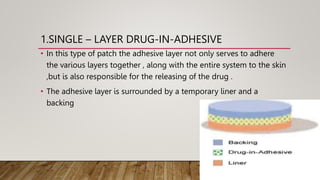
1.SINGLE – LAYER DRUG-IN-ADHESIVE
• In this type of patch the adhesive layer not only serves to adhere
the various layers together , along with the entire system to the skin
,but is also responsible for the releasing of the drug .
• The adhesive layer is surrounded by a temporary liner and a
backing
2. MULTI LAYER DRUG IN ADHESIVE
• The multi-layer drug-in adhesive patch is similar to the single layer
system in that both adhesive layers are also responsible for the
releasing of the drug.
• The multi-layer system is different however that it adds another
layer of drug in adhesive usually separated by a membrane ( but not
in all cases) .
• This patch also have a liner layer and a permanent backing layer
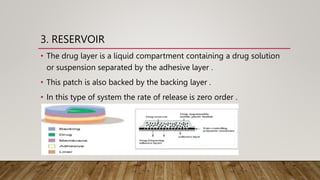
3. RESERVOIR
• The drug layer is a liquid compartment containing a drug solution
or suspension separated by the adhesive layer .
• This patch is also backed by the backing layer .
• In this type of system the rate of release is zero order .
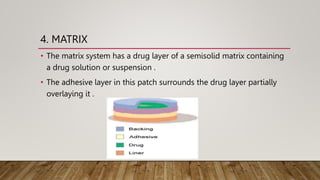
4. MATRIX
• The matrix system has a drug layer of a semisolid matrix containing
a drug solution or suspension .
• The adhesive layer in this patch surrounds the drug layer partially
overlaying it .
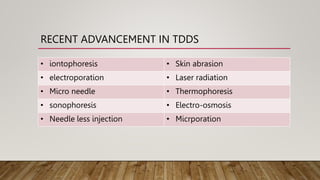
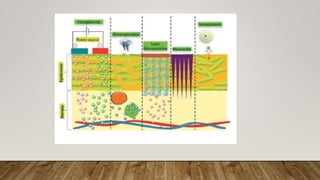
RECENT ADVANCEMENT IN TDDS
• iontophoresis • Skin abrasion
• electroporation • Laser radiation
• Micro needle • Thermophoresis
• sonophoresis • Electro-osmosis
• Needle less injection • Micrporation
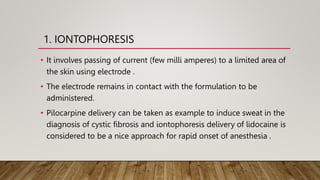
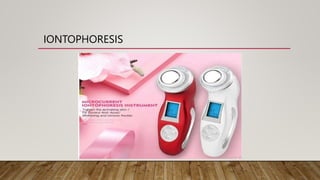
1. IONTOPHORESIS
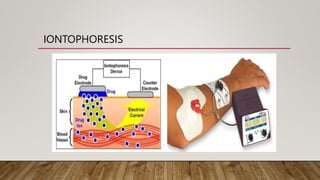
• It involves passing of current (few milli amperes) to a limited area of
the skin using electrode .
• The electrode remains in contact with the formulation to be
administered.
• Pilocarpine delivery can be taken as example to induce sweat in the
diagnosis of cystic fibrosis and iontophoresis delivery of lidocaine is
considered to be a nice approach for rapid onset of anesthesia .
IONTOPHORESIS
IONTOPHORESIS
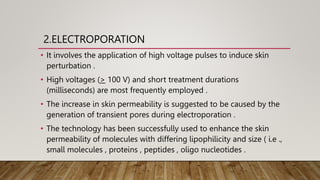
2.ELECTROPORATION
• It involves the application of high voltage pulses to induce skin
perturbation .
• High voltages (> 100 V) and short treatment durations
(milliseconds) are most frequently employed .
• The increase in skin permeability is suggested to be caused by the
generation of transient pores during electroporation .
• The technology has been successfully used to enhance the skin
permeability of molecules with differing lipophilicity and size ( i.e .,
small molecules , proteins , peptides , oligo nucleotides .
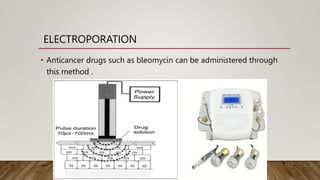
ELECTROPORATION
• Anticancer drugs such as bleomycin can be administered through
this method .
3. MICRO NEEDLES
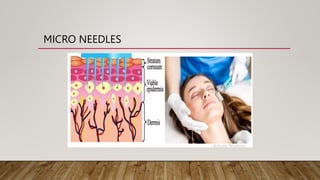
• Drug is delivered into the skin by invasive manner .
• Solid micro needles have been shown to painlessly pierce the skin
to increase skin permeability to a variety of small molecules ,
nanoparticles and proteins from an extended-release patch .
• Micro needles are needles that are 10 to 200 micro meter in hight
and10 to 50 micro meter in width .
• Micro needles do not stimulate the nerves ,so the patient does nt
experience pain .
MICRO NEEDLES
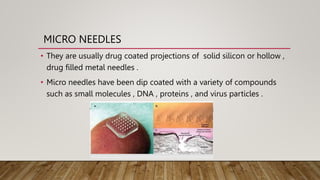
• They are usually drug coated projections of solid silicon or hollow ,
drug filled metal needles .
• Micro needles have been dip coated with a variety of compounds
such as small molecules , DNA , proteins , and virus particles .
MICRO NEEDLES
4. ULTRASOUND (PHONOPHORESIS,SONOPHORESIS)
• This technique was used originally in physiotherapy and sports
medicine .
• It uses an ultrasound sources to increase drug permeation through
the skin .
• The procedures was extended to transdermal drug delivery studies .
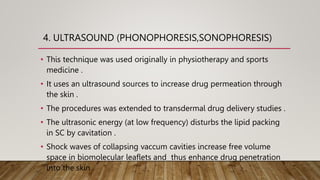
• The ultrasonic energy (at low frequency) disturbs the lipid packing
in SC by cavitation .
• Shock waves of collapsing vaccum cavities increase free volume
space in biomolecular leaflets and thus enhance drug penetration
into the skin .
SONOPHORESIS
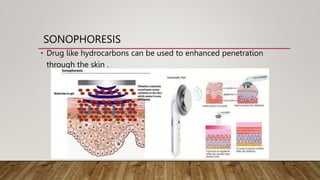
• Drug like hydrocarbons can be used to enhanced penetration
through the skin .
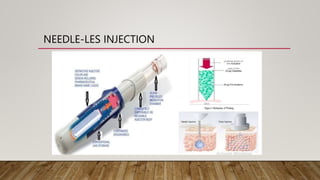
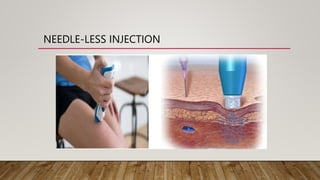
5. NEEDLE- LESS INJECTION
• In this transdermal drug delivery system , the liquid or solid
particles are fired at supersonic speeds through the outer layers of
the skin using a reliable energy source for delivering the drug .
• The mechanism is basically , forcing compressed gas (helium) via a
nozzle , such that the resultant drug particles entrained with in the
jet flow that travels at sufficient velocity for skin penetration .
NEEDLE-LES INJECTION
NEEDLE-LESS INJECTION
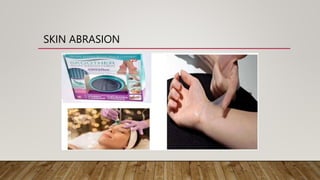
6. SKIN ABRASION
• In this technique , the upper layers of the skin is directly removed so
that it easily helps in permeation of topically applied medicaments .
• There are also some devices that are based on this technique which
are employed by dermatologists for superficial skin resurfacing ( e.g
micro dermabrasion) .
• They have use in the treatment of acne , scars , hyper pigmentation
and other skin blemishes .
SKIN ABRASION
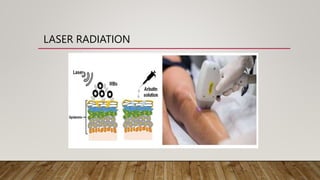
7.LASER RADIATION
• This method involves direct and controlled exposure of laser to the
skin which results in the abrasion of the stratum corneum without
significantly damaging the underlying epidermis .
• Removal of the stratum corneum using this method has been shown
to enhance the delivery of lipophilic drugs .
• Photomechanical waves significantly increase stratum cornea
permeability to drug substance through a possible permeability
mechanism due to development of transient channels .
LASER RADIATION
8. THERMOPHORESIS
• Controlled heat aided drug delivery (CHADD) SYSTEM :
• In CHADD system , the transfer of drug substance to the blood
circulatin takes place by applying heat to the skin .
• That increases the temperature and ultimately leads to increase in
microcirculation and permeability of the blood vessel.
• The skin surface temperature is usually maintained at 32 degree
celcius tetracaine and fentanyl from transdermal patches with
attached heating devices was shown to increase as a result of the
elevated temperature at the site of delivery .
9. ELECTRO-OSMOSIS
• To the porous membrane which is having some charge , a
voltage difference is applied to it , thus a bulk fluid or
volume flow takes place with no concentration gradients .
• This process is known as electro-osmosis .
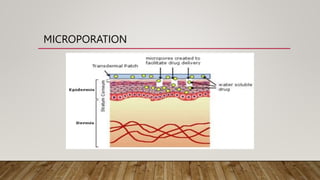
10. MICROPORATION
• Microporation involves the use of micro needles that are applied to
the skin so that they pierce only the stratum corneum and increase
skin permeability .
• The most effective strategy for overcoming the skins barrier
properties has been to focus on the creation of micropores in the
stratum corneum .
• Microchannels or micropores can be created by external means such
as micro needles , ultrasound , electroporation , radiofrequency and
laser .
MICROPORATION
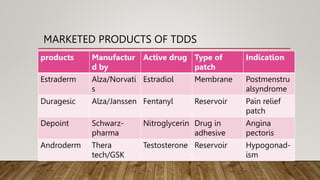
MARKETED PRODUCTS OF TDDS
products Manufactur
d by
Active drug Type of
patch
Indication
Estraderm Alza/Norvati
s
Estradiol Membrane Postmenstru
alsyndrome
Duragesic Alza/Janssen Fentanyl Reservoir Pain relief
patch
Depoint Schwarz-
pharma
Nitroglycerin Drug in
adhesive
Angina
pectoris
Androderm Thera
tech/GSK
Testosterone Reservoir Hypogonad-
ism
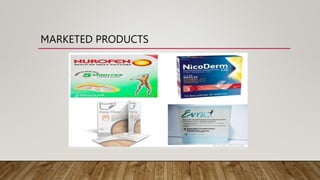
MARKETED PRODUCTS
CONCLUSION
• Many researches are going on in the present day to
incorporate newer drugs via this system .
• In time , it is hoped that technological advancements in
TDDS will lead to enhanced disease prevention , diagnosis
and control , with concomitant improvement in health –
related quality of life for patients world wide .

Transdermal Drug Delivery System

  • 1.
    TRANSDERMAL DRUG DELIVERY SYSTEM PRESENTEDBY ; R. SHIVA SAI KIRAN HALL . NO ; 256418881004 B.PHARMASY 4 TH YEAR WORKED UNDER THE GUIDENCE OF MR.RAJ KUMAR M. PHARM PH. D ASSISTANT PROFESSOR MOTHER TERESA COLLEGE OF PHARMACY
  • 2.
    CONTENTS • Introduction • Drugdelivery system • Transdermal drug delivery system • Anatomy and physiology of skin • Route of drug permeation through skin • Ideal properties of drugs for TDDS • Components used in TDDS • Types of patches • Recent advancement in TDDS • Marketed products of TDDS
  • 3.
    INTRODUCTION • The conceptof delivering drugs through the skin was first introdused in the early 1950s • The first generation ,passive , transdermal patches were designed to controle nausea, vomiting , angina , however failed to succeed in the market • Today transdermal patches are widely used to deliver hormones and pain management medications.
  • 4.
    DRUG DELIVERY SYSTEM •It refers to formulations , technologies , and systems for transporting a pharmaceutical compound to a specific site in the body at certain rate to safely achieve its desired therapeutic effect.
  • 5.
    TRANSDERMAL DRUG DELIVERYSYSTEM (TDDS) It is defined as the topically administered in self contained , discrete dosage forms of patches which when applied to the skin deliver the drug through the skin to systemic circulation at a predetermined and controled rate over prolonged period of time in order to increase the the therapeutic efficacy and reduse the side effect of drug .
  • 6.
    ADVANTAGES • Self administration •It avoids first pass metabolism • Improved patient compliance • Redused side effects • No interaction with gastrointestinal fluids • Flexibility of termination .
  • 7.
    DISADVANTAGES • Molecular sizerestriction(<500 Daltons ) • Formulations are expensive • Local irritation may observed • Rapid drug release is not possible • Low drug levels may observed in blood .
  • 8.
    ANATOMY AND PHYSIOLOGYOF SKIN • Skin is multi-layered organ composed of many histological layers. • It covers about 16 % of total body weight in adults. • Thikness is in range of 0.5mm(on eyelids) to 4.0mm(on sole and palms). • The main function of the skin is to provide protection from external environment , microorganisms UV radiation , chemicals , allergens and reduses the loss of water .
  • 9.
    LAYERS OF SKIN •EPIDERMIS : it is the outer most layer (superficial) which is keratinized and composed of stratified squamous epithelium. • DERMIS : it is the middle layer which contains collagen fibers (provide strength) , elastic fibers (provide flexibility) , reticular fibers (provide support) . • HYPODERMIS : it is the inner most layer .
  • 11.
    ROUTES OF DRUGPERMEATION OF SKIN TRANSCORNEAL PENETRATION : • Intracellular penetration(between the cells) : drug molecule passes through the stratum corneum. It is generally seen in case of hydrophilic drugs. • Intercellular penetration(across lipid rich region) : These molecules dissolve in and diffuse through the non-aqueus lipid matrix imbibed between the protein filaments.
  • 12.
    ROUTES OF DRUGPERMEATION OF SKIN • TRANSAPPENDEGEAL PENETRATION : • This is also called the shunt pathway . • In this route , the drug molecule may transverse through the hair follicles , the sebaceous glands or the aqueous pathway of the salty sweat glands .
  • 13.
    IDEAL PROPERTIES OFDRUGS FOR TDDS parameters properties Dose Shuold be low (less then 20 mg/day) Half-life 10 hours or less Molecular weight < 400 daltons Partition coefficient Log p (octanol-water) between 0.1 and 4.0 lipophilicity High Oral bioavalibility Low Therapeutic index Optimum Melting point < 200 celcious PH Between 5.0 and 9.0
  • 14.
    BASIC COMPONENTS OFTDDS • Polymer matrix / drug reservoier • Membrane • Drug • Permeation enhancers • Backing laminates • Release liner • Other excipients : like plasticizers and solvents
  • 15.
    TYPES OF TRANSDERMALPATCH • Old / first generation (passive) • Recent advancement (active)
  • 16.
    OLD / FIRSTGENERATION (PASSIVE) • Single-layer Drug-in-Adhesive • Multi-layer Drug-in-Adhesive • Reservoir • Matrix
  • 17.
    1.SINGLE – LAYERDRUG-IN-ADHESIVE • In this type of patch the adhesive layer not only serves to adhere the various layers together , along with the entire system to the skin ,but is also responsible for the releasing of the drug . • The adhesive layer is surrounded by a temporary liner and a backing
  • 18.
    2. MULTI LAYERDRUG IN ADHESIVE • The multi-layer drug-in adhesive patch is similar to the single layer system in that both adhesive layers are also responsible for the releasing of the drug. • The multi-layer system is different however that it adds another layer of drug in adhesive usually separated by a membrane ( but not in all cases) . • This patch also have a liner layer and a permanent backing layer
  • 19.
    3. RESERVOIR • Thedrug layer is a liquid compartment containing a drug solution or suspension separated by the adhesive layer . • This patch is also backed by the backing layer . • In this type of system the rate of release is zero order .
  • 20.
    4. MATRIX • Thematrix system has a drug layer of a semisolid matrix containing a drug solution or suspension . • The adhesive layer in this patch surrounds the drug layer partially overlaying it .
  • 21.
    RECENT ADVANCEMENT INTDDS • iontophoresis • Skin abrasion • electroporation • Laser radiation • Micro needle • Thermophoresis • sonophoresis • Electro-osmosis • Needle less injection • Micrporation
  • 23.
    1. IONTOPHORESIS • Itinvolves passing of current (few milli amperes) to a limited area of the skin using electrode . • The electrode remains in contact with the formulation to be administered. • Pilocarpine delivery can be taken as example to induce sweat in the diagnosis of cystic fibrosis and iontophoresis delivery of lidocaine is considered to be a nice approach for rapid onset of anesthesia .
  • 24.
  • 25.
  • 26.
    2.ELECTROPORATION • It involvesthe application of high voltage pulses to induce skin perturbation . • High voltages (> 100 V) and short treatment durations (milliseconds) are most frequently employed . • The increase in skin permeability is suggested to be caused by the generation of transient pores during electroporation . • The technology has been successfully used to enhance the skin permeability of molecules with differing lipophilicity and size ( i.e ., small molecules , proteins , peptides , oligo nucleotides .
  • 27.
    ELECTROPORATION • Anticancer drugssuch as bleomycin can be administered through this method .
  • 28.
    3. MICRO NEEDLES •Drug is delivered into the skin by invasive manner . • Solid micro needles have been shown to painlessly pierce the skin to increase skin permeability to a variety of small molecules , nanoparticles and proteins from an extended-release patch . • Micro needles are needles that are 10 to 200 micro meter in hight and10 to 50 micro meter in width . • Micro needles do not stimulate the nerves ,so the patient does nt experience pain .
  • 29.
    MICRO NEEDLES • Theyare usually drug coated projections of solid silicon or hollow , drug filled metal needles . • Micro needles have been dip coated with a variety of compounds such as small molecules , DNA , proteins , and virus particles .
  • 30.
  • 31.
    4. ULTRASOUND (PHONOPHORESIS,SONOPHORESIS) •This technique was used originally in physiotherapy and sports medicine . • It uses an ultrasound sources to increase drug permeation through the skin . • The procedures was extended to transdermal drug delivery studies . • The ultrasonic energy (at low frequency) disturbs the lipid packing in SC by cavitation . • Shock waves of collapsing vaccum cavities increase free volume space in biomolecular leaflets and thus enhance drug penetration into the skin .
  • 32.
    SONOPHORESIS • Drug likehydrocarbons can be used to enhanced penetration through the skin .
  • 33.
    5. NEEDLE- LESSINJECTION • In this transdermal drug delivery system , the liquid or solid particles are fired at supersonic speeds through the outer layers of the skin using a reliable energy source for delivering the drug . • The mechanism is basically , forcing compressed gas (helium) via a nozzle , such that the resultant drug particles entrained with in the jet flow that travels at sufficient velocity for skin penetration .
  • 34.
  • 35.
  • 36.
    6. SKIN ABRASION •In this technique , the upper layers of the skin is directly removed so that it easily helps in permeation of topically applied medicaments . • There are also some devices that are based on this technique which are employed by dermatologists for superficial skin resurfacing ( e.g micro dermabrasion) . • They have use in the treatment of acne , scars , hyper pigmentation and other skin blemishes .
  • 37.
  • 38.
    7.LASER RADIATION • Thismethod involves direct and controlled exposure of laser to the skin which results in the abrasion of the stratum corneum without significantly damaging the underlying epidermis . • Removal of the stratum corneum using this method has been shown to enhance the delivery of lipophilic drugs . • Photomechanical waves significantly increase stratum cornea permeability to drug substance through a possible permeability mechanism due to development of transient channels .
  • 39.
  • 40.
    8. THERMOPHORESIS • Controlledheat aided drug delivery (CHADD) SYSTEM : • In CHADD system , the transfer of drug substance to the blood circulatin takes place by applying heat to the skin . • That increases the temperature and ultimately leads to increase in microcirculation and permeability of the blood vessel. • The skin surface temperature is usually maintained at 32 degree celcius tetracaine and fentanyl from transdermal patches with attached heating devices was shown to increase as a result of the elevated temperature at the site of delivery .
  • 41.
    9. ELECTRO-OSMOSIS • Tothe porous membrane which is having some charge , a voltage difference is applied to it , thus a bulk fluid or volume flow takes place with no concentration gradients . • This process is known as electro-osmosis .
  • 42.
    10. MICROPORATION • Microporationinvolves the use of micro needles that are applied to the skin so that they pierce only the stratum corneum and increase skin permeability . • The most effective strategy for overcoming the skins barrier properties has been to focus on the creation of micropores in the stratum corneum . • Microchannels or micropores can be created by external means such as micro needles , ultrasound , electroporation , radiofrequency and laser .
  • 43.
  • 44.
    MARKETED PRODUCTS OFTDDS products Manufactur d by Active drug Type of patch Indication Estraderm Alza/Norvati s Estradiol Membrane Postmenstru alsyndrome Duragesic Alza/Janssen Fentanyl Reservoir Pain relief patch Depoint Schwarz- pharma Nitroglycerin Drug in adhesive Angina pectoris Androderm Thera tech/GSK Testosterone Reservoir Hypogonad- ism
  • 45.
  • 46.
    CONCLUSION • Many researchesare going on in the present day to incorporate newer drugs via this system . • In time , it is hoped that technological advancements in TDDS will lead to enhanced disease prevention , diagnosis and control , with concomitant improvement in health – related quality of life for patients world wide .