TDC 1
Pedagogical Grammar
Class 9
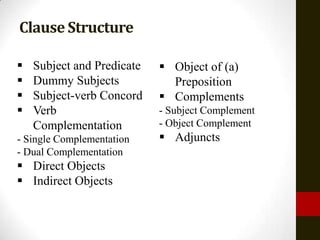
Clause Structure

   Subject and Predicate    Object of (a)
   Dummy Subjects            Preposition
   Subject-verb Concord     Complements
   Verb                    - Subject Complement
    Complementation         - Object Complement
- Single Complementation     Adjuncts
- Dual Complementation
 Direct Objects
 Indirect Objects
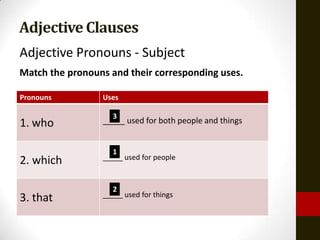
Adjective Clauses
Adjective Pronouns - Subject
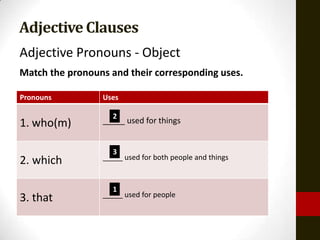
Match the pronouns and their corresponding uses.

Pronouns         Uses

                    3
1. who           _____ used for both people and things


                    1
                 _____ used for people
2. which

                    2
                 _____ used for things
3. that
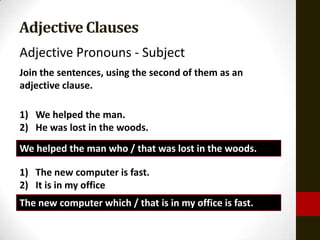
Adjective Clauses
Adjective Pronouns - Subject
Join the sentences, using the second of them as an
adjective clause.

1) We helped the man.
2) He was lost in the woods.
We helped the man who / that was lost in the woods.

1) The new computer is fast.
2) It is in my office
The new computer which / that is in my office is fast.
Adjective Clauses
Adjective Pronouns - Object
Match the pronouns and their corresponding uses.

Pronouns         Uses

                    2
1. who(m)        _____ used for things


                    3
                 _____ used for both people and things
2. which

                    1
                 _____ used for people
3. that
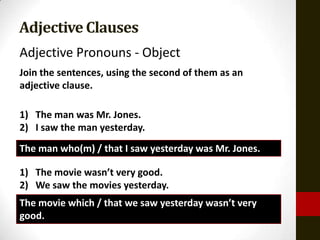
Adjective Clauses
Adjective Pronouns - Object
Join the sentences, using the second of them as an
adjective clause.

1) The man was Mr. Jones.
2) I saw the man yesterday.
The man who(m) / that I saw yesterday was Mr. Jones.

1) The movie wasn’t very good.
2) We saw the movies yesterday.
The movie which / that we saw yesterday wasn’t very
good.
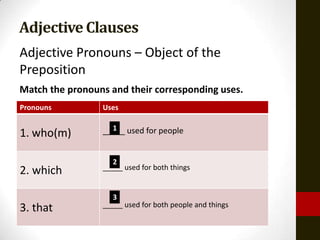
Adjective Clauses
Adjective Pronouns – Object of the
Preposition
Match the pronouns and their corresponding uses.
Pronouns         Uses

                   1
                 _____ used for people
1. who(m)

                    2
                 _____ used for both things
2. which

                    3
                 _____ used for both people and things
3. that
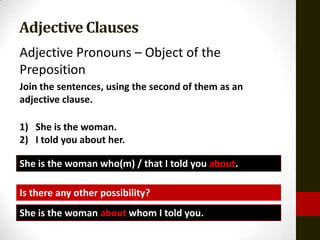
Adjective Clauses
Adjective Pronouns – Object of the
Preposition
Join the sentences, using the second of them as an
adjective clause.

1) She is the woman.
2) I told you about her.

She is the woman who(m) / that I told you about.

Is there any other possibility?
She is the woman about whom I told you.
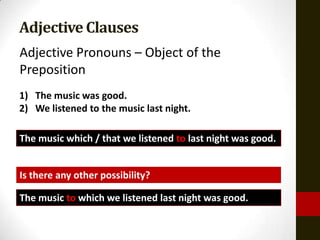
Adjective Clauses
Adjective Pronouns – Object of the
Preposition
1) The music was good.
2) We listened to the music last night.

The music which / that we listened to last night was good.


Is there any other possibility?

The music to which we listened last night was good.
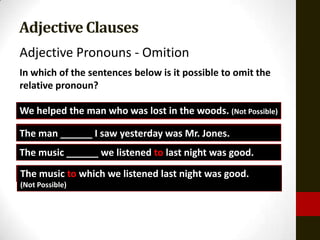
Adjective Clauses
Adjective Pronouns - Omition
In which of the sentences below is it possible to omit the
relative pronoun?

We helped the man who was lost in the woods. (Not Possible)
The man whom I Isaw yesterday was Mr. Jones.
        ______ saw yesterday was Mr. Jones.
The music that we we listened lastlast night was good.
          ______ listened to to night was good.
The music to which we listened last night was good.
(Not Possible)
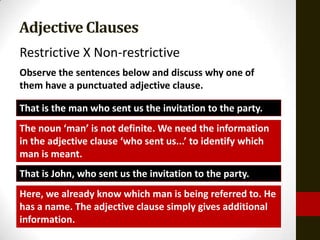
Adjective Clauses
Restrictive X Non-restrictive
Observe the sentences below and discuss why one of
them have a punctuated adjective clause.

That is the man who sent us the invitation to the party.
The noun ‘man’ is not definite. We need the information
in the adjective clause ‘who sent us...’ to identify which
man is meant.
That is John, who sent us the invitation to the party.
Here, we already know which man is being referred to. He
has a name. The adjective clause simply gives additional
information.
Adjective Clauses
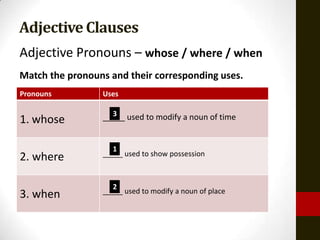
Adjective Pronouns – whose / where / when
Match the pronouns and their corresponding uses.
Pronouns         Uses

                   3
                 _____ used to modify a noun of time
1. whose

                    1
                 _____ used to show possession
2. where

                    2
                 _____ used to modify a noun of place
3. when
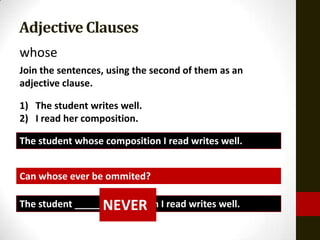
Adjective Clauses
whose
Join the sentences, using the second of them as an
adjective clause.

1) The student writes well.
2) I read her composition.

The student whose composition I read writes well.


Can whose ever be ommited?

The student _____ NEVER I read writes well.
                  composition
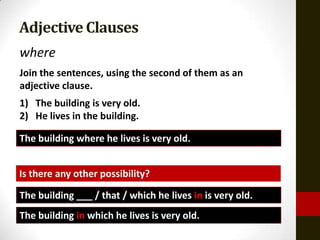
Adjective Clauses
where
Join the sentences, using the second of them as an
adjective clause.
1) The building is very old.
2) He lives in the building.

The building where he lives is very old.


Is there any other possibility?

The building ___ / that / which he lives in is very old.
The building in which he lives is very old.
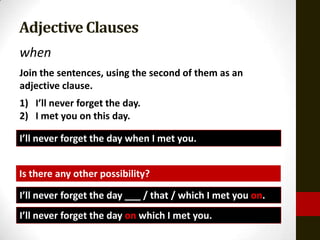
Adjective Clauses
when
Join the sentences, using the second of them as an
adjective clause.
1) I’ll never forget the day.
2) I met you on this day.

I’ll never forget the day when I met you.


Is there any other possibility?

I’ll never forget the day ___ / that / which I met you on.
I’ll never forget the day on which I met you.
Homework


• Verb Project
• Extra Exercises

TDC 1 Class 9

  • 1.
  • 2.
    Clause Structure  Subject and Predicate  Object of (a)  Dummy Subjects Preposition  Subject-verb Concord  Complements  Verb - Subject Complement Complementation - Object Complement - Single Complementation  Adjuncts - Dual Complementation  Direct Objects  Indirect Objects
  • 3.
    Adjective Clauses Adjective Pronouns- Subject Match the pronouns and their corresponding uses. Pronouns Uses 3 1. who _____ used for both people and things 1 _____ used for people 2. which 2 _____ used for things 3. that
  • 4.
    Adjective Clauses Adjective Pronouns- Subject Join the sentences, using the second of them as an adjective clause. 1) We helped the man. 2) He was lost in the woods. We helped the man who / that was lost in the woods. 1) The new computer is fast. 2) It is in my office The new computer which / that is in my office is fast.
  • 5.
    Adjective Clauses Adjective Pronouns- Object Match the pronouns and their corresponding uses. Pronouns Uses 2 1. who(m) _____ used for things 3 _____ used for both people and things 2. which 1 _____ used for people 3. that
  • 6.
    Adjective Clauses Adjective Pronouns- Object Join the sentences, using the second of them as an adjective clause. 1) The man was Mr. Jones. 2) I saw the man yesterday. The man who(m) / that I saw yesterday was Mr. Jones. 1) The movie wasn’t very good. 2) We saw the movies yesterday. The movie which / that we saw yesterday wasn’t very good.
  • 7.
    Adjective Clauses Adjective Pronouns– Object of the Preposition Match the pronouns and their corresponding uses. Pronouns Uses 1 _____ used for people 1. who(m) 2 _____ used for both things 2. which 3 _____ used for both people and things 3. that
  • 8.
    Adjective Clauses Adjective Pronouns– Object of the Preposition Join the sentences, using the second of them as an adjective clause. 1) She is the woman. 2) I told you about her. She is the woman who(m) / that I told you about. Is there any other possibility? She is the woman about whom I told you.
  • 9.
    Adjective Clauses Adjective Pronouns– Object of the Preposition 1) The music was good. 2) We listened to the music last night. The music which / that we listened to last night was good. Is there any other possibility? The music to which we listened last night was good.
  • 10.
    Adjective Clauses Adjective Pronouns- Omition In which of the sentences below is it possible to omit the relative pronoun? We helped the man who was lost in the woods. (Not Possible) The man whom I Isaw yesterday was Mr. Jones. ______ saw yesterday was Mr. Jones. The music that we we listened lastlast night was good. ______ listened to to night was good. The music to which we listened last night was good. (Not Possible)
  • 11.
    Adjective Clauses Restrictive XNon-restrictive Observe the sentences below and discuss why one of them have a punctuated adjective clause. That is the man who sent us the invitation to the party. The noun ‘man’ is not definite. We need the information in the adjective clause ‘who sent us...’ to identify which man is meant. That is John, who sent us the invitation to the party. Here, we already know which man is being referred to. He has a name. The adjective clause simply gives additional information.
  • 12.
    Adjective Clauses Adjective Pronouns– whose / where / when Match the pronouns and their corresponding uses. Pronouns Uses 3 _____ used to modify a noun of time 1. whose 1 _____ used to show possession 2. where 2 _____ used to modify a noun of place 3. when
  • 13.
    Adjective Clauses whose Join thesentences, using the second of them as an adjective clause. 1) The student writes well. 2) I read her composition. The student whose composition I read writes well. Can whose ever be ommited? The student _____ NEVER I read writes well. composition
  • 14.
    Adjective Clauses where Join thesentences, using the second of them as an adjective clause. 1) The building is very old. 2) He lives in the building. The building where he lives is very old. Is there any other possibility? The building ___ / that / which he lives in is very old. The building in which he lives is very old.
  • 15.
    Adjective Clauses when Join thesentences, using the second of them as an adjective clause. 1) I’ll never forget the day. 2) I met you on this day. I’ll never forget the day when I met you. Is there any other possibility? I’ll never forget the day ___ / that / which I met you on. I’ll never forget the day on which I met you.
  • 16.