
IT Industry & TCS Strategic
Analysis
Business Strategy
This report is submitted as part of industry analysis project of the course ‘Competitor’, under
the guidance of Prof. Vinay Chirania, in Post Graduate Diploma In Management at IILM
Graduate School of Management, Greater Noida.
Group 6
Submitted by:
 Abhigyan
 Dipandita Kar

 Himali Kulshrestha
 Mridul Tiwari
 Priyanka Aggarwal

Submitted to:

 Subhashree Roy

Prof. Vinay Chirania

 Vaibhav Singh
Indian IT Industry Overview
 The IT-ITeS industry in India has today become a growth engine for the
economy
 India is now the leading country in providing IT Enabled Services in the
world
 India holds a dominant share of the global offshore IT-ITES sector
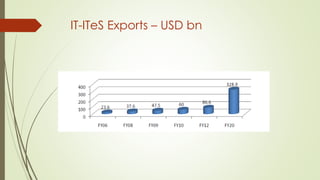
 Indian IT-ITES exports accounted for less than 3% of the global spend on ITITES
 Software and services exports (including BPO) are expected to grow
IT-ITeS Exports – USD bn
Why Outsourcing?
 To focus on their core competency
 So that they cannot waste their “time, money, and energy
 Gain access to world class capabilities
 Share risks with a partner company
Challenges
 Recruitment planning
 Performance management
 Training and development
 Compensation management
 HRM as whole
External Analysis

Current position of IT/ITeS sector in India
Environmental Scanning
BREAKUP OF TOTAL GLOBAL IT SPENDING
total global spending

support and training

out sourcing

869
2013

163
473
816

2012

157
438

763
2011

151
402
711

2010

144
368
External Environment - PESTLE Analysis
 Political:1. Political stability: Indian political structure is stable
2. Government owned companies and PSUs have decided to give more IT
projects to Indian IT companies
 Economic
1. Domestic market to grow by 30% and reach approx. USD 30 billion in 201415 estimated by NASSCOM
2. Due to recession, the layoff and job-cuts have resulted in low attrition rate

3. Economic attractiveness due to cost advantage and other factors
Cont…
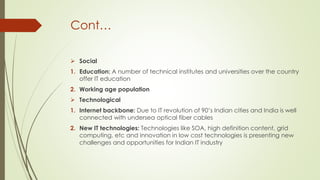
 Social
1. Education: A number of technical institutes and universities over the country
offer IT education
2. Working age population
 Technological
1. Internet backbone: Due to IT revolution of 90’s Indian cities and India is well
connected with undersea optical fiber cables
2. New IT technologies: Technologies like SOA, high definition content, grid
computing, etc and innovation in low cost technologies is presenting new
challenges and opportunities for Indian IT industry
Cont….
 Legal:
1. IT companies can set up SEZ with minimum area of 10 hectares and enjoy
a host of tax and fiscal benefits
2. Indian government is strengthening the IT act 2000 to provide a sound legal
environment
 Environment:
1. Companies are focusing on reducing the carbon footprints, energy
utilization, water consumption, etc.
Porter’s Five Forces Model (Indian IT
Industry)
Threat of
substitutes

Bargaining
power of
Supplier

Rivalry
among
firms:
High

Barrier to
Entry

Bargaining
power of
Customers
SWOT Analysis - IT & ITES Industry
 Strength:a) Cost advantage – most financially attractive country in a study by A T
Kearney on global IT destinations
b) Ease of Scalability – more than half of India’s population is less than 25
years old. English speaking IT – ITES professionals growing at a good pace
 Weaknesses:a) Excessive dependence on USA for revenues – US Companies are cutting
down IT budget hence revenues to be hit hard of Indian IT firms

b) Decreasing competitive advantage – rising salary expenses is taking away
the cost advantage enjoyed by India
Cont….
 Opportunities:a) Greater scope for product innovation Increased focus on high end work like
consulting and KPO Domestic demand for IT services is to grow at 20%
b) Greater scope to service domains other than BFSI such as Transportation,
Infrastructure, etc.
 Threats:a) Global economic slowdown may continue for several years – hence low IT
spending globally US Govt. against outsourcing

b) Increased competition from foreign firms like Accenture, IBM etc.
c) Rupee-dollar movement affects revenue and hence margins
TATA CONSULTANCY SERVICES
 Tata Consultancy Services Ltd. (Founded in 1968, went public in August,
2004)
 Mission: To help our customers achieve their business objectives by
providing innovative, best-in-class Consulting, IT solutions & services. We
shall make it a joy for all stakeholders to work with us
 Values: Integrity, Excellence, Respect for the individual, Continuous learning
and sharing, Leading change
 Leadership in IT Outsourcing: TCS is the largest IT consulting company in Asia
with 143,000 of the world's best trained IT consultants

 Trusted Partner: TCS is part of one of Asia's largest conglomerates - the TATA
Group. The group, with annual revenue of more than USD 72.5 billion+
Cont….
 Headquarters:- TCS is headquartered out of Mumbai, India
 Location:- TCS is operating in 47. TCS has 50+ delivery centers in India across
15 cities; 15+ development centers outside India. TCS’ employees are
spread across countries

 Turnover:- Tata Consultancy Services Limited (TCS) is a leading and India’s
largest provider of IT Services, Business Solutions and Outsourcing with
revenues of 62,989 crores(USD 11.57 billion), showing a 6-fold increase in
nine years, with a compounded annual growth rate (CAGR) of 26.27%
Overview of the financial results of TCS
Limited (consolidated):
SWOT Analysis
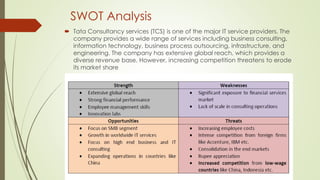
 Tata Consultancy services (TCS) is one of the major IT service providers. The
company provides a wide range of services including business consulting,
information technology, business process outsourcing, infrastructure, and
engineering. The company has extensive global reach, which provides a
diverse revenue base. However, increasing competition threatens to erode
its market share
TCS’ Resources & Capabilities
 TCS has over 2,76,196+ (March-13) World Class Professionals. 32% of
workforce is women. Non Indian nationals comprise 8.3% of TCS workforce.
TCS employees are from across 118 nationalities
 TCS has strong domain expertise in banking, financial services & insurance,
retail and consumer packaged goods, telecom, media and entertainment,
manufacturing and ‘other’ verticals which include hi-tech, life sciences &
healthcare, energy resources & utilities and travel transportation &
hospitality
Diversity
Top 10 nationalities
15.40%

19.70%

3.30%

10.50%
10.00%
8.70%

18.90%
4.90% 4.40%

4.20%
others

filipino

britishers

urugayan

colombian

chileans

ecuadorians

chinese

mexicans

americans
TCS’ Generic Business Strategy

 Low cost Global delivery 24X7 model.
 Focus on customer relationship management, customer retention (for
repeat business revenue which is 95.6%).
 Timely delivery with the help of proven delivery & quality framework – iQMS.
 Differentiation in low end services in terms of cost, resources.
 Differentiation in high end services such as consulting in term of niche
offerings, expertise.

 Protection from currency fluctuations with the help of currency hedging
TCS Service Practice Revenue
revenue

Application Development & maintanance

business intelligence

enterprise solutions

assurance services

engg. & industrial services

infrastructure services

global consulting

asset leverage solution

business process outsourcing
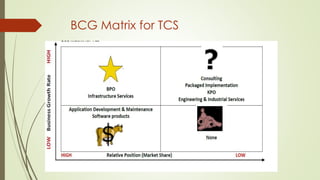
BCG Matrix for TCS
Market Development Strategy
 New/Emerging Markets: India, Middle-east and Australia
 Current Product: ADM, BPO, KPO, consultancy services (in BFSI,
manufacturing and retail) and software products (financial products)
 Recommendation: Since these are fast developing IT market, TCS needs a
paradigm shift in focus from US and EU markets to these markets
Other global strategies
 Since last few years TCS is successfully leveraging labor cost in Eastern
Europe, South America and China
 Recent acquisitions in Ireland and Latin America demonstrate its ambition
to create delivery centers of respectable size outside of India

 TCS was the first one to set up a delivery centre in China
Corporate Strategies
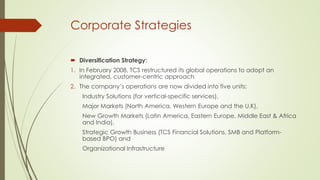
 Diversification Strategy:
1. In February 2008, TCS restructured its global operations to adopt an
integrated, customer-centric approach
2. The company’s operations are now divided into five units:

Industry Solutions (for vertical-specific services),
Major Markets (North America, Western Europe and the U.K),
New Growth Markets (Latin America, Eastern Europe, Middle East & Africa
and India),
Strategic Growth Business (TCS Financial Solutions, SMB and Platformbased BPO) and
Organizational Infrastructure
Cont….
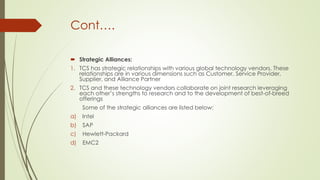
 Strategic Alliances:
1. TCS has strategic relationships with various global technology vendors. These
relationships are in various dimensions such as Customer, Service Provider,
Supplier, and Alliance Partner
2. TCS and these technology vendors collaborate on joint research leveraging
each other’s strengths to research and to the development of best-of-breed
offerings
Some of the strategic alliances are listed below:
a)

Intel

b)

SAP

c)

Hewlett-Packard

d)

EMC2
Cont….
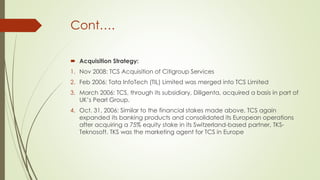
 Acquisition Strategy:
1. Nov 2008: TCS Acquisition of Citigroup Services
2. Feb 2006: Tata InfoTech (TIL) Limited was merged into TCS Limited
3. March 2006: TCS, through its subsidiary, Diligenta, acquired a basis in part of
UK’s Pearl Group.
4. Oct. 31, 2006: Similar to the financial stakes made above, TCS again
expanded its banking products and consolidated its European operations
after acquiring a 75% equity stake in its Switzerland-based partner, TKSTeknosoft. TKS was the marketing agent for TCS in Europe
Cont….
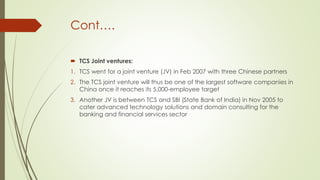
 TCS Joint ventures:
1. TCS went for a joint venture (JV) in Feb 2007 with three Chinese partners
2. The TCS joint venture will thus be one of the largest software companies in
China once it reaches its 5,000-employee target
3. Another JV is between TCS and SBI (State Bank of India) in Nov 2005 to
cater advanced technology solutions and domain consulting for the
banking and financial services sector
Recommendation
 The first and foremost recommendation for TCS is to change its vision
statement. In our humble opinion it is short sighted. TCS needs to have a
vision that will show its leadership qualities and long term thinking.
 Expect to see the landscape continue to consolidate. Clients will seek to
cut costs and focus on fewer provider relationships as the economy
worsens. TCS should take this opportunity to improve your market
positioning.
 Ensure marketing articulates your value proposition to all stakeholders
concerned. In a recession, marketing can work as a differentiator.
 Service providers like TCS need to create specific value propositions aimed
directly at the relevant stakeholders — and in the new tech ecosystem,
these relevant stakeholders must include business executives, not just IT
personnel
Cont….

 Provide more high-end services in value chain (3rd Wave in IT)
 There is a move required from ADM (Application Development and
maintenance) to value added services, BPO to Consulting and Package
Implementation, etc.
 TCS should shift focus from Low cost advantage to high quality services
commanding a premium being the pioneer in the industry
 TCS (rather all Indian IT players) should focus more on increasing their IP
(Intellectual Property) assets.
References

 Tata Consultancy Services www.tcs.com (Investors section)
 Forrester reports www.forrester.com
 Gartner reports www.gartner.com
 IT-ITeS Market & Opportunities – IBEF (India Brand Equity Foundation) report
 Tata Consultancy Services – A Company Profile – www.datamonitor.com
 Newspaper Mint – www.livemint.com
Thank You

It industry & tcs strategic analysis

  • 1.
    IT Industry &TCS Strategic Analysis Business Strategy This report is submitted as part of industry analysis project of the course ‘Competitor’, under the guidance of Prof. Vinay Chirania, in Post Graduate Diploma In Management at IILM Graduate School of Management, Greater Noida.
  • 2.
    Group 6 Submitted by: Abhigyan  Dipandita Kar  Himali Kulshrestha  Mridul Tiwari  Priyanka Aggarwal Submitted to:  Subhashree Roy Prof. Vinay Chirania  Vaibhav Singh
  • 3.
    Indian IT IndustryOverview  The IT-ITeS industry in India has today become a growth engine for the economy  India is now the leading country in providing IT Enabled Services in the world  India holds a dominant share of the global offshore IT-ITES sector  Indian IT-ITES exports accounted for less than 3% of the global spend on ITITES  Software and services exports (including BPO) are expected to grow
  • 4.
  • 5.
    Why Outsourcing?  Tofocus on their core competency  So that they cannot waste their “time, money, and energy  Gain access to world class capabilities  Share risks with a partner company
  • 6.
    Challenges  Recruitment planning Performance management  Training and development  Compensation management  HRM as whole
  • 7.
    External Analysis Current positionof IT/ITeS sector in India
  • 8.
    Environmental Scanning BREAKUP OFTOTAL GLOBAL IT SPENDING total global spending support and training out sourcing 869 2013 163 473 816 2012 157 438 763 2011 151 402 711 2010 144 368
  • 9.
    External Environment -PESTLE Analysis  Political:1. Political stability: Indian political structure is stable 2. Government owned companies and PSUs have decided to give more IT projects to Indian IT companies  Economic 1. Domestic market to grow by 30% and reach approx. USD 30 billion in 201415 estimated by NASSCOM 2. Due to recession, the layoff and job-cuts have resulted in low attrition rate 3. Economic attractiveness due to cost advantage and other factors
  • 10.
    Cont…  Social 1. Education:A number of technical institutes and universities over the country offer IT education 2. Working age population  Technological 1. Internet backbone: Due to IT revolution of 90’s Indian cities and India is well connected with undersea optical fiber cables 2. New IT technologies: Technologies like SOA, high definition content, grid computing, etc and innovation in low cost technologies is presenting new challenges and opportunities for Indian IT industry
  • 11.
    Cont….  Legal: 1. ITcompanies can set up SEZ with minimum area of 10 hectares and enjoy a host of tax and fiscal benefits 2. Indian government is strengthening the IT act 2000 to provide a sound legal environment  Environment: 1. Companies are focusing on reducing the carbon footprints, energy utilization, water consumption, etc.
  • 12.
    Porter’s Five ForcesModel (Indian IT Industry) Threat of substitutes Bargaining power of Supplier Rivalry among firms: High Barrier to Entry Bargaining power of Customers
  • 13.
    SWOT Analysis -IT & ITES Industry  Strength:a) Cost advantage – most financially attractive country in a study by A T Kearney on global IT destinations b) Ease of Scalability – more than half of India’s population is less than 25 years old. English speaking IT – ITES professionals growing at a good pace  Weaknesses:a) Excessive dependence on USA for revenues – US Companies are cutting down IT budget hence revenues to be hit hard of Indian IT firms b) Decreasing competitive advantage – rising salary expenses is taking away the cost advantage enjoyed by India
  • 14.
    Cont….  Opportunities:a) Greaterscope for product innovation Increased focus on high end work like consulting and KPO Domestic demand for IT services is to grow at 20% b) Greater scope to service domains other than BFSI such as Transportation, Infrastructure, etc.  Threats:a) Global economic slowdown may continue for several years – hence low IT spending globally US Govt. against outsourcing b) Increased competition from foreign firms like Accenture, IBM etc. c) Rupee-dollar movement affects revenue and hence margins
  • 15.
    TATA CONSULTANCY SERVICES Tata Consultancy Services Ltd. (Founded in 1968, went public in August, 2004)  Mission: To help our customers achieve their business objectives by providing innovative, best-in-class Consulting, IT solutions & services. We shall make it a joy for all stakeholders to work with us  Values: Integrity, Excellence, Respect for the individual, Continuous learning and sharing, Leading change  Leadership in IT Outsourcing: TCS is the largest IT consulting company in Asia with 143,000 of the world's best trained IT consultants  Trusted Partner: TCS is part of one of Asia's largest conglomerates - the TATA Group. The group, with annual revenue of more than USD 72.5 billion+
  • 16.
    Cont….  Headquarters:- TCSis headquartered out of Mumbai, India  Location:- TCS is operating in 47. TCS has 50+ delivery centers in India across 15 cities; 15+ development centers outside India. TCS’ employees are spread across countries  Turnover:- Tata Consultancy Services Limited (TCS) is a leading and India’s largest provider of IT Services, Business Solutions and Outsourcing with revenues of 62,989 crores(USD 11.57 billion), showing a 6-fold increase in nine years, with a compounded annual growth rate (CAGR) of 26.27%
  • 17.
    Overview of thefinancial results of TCS Limited (consolidated):
  • 18.
    SWOT Analysis  TataConsultancy services (TCS) is one of the major IT service providers. The company provides a wide range of services including business consulting, information technology, business process outsourcing, infrastructure, and engineering. The company has extensive global reach, which provides a diverse revenue base. However, increasing competition threatens to erode its market share
  • 19.
    TCS’ Resources &Capabilities  TCS has over 2,76,196+ (March-13) World Class Professionals. 32% of workforce is women. Non Indian nationals comprise 8.3% of TCS workforce. TCS employees are from across 118 nationalities  TCS has strong domain expertise in banking, financial services & insurance, retail and consumer packaged goods, telecom, media and entertainment, manufacturing and ‘other’ verticals which include hi-tech, life sciences & healthcare, energy resources & utilities and travel transportation & hospitality
  • 20.
    Diversity Top 10 nationalities 15.40% 19.70% 3.30% 10.50% 10.00% 8.70% 18.90% 4.90%4.40% 4.20% others filipino britishers urugayan colombian chileans ecuadorians chinese mexicans americans
  • 21.
    TCS’ Generic BusinessStrategy  Low cost Global delivery 24X7 model.  Focus on customer relationship management, customer retention (for repeat business revenue which is 95.6%).  Timely delivery with the help of proven delivery & quality framework – iQMS.  Differentiation in low end services in terms of cost, resources.  Differentiation in high end services such as consulting in term of niche offerings, expertise.  Protection from currency fluctuations with the help of currency hedging
  • 22.
    TCS Service PracticeRevenue revenue Application Development & maintanance business intelligence enterprise solutions assurance services engg. & industrial services infrastructure services global consulting asset leverage solution business process outsourcing
  • 23.
  • 24.
    Market Development Strategy New/Emerging Markets: India, Middle-east and Australia  Current Product: ADM, BPO, KPO, consultancy services (in BFSI, manufacturing and retail) and software products (financial products)  Recommendation: Since these are fast developing IT market, TCS needs a paradigm shift in focus from US and EU markets to these markets
  • 25.
    Other global strategies Since last few years TCS is successfully leveraging labor cost in Eastern Europe, South America and China  Recent acquisitions in Ireland and Latin America demonstrate its ambition to create delivery centers of respectable size outside of India  TCS was the first one to set up a delivery centre in China
  • 26.
    Corporate Strategies  DiversificationStrategy: 1. In February 2008, TCS restructured its global operations to adopt an integrated, customer-centric approach 2. The company’s operations are now divided into five units: Industry Solutions (for vertical-specific services), Major Markets (North America, Western Europe and the U.K), New Growth Markets (Latin America, Eastern Europe, Middle East & Africa and India), Strategic Growth Business (TCS Financial Solutions, SMB and Platformbased BPO) and Organizational Infrastructure
  • 27.
    Cont….  Strategic Alliances: 1.TCS has strategic relationships with various global technology vendors. These relationships are in various dimensions such as Customer, Service Provider, Supplier, and Alliance Partner 2. TCS and these technology vendors collaborate on joint research leveraging each other’s strengths to research and to the development of best-of-breed offerings Some of the strategic alliances are listed below: a) Intel b) SAP c) Hewlett-Packard d) EMC2
  • 28.
    Cont….  Acquisition Strategy: 1.Nov 2008: TCS Acquisition of Citigroup Services 2. Feb 2006: Tata InfoTech (TIL) Limited was merged into TCS Limited 3. March 2006: TCS, through its subsidiary, Diligenta, acquired a basis in part of UK’s Pearl Group. 4. Oct. 31, 2006: Similar to the financial stakes made above, TCS again expanded its banking products and consolidated its European operations after acquiring a 75% equity stake in its Switzerland-based partner, TKSTeknosoft. TKS was the marketing agent for TCS in Europe
  • 29.
    Cont….  TCS Jointventures: 1. TCS went for a joint venture (JV) in Feb 2007 with three Chinese partners 2. The TCS joint venture will thus be one of the largest software companies in China once it reaches its 5,000-employee target 3. Another JV is between TCS and SBI (State Bank of India) in Nov 2005 to cater advanced technology solutions and domain consulting for the banking and financial services sector
  • 30.
    Recommendation  The firstand foremost recommendation for TCS is to change its vision statement. In our humble opinion it is short sighted. TCS needs to have a vision that will show its leadership qualities and long term thinking.  Expect to see the landscape continue to consolidate. Clients will seek to cut costs and focus on fewer provider relationships as the economy worsens. TCS should take this opportunity to improve your market positioning.  Ensure marketing articulates your value proposition to all stakeholders concerned. In a recession, marketing can work as a differentiator.  Service providers like TCS need to create specific value propositions aimed directly at the relevant stakeholders — and in the new tech ecosystem, these relevant stakeholders must include business executives, not just IT personnel
  • 31.
    Cont….  Provide morehigh-end services in value chain (3rd Wave in IT)  There is a move required from ADM (Application Development and maintenance) to value added services, BPO to Consulting and Package Implementation, etc.  TCS should shift focus from Low cost advantage to high quality services commanding a premium being the pioneer in the industry  TCS (rather all Indian IT players) should focus more on increasing their IP (Intellectual Property) assets.
  • 32.
    References  Tata ConsultancyServices www.tcs.com (Investors section)  Forrester reports www.forrester.com  Gartner reports www.gartner.com  IT-ITeS Market & Opportunities – IBEF (India Brand Equity Foundation) report  Tata Consultancy Services – A Company Profile – www.datamonitor.com  Newspaper Mint – www.livemint.com
  • 33.