Somipam R. Shimray
IV/Semester
Pondicherry University
TATA Group
 Founded by J.N. Tata in 1868 headquartered in Mumbai,
Maharashtra
 Over 100 global operating companies
 Major Tata companies are:
 TCS
 Tata steel
 Tata Motors
 Tata power
 Tata chemicals
 Tata communication
 Indian hotels etc.
TCS
 TCS
 1968 as a division of Tata Sons Ltd. headquartered in Mumbai,
Maharashtra
 Operating in 46 countries with 199 branch
 Engineering, energy, financial services etc.
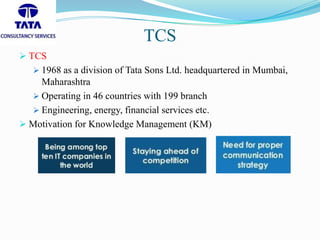
 Motivation for Knowledge Management (KM)
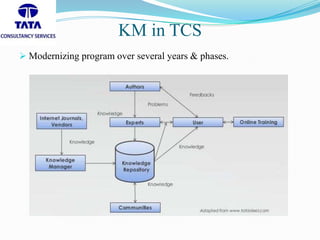
KM in TCS
 Modernizing program over several years & phases.
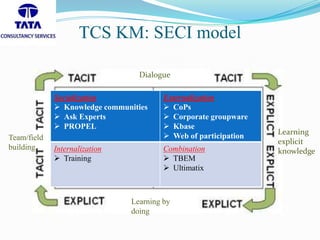
TCS KM: SECI model
Socialization
 Knowledge communities
 Ask Experts
 PROPEL
Externalization
 CoPs
 Corporate groupware
 Kbase
 Web of participation
Internalization
 Training
Combination
 TBEM
 Ultimatix
Team/field
building
Dialogue
Learning
explicit
knowledge
Learning by
doing
KM: Success factors in TCS
 Senior management drove the change and encourage knowledge
sharing
 Change is universal: people, process and technology
 Increased value of intellectual capital by constant learning
 Strong investment in human capital and training
KM: Success factors in TCS
Culture values
 People are most important factor
 Optimal resource utilization
 Global outlook
 Continuous change and constant learning
 Job rotation across projects, functions and companies
KM: Success factors in TCS
Ultimatix
 Digital KM
 Speed up the process of decision making
 Digitize the organization
 Connected all the employees around the globe
 Knowledge bases: Communication network and Knowledge
Repository
KM: Success factors in TCS
TBEM (Tata Business Excellence Model)
 Applied in many group companies urging best practices to be shared
among organization
 Addresses all aspects of quality e.g. leadership, Strategy, KM, HR,
etc.
 Helped employees learned about:
 Managing data
 Process orientation
 Motivating people
 TCS was accessed by trained TBEM people from other TATA group
companies for knowledge sharing
KM: Success factors in TCS
KM maturity
 Assessed the clients readiness to adopted KM initiatives
 Helped customers formulate a KM vision and strategy
 Suggested a KM “road map”: explaining policies and processes,
conducting awareness and training sessions
Codification and Personalization
 In 1990s, KM started to gain strategic management relevance
 Codification: Knowledge is codified and stored in database /
repositories and made independent of the person so that it can be
easily accessed and used by anyone
 Personalization: Knowledge is tried to the person who
developed/gained it and is shared through person-to-person contact
and build network of people
TCS
 TCS mixed approach (Codification and Personalization)
 Balance between Codification and Personalization strategies
Evaluation of KM efforts:TCS
-Employee jobs satisfaction
Increase -Employee engagement/
participation
-Overloading information
Reduce -Loss of intellectual capital
-Creativity, learning
Conclusion
 Established in 1968
 It is one of the leading TATA companies
 Indian multinational information technology (IT) services, business
process and consulting company
 TCS is the largest Indian company by market capitalization and is
the largest India-based IT services company by 2013 revenues
 TCS is ranked 40th overall in the Forbes World's Most Innovative
Companies ranking, making it both the highest-ranked IT services
company and the top Indian company

Knowledge Management Tata consultancy service

  • 1.
  • 2.
    TATA Group  Foundedby J.N. Tata in 1868 headquartered in Mumbai, Maharashtra  Over 100 global operating companies  Major Tata companies are:  TCS  Tata steel  Tata Motors  Tata power  Tata chemicals  Tata communication  Indian hotels etc.
  • 3.
    TCS  TCS  1968as a division of Tata Sons Ltd. headquartered in Mumbai, Maharashtra  Operating in 46 countries with 199 branch  Engineering, energy, financial services etc.  Motivation for Knowledge Management (KM)
  • 4.
    KM in TCS Modernizing program over several years & phases.
  • 5.
    TCS KM: SECImodel Socialization  Knowledge communities  Ask Experts  PROPEL Externalization  CoPs  Corporate groupware  Kbase  Web of participation Internalization  Training Combination  TBEM  Ultimatix Team/field building Dialogue Learning explicit knowledge Learning by doing
  • 6.
    KM: Success factorsin TCS  Senior management drove the change and encourage knowledge sharing  Change is universal: people, process and technology  Increased value of intellectual capital by constant learning  Strong investment in human capital and training
  • 7.
    KM: Success factorsin TCS Culture values  People are most important factor  Optimal resource utilization  Global outlook  Continuous change and constant learning  Job rotation across projects, functions and companies
  • 8.
    KM: Success factorsin TCS Ultimatix  Digital KM  Speed up the process of decision making  Digitize the organization  Connected all the employees around the globe  Knowledge bases: Communication network and Knowledge Repository
  • 9.
    KM: Success factorsin TCS TBEM (Tata Business Excellence Model)  Applied in many group companies urging best practices to be shared among organization  Addresses all aspects of quality e.g. leadership, Strategy, KM, HR, etc.  Helped employees learned about:  Managing data  Process orientation  Motivating people  TCS was accessed by trained TBEM people from other TATA group companies for knowledge sharing
  • 10.
    KM: Success factorsin TCS KM maturity  Assessed the clients readiness to adopted KM initiatives  Helped customers formulate a KM vision and strategy  Suggested a KM “road map”: explaining policies and processes, conducting awareness and training sessions
  • 11.
    Codification and Personalization In 1990s, KM started to gain strategic management relevance  Codification: Knowledge is codified and stored in database / repositories and made independent of the person so that it can be easily accessed and used by anyone  Personalization: Knowledge is tried to the person who developed/gained it and is shared through person-to-person contact and build network of people
  • 12.
    TCS  TCS mixedapproach (Codification and Personalization)  Balance between Codification and Personalization strategies
  • 13.
    Evaluation of KMefforts:TCS -Employee jobs satisfaction Increase -Employee engagement/ participation -Overloading information Reduce -Loss of intellectual capital -Creativity, learning
  • 14.
    Conclusion  Established in1968  It is one of the leading TATA companies  Indian multinational information technology (IT) services, business process and consulting company  TCS is the largest Indian company by market capitalization and is the largest India-based IT services company by 2013 revenues  TCS is ranked 40th overall in the Forbes World's Most Innovative Companies ranking, making it both the highest-ranked IT services company and the top Indian company