KM maturity model
(KMMM)
Barbie Keiser
Library Juice Academy
June 2021
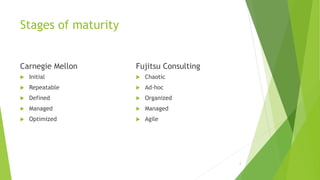
Stages of maturity
Carnegie Mellon
 Initial
 Repeatable
 Defined
 Managed
 Optimized
Fujitsu Consulting
 Chaotic
 Ad-hoc
 Organized
 Managed
 Agile
2
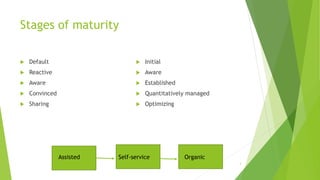
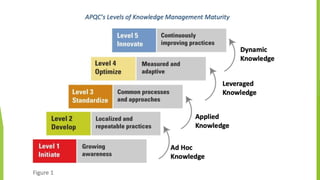
Stages of maturity
 Default
 Reactive
 Aware
 Convinced
 Sharing
 Initial
 Aware
 Established
 Quantitatively managed
 Optimizing
3
Assisted Self-service Organic
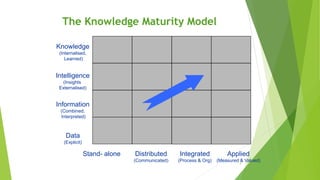
Data
(Explicit)
Information
(Combined,
Interpreted)
Intelligence
(Insights
Externalised)
Knowledge
(Internalised,
Learned)
Integrated
(Process & Org)
Applied
(Measured & Valued)
Stand- alone Distributed
(Communicated)
The Knowledge Maturity Model
4
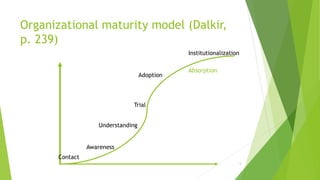
Organizational maturity model (Dalkir,
p. 239)
5
Contact
Awareness
Understanding
Trial
Institutionalization
Adoption
Absorption
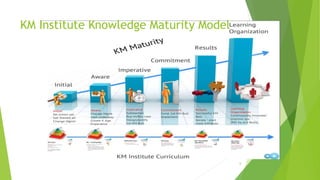
KM Institute Knowledge Maturity Model
6
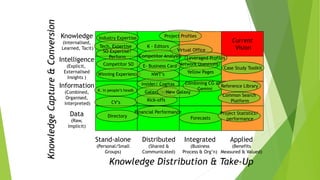
Current
Vision
Competitor SO
Winning Experience
Industry Expertise
K. in people’s heads
Knowledge
Capture
&
Conversion
Tech. Expertise
SO Expertise/
Perform
Directory
Knowledge Distribution & Take-Up
CV’s
Financial Performance
Forecasts
Insider/ Cogitas
NWT’s
Galaxy/Intra
Kick-offs
K - Editors
Network Questions
Competitor Analysis
New Galaxy
E- Business Card
Combining CG and
Gemini
Yellow Pages
Project Profiles
Virtual Office
Project Statistics/
performance
Leveraged Profiles
Case Study Toolkit
Reference Library
Common Search
Platform
Data
(Raw,
Implicit)
Information
(Combined,
Organised,
Interpreted)
Intelligence
(Explicit,
Externalised
Insights )
Knowledge
(Internalised,
Learned, Tacit)
Stand-alone
(Personal/Small
Groups)
Distributed
(Shared &
Communicated)
Integrated
(Business
Process & Org’n)
Applied
(Benefits
Measured & Valued)
8
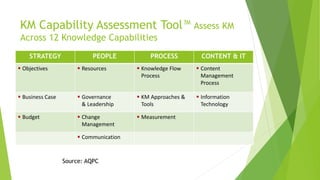
KM Capability Assessment Tool™ Assess KM
Across 12 Knowledge Capabilities
STRATEGY PEOPLE PROCESS CONTENT & IT
 Objectives  Resources  Knowledge Flow
Process
 Content
Management
Process
 Business Case  Governance
& Leadership
 KM Approaches &
Tools
 Information
Technology
 Budget  Change
Management
 Measurement
 Communication
Source: AQPC
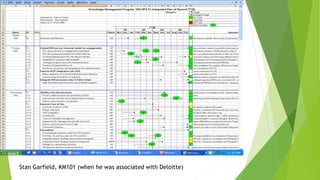
Stan Garfield, KM101 (when he was associated with Deloitte)
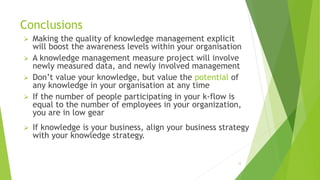
Conclusions
 Making the quality of knowledge management explicit
will boost the awareness levels within your organisation
 A knowledge management measure project will involve
newly measured data, and newly involved management
 Don’t value your knowledge, but value the potential of
any knowledge in your organisation at any time
 If the number of people participating in your k-flow is
equal to the number of employees in your organization,
you are in low gear
 If knowledge is your business, align your business strategy
with your knowledge strategy.
12
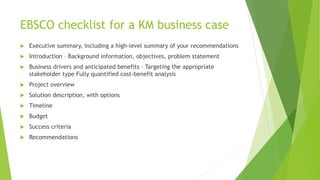
EBSCO checklist for a KM business case
 Executive summary, including a high-level summary of your recommendations
 Introduction – Background information, objectives, problem statement
 Business drivers and anticipated benefits – Targeting the appropriate
stakeholder type Fully quantified cost-benefit analysis
 Project overview
 Solution description, with options
 Timeline
 Budget
 Success criteria
 Recommendations

Knowledge management maturity model

  • 1.
    KM maturity model (KMMM) BarbieKeiser Library Juice Academy June 2021
  • 2.
    Stages of maturity CarnegieMellon  Initial  Repeatable  Defined  Managed  Optimized Fujitsu Consulting  Chaotic  Ad-hoc  Organized  Managed  Agile 2
  • 3.
    Stages of maturity Default  Reactive  Aware  Convinced  Sharing  Initial  Aware  Established  Quantitatively managed  Optimizing 3 Assisted Self-service Organic
  • 4.
  • 5.
    Organizational maturity model(Dalkir, p. 239) 5 Contact Awareness Understanding Trial Institutionalization Adoption Absorption
  • 6.
    KM Institute KnowledgeMaturity Model 6
  • 8.
    Current Vision Competitor SO Winning Experience IndustryExpertise K. in people’s heads Knowledge Capture & Conversion Tech. Expertise SO Expertise/ Perform Directory Knowledge Distribution & Take-Up CV’s Financial Performance Forecasts Insider/ Cogitas NWT’s Galaxy/Intra Kick-offs K - Editors Network Questions Competitor Analysis New Galaxy E- Business Card Combining CG and Gemini Yellow Pages Project Profiles Virtual Office Project Statistics/ performance Leveraged Profiles Case Study Toolkit Reference Library Common Search Platform Data (Raw, Implicit) Information (Combined, Organised, Interpreted) Intelligence (Explicit, Externalised Insights ) Knowledge (Internalised, Learned, Tacit) Stand-alone (Personal/Small Groups) Distributed (Shared & Communicated) Integrated (Business Process & Org’n) Applied (Benefits Measured & Valued) 8
  • 10.
    KM Capability AssessmentTool™ Assess KM Across 12 Knowledge Capabilities STRATEGY PEOPLE PROCESS CONTENT & IT  Objectives  Resources  Knowledge Flow Process  Content Management Process  Business Case  Governance & Leadership  KM Approaches & Tools  Information Technology  Budget  Change Management  Measurement  Communication Source: AQPC
  • 11.
    Stan Garfield, KM101(when he was associated with Deloitte)
  • 12.
    Conclusions  Making thequality of knowledge management explicit will boost the awareness levels within your organisation  A knowledge management measure project will involve newly measured data, and newly involved management  Don’t value your knowledge, but value the potential of any knowledge in your organisation at any time  If the number of people participating in your k-flow is equal to the number of employees in your organization, you are in low gear  If knowledge is your business, align your business strategy with your knowledge strategy. 12
  • 14.
    EBSCO checklist fora KM business case  Executive summary, including a high-level summary of your recommendations  Introduction – Background information, objectives, problem statement  Business drivers and anticipated benefits – Targeting the appropriate stakeholder type Fully quantified cost-benefit analysis  Project overview  Solution description, with options  Timeline  Budget  Success criteria  Recommendations