WQ Management Developments
     Nutrients, Bacteria
Jim Davenport
Monitoring & Assessment Section
Water Quality Planning Division
Office of Water
Texas Commission on Environmental Quality
jdavenpo@tceq.state.tx.us tel. 512/239-4585

February 22, 2011
Nutrient Criteria: National
EPA and numerical nutrient criteria:
- 1998 mandate: states to have criteria by 2004
- Allowed state development plans and schedules
- Established stringent national guidance criteria
  ○ Calculated from historical instream data
  ○ Separate for lakes, streams, reservoirs
  ○ Pooled for large, aggregate ecoregions
  ○ Criteria = 75th percentile of unimpacted sites
- Urged by EPA Inspector General, Aug 2009
- Lawsuits: Florida (Wisconsin, Kansas)
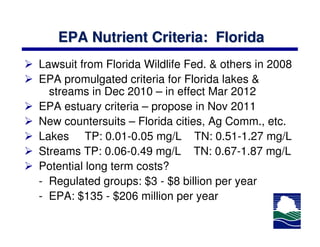
EPA Nutrient Criteria: Florida
Lawsuit from Florida Wildlife Fed. & others in 2008
EPA promulgated criteria for Florida lakes &
  streams in Dec 2010 – in effect Mar 2012
EPA estuary criteria – propose in Nov 2011
New countersuits – Florida cities, Ag Comm., etc.
Lakes TP: 0.01-0.05 mg/L TN: 0.51-1.27 mg/L
Streams TP: 0.06-0.49 mg/L TN: 0.67-1.87 mg/L
Potential long term costs?
- Regulated groups: $3 - $8 billion per year
- EPA: $135 - $206 million per year
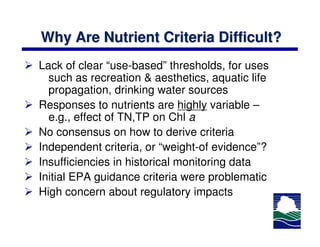
Why Are Nutrient Criteria Difficult?
Lack of clear “use-based” thresholds, for uses
  such as recreation & aesthetics, aquatic life
  propagation, drinking water sources
Responses to nutrients are highly variable –
  e.g., effect of TN,TP on Chl a
No consensus on how to derive criteria
Independent criteria, or “weight-of evidence”?
Insufficiencies in historical monitoring data
Initial EPA guidance criteria were problematic
High concern about regulatory impacts
TCEQ Nutrient Criteria: Development

Submitted plans to EPA in 2001, 2006
Reservoirs, then streams & estuaries
Convened advisory workgroup
Separate criteria for each reservoir
Set on historical conditions
Adopted for 75 reservoirs – 6/30/10
Based on Chlorophyll a
 (suspended algae)
New permitting procedures for nutrients
Nutrient Criteria: Examples

   Reservoir   Chl a (µg/L)    TP (mg/L)    Transparency
               Stand-alone    Not adopted     (meters)
                                             Not adopted
Eagle Mtn         25.4           0.07           0.80

Cedar Creek       30.4           0.07           0.80

Livingston        23.0           0.16           0.67

Lewisville        18.5           0.06           0.60

[Houston –        [12.4]         0.18           0.28
not adopted]
Travis              3.7          0.03           3.13
2010 Nutrient Implementation Procedures


In 2010 Standards Implementation Procedures
Applied to increases in domestic discharges
Sets framework for nutrient (TP) effluent limits
Reservoirs – predict effects on “main pool”
Relate TP to reservoir chlorophyll a criteria
Streams and reservoirs – assess local impacts:
- Apply site-specific screening factors
- Level of concern – low, moderate, or high
- Assess “weight-of-evidence”
Nutrient Screening: Local Factors for Streams

- Size of discharge
- Instream dilution
- Sensitivity to attached vegetation – type of bottom
- Sensitivity to attached vegetation – depth
- Sensitivity to nutrient enrichment – clarity
- Sensitivity to aquatic vegetation – observations
- Sensitivity to aquatic vegetation – sunlight, tree shading
- Streamflow sustainability
- Impoundments and pools
- Consistency with other permits
- Listed as a nutrient concern in WQ inventory?
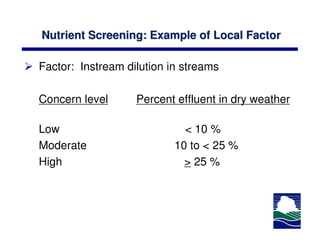
Nutrient Screening: Example of Local Factor

Factor: Instream dilution in streams

Concern level      Percent effluent in dry weather

Low                          < 10 %
Moderate                   10 to < 25 %
High                         > 25 %
Nutrient Criteria: The Road Ahead

Reconvene nutrient advisory committee
Review data and academic research; and
survey criteria development state-by-state
(joint project with U. of Houston Clear Lake)
Continue special stream surveys (> 100 so far)
Develop criteria options for streams & estuaries:
(1) Historical levels at reference sites
(2) Relate TP,TN to D.O., algae, biological indices
Consider in part for next standards revisions
Revised Recreational Standards (6/30/10)

<    Previously: Almost all water bodies primary contact
<    303 water bodies not meeting bacteria criteria (2010)
<    Expand recreational categories
<    Implement new use-attainability analyses
<    Require bacteria limits in discharge permits
        - in addition to chlorination (11/4/09)
Recreation Uses                 Indicator Bacteria
                       Geometric Mean Criteria (colonies/100 ml)
                       E. coli (FW)      Enterococci (SW)
Previous Standards:
 Contact recreation        126                    35
 Noncontact rec.           605                    168
Adopted Standards:
    (6/30/2010)
 Primary contact           126                    35
 Secondary contact 1       630                    175
 Secondary contact 2      1030                     --
 Noncontact rec.          2060                    350
Recreational Use-Attainability

▸ Uses other than primary contact may be
  appropriate for some water bodies
▸ TCEQ has new recreational UAA procedures
▸ Surveys include physical & flow characteristics,
  + observed evidence of recreation
▸ Local input (interviews) important
▸ Initiated 124 recreational UAAs
▸ Involves major coordination effort
  and public participation
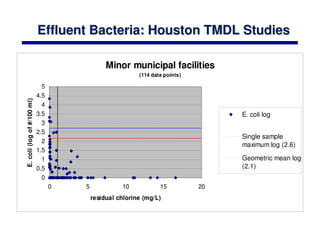
Effluent Bacteria: Houston TMDL Studies

                                               Minor municipal facilities
                                                          (114 data points)

                              5
                            4.5
E. coli (log of #/100 ml)


                              4
                            3.5                                                    E. coli log
                              3
                            2.5
                                                                                   Single sample
                              2
                                                                                   maximum log (2.6)
                            1.5
                              1                                                    Geometric mean log
                            0.5                                                    (2.1)
                              0
                                  0   5             10            15          20
                                          residual chlorine (mg/L)
Summary

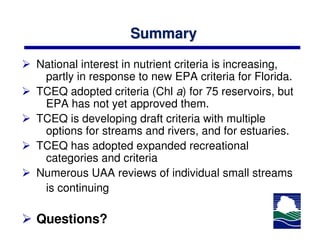
National interest in nutrient criteria is increasing,
 partly in response to new EPA criteria for Florida.
TCEQ adopted criteria (Chl a) for 75 reservoirs, but
 EPA has not yet approved them.
TCEQ is developing draft criteria with multiple
 options for streams and rivers, and for estuaries.
TCEQ has adopted expanded recreational
 categories and criteria
Numerous UAA reviews of individual small streams
 is continuing

Questions?
Bacteria
Requirements
      Bacteria Limits
in TPDES Domestic Permits
Agreement with EPA
Interim: bacteria limits in certain
permits
Bacteria limits in all permit actions
issued after 1/1/10.
Permits issued under interim
agreement may see frequency
adjustment in next permit
Implementation
Next permit action
  New
  Renewal
  Amendment
No compliance schedule
Recommend evaluating now
Bacteria Limits
Standard
  E coli
   126 avg
   394 max
 Enterococci
   35 avg
   89 max
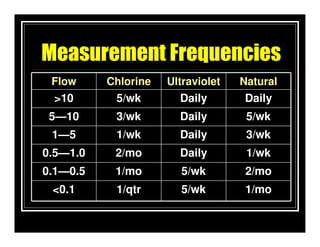
Measurement Frequencies
 Flow     Chlorine   Ultraviolet   Natural
 >10       5/wk        Daily       Daily
 5—10      3/wk        Daily        5/wk
 1—5       1/wk        Daily        3/wk
0.5—1.0    2/mo        Daily        1/wk
0.1—0.5    1/mo        5/wk         2/mo
 <0.1      1/qtr       5/wk         1/mo
Continued Need for
          Chlorine Testing
Retain
  4.0 mg maximum
  0.1 mg dechlor


Regular check
between bacteria
samples
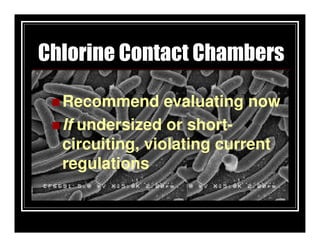
Chlorine Contact Chambers

  Recommend evaluating now
  If undersized or short-
  circuiting, violating current
  regulations
Pond Systems
21-day retention time
Recommend evaluating
 Capacities
 Sample Locations
 Wildlife impacts (birds, nutria, etc)
Compliance schedule for new
construction
Laboratory Issues
In-house testing
without NELAC
Contract lab must be
NELAC certified
Proximity to plant
Increased workload
Sample Holding Times
Standard Methods
  Holding time – 6 hours
  Set-up time – 2 hours
Travel time issues
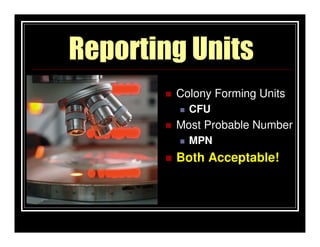
Reporting Units
        Colony Forming Units
          CFU
        Most Probable Number
          MPN
        Both Acceptable!
Nutrient Removal


              Chapter 217:
Design Criteria for Wastewater Systems
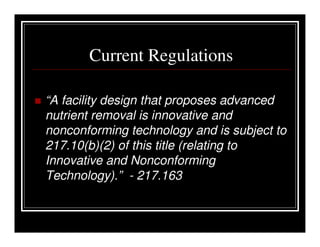
Current Regulations

“A facility design that proposes advanced
nutrient removal is innovative and
nonconforming technology and is subject to
217.10(b)(2) of this title (relating to
Innovative and Nonconforming
Technology).” - 217.163
Results
Wide variety of removal processes yielding
eco-regionally dependent results

Problems-
  Variability of ego-regional conditions in Texas
  One treatment process with several different
  performance reports
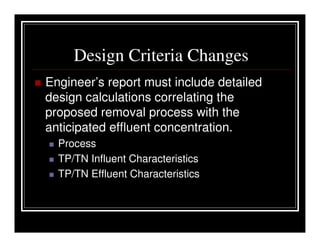
Design Criteria Changes
Engineer’s report must include detailed
design calculations correlating the
proposed removal process with the
anticipated effluent concentration.
  Process
  TP/TN Influent Characteristics
  TP/TN Effluent Characteristics
Desired Ranges
Total Nitrogen           < 8 mg/L

Total Phosphorous
  Chemical Addition:     0.1 - 0.5 mg/L
  Membrane Filtration:   0.1 - 0.5 mg/L
  BNR:                   0.2 - 0.3 mg/L
Specific effluent standards are still
considered on case-by-case basis in each
permit
Contact Info
Louis C. Herrin, III, P.E.

louis.herrin@tceq.texas.gov


512.239.4552
Membrane Bioreactors (MBR)


Compiled Surveys from Vendors of Membranes
          Huber, Koch, Kruger, Kubota, Siemens, Zenon

Results of Survey, Literature and Other State Regulations

Concerns
           Prevention of Fouling
           Adequate aeration at high MLSS concentrations
           Achievable rate of flow through membranes
           Adequate pretreatment i.e. fine screening
           Hydraulics
           Ensure Integrity
           Foam Control
           Warranty
           Nutrient Removal
Membrane Bioreactors (MBR)


                         Applicability
Submerged
Low-pressure, vacuum or gravity
Ultrafiltration or microfiltration

217.8(b)(2) Approval of Nonconforming and Innovative
Technologies
   May require pilot study and/or 2 year performance bond
Membrane Bioreactors (MBR)
                     Expected Performance

    CBOD5                                               5 mg/l
    TSS                                                 1 mg/l
    Ammonia                                             1 mg/l
    Total Nitrogen (w/pre-anoxic zone)                  10 mg/l
    Total Nitrogen (w/pre-anoxic and
         post-anoxic zone)                              3 mg/l
    Total Phosphorus (with chemical addition)           0.2 mg/l
    Total Phosphorus (with Bio-P removal)               0.5 mg/l
    Turbidity                                           0.2 NTU
    Bacteria                         up to 6 log removal (99.9999%)
    Viruses                          up to 3 log removal (99.9999%)


If proposed design is for higher quality effluent,
     Pilot Study or Data from Similar Facility
Membrane Bioreactors (MBR)

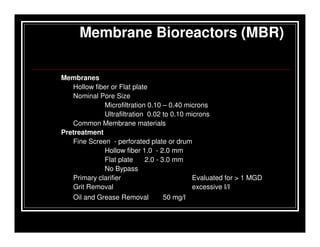
Membranes
   Hollow fiber or Flat plate
   Nominal Pore Size
             Microfiltration 0.10 – 0.40 microns
             Ultrafiltration 0.02 to 0.10 microns
   Common Membrane materials
Pretreatment
   Fine Screen - perforated plate or drum
             Hollow fiber 1.0 - 2.0 mm
             Flat plate     2.0 - 3.0 mm
             No Bypass
   Primary clarifier                       Evaluated for > 1 MGD
   Grit Removal                             excessive I/I
   Oil and Grease Removal       50 mg/l
Membrane Bioreactors (MBR)


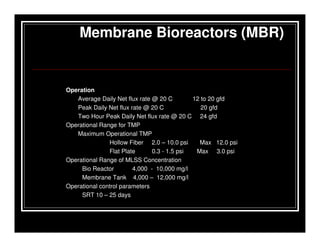
Operation
   Average Daily Net flux rate @ 20 C        12 to 20 gfd
   Peak Daily Net flux rate @ 20 C              20 gfd
   Two Hour Peak Daily Net flux rate @ 20 C 24 gfd
Operational Range for TMP
   Maximum Operational TMP
               Hollow Fiber 2.0 – 10.0 psi     Max 12.0 psi
               Flat Plate      0.3 - 1.5 psi  Max 3.0 psi
Operational Range of MLSS Concentration
     Bio Reactor        4,000 - 10,000 mg/l
     Membrane Tank 4,000 – 12,000 mg/l
Operational control parameters
     SRT 10 – 25 days
Membrane Bioreactors (MBR)


Operation
Amount of air used per square foot of membrane
                0.01 – 0.04 SCFM / SF
Method of Integrity Testing : In-line Turbidity <=1.0 NTU
Hollow Fiber Pressure Decay Testing
Surface Wasting to Foam Control
Run in full manual mode or backup PLC
Aeration
    alpha value of 0.5 or lower
    anoxic                  0.5 mg/l DO
    aerobic                 1.5 – 3.0 mg/l DO
    membrane 2.0 - 8.0 mg/l DO
Nutrient Removal
    deoxygenate recycle
    recycle 300 – 600 percent
Membrane Bioreactors (MBR)


Redundancy
   N+1, trains, units or storage. Show calculations
Peak Flow
   Peak Ratio of 2.5 requires Equalization, off-line storage or reserve
   membrane capacity
RAS rate
   200 – 400 percent of influent
Warranty
   5 year on Membranes
    May require a 2 year performance bond
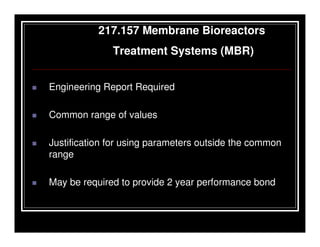
217.157 Membrane Bioreactors
              Treatment Systems (MBR)


Engineering Report Required

Common range of values

Justification for using parameters outside the common
range

May be required to provide 2 year performance bond

Water Quality Managements Developments: Nutrients and Bacteria

  • 1.
    WQ Management Developments Nutrients, Bacteria Jim Davenport Monitoring & Assessment Section Water Quality Planning Division Office of Water Texas Commission on Environmental Quality jdavenpo@tceq.state.tx.us tel. 512/239-4585 February 22, 2011
  • 2.
    Nutrient Criteria: National EPAand numerical nutrient criteria: - 1998 mandate: states to have criteria by 2004 - Allowed state development plans and schedules - Established stringent national guidance criteria ○ Calculated from historical instream data ○ Separate for lakes, streams, reservoirs ○ Pooled for large, aggregate ecoregions ○ Criteria = 75th percentile of unimpacted sites - Urged by EPA Inspector General, Aug 2009 - Lawsuits: Florida (Wisconsin, Kansas)
  • 3.
    EPA Nutrient Criteria:Florida Lawsuit from Florida Wildlife Fed. & others in 2008 EPA promulgated criteria for Florida lakes & streams in Dec 2010 – in effect Mar 2012 EPA estuary criteria – propose in Nov 2011 New countersuits – Florida cities, Ag Comm., etc. Lakes TP: 0.01-0.05 mg/L TN: 0.51-1.27 mg/L Streams TP: 0.06-0.49 mg/L TN: 0.67-1.87 mg/L Potential long term costs? - Regulated groups: $3 - $8 billion per year - EPA: $135 - $206 million per year
  • 4.
    Why Are NutrientCriteria Difficult? Lack of clear “use-based” thresholds, for uses such as recreation & aesthetics, aquatic life propagation, drinking water sources Responses to nutrients are highly variable – e.g., effect of TN,TP on Chl a No consensus on how to derive criteria Independent criteria, or “weight-of evidence”? Insufficiencies in historical monitoring data Initial EPA guidance criteria were problematic High concern about regulatory impacts
  • 5.
    TCEQ Nutrient Criteria:Development Submitted plans to EPA in 2001, 2006 Reservoirs, then streams & estuaries Convened advisory workgroup Separate criteria for each reservoir Set on historical conditions Adopted for 75 reservoirs – 6/30/10 Based on Chlorophyll a (suspended algae) New permitting procedures for nutrients
  • 6.
    Nutrient Criteria: Examples Reservoir Chl a (µg/L) TP (mg/L) Transparency Stand-alone Not adopted (meters) Not adopted Eagle Mtn 25.4 0.07 0.80 Cedar Creek 30.4 0.07 0.80 Livingston 23.0 0.16 0.67 Lewisville 18.5 0.06 0.60 [Houston – [12.4] 0.18 0.28 not adopted] Travis 3.7 0.03 3.13
  • 7.
    2010 Nutrient ImplementationProcedures In 2010 Standards Implementation Procedures Applied to increases in domestic discharges Sets framework for nutrient (TP) effluent limits Reservoirs – predict effects on “main pool” Relate TP to reservoir chlorophyll a criteria Streams and reservoirs – assess local impacts: - Apply site-specific screening factors - Level of concern – low, moderate, or high - Assess “weight-of-evidence”
  • 8.
    Nutrient Screening: LocalFactors for Streams - Size of discharge - Instream dilution - Sensitivity to attached vegetation – type of bottom - Sensitivity to attached vegetation – depth - Sensitivity to nutrient enrichment – clarity - Sensitivity to aquatic vegetation – observations - Sensitivity to aquatic vegetation – sunlight, tree shading - Streamflow sustainability - Impoundments and pools - Consistency with other permits - Listed as a nutrient concern in WQ inventory?
  • 9.
    Nutrient Screening: Exampleof Local Factor Factor: Instream dilution in streams Concern level Percent effluent in dry weather Low < 10 % Moderate 10 to < 25 % High > 25 %
  • 10.
    Nutrient Criteria: TheRoad Ahead Reconvene nutrient advisory committee Review data and academic research; and survey criteria development state-by-state (joint project with U. of Houston Clear Lake) Continue special stream surveys (> 100 so far) Develop criteria options for streams & estuaries: (1) Historical levels at reference sites (2) Relate TP,TN to D.O., algae, biological indices Consider in part for next standards revisions
  • 11.
    Revised Recreational Standards(6/30/10) < Previously: Almost all water bodies primary contact < 303 water bodies not meeting bacteria criteria (2010) < Expand recreational categories < Implement new use-attainability analyses < Require bacteria limits in discharge permits - in addition to chlorination (11/4/09)
  • 12.
    Recreation Uses Indicator Bacteria Geometric Mean Criteria (colonies/100 ml) E. coli (FW) Enterococci (SW) Previous Standards: Contact recreation 126 35 Noncontact rec. 605 168 Adopted Standards: (6/30/2010) Primary contact 126 35 Secondary contact 1 630 175 Secondary contact 2 1030 -- Noncontact rec. 2060 350
  • 13.
    Recreational Use-Attainability ▸ Usesother than primary contact may be appropriate for some water bodies ▸ TCEQ has new recreational UAA procedures ▸ Surveys include physical & flow characteristics, + observed evidence of recreation ▸ Local input (interviews) important ▸ Initiated 124 recreational UAAs ▸ Involves major coordination effort and public participation
  • 14.
    Effluent Bacteria: HoustonTMDL Studies Minor municipal facilities (114 data points) 5 4.5 E. coli (log of #/100 ml) 4 3.5 E. coli log 3 2.5 Single sample 2 maximum log (2.6) 1.5 1 Geometric mean log 0.5 (2.1) 0 0 5 10 15 20 residual chlorine (mg/L)
  • 15.
    Summary National interest innutrient criteria is increasing, partly in response to new EPA criteria for Florida. TCEQ adopted criteria (Chl a) for 75 reservoirs, but EPA has not yet approved them. TCEQ is developing draft criteria with multiple options for streams and rivers, and for estuaries. TCEQ has adopted expanded recreational categories and criteria Numerous UAA reviews of individual small streams is continuing Questions?
  • 16.
    Bacteria Requirements Bacteria Limits in TPDES Domestic Permits
  • 17.
    Agreement with EPA Interim:bacteria limits in certain permits Bacteria limits in all permit actions issued after 1/1/10. Permits issued under interim agreement may see frequency adjustment in next permit
  • 18.
    Implementation Next permit action New Renewal Amendment No compliance schedule Recommend evaluating now
  • 19.
    Bacteria Limits Standard E coli 126 avg 394 max Enterococci 35 avg 89 max
  • 20.
    Measurement Frequencies Flow Chlorine Ultraviolet Natural >10 5/wk Daily Daily 5—10 3/wk Daily 5/wk 1—5 1/wk Daily 3/wk 0.5—1.0 2/mo Daily 1/wk 0.1—0.5 1/mo 5/wk 2/mo <0.1 1/qtr 5/wk 1/mo
  • 21.
    Continued Need for Chlorine Testing Retain 4.0 mg maximum 0.1 mg dechlor Regular check between bacteria samples
  • 22.
    Chlorine Contact Chambers Recommend evaluating now If undersized or short- circuiting, violating current regulations
  • 23.
    Pond Systems 21-day retentiontime Recommend evaluating Capacities Sample Locations Wildlife impacts (birds, nutria, etc) Compliance schedule for new construction
  • 24.
    Laboratory Issues In-house testing withoutNELAC Contract lab must be NELAC certified Proximity to plant Increased workload
  • 25.
    Sample Holding Times StandardMethods Holding time – 6 hours Set-up time – 2 hours Travel time issues
  • 26.
    Reporting Units Colony Forming Units CFU Most Probable Number MPN Both Acceptable!
  • 27.
    Nutrient Removal Chapter 217: Design Criteria for Wastewater Systems
  • 28.
    Current Regulations “A facilitydesign that proposes advanced nutrient removal is innovative and nonconforming technology and is subject to 217.10(b)(2) of this title (relating to Innovative and Nonconforming Technology).” - 217.163
  • 29.
    Results Wide variety ofremoval processes yielding eco-regionally dependent results Problems- Variability of ego-regional conditions in Texas One treatment process with several different performance reports
  • 30.
    Design Criteria Changes Engineer’sreport must include detailed design calculations correlating the proposed removal process with the anticipated effluent concentration. Process TP/TN Influent Characteristics TP/TN Effluent Characteristics
  • 31.
    Desired Ranges Total Nitrogen < 8 mg/L Total Phosphorous Chemical Addition: 0.1 - 0.5 mg/L Membrane Filtration: 0.1 - 0.5 mg/L BNR: 0.2 - 0.3 mg/L
  • 32.
    Specific effluent standardsare still considered on case-by-case basis in each permit
  • 33.
    Contact Info Louis C.Herrin, III, P.E. louis.herrin@tceq.texas.gov 512.239.4552
  • 34.
    Membrane Bioreactors (MBR) CompiledSurveys from Vendors of Membranes Huber, Koch, Kruger, Kubota, Siemens, Zenon Results of Survey, Literature and Other State Regulations Concerns Prevention of Fouling Adequate aeration at high MLSS concentrations Achievable rate of flow through membranes Adequate pretreatment i.e. fine screening Hydraulics Ensure Integrity Foam Control Warranty Nutrient Removal
  • 35.
    Membrane Bioreactors (MBR) Applicability Submerged Low-pressure, vacuum or gravity Ultrafiltration or microfiltration 217.8(b)(2) Approval of Nonconforming and Innovative Technologies May require pilot study and/or 2 year performance bond
  • 36.
    Membrane Bioreactors (MBR) Expected Performance CBOD5 5 mg/l TSS 1 mg/l Ammonia 1 mg/l Total Nitrogen (w/pre-anoxic zone) 10 mg/l Total Nitrogen (w/pre-anoxic and post-anoxic zone) 3 mg/l Total Phosphorus (with chemical addition) 0.2 mg/l Total Phosphorus (with Bio-P removal) 0.5 mg/l Turbidity 0.2 NTU Bacteria up to 6 log removal (99.9999%) Viruses up to 3 log removal (99.9999%) If proposed design is for higher quality effluent, Pilot Study or Data from Similar Facility
  • 37.
    Membrane Bioreactors (MBR) Membranes Hollow fiber or Flat plate Nominal Pore Size Microfiltration 0.10 – 0.40 microns Ultrafiltration 0.02 to 0.10 microns Common Membrane materials Pretreatment Fine Screen - perforated plate or drum Hollow fiber 1.0 - 2.0 mm Flat plate 2.0 - 3.0 mm No Bypass Primary clarifier Evaluated for > 1 MGD Grit Removal excessive I/I Oil and Grease Removal 50 mg/l
  • 38.
    Membrane Bioreactors (MBR) Operation Average Daily Net flux rate @ 20 C 12 to 20 gfd Peak Daily Net flux rate @ 20 C 20 gfd Two Hour Peak Daily Net flux rate @ 20 C 24 gfd Operational Range for TMP Maximum Operational TMP Hollow Fiber 2.0 – 10.0 psi Max 12.0 psi Flat Plate 0.3 - 1.5 psi Max 3.0 psi Operational Range of MLSS Concentration Bio Reactor 4,000 - 10,000 mg/l Membrane Tank 4,000 – 12,000 mg/l Operational control parameters SRT 10 – 25 days
  • 39.
    Membrane Bioreactors (MBR) Operation Amountof air used per square foot of membrane 0.01 – 0.04 SCFM / SF Method of Integrity Testing : In-line Turbidity <=1.0 NTU Hollow Fiber Pressure Decay Testing Surface Wasting to Foam Control Run in full manual mode or backup PLC Aeration alpha value of 0.5 or lower anoxic 0.5 mg/l DO aerobic 1.5 – 3.0 mg/l DO membrane 2.0 - 8.0 mg/l DO Nutrient Removal deoxygenate recycle recycle 300 – 600 percent
  • 40.
    Membrane Bioreactors (MBR) Redundancy N+1, trains, units or storage. Show calculations Peak Flow Peak Ratio of 2.5 requires Equalization, off-line storage or reserve membrane capacity RAS rate 200 – 400 percent of influent Warranty 5 year on Membranes May require a 2 year performance bond
  • 41.
    217.157 Membrane Bioreactors Treatment Systems (MBR) Engineering Report Required Common range of values Justification for using parameters outside the common range May be required to provide 2 year performance bond