The Groundwater Rule


Presented to the SE Chapter, Texas American Water Works Association

Anthony E. Bennett, RS

Technical Director

AECOM Water – Austin, TX
Introduction


• Statutory Authority
• EPA Rule Types
• Rule Requirements (watch out for the bear traps)
• State Responsibilities
Statutory Citations From SDWA 1986


• Maximum contaminant levels.
 – Except as provided …, each national primary drinking water
   regulation for a contaminant for which a maximum contaminant level
   goal is established under this subsection shall specify a maximum
   contaminant level for such contaminant which is as close to the
   maximum contaminant level goal as is feasible.
Statutory Citations From SDWA 1986


• Treatment Technique
                  q
 – The Administrator is authorized to promulgate a national primary
   drinking water regulation that requires the use of a treatment
   technique in lieu of establishing a maximum contaminant level, if the
   Administrator makes a finding that it is not economically or
   technologically feasible to ascertain the level of the contaminant. In
   such case, the Administrator shall identify those treatment
   techniques which in the Administrator’s judgment, would prevent
               which,        Administrator s judgment
   known or anticipated adverse effects on the health of persons to the
   extent feasible…
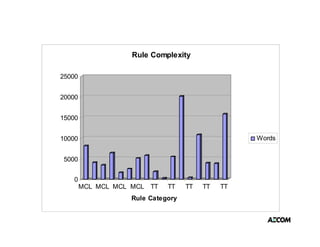
Rule Complexity

25000


20000


15000


10000                                             Words


5000


   0
        MCL MCL MCL MCL TT   TT    TT   TT   TT
                   Rule Category
                            g y
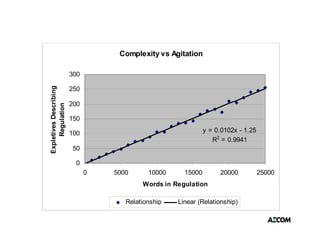
Complexity vs Agitation

                        300
    etives Describing


                        250

                        200
             on
     Regulatio


                        150

                        100                                   y = 0.0102x - 1.25
                                                                 R2 = 0.9941
Exple


                                                                      0 9941
                        50

                         0
                              0   5000      10000     15000        20000           25000
                                          Words in Regulation

                                     Relationship   Linear (Relationship)
Federal Statutory Requirements


• 1996 Amendments to the Safe Drinking Water Act
  – Disinfection.--At any time after the end of the 3-year period that
    begins on the date of enactment of the Safe Drinking Water Act
    Amendments of 1996, but not later than the date on which the
    Administrator
    Ad i i t t promulgates a Stage II rulemaking f di i f t t
                          l t      St        l     ki for disinfectants
    and disinfection byproducts …, the Administrator shall also
    promulgate national primary drinking water regulations requiring
    disinfection as a treatment technique for all public water systems
                                                               systems,
    including surface water systems and, as necessary, ground water
    systems. After consultation with the States, the Administrator shall
    (as part of the regulations) promulgate criteria that the Administrator,
    or a State that has primary enforcement responsibility under section
    1413, shall apply to determine whether disinfection shall be required
    as a treatment technique for any public water system served by
    ground water
            water.
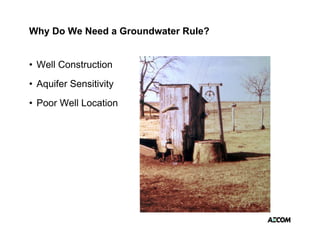
Why Do We Need a Groundwater Rule?


• Well Construction
• Aquifer Sensitivity
• Poor Well Location
Rule Purpose


• Provide additional protection from contamination of
  groundwater by viruses and bacteria
• Rule does not apply to groundwater sources that are under
  the direct influence of surface water
 – Already covered under the surface water treatment rules
How Long Has this Rule Been in Discussion


• GW “Disinfection” Rule Discussion
 – Before the 1996 Amendments
 – EPA sponsored Workgroup at the National Water Research Institute,
   1992
Four Major Components of the GWR


1. Periodic sanitary surveys of ground water systems that
                     y       y    g              y
   require the evaluation of eight critical elements and the
   identification of significant deficiencies
2. Source water monitoring to test for the presence of E.
   coli, enterococci, or coliphage
   –   Assessment (Routine) monitoring
   –   Triggered monitoring
Major Components of the GWR (cont.)


3. Corrective actions required for any system with a
                         q           y y
   significant deficiency or source water fecal contamination
   –   Correct all significant deficiencies
   –   Eliminate the source of contamination
   –   Provide an alternate source of water
   –   Provide treatment which reliably achieves 99.99 percent (4-log)
       inactivation or removal of viruses

4. Compliance monitoring to ensure that treatment
   technology installed to treat drinking water reliably
   achieves at least 99.99 percent (4-log) inactivation or
   removal of viruses
Sanitary Surveys


• States are required to identify State-defined significant
               q                y                 g
  deficiencies and other deficiencies within the following
  components (where applicable):
 –   1) source
 –   2) treatment
 –   3) distribution system
 –   4) finished water storage
 –   5) pumps, pump facilities, and controls
 –   6) monitoring, reporting, and data verification
 –   7) system management and operation
      )
 –   8) operator compliance with State requirements
Once a Significant Deficiency has been Identified…


• States have 30 days to provide written notification
                   y     p
• Systems have 30 days from receiving written notification to
  “consult” with State regarding corrective action
• System must be in compliance or be in compliance with a
  State-approved plan within 120 days of receiving written
  notice from State
 – 90 days from consultation to prepare and submit plan and gain State
   approval
Source Water Monitoring


• Two types of monitoring
       yp               g
 – Assessment (routine)
 – Triggered

• States will specify the use of one or more fecal indicators
 – E. coli
 – Enterococci
 – or coliphage
Assessment Monitoring


• Flexible provision g
           p         gives States the opportunity to target
                                       pp       y       g
  higher risk systems for additional source water monitoring
  and evaluation
• State to specify specific monitoring requirements
 – EPA has provided guidance
Assessment Monitoring

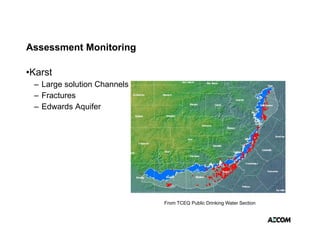
•Karst
 – Large solution Channels
 – Fractures
 – Edwards Aquifer


                             From TCEQ Public D i ki W t S ti
                             F         P bli Drinking Water Section
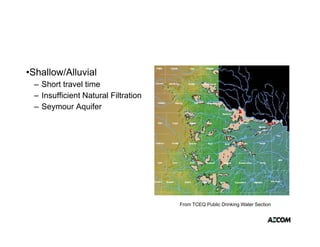
•Shallow/Alluvial
 – Short travel time
 – Insufficient Natural Filtration
 – Seymour Aquifer


                                     From TCEQ Public Drinking Water Section
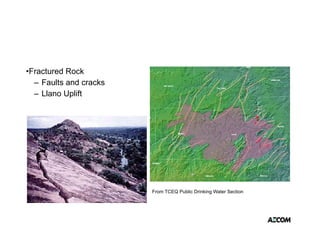
•Fractured Rock
  – Faults and cracks
  – Llano Uplift


                        From TCEQ Public Drinking Water Section
Triggered Monitoring


• Within 24 hours of receiving a total coliform-positive result under the
  TCR, PWS must collect at least one sample from each ground water
  source that was in use at the time the distribution sample was collected
  – System that does not provide 4-log treatment of viruses
• The source sample can be used as the 4th TCR repeat sample for
  small systems
  – Must be tested for Fecal indicator and total coliform
  – Could lead to a monthly MCL under the TCR
  – Could lead to an acute MCL under the TCR
Triggered Monitoring - excused


• Source water sampling is not required if:
                  p g            q
 – The State determines that the cause of a total coliform-positive
   sample is directly related to the distribution system
   • This must be documented in writing within a 24 hour window
                                        g
   • Sample meets State criteria for distribution system conditions that will
     cause total coliform-positive samples as defined in their primacy
     application
   • M t provide d
     Must      id documentation to State within 30 d
                            t ti t St t      ithi     days
Representative Sampling


• States may allow systems with multiple sources to conduct
  representative source sampling and collect samples from
  the sources that represent (serve) the TCR monitoring site
  rather than from all sources
• The draft EPA guidance on representative sampling is
  approximately 95 pages.
Consecutive Systems (Wholesale connections)


• A total coliform positive sample in a consecutive system
                   p           p                     y
  could lead to source water monitoring in the wholesale
  system
• A source water fecal indicator positive in a wholesale
  system could lead to public notification in the consecutive
   y
  system
Source Water monitoring response actions


• Detection of fecal contamination in a ground water source
                                          g
  is not a violation, but does trigger the following:
 – Tier 1 public notification that a source water sample was fecal
   indicator positive
 – The system is required to collect five confirmation samples from the
   same source and analyze them for the State-specified fecal indicator
 – Wholesalers must notify consecutive systems of a positive fecal
   indicator source water sample within 24 hours, at which time the
   consecutive system must provide Tier 1 public notification to its
   customers
       t
Corrective Action for a Fecally Contaminated Source


• Acceptable corrective actions for a fecally-contaminated
       p                                    y
  source include:
 – remove the water source from service;
 – remove the source of contamination; or
 – install treatment that provides 4-log treatment of viruses (with
   compliance monitoring).

• States have the authority to require that interim measures
  be taken (typically in conjunction with a long-term State-
  approved corrective action plan)
4-log Inactivation with Disinfection


• If you do not provide 4-log
 – Source water monitoringg
 – Consecutive system issues
 – Required to provide corrective action when needed

• If you do provide 4 log
                    4-log
 – Compliance monitoring
Compliance Monitoring – Chemical Disinfection


• More than 3,300 people
 – Provide continuous residual monitoring and maintain a State-
   determined residual disinfectant concentration

• 3,300 or fewer people
 – Monitor and maintain the State-determined residual disinfectant
   concentration based on daily grab sample during the hour of peak
   flow or another time specified by the State (or install analyzer)
 –S t
   Systems th t f il t maintain th St t
             that fail to i t i the State-specified l
                                                ifi d levels must t k
                                                           l     t take
   collect grab samples every four hours until the levels are attained
Analyzer


• Type
   yp
 – Must use EPA approved process
 – Amperomertic probes have just recently been approved

• Location
 – “…at a location approved by the State”
 – After the contact time has been met
Conflict with the TCR Agreement in Principle


• No single sample makes an MCL or triggers Public Notice
        g      p                      gg
• GWR requires PN even when all distribution samples are
  negative
• TCR positives trigger identification of “Sanitary Defects”
 – Correction of those is on a schedule identified by the water system
 – Identification of “Significant Deficiencies” by the State require
   correction within 120 days
Tier 1 Public Notice


• When a ground water PWS collects a source water sample
  that is fecal indicator positive (and is not invalidated)
 – Includes results from:
   • Provider PWS
   •Ti
     Triggered source monitoring
             d            it i
   • Assessment source monitoring
Tier 2 Public Notice


• When a GW PWS fails to:
 – Take corrective action
   • Fecal indicator positive
   • Significant deficiency
 –CComply with a TCEQ
         l    ith TCEQ-approved schedule and plan
                                  d h d l  d l
 – Maintain 4-log treatment of viruses
Tier 3 Public Notice


• When a GW PWS fails to:
 – Conduct triggered source water monitoring
 – Conduct assessment source water monitoring
 – Conduct monitoring to demonstrate compliance with 4-log treatment
   requirement
CCR Notice


• When a GW PWS has:
 – An uncorrected significant deficiency
 – Corrected significant deficiency
 – Fecal indicator positive source water sample
Summary


• GWR is a Treatment Technique Rule
 – Monitoring results trigger actions

• Various options for achieving compliance
 – PWS must be aware of the consequences of the options

• State (TCEQ) must make a number of determinations and
  has some flexibility
Questions?
Anthony (Tony) E. Bennett, RS
AECOM Water
Anthony.bennett@aecom.com

T Bennett 030810 Setawwa

  • 1.
    The Groundwater Rule Presentedto the SE Chapter, Texas American Water Works Association Anthony E. Bennett, RS Technical Director AECOM Water – Austin, TX
  • 2.
    Introduction • Statutory Authority •EPA Rule Types • Rule Requirements (watch out for the bear traps) • State Responsibilities
  • 3.
    Statutory Citations FromSDWA 1986 • Maximum contaminant levels. – Except as provided …, each national primary drinking water regulation for a contaminant for which a maximum contaminant level goal is established under this subsection shall specify a maximum contaminant level for such contaminant which is as close to the maximum contaminant level goal as is feasible.
  • 4.
    Statutory Citations FromSDWA 1986 • Treatment Technique q – The Administrator is authorized to promulgate a national primary drinking water regulation that requires the use of a treatment technique in lieu of establishing a maximum contaminant level, if the Administrator makes a finding that it is not economically or technologically feasible to ascertain the level of the contaminant. In such case, the Administrator shall identify those treatment techniques which in the Administrator’s judgment, would prevent which, Administrator s judgment known or anticipated adverse effects on the health of persons to the extent feasible…
  • 5.
    Rule Complexity 25000 20000 15000 10000 Words 5000 0 MCL MCL MCL MCL TT TT TT TT TT Rule Category g y
  • 6.
    Complexity vs Agitation 300 etives Describing 250 200 on Regulatio 150 100 y = 0.0102x - 1.25 R2 = 0.9941 Exple 0 9941 50 0 0 5000 10000 15000 20000 25000 Words in Regulation Relationship Linear (Relationship)
  • 7.
    Federal Statutory Requirements •1996 Amendments to the Safe Drinking Water Act – Disinfection.--At any time after the end of the 3-year period that begins on the date of enactment of the Safe Drinking Water Act Amendments of 1996, but not later than the date on which the Administrator Ad i i t t promulgates a Stage II rulemaking f di i f t t l t St l ki for disinfectants and disinfection byproducts …, the Administrator shall also promulgate national primary drinking water regulations requiring disinfection as a treatment technique for all public water systems systems, including surface water systems and, as necessary, ground water systems. After consultation with the States, the Administrator shall (as part of the regulations) promulgate criteria that the Administrator, or a State that has primary enforcement responsibility under section 1413, shall apply to determine whether disinfection shall be required as a treatment technique for any public water system served by ground water water.
  • 8.
    Why Do WeNeed a Groundwater Rule? • Well Construction • Aquifer Sensitivity • Poor Well Location
  • 9.
    Rule Purpose • Provideadditional protection from contamination of groundwater by viruses and bacteria • Rule does not apply to groundwater sources that are under the direct influence of surface water – Already covered under the surface water treatment rules
  • 10.
    How Long Hasthis Rule Been in Discussion • GW “Disinfection” Rule Discussion – Before the 1996 Amendments – EPA sponsored Workgroup at the National Water Research Institute, 1992
  • 11.
    Four Major Componentsof the GWR 1. Periodic sanitary surveys of ground water systems that y y g y require the evaluation of eight critical elements and the identification of significant deficiencies 2. Source water monitoring to test for the presence of E. coli, enterococci, or coliphage – Assessment (Routine) monitoring – Triggered monitoring
  • 12.
    Major Components ofthe GWR (cont.) 3. Corrective actions required for any system with a q y y significant deficiency or source water fecal contamination – Correct all significant deficiencies – Eliminate the source of contamination – Provide an alternate source of water – Provide treatment which reliably achieves 99.99 percent (4-log) inactivation or removal of viruses 4. Compliance monitoring to ensure that treatment technology installed to treat drinking water reliably achieves at least 99.99 percent (4-log) inactivation or removal of viruses
  • 13.
    Sanitary Surveys • Statesare required to identify State-defined significant q y g deficiencies and other deficiencies within the following components (where applicable): – 1) source – 2) treatment – 3) distribution system – 4) finished water storage – 5) pumps, pump facilities, and controls – 6) monitoring, reporting, and data verification – 7) system management and operation ) – 8) operator compliance with State requirements
  • 14.
    Once a SignificantDeficiency has been Identified… • States have 30 days to provide written notification y p • Systems have 30 days from receiving written notification to “consult” with State regarding corrective action • System must be in compliance or be in compliance with a State-approved plan within 120 days of receiving written notice from State – 90 days from consultation to prepare and submit plan and gain State approval
  • 15.
    Source Water Monitoring •Two types of monitoring yp g – Assessment (routine) – Triggered • States will specify the use of one or more fecal indicators – E. coli – Enterococci – or coliphage
  • 16.
    Assessment Monitoring • Flexibleprovision g p gives States the opportunity to target pp y g higher risk systems for additional source water monitoring and evaluation • State to specify specific monitoring requirements – EPA has provided guidance
  • 17.
    Assessment Monitoring •Karst –Large solution Channels – Fractures – Edwards Aquifer From TCEQ Public D i ki W t S ti F P bli Drinking Water Section
  • 18.
    •Shallow/Alluvial – Shorttravel time – Insufficient Natural Filtration – Seymour Aquifer From TCEQ Public Drinking Water Section
  • 19.
    •Fractured Rock – Faults and cracks – Llano Uplift From TCEQ Public Drinking Water Section
  • 20.
    Triggered Monitoring • Within24 hours of receiving a total coliform-positive result under the TCR, PWS must collect at least one sample from each ground water source that was in use at the time the distribution sample was collected – System that does not provide 4-log treatment of viruses • The source sample can be used as the 4th TCR repeat sample for small systems – Must be tested for Fecal indicator and total coliform – Could lead to a monthly MCL under the TCR – Could lead to an acute MCL under the TCR
  • 21.
    Triggered Monitoring -excused • Source water sampling is not required if: p g q – The State determines that the cause of a total coliform-positive sample is directly related to the distribution system • This must be documented in writing within a 24 hour window g • Sample meets State criteria for distribution system conditions that will cause total coliform-positive samples as defined in their primacy application • M t provide d Must id documentation to State within 30 d t ti t St t ithi days
  • 22.
    Representative Sampling • Statesmay allow systems with multiple sources to conduct representative source sampling and collect samples from the sources that represent (serve) the TCR monitoring site rather than from all sources • The draft EPA guidance on representative sampling is approximately 95 pages.
  • 23.
    Consecutive Systems (Wholesaleconnections) • A total coliform positive sample in a consecutive system p p y could lead to source water monitoring in the wholesale system • A source water fecal indicator positive in a wholesale system could lead to public notification in the consecutive y system
  • 24.
    Source Water monitoringresponse actions • Detection of fecal contamination in a ground water source g is not a violation, but does trigger the following: – Tier 1 public notification that a source water sample was fecal indicator positive – The system is required to collect five confirmation samples from the same source and analyze them for the State-specified fecal indicator – Wholesalers must notify consecutive systems of a positive fecal indicator source water sample within 24 hours, at which time the consecutive system must provide Tier 1 public notification to its customers t
  • 25.
    Corrective Action fora Fecally Contaminated Source • Acceptable corrective actions for a fecally-contaminated p y source include: – remove the water source from service; – remove the source of contamination; or – install treatment that provides 4-log treatment of viruses (with compliance monitoring). • States have the authority to require that interim measures be taken (typically in conjunction with a long-term State- approved corrective action plan)
  • 26.
    4-log Inactivation withDisinfection • If you do not provide 4-log – Source water monitoringg – Consecutive system issues – Required to provide corrective action when needed • If you do provide 4 log 4-log – Compliance monitoring
  • 27.
    Compliance Monitoring –Chemical Disinfection • More than 3,300 people – Provide continuous residual monitoring and maintain a State- determined residual disinfectant concentration • 3,300 or fewer people – Monitor and maintain the State-determined residual disinfectant concentration based on daily grab sample during the hour of peak flow or another time specified by the State (or install analyzer) –S t Systems th t f il t maintain th St t that fail to i t i the State-specified l ifi d levels must t k l t take collect grab samples every four hours until the levels are attained
  • 28.
    Analyzer • Type yp – Must use EPA approved process – Amperomertic probes have just recently been approved • Location – “…at a location approved by the State” – After the contact time has been met
  • 29.
    Conflict with theTCR Agreement in Principle • No single sample makes an MCL or triggers Public Notice g p gg • GWR requires PN even when all distribution samples are negative • TCR positives trigger identification of “Sanitary Defects” – Correction of those is on a schedule identified by the water system – Identification of “Significant Deficiencies” by the State require correction within 120 days
  • 30.
    Tier 1 PublicNotice • When a ground water PWS collects a source water sample that is fecal indicator positive (and is not invalidated) – Includes results from: • Provider PWS •Ti Triggered source monitoring d it i • Assessment source monitoring
  • 31.
    Tier 2 PublicNotice • When a GW PWS fails to: – Take corrective action • Fecal indicator positive • Significant deficiency –CComply with a TCEQ l ith TCEQ-approved schedule and plan d h d l d l – Maintain 4-log treatment of viruses
  • 32.
    Tier 3 PublicNotice • When a GW PWS fails to: – Conduct triggered source water monitoring – Conduct assessment source water monitoring – Conduct monitoring to demonstrate compliance with 4-log treatment requirement
  • 33.
    CCR Notice • Whena GW PWS has: – An uncorrected significant deficiency – Corrected significant deficiency – Fecal indicator positive source water sample
  • 34.
    Summary • GWR isa Treatment Technique Rule – Monitoring results trigger actions • Various options for achieving compliance – PWS must be aware of the consequences of the options • State (TCEQ) must make a number of determinations and has some flexibility
  • 35.
    Questions? Anthony (Tony) E.Bennett, RS AECOM Water Anthony.bennett@aecom.com