Dania Beach, FL 33004
100 W. Dania Beach Blvd.
City of Dania Beach
                           City of Dania Beach


                                         2010
                                        Annual
                            Drinking Water Quality Report
                                        for the
                                 City of Dania Beach
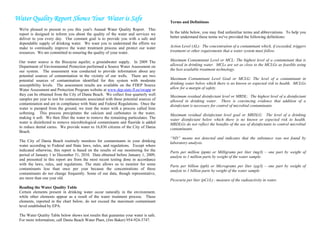
Water Quality Report Shows Your Water is Safe                                           Terms and Definitions
 We're pleased to present to you this year's Annual Water Quality Report. This
 report is designed to inform you about the quality of the water and services we        In the table below, you may find unfamiliar terms and abbreviations. To help you
 deliver to you every day. Our constant goal is to provide you with a safe and          better understand these terms we've provided the following definitions:
 dependable supply of drinking water. We want you to understand the efforts we
 make to continually improve the water treatment process and protect our water          Action Level (AL): The concentration of a contaminant which, if exceeded, triggers
 resources. We are committed to ensuring the quality of your water.                     treatment or other requirements that a water system must follow.

 Our water source is the Biscayne aquifer, a groundwater supply. In 2009 The            Maximum Contaminant Level or MCL: The highest level of a contaminant that is
 Department of Enviromnental Protection performed a Source Water Assessment on          allowed in drinking water. MCLs are set as close to the MCLGs as feasible using
 our system. The assessment was conducted to provide information about any              the best available treatment technology.
 potential sources of contamination in the vicinity of our wells. There are two
 potential sources of contamination identified for this system with moderate            Maximum Contaminant Level Goal or MCLG: The level of a contaminant in
 susceptibility levels. The assessment results are available on the FDEP Source         drinking water below which there is no known or expected risk to health. MCLGs
 Water Assessment and Protection Program website at www.dep.state.fl.us/swapp or        allow for a margin of safety.
                                                                                        .
 they can be obtained from the City of Dania Beach. We collect four quarterly well      Maximum residual disinfectant level or MRDL: The highest level of a disinfectant
 samples per year to test for contaminants associated with these potential sources of   allowed in drinking water. There is convincing evidence that addition of a
 contamination and are in compliance with State and Federal Regulations. Once the       disinfectant is necessary for control of microbial contaminants.
 water is pumped from the ground, we treat the water with a process called lime
 softening. This process precipitates the calcium and carbonates in the water,          Maximum residual disinfectant level goal or MRDLG: The level of a drinking
 making it soft. We then filter the water to remove the remaining particulates. The     water disinfectant below which there is no known or expected risk to health.
 water is disinfected to remove microbiological contaminants and fluoride is added      MRDLGs do not reflect the benefits of the use of disinfectants to control microbial
 to reduce dental caries. We provide water to 16,830 citizens of the City of Dania      contaminants.
 Beach.
                                                                                        “ND” means not detected and indicates that the substance was not found by
 The City of Dania Beach routinely monitors for contaminants in your drinking           laboratory analysis.
 water according to Federal and State laws, rules, and regulations. Except where
 indicated otherwise, this report is based on the results of our monitoring for the     Parts per million (ppm) or Milligrams per liter (mg/l) – one part by weight of
 period of January 1 to December 31, 2010. Data obtained before January 1, 2009,        analyte to 1 million parts by weight of the water sample.
 and presented in this report are from the most recent testing done in accordance
 with the laws, rules, and regulations. The state allows us to monitor for some         Parts per billion (ppb) or Micrograms per liter (µg/l) – one part by weight of
 contaminants less than once per year because the concentrations of these               analyte to 1 billion parts by weight of the water sample
 contaminants do not change frequently. Some of our data, though representative,
 are more than one year old.                                                            Picocurie per liter (pCi/L) - measure of the radioactivity in water.
 Reading the Water Quality Table
 Certain elements present in drinking water occur naturally in the environment,
 while other elements appear as a result of the water treatment process. These
 elements, reported in the chart below, do not exceed the maximum contaminant
 level established by EPA.

 The Water Quality Table below shows test results that guarantee your water is safe.
 For more information, call Dania Beach Water Plant, (Jim Baker) 954-924-3747.
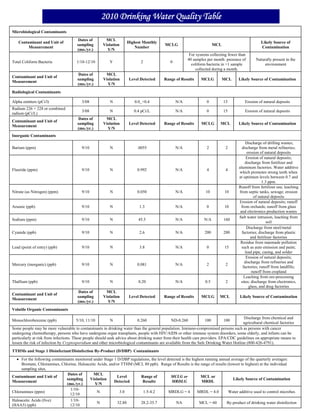
2010 Drinking Water Quality Table
Microbiological Contaminants
                                       Dates of       MCL
   Contaminant and Unit of                                         Highest Monthly                                                                Likely Source of
                                      sampling       Violation                            MCLG                         MCL
        Measurement                                                   Number                                                                      Contamination
                                      (mo./yr.)        Y/N
                                                                                                        For systems collecting fewer than
                                                                                                       40 samples per month: presence of       Naturally present in the
Total Coliform Bacteria               1/10-12/10         Y                 2                 0
                                                                                                         coliform bacteria in >1 sample             environment
                                                                                                            collected during a month.
                                       Dates of       MCL
Contaminant and Unit of
                                      sampling       Violation      Level Detected       Range of Results      MCLG          MCL     Likely Source of Contamination
Measurement
                                      (mo./yr.)        Y/N
Radiological Contaminants

Alpha emitters (pCi/l)                   3/08            N              0.0_+0.4                 N/A              0          15          Erosion of natural deposits
Radium 226 + 228 or combined
                                         3/08            N             0.4 pCi/L                 N/A              0          15          Erosion of natural deposits
radium (pCi/L)
                                       Dates of       MCL
Contaminant and Unit of
                                      sampling       Violation      Level Detected       Range of Results      MCLG       MCL        Likely Source of Contamination
Measurement
                                      (mo./yr.)        Y/N
Inorganic Contaminants
                                                                                                                                          Discharge of drilling wastes;
Barium (ppm)                             9/10            N               .0055                   N/A              2           2        discharge from metal refineries;
                                                                                                                                           erosion of natural deposits
                                                                                                                                           Erosion of natural deposits;
                                                                                                                                          discharge from fertilizer and
                                                                                                                                     aluminum factories. Water additive
Fluoride (ppm)                           9/10            N               0.992                   N/A              4           4
                                                                                                                                     which promotes strong teeth when
                                                                                                                                     at optimum levels between 0.7 and
                                                                                                                                                    1.3 ppm.
                                                                                                                                     Runoff from fertilizer use; leaching
Nitrate (as Nitrogen) (ppm)              9/10            N               0.050                   N/A              10         10      from septic tanks, sewage; erosion
                                                                                                                                               of natural deposits
                                                                                                                                     Erosion of natural deposits; runoff
Arsenic (ppb)                            9/10            N                 1.3                   N/A              0          10       from orchards; runoff from glass
                                                                                                                                      and electronics production wastes
                                                                                                                                     Salt water intrusion, leaching from
Sodium (ppm)                             9/10            N                45.5                   N/A             N/A         160
                                                                                                                                                       soil
                                                                                                                                           Discharge from steel/metal
Cyanide (ppb)                            9/10            N                 2.6                   N/A             200         200       factories; discharge from plastic
                                                                                                                                             and fertilizer factories
                                                                                                                                      Residue from manmade pollution
Lead (point of entry) (ppb)              9/10            N                 3.8                   N/A              0          15        such as auto emission and paint;
                                                                                                                                          lead pipe, casing, and solder
                                                                                                                                           Erosion of natural deposits;
                                                                                                                                         discharge from refineries and
Mercury (inorganic) (ppb)                9/10            N               0.081                   N/A              2           2
                                                                                                                                        factories; runoff from landfills;
                                                                                                                                              runoff from cropland
                                                                                                                                         Leaching from ore-processing
Thallium (ppb)                           9/10            N                0.20                   N/A             0.5          2       sites; discharge from electronics,
                                                                                                                                            glass, and drug factories
                                       Dates of       MCL
Contaminant and Unit of
                                      sampling       Violation      Level Detected       Range of Results      MCLG       MCL         Likely Source of Contamination
Measurement
                                      (mo./yr.)        Y/N
Volatile Organic Contaminants

                                                                                                                                         Discharge from chemical and
Monochlorobenzene (ppb)              5/10, 11/10         N               0.260               ND-0.260            100         100
                                                                                                                                        agricultural chemical factories
Some people may be more vulnerable to contaminants in drinking water than the general population. Immuno-compromised persons such as persons with cancer
undergoing chemotherapy, persons who have undergone organ transplants, people with HIV/AIDS or other immune system disorders, some elderly, and infants can be
particularly at risk from infections. These people should seek advice about drinking water from their health care providers. EPA/CDC guidelines on appropriate means to
lessen the risk of infection by Cryptosporidium and other microbiological contaminants are available from the Safe Drinking Water Hotline (800-426-4791).
TTHMs and Stage 1 Disinfectant/Disinfection By-Product (D/DBP) Contaminants
  • For the following contaminants monitored under Stage 1 D/DBP regulations, the level detected is the highest running annual average of the quarterly averages:
     Bromate, Chloramines, Chlorine, Haloacetic Acids, and/or TTHM (MCL 80 ppb). Range of Results is the range of results (lowest to highest) at the individual
     sampling sites.
                               Dates of      MCL
Contaminant and Unit of                                    Level       Range of           MCLG or            MCL or
                              sampling     Violation                                                                            Likely Source of Contamination
Measurement                                               Detected      Results            MRDLG             MRDL
                              (mo./yr.)       Y/N
                                1/10-
Chloramines (ppm)                               N            3.0         1.5-4.2         MRDLG = 4         MRDL = 4.0        Water additive used to control microbes
                                12/10
Haloacetic Acids (five)         1/10-
                                                N           32.88      28.2-35.7             NA             MCL = 60        By-product of drinking water disinfection
(HAA5) (ppb)                    12/10
TTHM [Total                   1/10-
                                            N          61.47       33.5-67.17       NA     MCL = 80     By-product of drinking water disinfection
trihalomethanes] (ppb)        12/10
                                                                     No. of
                              Dates of      AL         90th
Contaminant and Unit of                                           sampling sites           AL (Action
                             sampling    Violation   Percentile                    MCLG                     Likely Source of Contamination
Measurement                                                       exceeding the              Level)
                             (mo./yr.)     Y/N        Result
                                                                       AL
Lead and Copper (Tap Water)
                                                                                                        Corrosion of household plumbing systems;
* Copper (tap water) (ppm)     7/09         N          0.125           0           1.3        1.3       erosion of natural deposits; leaching from
                                                                                                                   wood preservatives
                                                                                                        Corrosion of household plumbing systems,
* Lead (tap water) (ppb)       7/09         N            5             1            0         15
                                                                                                                erosion of natural deposits
   *Lead and Copper are measured in Action Levels (AL): the concentration of a contaminant that, if exceeded, triggers treatment of
   other requirements that a water system must follow. Ninety percent (90%) of water samples must have levels below AL. Dania Beach
   water is in compliance with EPA standards.

   The sources of drinking water (both tap water and bottled water) include rivers, lakes, streams, ponds, reservoirs, springs, and wells.
   As water travels over the surface of the land or through the ground, it dissolves naturally occurring minerals and, in some cases,
   radioactive material, and can pick up substances resulting from the presence of animals or from human activity.

   Contaminants that may be present in source water include:

   (A)         Microbial contaminants, such as viruses and bacteria, which may come from sewage treatment plants, septic systems,
               agricultural livestock operations, and wildlife.
   (B)         Inorganic contaminants, such as salts and metals, which can be naturally-occurring or result from urban stormwater runoff,
               industrial or domestic wastewater discharges, oil and gas production, mining, or farming.
   (C)         Pesticides and herbicides, which may come from a variety of sources such as agriculture, urban stormwater runoff, and
               residential uses.
   (D)         Organic chemical contaminants, including synthetic and volatile organic chemicals, which are by-products of industrial
               processes and petroleum production, and can also come from gas stations, urban stormwater runoff, and septic systems.
   (E)         Radioactive contaminants, which can be naturally occurring or be the result of oil and gas production and mining activities.

   In order to ensure that tap water is safe to drink, the EPA prescribes regulations, which limit the amount of certain contaminants in
   water provided by public water systems. The Food and Drug Administration (FDA) regulations establish limits for contaminants in
   bottled water, which must provide the same protection for public health.

   Drinking water, including bottled water, may reasonably be expected to contain at least small amounts of some contaminants. The
   presence of contaminants does not necessarily indicate that the water poses a health risk. More information about contaminants and
   potential health effects can be obtained by calling the Environmental Protection Agency’s Safe Drinking Water Hotline at 1-800-426-
   4791.

   Lead: If present, elevated levels of lead can cause serious health problems, especially for pregnant women and young children. Lead
   in drinking water is primarily from materials and components associated with service lines and home plumbing The City of Dania
   Beach is responsible for providing high quality drinking water, but cannot control the variety of materials used in plumbing
   components. When your water has been sitting for several hours, you can minimize the potential for lead exposure by flushing your
   tap for 30 seconds to 2 minutes before using water for drinking or cooking. If you are concerned about lead in your water, you may
   whish to have your water tested. Information on lead in drinking water, testing methods, and steps you can take to minimize exposure
   is available from the Safe Drinking Water Hotline or at http://www.epa.gov/safewater/lead.

   Note: Our system exceeded a drinking water standard for total coliform bacteria while performing routine monthly monitoring during
   the months of July and November 2010. “Total Coliform. Coliforms are bacteria that are naturally present in the environment and are
   used as an indicator that other, potentially harmful, bacteria may be present. Coliforms were found in more samples than allowed and
   this was a warning of potential problems.” These violations were considered non-acute and there was no need to boil water or take
   other corrective actions. We immediately notified the Health Department after each incident and conducted required resampling at
   the exact sites originally sampled and at points immediately upstream and downstream of the affected sites. The repeat samples
   showed no coliform bacteria present. An auto flushing devise was installed and further testing indicates that this problem has been
   resolved.

   If you have any questions about this report or concerning your water utility, please contact Dania Beach Water Plant, (Jim Baker)
   954-924-3747. We encourage our valued customers to be informed about their water utility. If you want to learn more, please attend
   any of our regularly scheduled City Commission meetings. Meetings are held at City Hall on the second and fourth Tuesday of each
   month at 7 p.m.

Drinking Water Quality Report

  • 1.
    Dania Beach, FL33004 100 W. Dania Beach Blvd. City of Dania Beach City of Dania Beach 2010 Annual Drinking Water Quality Report for the City of Dania Beach
  • 2.
    Water Quality ReportShows Your Water is Safe Terms and Definitions We're pleased to present to you this year's Annual Water Quality Report. This report is designed to inform you about the quality of the water and services we In the table below, you may find unfamiliar terms and abbreviations. To help you deliver to you every day. Our constant goal is to provide you with a safe and better understand these terms we've provided the following definitions: dependable supply of drinking water. We want you to understand the efforts we make to continually improve the water treatment process and protect our water Action Level (AL): The concentration of a contaminant which, if exceeded, triggers resources. We are committed to ensuring the quality of your water. treatment or other requirements that a water system must follow. Our water source is the Biscayne aquifer, a groundwater supply. In 2009 The Maximum Contaminant Level or MCL: The highest level of a contaminant that is Department of Enviromnental Protection performed a Source Water Assessment on allowed in drinking water. MCLs are set as close to the MCLGs as feasible using our system. The assessment was conducted to provide information about any the best available treatment technology. potential sources of contamination in the vicinity of our wells. There are two potential sources of contamination identified for this system with moderate Maximum Contaminant Level Goal or MCLG: The level of a contaminant in susceptibility levels. The assessment results are available on the FDEP Source drinking water below which there is no known or expected risk to health. MCLGs Water Assessment and Protection Program website at www.dep.state.fl.us/swapp or allow for a margin of safety. . they can be obtained from the City of Dania Beach. We collect four quarterly well Maximum residual disinfectant level or MRDL: The highest level of a disinfectant samples per year to test for contaminants associated with these potential sources of allowed in drinking water. There is convincing evidence that addition of a contamination and are in compliance with State and Federal Regulations. Once the disinfectant is necessary for control of microbial contaminants. water is pumped from the ground, we treat the water with a process called lime softening. This process precipitates the calcium and carbonates in the water, Maximum residual disinfectant level goal or MRDLG: The level of a drinking making it soft. We then filter the water to remove the remaining particulates. The water disinfectant below which there is no known or expected risk to health. water is disinfected to remove microbiological contaminants and fluoride is added MRDLGs do not reflect the benefits of the use of disinfectants to control microbial to reduce dental caries. We provide water to 16,830 citizens of the City of Dania contaminants. Beach. “ND” means not detected and indicates that the substance was not found by The City of Dania Beach routinely monitors for contaminants in your drinking laboratory analysis. water according to Federal and State laws, rules, and regulations. Except where indicated otherwise, this report is based on the results of our monitoring for the Parts per million (ppm) or Milligrams per liter (mg/l) – one part by weight of period of January 1 to December 31, 2010. Data obtained before January 1, 2009, analyte to 1 million parts by weight of the water sample. and presented in this report are from the most recent testing done in accordance with the laws, rules, and regulations. The state allows us to monitor for some Parts per billion (ppb) or Micrograms per liter (µg/l) – one part by weight of contaminants less than once per year because the concentrations of these analyte to 1 billion parts by weight of the water sample contaminants do not change frequently. Some of our data, though representative, are more than one year old. Picocurie per liter (pCi/L) - measure of the radioactivity in water. Reading the Water Quality Table Certain elements present in drinking water occur naturally in the environment, while other elements appear as a result of the water treatment process. These elements, reported in the chart below, do not exceed the maximum contaminant level established by EPA. The Water Quality Table below shows test results that guarantee your water is safe. For more information, call Dania Beach Water Plant, (Jim Baker) 954-924-3747.
  • 3.
    2010 Drinking WaterQuality Table Microbiological Contaminants Dates of MCL Contaminant and Unit of Highest Monthly Likely Source of sampling Violation MCLG MCL Measurement Number Contamination (mo./yr.) Y/N For systems collecting fewer than 40 samples per month: presence of Naturally present in the Total Coliform Bacteria 1/10-12/10 Y 2 0 coliform bacteria in >1 sample environment collected during a month. Dates of MCL Contaminant and Unit of sampling Violation Level Detected Range of Results MCLG MCL Likely Source of Contamination Measurement (mo./yr.) Y/N Radiological Contaminants Alpha emitters (pCi/l) 3/08 N 0.0_+0.4 N/A 0 15 Erosion of natural deposits Radium 226 + 228 or combined 3/08 N 0.4 pCi/L N/A 0 15 Erosion of natural deposits radium (pCi/L) Dates of MCL Contaminant and Unit of sampling Violation Level Detected Range of Results MCLG MCL Likely Source of Contamination Measurement (mo./yr.) Y/N Inorganic Contaminants Discharge of drilling wastes; Barium (ppm) 9/10 N .0055 N/A 2 2 discharge from metal refineries; erosion of natural deposits Erosion of natural deposits; discharge from fertilizer and aluminum factories. Water additive Fluoride (ppm) 9/10 N 0.992 N/A 4 4 which promotes strong teeth when at optimum levels between 0.7 and 1.3 ppm. Runoff from fertilizer use; leaching Nitrate (as Nitrogen) (ppm) 9/10 N 0.050 N/A 10 10 from septic tanks, sewage; erosion of natural deposits Erosion of natural deposits; runoff Arsenic (ppb) 9/10 N 1.3 N/A 0 10 from orchards; runoff from glass and electronics production wastes Salt water intrusion, leaching from Sodium (ppm) 9/10 N 45.5 N/A N/A 160 soil Discharge from steel/metal Cyanide (ppb) 9/10 N 2.6 N/A 200 200 factories; discharge from plastic and fertilizer factories Residue from manmade pollution Lead (point of entry) (ppb) 9/10 N 3.8 N/A 0 15 such as auto emission and paint; lead pipe, casing, and solder Erosion of natural deposits; discharge from refineries and Mercury (inorganic) (ppb) 9/10 N 0.081 N/A 2 2 factories; runoff from landfills; runoff from cropland Leaching from ore-processing Thallium (ppb) 9/10 N 0.20 N/A 0.5 2 sites; discharge from electronics, glass, and drug factories Dates of MCL Contaminant and Unit of sampling Violation Level Detected Range of Results MCLG MCL Likely Source of Contamination Measurement (mo./yr.) Y/N Volatile Organic Contaminants Discharge from chemical and Monochlorobenzene (ppb) 5/10, 11/10 N 0.260 ND-0.260 100 100 agricultural chemical factories Some people may be more vulnerable to contaminants in drinking water than the general population. Immuno-compromised persons such as persons with cancer undergoing chemotherapy, persons who have undergone organ transplants, people with HIV/AIDS or other immune system disorders, some elderly, and infants can be particularly at risk from infections. These people should seek advice about drinking water from their health care providers. EPA/CDC guidelines on appropriate means to lessen the risk of infection by Cryptosporidium and other microbiological contaminants are available from the Safe Drinking Water Hotline (800-426-4791). TTHMs and Stage 1 Disinfectant/Disinfection By-Product (D/DBP) Contaminants • For the following contaminants monitored under Stage 1 D/DBP regulations, the level detected is the highest running annual average of the quarterly averages: Bromate, Chloramines, Chlorine, Haloacetic Acids, and/or TTHM (MCL 80 ppb). Range of Results is the range of results (lowest to highest) at the individual sampling sites. Dates of MCL Contaminant and Unit of Level Range of MCLG or MCL or sampling Violation Likely Source of Contamination Measurement Detected Results MRDLG MRDL (mo./yr.) Y/N 1/10- Chloramines (ppm) N 3.0 1.5-4.2 MRDLG = 4 MRDL = 4.0 Water additive used to control microbes 12/10 Haloacetic Acids (five) 1/10- N 32.88 28.2-35.7 NA MCL = 60 By-product of drinking water disinfection (HAA5) (ppb) 12/10
  • 4.
    TTHM [Total 1/10- N 61.47 33.5-67.17 NA MCL = 80 By-product of drinking water disinfection trihalomethanes] (ppb) 12/10 No. of Dates of AL 90th Contaminant and Unit of sampling sites AL (Action sampling Violation Percentile MCLG Likely Source of Contamination Measurement exceeding the Level) (mo./yr.) Y/N Result AL Lead and Copper (Tap Water) Corrosion of household plumbing systems; * Copper (tap water) (ppm) 7/09 N 0.125 0 1.3 1.3 erosion of natural deposits; leaching from wood preservatives Corrosion of household plumbing systems, * Lead (tap water) (ppb) 7/09 N 5 1 0 15 erosion of natural deposits *Lead and Copper are measured in Action Levels (AL): the concentration of a contaminant that, if exceeded, triggers treatment of other requirements that a water system must follow. Ninety percent (90%) of water samples must have levels below AL. Dania Beach water is in compliance with EPA standards. The sources of drinking water (both tap water and bottled water) include rivers, lakes, streams, ponds, reservoirs, springs, and wells. As water travels over the surface of the land or through the ground, it dissolves naturally occurring minerals and, in some cases, radioactive material, and can pick up substances resulting from the presence of animals or from human activity. Contaminants that may be present in source water include: (A) Microbial contaminants, such as viruses and bacteria, which may come from sewage treatment plants, septic systems, agricultural livestock operations, and wildlife. (B) Inorganic contaminants, such as salts and metals, which can be naturally-occurring or result from urban stormwater runoff, industrial or domestic wastewater discharges, oil and gas production, mining, or farming. (C) Pesticides and herbicides, which may come from a variety of sources such as agriculture, urban stormwater runoff, and residential uses. (D) Organic chemical contaminants, including synthetic and volatile organic chemicals, which are by-products of industrial processes and petroleum production, and can also come from gas stations, urban stormwater runoff, and septic systems. (E) Radioactive contaminants, which can be naturally occurring or be the result of oil and gas production and mining activities. In order to ensure that tap water is safe to drink, the EPA prescribes regulations, which limit the amount of certain contaminants in water provided by public water systems. The Food and Drug Administration (FDA) regulations establish limits for contaminants in bottled water, which must provide the same protection for public health. Drinking water, including bottled water, may reasonably be expected to contain at least small amounts of some contaminants. The presence of contaminants does not necessarily indicate that the water poses a health risk. More information about contaminants and potential health effects can be obtained by calling the Environmental Protection Agency’s Safe Drinking Water Hotline at 1-800-426- 4791. Lead: If present, elevated levels of lead can cause serious health problems, especially for pregnant women and young children. Lead in drinking water is primarily from materials and components associated with service lines and home plumbing The City of Dania Beach is responsible for providing high quality drinking water, but cannot control the variety of materials used in plumbing components. When your water has been sitting for several hours, you can minimize the potential for lead exposure by flushing your tap for 30 seconds to 2 minutes before using water for drinking or cooking. If you are concerned about lead in your water, you may whish to have your water tested. Information on lead in drinking water, testing methods, and steps you can take to minimize exposure is available from the Safe Drinking Water Hotline or at http://www.epa.gov/safewater/lead. Note: Our system exceeded a drinking water standard for total coliform bacteria while performing routine monthly monitoring during the months of July and November 2010. “Total Coliform. Coliforms are bacteria that are naturally present in the environment and are used as an indicator that other, potentially harmful, bacteria may be present. Coliforms were found in more samples than allowed and this was a warning of potential problems.” These violations were considered non-acute and there was no need to boil water or take other corrective actions. We immediately notified the Health Department after each incident and conducted required resampling at the exact sites originally sampled and at points immediately upstream and downstream of the affected sites. The repeat samples showed no coliform bacteria present. An auto flushing devise was installed and further testing indicates that this problem has been resolved. If you have any questions about this report or concerning your water utility, please contact Dania Beach Water Plant, (Jim Baker) 954-924-3747. We encourage our valued customers to be informed about their water utility. If you want to learn more, please attend any of our regularly scheduled City Commission meetings. Meetings are held at City Hall on the second and fourth Tuesday of each month at 7 p.m.