OR Barrier Management Dashboard
Mintra Competence Days 30.04.14
Do we know the
status of our barriers?
A rig or a drillship is a very complex piece of
machinery, with many interdependent areas
working together.
We should not commence any operations
without knowing if safety barriers are in place
and functional.
This knowledge depends on information from
many various sources.
You wouldn’t drive a car if you knew the
brakes were out of order?
Background - Overview
When bringing the Leiv Eiriksson to Norway
the Petroleum Safety Authority underlined the
regulatory requirements in relation to Barriers.
The consultancy firm SafeTec were tasked with
assessing the various areas and operations
and identified the 17 barrier functions.
The IT-developers Presight were tasked with
developing a dashboard solution for the
barriers. Based on input from Ocean Rig
Presight designed a tool collating information
from Star, OCS and Mintra into a graphic
interphase.
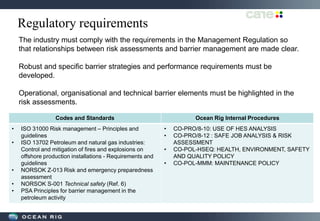
Regulatory requirements
The industry must comply with the requirements in the Management Regulation so
that relationships between risk assessments and barrier management are made clear.
Robust and specific barrier strategies and performance requirements must be
developed.
Operational, organisational and technical barrier elements must be highlighted in the
risk assessments.
Codes and Standards Ocean Rig Internal Procedures
• ISO 31000 Risk management – Principles and
guidelines
• ISO 13702 Petroleum and natural gas industries:
Control and mitigation of fires and explosions on
offshore production installations - Requirements and
guidelines
• NORSOK Z-013 Risk and emergency preparedness
assessment
• NORSOK S-001 Technical safety (Ref. 6)
• PSA Principles for barrier management in the
petroleum activity
• CO-PRO/8-10: USE OF HES ANALYSIS
• CO-PRO/8-12 : SAFE JOB ANALYSIS & RISK
ASSESSMENT
• CO-POL-HSEQ: HEALTH, ENVIRONMENT, SAFETY
AND QUALITY POLICY
• CO-POL-MMM: MAINTENANCE POLICY
Measuring and verifying performance
The regulations specify that non-functioning or
impaired barriers must be identified.
This requires the responsible party to establish
systems and processes which verify that
established barrier functions and associated barrier
elements have the intended properties.
This means that routines and practice for verifying
conformity with the established context must be in
place, along with routines to assess the
consequences of changes.
Experience in recent years from serious petroleum-
industry incidents, nationally and internationally,
shows that substantial improvement is required in
operational and organisational conditions.
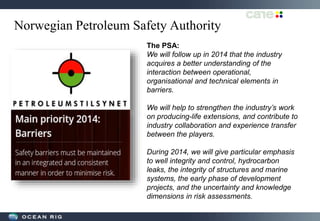
Norwegian Petroleum Safety Authority
The PSA:
We will follow up in 2014 that the industry
acquires a better understanding of the
interaction between operational,
organisational and technical elements in
barriers.
We will help to strengthen the industry’s work
on producing-life extensions, and contribute to
industry collaboration and experience transfer
between the players.
During 2014, we will give particular emphasis
to well integrity and control, hydrocarbon
leaks, the integrity of structures and marine
systems, the early phase of development
projects, and the uncertainty and knowledge
dimensions in risk assessments.
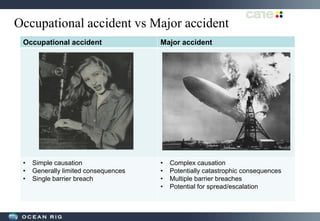
Occupational accident vs Major accident
Occupational accident Major accident
• Simple causation
• Generally limited consequences
• Single barrier breach
• Complex causation
• Potentially catastrophic consequences
• Multiple barrier breaches
• Potential for spread/escalation
Identify potential
hazards and accidents
Identification of potential hazards and accidents
must be carried out with a sufficient degree of detail,
in order to identify all the situations which a specific
barrier element could play a role in.
In most cases, this means that identification must
take place at an area level (by fire area, for
instance) and that the assessment covers:
a) all incidents which might occur in the specific
area and
b) incidents occurring in other areas which could
expose the specific area.
For certain types of hazard, it could be more
appropriate to adopt an exposure perspective and
not necessarily an area one.
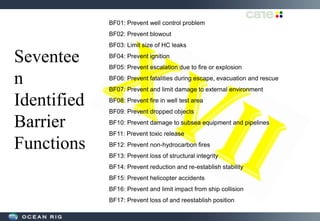
Seventee
n
Identified
Barrier
Functions
BF01: Prevent well control problem
BF02: Prevent blowout
BF03: Limit size of HC leaks
BF04: Prevent ignition
BF05: Prevent escalation due to fire or explosion
BF06: Prevent fatalities during escape, evacuation and rescue
BF07: Prevent and limit damage to external environment
BF08: Prevent fire in well test area
BF09: Prevent dropped objects
BF10: Prevent damage to subsea equipment and pipelines
BF11: Prevent toxic release
BF12: Prevent non-hydrocarbon fires
BF13: Prevent loss of structural integrity
BF14: Prevent reduction and re-establish stability
BF15: Prevent helicopter accidents
BF16: Prevent and limit impact from ship collision
BF17: Prevent loss of and reestablish position
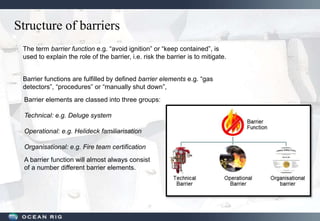
Structure of barriers
The term barrier function e.g. “avoid ignition” or “keep contained”, is
used to explain the role of the barrier, i.e. risk the barrier is to mitigate.
Barrier functions are fulfilled by defined barrier elements e.g. “gas
detectors”, “procedures” or “manually shut down”,
Barrier elements are classed into three groups:
Technical: e.g. Deluge system
Operational: e.g. Helideck familiarisation
Organisational: e.g. Fire team certification
A barrier function will almost always consist
of a number different barrier elements.
STAR
‘Star Information & Planning System’ (IPS) is
Ocean Rigs Computerized Maintenance
Management System.
Star consists of several integrated modules used
for the administration of Maintenance & Repairs,
Spare-parts & Logistics and QHSE Events &
Issues.
Overdue PMs and Corrective work orders for
Safety Critical Elements are linked to the Barrier
Dashboard.
Important to ensure correct entry of data.
Use of ‘Barrier
Verification Jobs’ in Star:
In order to ensure that all Systems & Equipment
(Technical Accounts) which (by the Performance
Standards) are defined as Safety Critical
Elements, Scheduled Jobs which cover the
defined Verification Activities are made and
coded with the words BARRIER VERIFICATION
added to the initial Job IDs. These verification
jobs may be combined with long term class, or
major overhaul jobs, or created solely for barrier
verification.
The Barrier Dashboard will monitor all ‘BARRIER
VERIFICATION’ ‘Sch. Jobs’ and ‘Planned
Maintenance Work Orders’, and will count and
display all such jobs which are not completed
within the ‘Due Date’ specified in Star:
The affected Barriers will be displayed as
threatened in the dashboard.
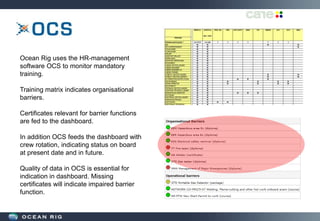
OCS
Ocean Rig uses the HR-management
software OCS to monitor mandatory
training.
Training matrix indicates organisational
barriers.
Certificates relevant for barrier functions
are fed to the dashboard.
In addition OCS feeds the dashboard with
crew rotation, indicating status on board
at present date and in future.
Quality of data in OCS is essential for
indication in dashboard. Missing
certificates will indicate impaired barrier
function.
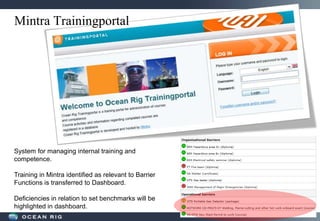
Mintra Trainingportal
System for managing internal training and
competence.
Training in Mintra identified as relevant to Barrier
Functions is transferred to Dashboard.
Deficiencies in relation to set benchmarks will be
highlighted in dashboard.
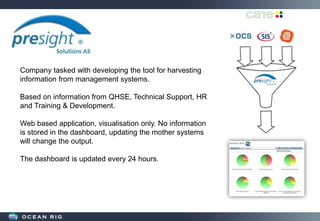
PreSight
Company tasked with developing the tool for harvesting
information from management systems.
Based on information from QHSE, Technical Support, HR
and Training & Development.
Web based application, visualisation only. No information
is stored in the dashboard, updating the mother systems
will change the output.
The dashboard is updated every 24 hours.
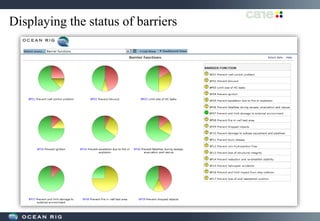
Displaying the status of barriers
Colour coding
All measured elements have defined standards.
Green = Function at or above benchmark
Yellow = Acceptable
Red = Not functioning
A red barrier element will influence the status signal
for the barrier function.
A red light does not mean that operations
cannot be executed, but it highlights needs to
repair the barrier.
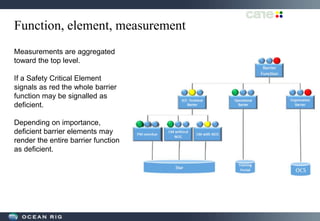
Function, element, measurement
Measurements are aggregated
toward the top level.
If a Safety Critical Element
signals as red the whole barrier
function may be signalled as
deficient.
Depending on importance,
deficient barrier elements may
render the entire barrier function
as deficient.
Aggregation into Area
Barrier functions may be
aggregated into Areas.
6 different areas have been
defined:
• Living Quarter
• Helideck
• Drilling area
• Open deck
• Pontoons and columns
• Machinery spaces
• Well Test Area
Dashboard displays status
for Areas.
Drill down into the areas for
more information.
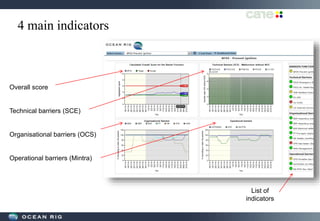
4 main indicators
Overall score
Technical barriers (SCE)
Organisational barriers (OCS)
Operational barriers (Mintra)
List of
indicators
OIM dashboard
This view gives the whole picture before drilling down into the barrier functions.
Shows status 30 days forward.

Tcd 2014 onsdag_03 ocean rig_presight_tp i risikoovervaaking

  • 1.
    OR Barrier ManagementDashboard Mintra Competence Days 30.04.14
  • 2.
    Do we knowthe status of our barriers? A rig or a drillship is a very complex piece of machinery, with many interdependent areas working together. We should not commence any operations without knowing if safety barriers are in place and functional. This knowledge depends on information from many various sources. You wouldn’t drive a car if you knew the brakes were out of order?
  • 3.
    Background - Overview Whenbringing the Leiv Eiriksson to Norway the Petroleum Safety Authority underlined the regulatory requirements in relation to Barriers. The consultancy firm SafeTec were tasked with assessing the various areas and operations and identified the 17 barrier functions. The IT-developers Presight were tasked with developing a dashboard solution for the barriers. Based on input from Ocean Rig Presight designed a tool collating information from Star, OCS and Mintra into a graphic interphase.
  • 4.
    Regulatory requirements The industrymust comply with the requirements in the Management Regulation so that relationships between risk assessments and barrier management are made clear. Robust and specific barrier strategies and performance requirements must be developed. Operational, organisational and technical barrier elements must be highlighted in the risk assessments. Codes and Standards Ocean Rig Internal Procedures • ISO 31000 Risk management – Principles and guidelines • ISO 13702 Petroleum and natural gas industries: Control and mitigation of fires and explosions on offshore production installations - Requirements and guidelines • NORSOK Z-013 Risk and emergency preparedness assessment • NORSOK S-001 Technical safety (Ref. 6) • PSA Principles for barrier management in the petroleum activity • CO-PRO/8-10: USE OF HES ANALYSIS • CO-PRO/8-12 : SAFE JOB ANALYSIS & RISK ASSESSMENT • CO-POL-HSEQ: HEALTH, ENVIRONMENT, SAFETY AND QUALITY POLICY • CO-POL-MMM: MAINTENANCE POLICY
  • 5.
    Measuring and verifyingperformance The regulations specify that non-functioning or impaired barriers must be identified. This requires the responsible party to establish systems and processes which verify that established barrier functions and associated barrier elements have the intended properties. This means that routines and practice for verifying conformity with the established context must be in place, along with routines to assess the consequences of changes. Experience in recent years from serious petroleum- industry incidents, nationally and internationally, shows that substantial improvement is required in operational and organisational conditions.
  • 6.
    Norwegian Petroleum SafetyAuthority The PSA: We will follow up in 2014 that the industry acquires a better understanding of the interaction between operational, organisational and technical elements in barriers. We will help to strengthen the industry’s work on producing-life extensions, and contribute to industry collaboration and experience transfer between the players. During 2014, we will give particular emphasis to well integrity and control, hydrocarbon leaks, the integrity of structures and marine systems, the early phase of development projects, and the uncertainty and knowledge dimensions in risk assessments.
  • 7.
    Occupational accident vsMajor accident Occupational accident Major accident • Simple causation • Generally limited consequences • Single barrier breach • Complex causation • Potentially catastrophic consequences • Multiple barrier breaches • Potential for spread/escalation
  • 8.
    Identify potential hazards andaccidents Identification of potential hazards and accidents must be carried out with a sufficient degree of detail, in order to identify all the situations which a specific barrier element could play a role in. In most cases, this means that identification must take place at an area level (by fire area, for instance) and that the assessment covers: a) all incidents which might occur in the specific area and b) incidents occurring in other areas which could expose the specific area. For certain types of hazard, it could be more appropriate to adopt an exposure perspective and not necessarily an area one.
  • 9.
    Seventee n Identified Barrier Functions BF01: Prevent wellcontrol problem BF02: Prevent blowout BF03: Limit size of HC leaks BF04: Prevent ignition BF05: Prevent escalation due to fire or explosion BF06: Prevent fatalities during escape, evacuation and rescue BF07: Prevent and limit damage to external environment BF08: Prevent fire in well test area BF09: Prevent dropped objects BF10: Prevent damage to subsea equipment and pipelines BF11: Prevent toxic release BF12: Prevent non-hydrocarbon fires BF13: Prevent loss of structural integrity BF14: Prevent reduction and re-establish stability BF15: Prevent helicopter accidents BF16: Prevent and limit impact from ship collision BF17: Prevent loss of and reestablish position
  • 10.
    Structure of barriers Theterm barrier function e.g. “avoid ignition” or “keep contained”, is used to explain the role of the barrier, i.e. risk the barrier is to mitigate. Barrier functions are fulfilled by defined barrier elements e.g. “gas detectors”, “procedures” or “manually shut down”, Barrier elements are classed into three groups: Technical: e.g. Deluge system Operational: e.g. Helideck familiarisation Organisational: e.g. Fire team certification A barrier function will almost always consist of a number different barrier elements.
  • 11.
    STAR ‘Star Information &Planning System’ (IPS) is Ocean Rigs Computerized Maintenance Management System. Star consists of several integrated modules used for the administration of Maintenance & Repairs, Spare-parts & Logistics and QHSE Events & Issues. Overdue PMs and Corrective work orders for Safety Critical Elements are linked to the Barrier Dashboard. Important to ensure correct entry of data.
  • 12.
    Use of ‘Barrier VerificationJobs’ in Star: In order to ensure that all Systems & Equipment (Technical Accounts) which (by the Performance Standards) are defined as Safety Critical Elements, Scheduled Jobs which cover the defined Verification Activities are made and coded with the words BARRIER VERIFICATION added to the initial Job IDs. These verification jobs may be combined with long term class, or major overhaul jobs, or created solely for barrier verification. The Barrier Dashboard will monitor all ‘BARRIER VERIFICATION’ ‘Sch. Jobs’ and ‘Planned Maintenance Work Orders’, and will count and display all such jobs which are not completed within the ‘Due Date’ specified in Star: The affected Barriers will be displayed as threatened in the dashboard.
  • 13.
    OCS Ocean Rig usesthe HR-management software OCS to monitor mandatory training. Training matrix indicates organisational barriers. Certificates relevant for barrier functions are fed to the dashboard. In addition OCS feeds the dashboard with crew rotation, indicating status on board at present date and in future. Quality of data in OCS is essential for indication in dashboard. Missing certificates will indicate impaired barrier function.
  • 14.
    Mintra Trainingportal System formanaging internal training and competence. Training in Mintra identified as relevant to Barrier Functions is transferred to Dashboard. Deficiencies in relation to set benchmarks will be highlighted in dashboard.
  • 15.
    PreSight Company tasked withdeveloping the tool for harvesting information from management systems. Based on information from QHSE, Technical Support, HR and Training & Development. Web based application, visualisation only. No information is stored in the dashboard, updating the mother systems will change the output. The dashboard is updated every 24 hours.
  • 16.
  • 17.
    Colour coding All measuredelements have defined standards. Green = Function at or above benchmark Yellow = Acceptable Red = Not functioning A red barrier element will influence the status signal for the barrier function. A red light does not mean that operations cannot be executed, but it highlights needs to repair the barrier.
  • 18.
    Function, element, measurement Measurementsare aggregated toward the top level. If a Safety Critical Element signals as red the whole barrier function may be signalled as deficient. Depending on importance, deficient barrier elements may render the entire barrier function as deficient.
  • 19.
    Aggregation into Area Barrierfunctions may be aggregated into Areas. 6 different areas have been defined: • Living Quarter • Helideck • Drilling area • Open deck • Pontoons and columns • Machinery spaces • Well Test Area Dashboard displays status for Areas. Drill down into the areas for more information.
  • 20.
    4 main indicators Overallscore Technical barriers (SCE) Organisational barriers (OCS) Operational barriers (Mintra) List of indicators
  • 21.
    OIM dashboard This viewgives the whole picture before drilling down into the barrier functions. Shows status 30 days forward.