Learntoknowwhatis
essentialtounderstandthe
diferecensinphraseology.
LEARN&APPLY
TheDifferencesin
FAA/ICAO
PHRASEOLOGY
1 - Air Traffic Control Units and Position
ICAO FAA
Flight Information Region (FIR) Air Route Traffic Control Center (ARTCC)
Radar / Control Center
Arrival Approach
Departure Departure
Director / Final Final
Tower Tower
Ground Ground
Apron Ramp
Delivery Clearance Delivery
2 - Communictions
ICAO FAA
QNH 1013 Altimeter 2992
Holding Point Hold Short
Line up and wait Line up and wait
Decimal Point
Report altitude Say altitude
Join base Enter base
Circuit Traffic pattern / Closed traffic
Vacate runway Clear runway
Runway 09 Runway 9
Backtrack Taxi back
Speed is yours No speed restriction/ Resume normal speed
Climb Climb and maintain
Descend Descend and maintain
Continue approach, you're number 2 Clear to land number 2
With you FL Checking in on FL
Left/right Orbit Left/right 360
3 - Clearance
ICAO FAA
Cleared to AIRPORT, via SID, flight planned
route, Squawk CODE.
Cleared to AIRPORT, via SID/VECTORS,
maintain ALTITUDE, expect ALTITUDE/FL
ten minutes after departure. Departure
frequency is FREQ. Squawk CODE.
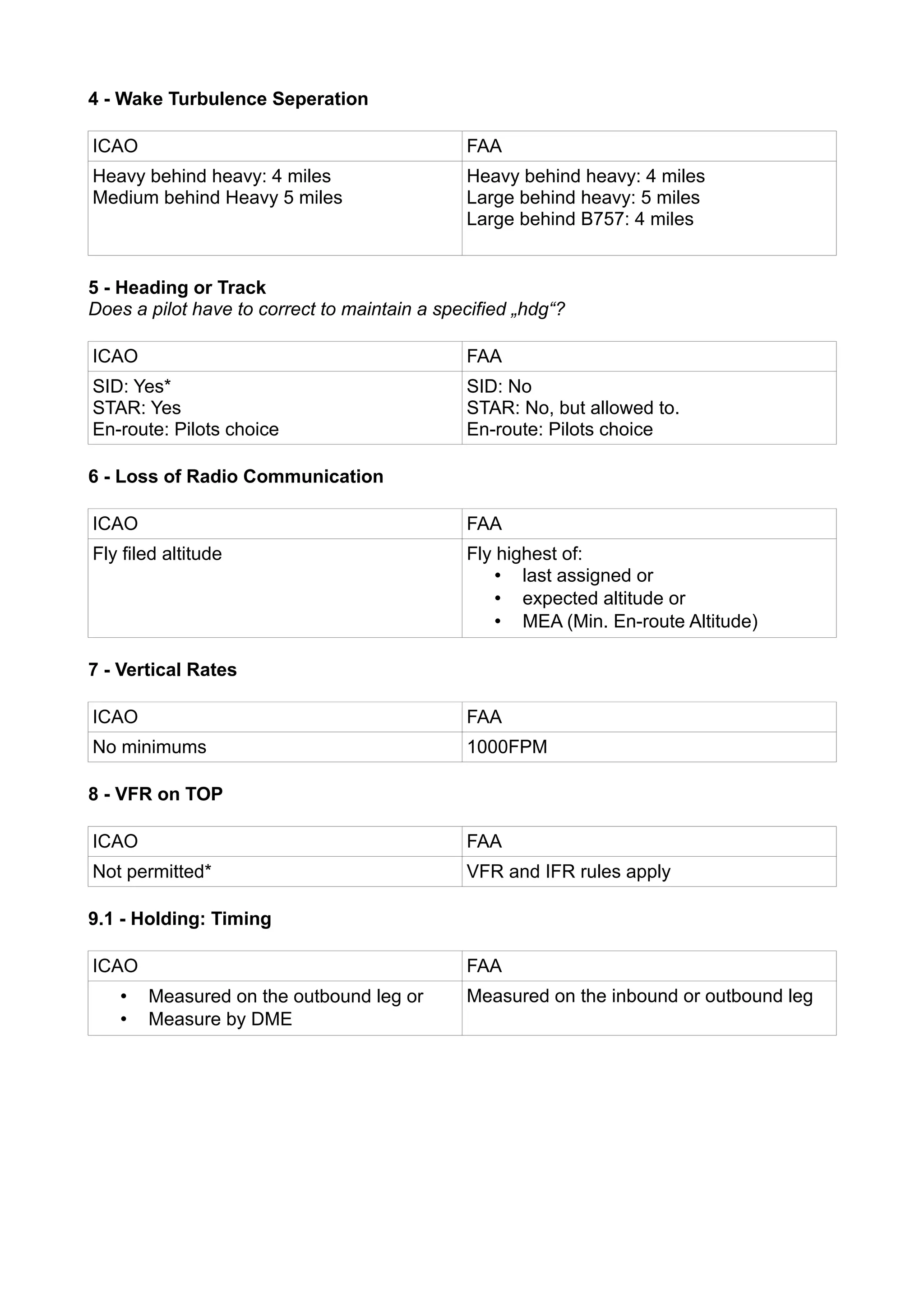
4 - Wake Turbulence Seperation
ICAO FAA
Heavy behind heavy: 4 miles
Medium behind Heavy 5 miles
Heavy behind heavy: 4 miles
Large behind heavy: 5 miles
Large behind B757: 4 miles
5 - Heading or Track
Does a pilot have to correct to maintain a specified „hdg“?
ICAO FAA
SID: Yes*
STAR: Yes
En-route: Pilots choice
SID: No
STAR: No, but allowed to.
En-route: Pilots choice
6 - Loss of Radio Communication
ICAO FAA
Fly filed altitude Fly highest of:
• last assigned or
• expected altitude or
• MEA (Min. En-route Altitude)
7 - Vertical Rates
ICAO FAA
No minimums 1000FPM
8 - VFR on TOP
ICAO FAA
Not permitted* VFR and IFR rules apply
9.1 - Holding: Timing
ICAO FAA
• Measured on the outbound leg or
• Measure by DME
Measured on the inbound or outbound leg
9.2 - Holding: Altitude/Speed
ICAO FAA
6000 and below: 210 KIAS 6000 and below: 200 KIAS
6000 – 14000: 220 KIAS* 6000 – 14000: 230 KIAS**
14000 – 20000: 240 KIAS Above 14000: 265 KIAS
20000 – 34000: 265 KIAS
Above 34000: Mach 0.83
*cat A and B only: 170 KIAS below 14,000
**except 210 KIAS where published
9.3 - Holding: Restrictions (MHA/ MAX IAS)
ICAO FAA
Noted on chart adjacent to the holding
pattern
Almost all holdings are treated the same
9.4 - Holding: EFC – Expected Further Clearance
ICAO FAA
Dependent on country Always given
10 - Descent Crossing Restrictions
ICAO FAA
Later clearance does not remove a previous
crossing restriction
Later clearane does remove a previous
crossing restriction
11 - Sidestep Approach
ICAO FAA
No such procedure Only if two runways are less than 1200ft
apart
www.ivaousa.org © 2010 - Revision 1.2 (by Aldo Benitez)

Faa icao

  • 1.
  • 2.
    1 - AirTraffic Control Units and Position ICAO FAA Flight Information Region (FIR) Air Route Traffic Control Center (ARTCC) Radar / Control Center Arrival Approach Departure Departure Director / Final Final Tower Tower Ground Ground Apron Ramp Delivery Clearance Delivery 2 - Communictions ICAO FAA QNH 1013 Altimeter 2992 Holding Point Hold Short Line up and wait Line up and wait Decimal Point Report altitude Say altitude Join base Enter base Circuit Traffic pattern / Closed traffic Vacate runway Clear runway Runway 09 Runway 9 Backtrack Taxi back Speed is yours No speed restriction/ Resume normal speed Climb Climb and maintain Descend Descend and maintain Continue approach, you're number 2 Clear to land number 2 With you FL Checking in on FL Left/right Orbit Left/right 360 3 - Clearance ICAO FAA Cleared to AIRPORT, via SID, flight planned route, Squawk CODE. Cleared to AIRPORT, via SID/VECTORS, maintain ALTITUDE, expect ALTITUDE/FL ten minutes after departure. Departure frequency is FREQ. Squawk CODE.
  • 3.
    4 - WakeTurbulence Seperation ICAO FAA Heavy behind heavy: 4 miles Medium behind Heavy 5 miles Heavy behind heavy: 4 miles Large behind heavy: 5 miles Large behind B757: 4 miles 5 - Heading or Track Does a pilot have to correct to maintain a specified „hdg“? ICAO FAA SID: Yes* STAR: Yes En-route: Pilots choice SID: No STAR: No, but allowed to. En-route: Pilots choice 6 - Loss of Radio Communication ICAO FAA Fly filed altitude Fly highest of: • last assigned or • expected altitude or • MEA (Min. En-route Altitude) 7 - Vertical Rates ICAO FAA No minimums 1000FPM 8 - VFR on TOP ICAO FAA Not permitted* VFR and IFR rules apply 9.1 - Holding: Timing ICAO FAA • Measured on the outbound leg or • Measure by DME Measured on the inbound or outbound leg
  • 4.
    9.2 - Holding:Altitude/Speed ICAO FAA 6000 and below: 210 KIAS 6000 and below: 200 KIAS 6000 – 14000: 220 KIAS* 6000 – 14000: 230 KIAS** 14000 – 20000: 240 KIAS Above 14000: 265 KIAS 20000 – 34000: 265 KIAS Above 34000: Mach 0.83 *cat A and B only: 170 KIAS below 14,000 **except 210 KIAS where published 9.3 - Holding: Restrictions (MHA/ MAX IAS) ICAO FAA Noted on chart adjacent to the holding pattern Almost all holdings are treated the same 9.4 - Holding: EFC – Expected Further Clearance ICAO FAA Dependent on country Always given 10 - Descent Crossing Restrictions ICAO FAA Later clearance does not remove a previous crossing restriction Later clearane does remove a previous crossing restriction 11 - Sidestep Approach ICAO FAA No such procedure Only if two runways are less than 1200ft apart www.ivaousa.org © 2010 - Revision 1.2 (by Aldo Benitez)