What’s new inWhat’s new in
Cardiac?Cardiac?
WatchmanWatchman
Chris Saraceno, DNAP, CRNAChris Saraceno, DNAP, CRNA
NCANA District 3 & 4 MeetingNCANA District 3 & 4 Meeting
February 4February 4thth
, 2017, 2017
disclaimersdisclaimers
• NONENONE
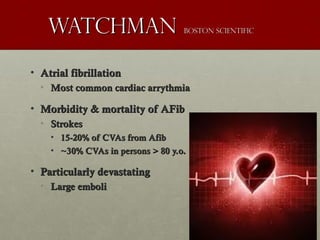
WatchmanWatchman boston Scientificboston Scientific
• Atrial fibrillationAtrial fibrillation
• Most common cardiac arrythmiaMost common cardiac arrythmia
• Morbidity & mortality of AFibMorbidity & mortality of AFib
• StrokesStrokes
• 15-20% of CVAs from Afib15-20% of CVAs from Afib
• ~30% CVAs in persons > 80 y.o.~30% CVAs in persons > 80 y.o.
• Particularly devastatingParticularly devastating
• Large emboliLarge emboli
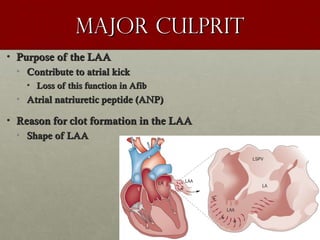
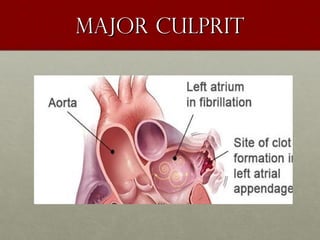
Major culpritMajor culprit
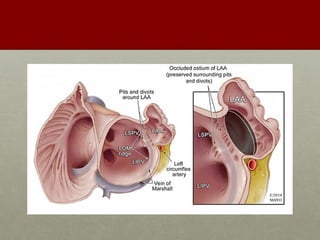
• Purpose of the LAAPurpose of the LAA
• Contribute to atrial kickContribute to atrial kick
• Loss of this function in AfibLoss of this function in Afib
• Atrial natriuretic peptide (ANP)Atrial natriuretic peptide (ANP)
• Reason for clot formation in the LAAReason for clot formation in the LAA
• Shape of LAAShape of LAA
Major culpritMajor culprit
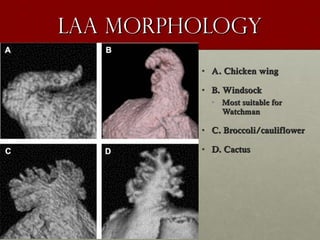
LAA MorphologyLAA Morphology
• A. Chicken wingA. Chicken wing
• B. WindsockB. Windsock
• Most suitable forMost suitable for
WatchmanWatchman
• C. Broccoli/cauliflowerC. Broccoli/cauliflower
• D. CactusD. Cactus
Prevention ofPrevention of
strokes from AFibstrokes from AFib
• Stop the arrythmia:Stop the arrythmia:
• Medical regimenMedical regimen
• antiarrythmicsantiarrythmics
• Radiofrequency Ablation (RFA)Radiofrequency Ablation (RFA)
• Problem:Problem:
• Typically, Afib is not eradicated with either treatmentTypically, Afib is not eradicated with either treatment
• ACC Guidelines do not recommend d/c of oralACC Guidelines do not recommend d/c of oral
anticoagulants (OAC)anticoagulants (OAC)
** decreased risk of CVA in patients with RFA than without** decreased risk of CVA in patients with RFA than without
Prevention of strokesPrevention of strokes
from AFibfrom AFib
• AnticoagulantsAnticoagulants
• Warfarin-standard of careWarfarin-standard of care
• Drug interactionsDrug interactions
• Risk of bleedingRisk of bleeding
• Narrow therapeutic rangeNarrow therapeutic range
• Frequent blood testingFrequent blood testing
• Poor compliancePoor compliance
• Diet restrictions due to food interactionsDiet restrictions due to food interactions
• Pradaxa®, Xarelto®, Eliquis®Pradaxa®, Xarelto®, Eliquis®
• Risk of bleedingRisk of bleeding
• No antidoteNo antidote
Prevention of strokesPrevention of strokes
from AFibfrom AFib
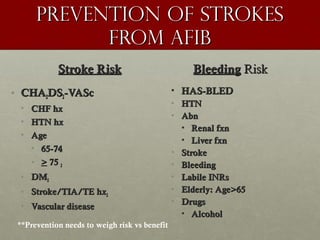
Stroke RiskStroke Risk
• CHACHA22DSDS22-VASc-VASc
• CHF hxCHF hx
• HTN hxHTN hx
• AgeAge
• 65-7465-74
• >> 7575 22
• DMDM22
• Stroke/TIA/TE hxStroke/TIA/TE hx22
• Vascular diseaseVascular disease
BleedingBleeding RiskRisk
• HAS-BLEDHAS-BLED
• HTNHTN
• AbnAbn
• Renal fxnRenal fxn
• Liver fxnLiver fxn
• StrokeStroke
• BleedingBleeding
• Labile INRsLabile INRs
• Elderly: Age>65Elderly: Age>65
• DrugsDrugs
• AlcoholAlcohol
**Prevention needs to weigh risk vs benefit
Prevention of strokesPrevention of strokes
from AFibfrom AFib
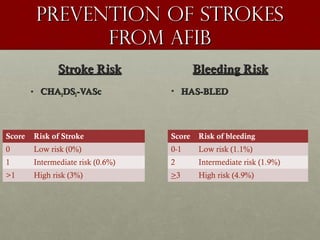
Stroke RiskStroke Risk
• CHACHA22DSDS22-VASc-VASc
Bleeding RiskBleeding Risk
• HAS-BLEDHAS-BLED
Score Risk of bleeding
0-1 Low risk (1.1%)
2 Intermediate risk (1.9%)
>3 High risk (4.9%)
Score Risk of Stroke
0 Low risk (0%)
1 Intermediate risk (0.6%)
>1 High risk (3%)
Prevention of strokesPrevention of strokes
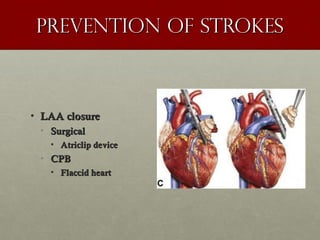
• LAA closureLAA closure
• SurgicalSurgical
• Atriclip deviceAtriclip device
• CPBCPB
• Flaccid heartFlaccid heart
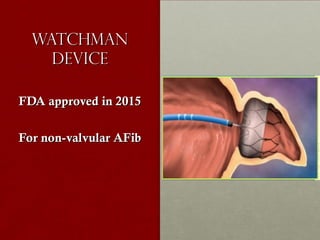
WatchmanWatchman
DeviceDevice
FDA approved in 2015FDA approved in 2015
For non-valvular AFibFor non-valvular AFib
WatchmanWatchman
• Patient considerationsPatient considerations
• Non-valvular AfibNon-valvular Afib
• High stroke risk score*High stroke risk score*
• CHACHA22DSDS22-VASc-VASc
• High bleeding risk score*High bleeding risk score*
• HAS-BLEDHAS-BLED
*high stroke AND bleeding risk score = most suitable*high stroke AND bleeding risk score = most suitable
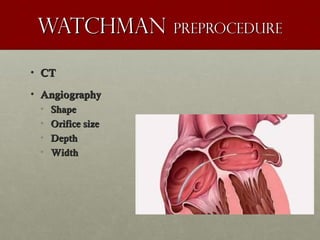
WatchmanWatchman preprocedurepreprocedure
• CTCT
• AngiographyAngiography
• ShapeShape
• Orifice sizeOrifice size
• DepthDepth
• WidthWidth
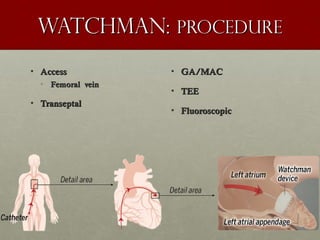
Watchman:Watchman: procedureprocedure
• AccessAccess
• Femoral veinFemoral vein
• TranseptalTranseptal
• GA/MACGA/MAC
• TEETEE
• FluoroscopicFluoroscopic
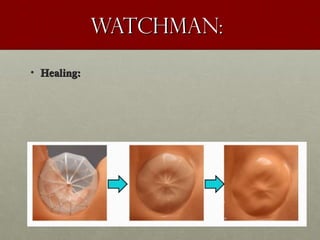
WATCHMAN:WATCHMAN:
• Healing:Healing:
Watchman:Watchman:
Anesthetic considerationsAnesthetic considerations
• Cath labCath lab
• EPs or interventional cardiologistsEPs or interventional cardiologists
• TranseptalTranseptal
• AnticoagulantsAnticoagulants
• ComplicationsComplications
• Procedural strokeProcedural stroke
• Pericardial effusionPericardial effusion
• Air embolismAir embolism
• Cardiac perforationCardiac perforation
• Device embolizationDevice embolization
• VascularVascular
• Bleeding, hematoma, pseudoaneurysmBleeding, hematoma, pseudoaneurysm
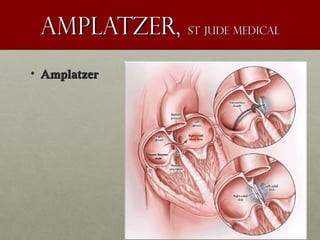
Amplatzer,Amplatzer, St jude medicalSt jude medical
• AmplatzerAmplatzer
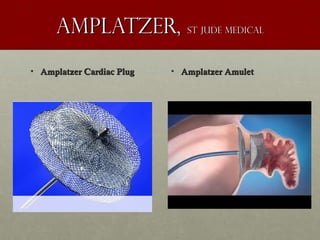
Amplatzer,Amplatzer, St jude medicalSt jude medical
• Amplatzer Cardiac PlugAmplatzer Cardiac Plug • Amplatzer AmuletAmplatzer Amulet
Other devicesOther devices
• Coherex Wavecrest LAA occluderCoherex Wavecrest LAA occluder
• Still others:Still others:
• OCCLUTECH LAA OCCLUDEROCCLUTECH LAA OCCLUDER
• LIFETECH LAA OCCLUDER: LambreLIFETECH LAA OCCLUDER: Lambre
• Cardia ultrasept LAA OCCLUDERCardia ultrasept LAA OCCLUDER
• AEGIS-ECG guided LAA capture andAEGIS-ECG guided LAA capture and
ligation systemligation system
• EPITEK- fiberoptic endoscope mediatedEPITEK- fiberoptic endoscope mediated
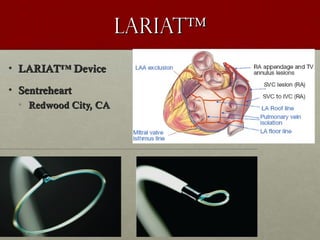
LARIAT™LARIAT™
• LARIAT™ DeviceLARIAT™ Device
• SentreheartSentreheart
• Redwood City, CARedwood City, CA
Post watchmanPost watchman
• Oral anticoagulants**Oral anticoagulants**
• Dual antiplatelet therapyDual antiplatelet therapy
TAVRTAVR
Transcatheter Aortic Valve ReplacementTranscatheter Aortic Valve Replacement
AORTIC valveAORTIC valve
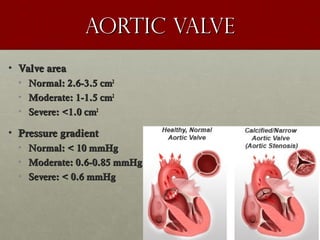
• Valve areaValve area
• Normal: 2.6-3.5 cmNormal: 2.6-3.5 cm22
• Moderate: 1-1.5 cmModerate: 1-1.5 cm22
• Severe: <1.0 cmSevere: <1.0 cm22
• Pressure gradientPressure gradient
• Normal: < 10 mmHgNormal: < 10 mmHg
• Moderate: 0.6-0.85 mmHgModerate: 0.6-0.85 mmHg
• Severe: < 0.6 mmHgSevere: < 0.6 mmHg
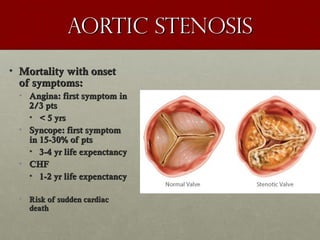
Aortic stenosisAortic stenosis
• Mortality with onsetMortality with onset
of symptoms:of symptoms:
• Angina: first symptom inAngina: first symptom in
2/3 pts2/3 pts
• < 5 yrs< 5 yrs
• Syncope: first symptomSyncope: first symptom
in 15-30% of ptsin 15-30% of pts
• 3-4 yr life expenctancy3-4 yr life expenctancy
• CHFCHF
• 1-2 yr life expenctancy1-2 yr life expenctancy
• Risk of sudden cardiacRisk of sudden cardiac
deathdeath
Aortic valveAortic valve
Repair/replacementRepair/replacement
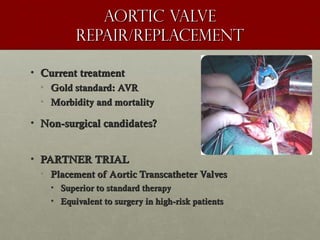
• Current treatmentCurrent treatment
• Gold standard: AVRGold standard: AVR
• Morbidity and mortalityMorbidity and mortality
• Non-surgical candidates?Non-surgical candidates?
• PARTNER TRIALPARTNER TRIAL
• Placement of Aortic Transcatheter ValvesPlacement of Aortic Transcatheter Valves
• Superior to standard therapySuperior to standard therapy
• Equivalent to surgery in high-risk patientsEquivalent to surgery in high-risk patients
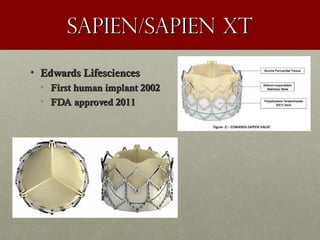
Sapien/sapien xtSapien/sapien xt
• Edwards LifesciencesEdwards Lifesciences
• First human implant 2002First human implant 2002
• FDA approved 2011FDA approved 2011
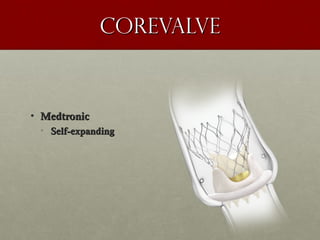
corevalvecorevalve
• MedtronicMedtronic
• Self-expandingSelf-expanding
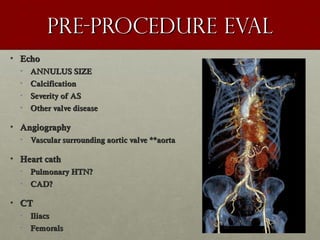
Pre-procedure evalPre-procedure eval
• EchoEcho
• ANNULUS SIZEANNULUS SIZE
• CalcificationCalcification
• Severity of ASSeverity of AS
• Other valve diseaseOther valve disease
• AngiographyAngiography
• Vascular surrounding aortic valve **aortaVascular surrounding aortic valve **aorta
• Heart cathHeart cath
• Pulmonary HTN?Pulmonary HTN?
• CAD?CAD?
• CTCT
• IliacsIliacs
• FemoralsFemorals
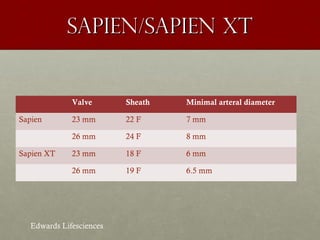
Sapien/sapien xtSapien/sapien xt
Valve Sheath Minimal arteral diameter
Sapien 23 mm 22 F 7 mm
26 mm 24 F 8 mm
Sapien XT 23 mm 18 F 6 mm
26 mm 19 F 6.5 mm
Edwards Lifesciences
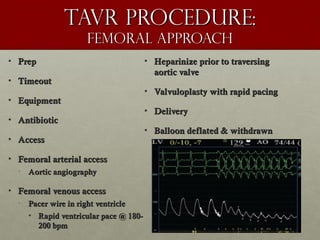
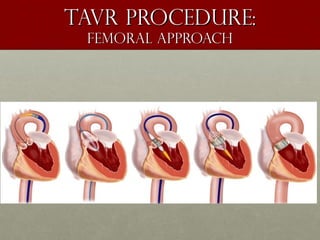
Tavr procedure:Tavr procedure:
femoral approachfemoral approach
• PrepPrep
• TimeoutTimeout
• EquipmentEquipment
• AntibioticAntibiotic
• AccessAccess
• Femoral arterial accessFemoral arterial access
• Aortic angiographyAortic angiography
• Femoral venous accessFemoral venous access
• Pacer wire in right ventriclePacer wire in right ventricle
• Rapid ventricular pace @ 180-Rapid ventricular pace @ 180-
200 bpm200 bpm
• Heparinize prior to traversingHeparinize prior to traversing
aortic valveaortic valve
• Valvuloplasty with rapid pacingValvuloplasty with rapid pacing
• DeliveryDelivery
• Balloon deflated & withdrawnBalloon deflated & withdrawn
Tavr procedure:Tavr procedure:
femoral approachfemoral approach
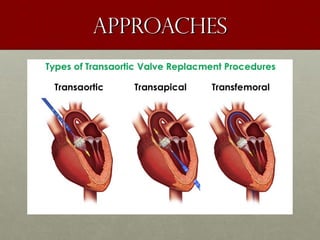
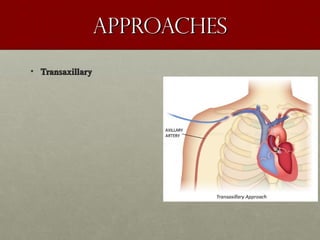
ApproachesApproaches
• TransaxillaryTransaxillary
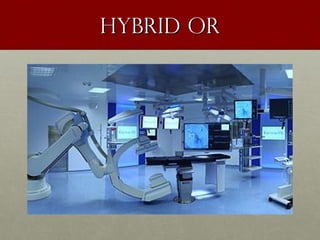
Hybrid orHybrid or
Tavr complicationsTavr complications
• Structural failure-rareStructural failure-rare
• Vascular injury/ perforationVascular injury/ perforation
• Iliacs, femorals, aortaIliacs, femorals, aorta
• RETROPERITONEAL BLEEDRETROPERITONEAL BLEED
• IVUSIVUS
• ThrombusThrombus
• Heparinize, ACT 250-300 seconds, check q 30 minutesHeparinize, ACT 250-300 seconds, check q 30 minutes
• Cerebral embolizationCerebral embolization
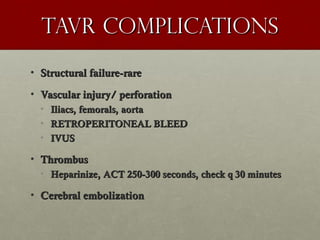
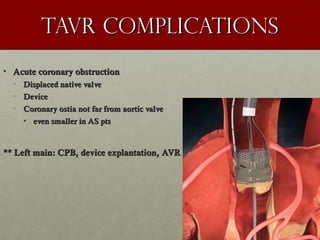
Tavr complicationsTavr complications
• Acute coronary obstructionAcute coronary obstruction
• Displaced native valveDisplaced native valve
• DeviceDevice
• Coronary ostia not far from aortic valveCoronary ostia not far from aortic valve
• even smaller in AS ptseven smaller in AS pts
** Left main: CPB, device explantation, AVR** Left main: CPB, device explantation, AVR
Tavr complicationsTavr complications
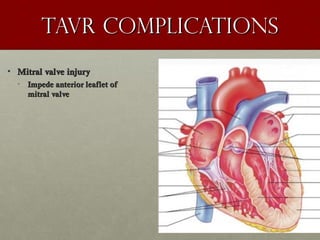
• Mitral valve injuryMitral valve injury
• Impede anterior leaflet ofImpede anterior leaflet of
mitral valvemitral valve
Tavr complicationsTavr complications
• Annular and aortic root rupture/dissectionAnnular and aortic root rupture/dissection
• Device too largeDevice too large
• Risk increases with manipulation of deviceRisk increases with manipulation of device
• Perivalvular regurgitationPerivalvular regurgitation
• Inappropriate sizing- too smallInappropriate sizing- too small
• * embolize device* embolize device
• Malposition (valve in valve)Malposition (valve in valve)
• Under expansion of deviceUnder expansion of device
Tavr complicationsTavr complications
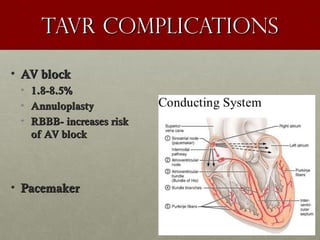
• AV blockAV block
• 1.8-8.5%1.8-8.5%
• AnnuloplastyAnnuloplasty
• RBBB- increases riskRBBB- increases risk
of AV blockof AV block
• PacemakerPacemaker
Tavr complicationsTavr complications
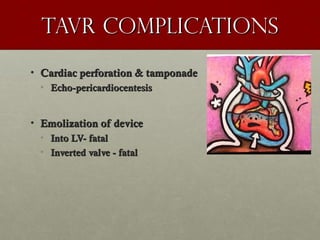
• Cardiac perforation & tamponadeCardiac perforation & tamponade
• Echo-pericardiocentesisEcho-pericardiocentesis
• Emolization of deviceEmolization of device
• Into LV- fatalInto LV- fatal
• Inverted valve - fatalInverted valve - fatal
Tavr complicationsTavr complications
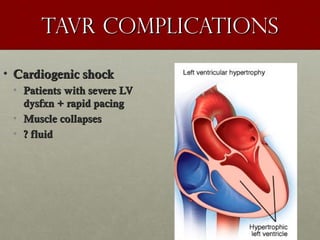
• Cardiogenic shockCardiogenic shock
• Patients with severe LVPatients with severe LV
dysfxn + rapid pacingdysfxn + rapid pacing
• Muscle collapsesMuscle collapses
• ? fluid? fluid
AnestheticAnesthetic
considerationsconsiderations
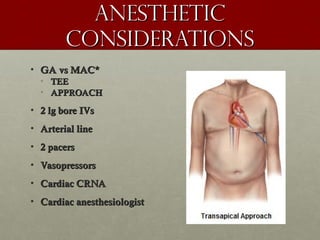
• GA vs MAC*GA vs MAC*
• TEETEE
• APPROACHAPPROACH
• 2 lg bore IVs2 lg bore IVs
• Arterial lineArterial line
• 2 pacers2 pacers
• VasopressorsVasopressors
• Cardiac CRNACardiac CRNA
• Cardiac anesthesiologistCardiac anesthesiologist
AnestheticAnesthetic
considerationsconsiderations
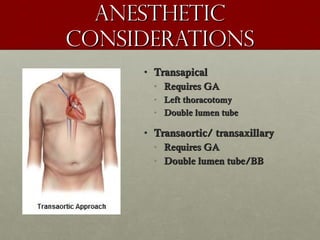
• TransapicalTransapical
• Requires GARequires GA
• Left thoracotomyLeft thoracotomy
• Double lumen tubeDouble lumen tube
• Transaortic/ transaxillaryTransaortic/ transaxillary
• Requires GARequires GA
• Double lumen tube/BBDouble lumen tube/BB
AnestheticAnesthetic
considerationsconsiderations
• OR staffOR staff
• Cath lab staffCath lab staff
• CPB machineCPB machine
• FluoroFluoro
• PerfusionPerfusion
• 3 big dogs3 big dogs
PARTNER IIA TRIALPARTNER IIA TRIAL
• December 2011-NovemberDecember 2011-November
20132013
• Severe ASSevere AS
• Intermediate riskIntermediate risk
• 1011 patients1011 patients
• RandomizedRandomized
• 57 centers in U.S. and57 centers in U.S. and
CanadaCanada
• Results:Results:
• Pacemaker requirementsPacemaker requirements
• No change fromNo change from
PARTNER TrialPARTNER Trial
• Aortic regurgitationAortic regurgitation
• 3.7%3.7%
• Not related to adverseNot related to adverse
outcomesoutcomes
2016 FDA approves Sapien XT & Sapien 3 for intermediate risk
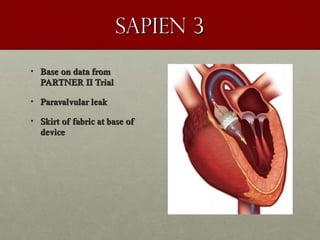
Sapien 3Sapien 3
• Base on data fromBase on data from
PARTNER II TrialPARTNER II Trial
• Paravalvular leakParavalvular leak
• Skirt of fabric at base ofSkirt of fabric at base of
devicedevice
VARCVARC
• VALVE ACADEMIC RESEARCH CONSORTIUMVALVE ACADEMIC RESEARCH CONSORTIUM
• ComplicationsComplications
• Stroke & TIAsStroke & TIAs
• ARAR
• Vascular access complicationsVascular access complications
• Conduction system disturbancesConduction system disturbances
• Coronary artery occlusionCoronary artery occlusion
• ARFARF
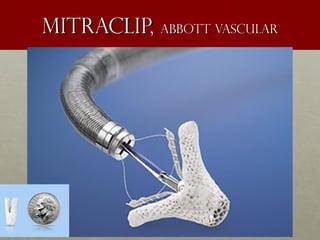
MitraClipMitraClip™™ abbott Vascularabbott Vascular
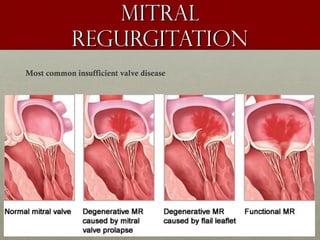
MitralMitral
regurgitationregurgitation
Most common insufficient valve disease
Current therapyCurrent therapy
• Mitral repairMitral repair
• Low risk mortality: 1.4%Low risk mortality: 1.4%
• Hight risk mortality/ age > 80: 11%Hight risk mortality/ age > 80: 11%
• Mitral replacementMitral replacement
• Low risk mortality: 1.6%Low risk mortality: 1.6%
• Hight risk mortality/ age > 80: 18.9%Hight risk mortality/ age > 80: 18.9%
• EVEREST TRIALEVEREST TRIAL
• EndoVascular Edge- to-Edge REpair StudyEndoVascular Edge- to-Edge REpair Study
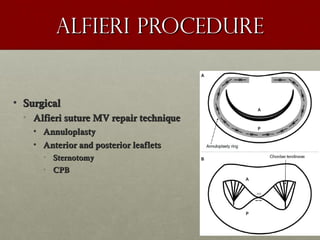
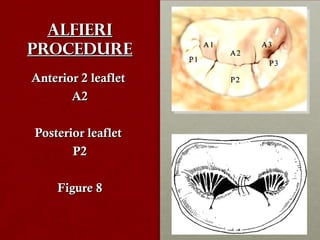
Alfieri procedureAlfieri procedure
• SurgicalSurgical
• Alfieri suture MV repair techniqueAlfieri suture MV repair technique
• AnnuloplastyAnnuloplasty
• Anterior and posterior leafletsAnterior and posterior leaflets
• SternotomySternotomy
• CPBCPB
AlfieriAlfieri
procedureprocedure
Anterior 2 leafletAnterior 2 leaflet
A2A2
Posterior leafletPosterior leaflet
P2P2
Figure 8Figure 8
Mitraclip,Mitraclip, Abbott vascularAbbott vascular
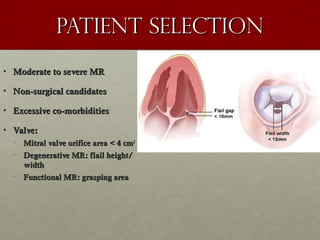
Patient selectionPatient selection
• Moderate to severe MRModerate to severe MR
• Non-surgical candidatesNon-surgical candidates
• Excessive co-morbiditiesExcessive co-morbidities
• Valve:Valve:
• Mitral valve orifice area < 4 cmMitral valve orifice area < 4 cm22
• Degenerative MR: flail height/Degenerative MR: flail height/
widthwidth
• Functional MR: grasping areaFunctional MR: grasping area
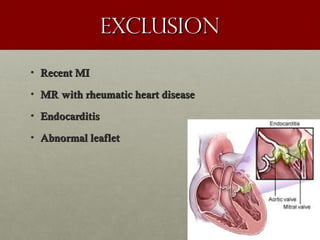
exclusionexclusion
• Recent MIRecent MI
• MR with rheumatic heart diseaseMR with rheumatic heart disease
• EndocarditisEndocarditis
• Abnormal leafletAbnormal leaflet
procedureprocedure
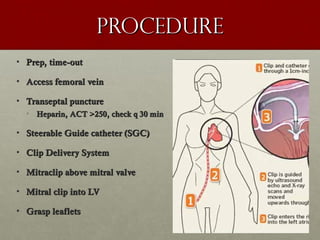
• Prep, time-outPrep, time-out
• Access femoral veinAccess femoral vein
• Transeptal punctureTranseptal puncture
• Heparin, ACT >250, check q 30 minHeparin, ACT >250, check q 30 min
• Steerable Guide catheter (SGC)Steerable Guide catheter (SGC)
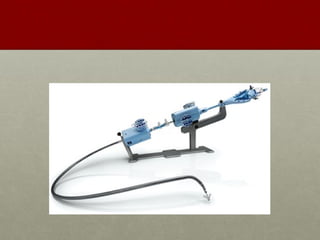
• Clip Delivery SystemClip Delivery System
• Mitraclip above mitral valveMitraclip above mitral valve
• Mitral clip into LVMitral clip into LV
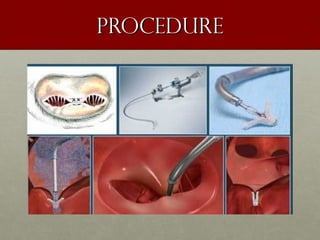
• Grasp leafletsGrasp leaflets
procedureprocedure
procedureprocedure
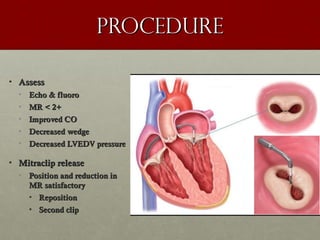
• AssessAssess
• Echo & fluoroEcho & fluoro
• MR < 2+MR < 2+
• Improved COImproved CO
• Decreased wedgeDecreased wedge
• Decreased LVEDV pressureDecreased LVEDV pressure
• Mitraclip releaseMitraclip release
• Position and reduction inPosition and reduction in
MR satisfactoryMR satisfactory
• RepositionReposition
• Second clipSecond clip
complicationscomplications
• Tear mitral leaflet(s)Tear mitral leaflet(s)
• Worsen MRWorsen MR
• Mitral stenosisMitral stenosis
• Acute or chronicAcute or chronic
• Clip surfaces endothelializeClip surfaces endothelialize
• Create an atrial-septal defectCreate an atrial-septal defect
• Rupture of atrial wallsRupture of atrial walls
• Cardiac tamponadeCardiac tamponade
• Echo-guided pericardiocentesisEcho-guided pericardiocentesis
AnestheticAnesthetic
considerationsconsiderations
• GAGA
• 2 large bore IVs2 large bore IVs
• Arterial lineArterial line
• VasopressorsVasopressors
• Phenylephrine vs ephedrinePhenylephrine vs ephedrine
• ? fluids? fluids
• PatientPatient
• LV dysfxnLV dysfxn
• Pulmonary HTNPulmonary HTN
• ? Afib? Afib
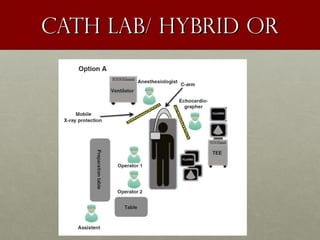
Cath lab/ hybrid ORCath lab/ hybrid ORArrangementsin the ca
FutureFuture
• EVEREST II TrialEVEREST II Trial
• 20152015
• 5 year follow up:5 year follow up:
• If intervention required (surgery): first 6 monthsIf intervention required (surgery): first 6 months
• After 1 year- cardiac remodelingAfter 1 year- cardiac remodeling
• Clinical outcomes similar to surgical approachClinical outcomes similar to surgical approach
• ** greater level of safety** greater level of safety

What's New in Cardiac

  • 1.
    What’s new inWhat’snew in Cardiac?Cardiac? WatchmanWatchman Chris Saraceno, DNAP, CRNAChris Saraceno, DNAP, CRNA NCANA District 3 & 4 MeetingNCANA District 3 & 4 Meeting February 4February 4thth , 2017, 2017
  • 2.
  • 3.
    WatchmanWatchman boston ScientificbostonScientific • Atrial fibrillationAtrial fibrillation • Most common cardiac arrythmiaMost common cardiac arrythmia • Morbidity & mortality of AFibMorbidity & mortality of AFib • StrokesStrokes • 15-20% of CVAs from Afib15-20% of CVAs from Afib • ~30% CVAs in persons > 80 y.o.~30% CVAs in persons > 80 y.o. • Particularly devastatingParticularly devastating • Large emboliLarge emboli
  • 4.
    Major culpritMajor culprit •Purpose of the LAAPurpose of the LAA • Contribute to atrial kickContribute to atrial kick • Loss of this function in AfibLoss of this function in Afib • Atrial natriuretic peptide (ANP)Atrial natriuretic peptide (ANP) • Reason for clot formation in the LAAReason for clot formation in the LAA • Shape of LAAShape of LAA
  • 5.
  • 6.
    LAA MorphologyLAA Morphology •A. Chicken wingA. Chicken wing • B. WindsockB. Windsock • Most suitable forMost suitable for WatchmanWatchman • C. Broccoli/cauliflowerC. Broccoli/cauliflower • D. CactusD. Cactus
  • 7.
    Prevention ofPrevention of strokesfrom AFibstrokes from AFib • Stop the arrythmia:Stop the arrythmia: • Medical regimenMedical regimen • antiarrythmicsantiarrythmics • Radiofrequency Ablation (RFA)Radiofrequency Ablation (RFA) • Problem:Problem: • Typically, Afib is not eradicated with either treatmentTypically, Afib is not eradicated with either treatment • ACC Guidelines do not recommend d/c of oralACC Guidelines do not recommend d/c of oral anticoagulants (OAC)anticoagulants (OAC) ** decreased risk of CVA in patients with RFA than without** decreased risk of CVA in patients with RFA than without
  • 8.
    Prevention of strokesPreventionof strokes from AFibfrom AFib • AnticoagulantsAnticoagulants • Warfarin-standard of careWarfarin-standard of care • Drug interactionsDrug interactions • Risk of bleedingRisk of bleeding • Narrow therapeutic rangeNarrow therapeutic range • Frequent blood testingFrequent blood testing • Poor compliancePoor compliance • Diet restrictions due to food interactionsDiet restrictions due to food interactions • Pradaxa®, Xarelto®, Eliquis®Pradaxa®, Xarelto®, Eliquis® • Risk of bleedingRisk of bleeding • No antidoteNo antidote
  • 9.
    Prevention of strokesPreventionof strokes from AFibfrom AFib Stroke RiskStroke Risk • CHACHA22DSDS22-VASc-VASc • CHF hxCHF hx • HTN hxHTN hx • AgeAge • 65-7465-74 • >> 7575 22 • DMDM22 • Stroke/TIA/TE hxStroke/TIA/TE hx22 • Vascular diseaseVascular disease BleedingBleeding RiskRisk • HAS-BLEDHAS-BLED • HTNHTN • AbnAbn • Renal fxnRenal fxn • Liver fxnLiver fxn • StrokeStroke • BleedingBleeding • Labile INRsLabile INRs • Elderly: Age>65Elderly: Age>65 • DrugsDrugs • AlcoholAlcohol **Prevention needs to weigh risk vs benefit
  • 10.
    Prevention of strokesPreventionof strokes from AFibfrom AFib Stroke RiskStroke Risk • CHACHA22DSDS22-VASc-VASc Bleeding RiskBleeding Risk • HAS-BLEDHAS-BLED Score Risk of bleeding 0-1 Low risk (1.1%) 2 Intermediate risk (1.9%) >3 High risk (4.9%) Score Risk of Stroke 0 Low risk (0%) 1 Intermediate risk (0.6%) >1 High risk (3%)
  • 11.
    Prevention of strokesPreventionof strokes • LAA closureLAA closure • SurgicalSurgical • Atriclip deviceAtriclip device • CPBCPB • Flaccid heartFlaccid heart
  • 12.
    WatchmanWatchman DeviceDevice FDA approved in2015FDA approved in 2015 For non-valvular AFibFor non-valvular AFib
  • 13.
    WatchmanWatchman • Patient considerationsPatientconsiderations • Non-valvular AfibNon-valvular Afib • High stroke risk score*High stroke risk score* • CHACHA22DSDS22-VASc-VASc • High bleeding risk score*High bleeding risk score* • HAS-BLEDHAS-BLED *high stroke AND bleeding risk score = most suitable*high stroke AND bleeding risk score = most suitable
  • 14.
    WatchmanWatchman preprocedurepreprocedure • CTCT •AngiographyAngiography • ShapeShape • Orifice sizeOrifice size • DepthDepth • WidthWidth
  • 15.
    Watchman:Watchman: procedureprocedure • AccessAccess •Femoral veinFemoral vein • TranseptalTranseptal • GA/MACGA/MAC • TEETEE • FluoroscopicFluoroscopic
  • 16.
  • 17.
    Watchman:Watchman: Anesthetic considerationsAnesthetic considerations •Cath labCath lab • EPs or interventional cardiologistsEPs or interventional cardiologists • TranseptalTranseptal • AnticoagulantsAnticoagulants • ComplicationsComplications • Procedural strokeProcedural stroke • Pericardial effusionPericardial effusion • Air embolismAir embolism • Cardiac perforationCardiac perforation • Device embolizationDevice embolization • VascularVascular • Bleeding, hematoma, pseudoaneurysmBleeding, hematoma, pseudoaneurysm
  • 19.
    Amplatzer,Amplatzer, St judemedicalSt jude medical • AmplatzerAmplatzer
  • 20.
    Amplatzer,Amplatzer, St judemedicalSt jude medical • Amplatzer Cardiac PlugAmplatzer Cardiac Plug • Amplatzer AmuletAmplatzer Amulet
  • 21.
    Other devicesOther devices •Coherex Wavecrest LAA occluderCoherex Wavecrest LAA occluder • Still others:Still others: • OCCLUTECH LAA OCCLUDEROCCLUTECH LAA OCCLUDER • LIFETECH LAA OCCLUDER: LambreLIFETECH LAA OCCLUDER: Lambre • Cardia ultrasept LAA OCCLUDERCardia ultrasept LAA OCCLUDER • AEGIS-ECG guided LAA capture andAEGIS-ECG guided LAA capture and ligation systemligation system • EPITEK- fiberoptic endoscope mediatedEPITEK- fiberoptic endoscope mediated
  • 22.
    LARIAT™LARIAT™ • LARIAT™ DeviceLARIAT™Device • SentreheartSentreheart • Redwood City, CARedwood City, CA
  • 23.
    Post watchmanPost watchman •Oral anticoagulants**Oral anticoagulants** • Dual antiplatelet therapyDual antiplatelet therapy
  • 24.
    TAVRTAVR Transcatheter Aortic ValveReplacementTranscatheter Aortic Valve Replacement
  • 25.
    AORTIC valveAORTIC valve •Valve areaValve area • Normal: 2.6-3.5 cmNormal: 2.6-3.5 cm22 • Moderate: 1-1.5 cmModerate: 1-1.5 cm22 • Severe: <1.0 cmSevere: <1.0 cm22 • Pressure gradientPressure gradient • Normal: < 10 mmHgNormal: < 10 mmHg • Moderate: 0.6-0.85 mmHgModerate: 0.6-0.85 mmHg • Severe: < 0.6 mmHgSevere: < 0.6 mmHg
  • 26.
    Aortic stenosisAortic stenosis •Mortality with onsetMortality with onset of symptoms:of symptoms: • Angina: first symptom inAngina: first symptom in 2/3 pts2/3 pts • < 5 yrs< 5 yrs • Syncope: first symptomSyncope: first symptom in 15-30% of ptsin 15-30% of pts • 3-4 yr life expenctancy3-4 yr life expenctancy • CHFCHF • 1-2 yr life expenctancy1-2 yr life expenctancy • Risk of sudden cardiacRisk of sudden cardiac deathdeath
  • 27.
    Aortic valveAortic valve Repair/replacementRepair/replacement •Current treatmentCurrent treatment • Gold standard: AVRGold standard: AVR • Morbidity and mortalityMorbidity and mortality • Non-surgical candidates?Non-surgical candidates? • PARTNER TRIALPARTNER TRIAL • Placement of Aortic Transcatheter ValvesPlacement of Aortic Transcatheter Valves • Superior to standard therapySuperior to standard therapy • Equivalent to surgery in high-risk patientsEquivalent to surgery in high-risk patients
  • 28.
    Sapien/sapien xtSapien/sapien xt •Edwards LifesciencesEdwards Lifesciences • First human implant 2002First human implant 2002 • FDA approved 2011FDA approved 2011
  • 29.
  • 30.
    Pre-procedure evalPre-procedure eval •EchoEcho • ANNULUS SIZEANNULUS SIZE • CalcificationCalcification • Severity of ASSeverity of AS • Other valve diseaseOther valve disease • AngiographyAngiography • Vascular surrounding aortic valve **aortaVascular surrounding aortic valve **aorta • Heart cathHeart cath • Pulmonary HTN?Pulmonary HTN? • CAD?CAD? • CTCT • IliacsIliacs • FemoralsFemorals
  • 31.
    Sapien/sapien xtSapien/sapien xt ValveSheath Minimal arteral diameter Sapien 23 mm 22 F 7 mm 26 mm 24 F 8 mm Sapien XT 23 mm 18 F 6 mm 26 mm 19 F 6.5 mm Edwards Lifesciences
  • 32.
    Tavr procedure:Tavr procedure: femoralapproachfemoral approach • PrepPrep • TimeoutTimeout • EquipmentEquipment • AntibioticAntibiotic • AccessAccess • Femoral arterial accessFemoral arterial access • Aortic angiographyAortic angiography • Femoral venous accessFemoral venous access • Pacer wire in right ventriclePacer wire in right ventricle • Rapid ventricular pace @ 180-Rapid ventricular pace @ 180- 200 bpm200 bpm • Heparinize prior to traversingHeparinize prior to traversing aortic valveaortic valve • Valvuloplasty with rapid pacingValvuloplasty with rapid pacing • DeliveryDelivery • Balloon deflated & withdrawnBalloon deflated & withdrawn
  • 33.
  • 34.
  • 35.
  • 36.
  • 37.
    Tavr complicationsTavr complications •Structural failure-rareStructural failure-rare • Vascular injury/ perforationVascular injury/ perforation • Iliacs, femorals, aortaIliacs, femorals, aorta • RETROPERITONEAL BLEEDRETROPERITONEAL BLEED • IVUSIVUS • ThrombusThrombus • Heparinize, ACT 250-300 seconds, check q 30 minutesHeparinize, ACT 250-300 seconds, check q 30 minutes • Cerebral embolizationCerebral embolization
  • 38.
    Tavr complicationsTavr complications •Acute coronary obstructionAcute coronary obstruction • Displaced native valveDisplaced native valve • DeviceDevice • Coronary ostia not far from aortic valveCoronary ostia not far from aortic valve • even smaller in AS ptseven smaller in AS pts ** Left main: CPB, device explantation, AVR** Left main: CPB, device explantation, AVR
  • 39.
    Tavr complicationsTavr complications •Mitral valve injuryMitral valve injury • Impede anterior leaflet ofImpede anterior leaflet of mitral valvemitral valve
  • 40.
    Tavr complicationsTavr complications •Annular and aortic root rupture/dissectionAnnular and aortic root rupture/dissection • Device too largeDevice too large • Risk increases with manipulation of deviceRisk increases with manipulation of device • Perivalvular regurgitationPerivalvular regurgitation • Inappropriate sizing- too smallInappropriate sizing- too small • * embolize device* embolize device • Malposition (valve in valve)Malposition (valve in valve) • Under expansion of deviceUnder expansion of device
  • 41.
    Tavr complicationsTavr complications •AV blockAV block • 1.8-8.5%1.8-8.5% • AnnuloplastyAnnuloplasty • RBBB- increases riskRBBB- increases risk of AV blockof AV block • PacemakerPacemaker
  • 42.
    Tavr complicationsTavr complications •Cardiac perforation & tamponadeCardiac perforation & tamponade • Echo-pericardiocentesisEcho-pericardiocentesis • Emolization of deviceEmolization of device • Into LV- fatalInto LV- fatal • Inverted valve - fatalInverted valve - fatal
  • 43.
    Tavr complicationsTavr complications •Cardiogenic shockCardiogenic shock • Patients with severe LVPatients with severe LV dysfxn + rapid pacingdysfxn + rapid pacing • Muscle collapsesMuscle collapses • ? fluid? fluid
  • 44.
    AnestheticAnesthetic considerationsconsiderations • GA vsMAC*GA vs MAC* • TEETEE • APPROACHAPPROACH • 2 lg bore IVs2 lg bore IVs • Arterial lineArterial line • 2 pacers2 pacers • VasopressorsVasopressors • Cardiac CRNACardiac CRNA • Cardiac anesthesiologistCardiac anesthesiologist
  • 45.
    AnestheticAnesthetic considerationsconsiderations • TransapicalTransapical • RequiresGARequires GA • Left thoracotomyLeft thoracotomy • Double lumen tubeDouble lumen tube • Transaortic/ transaxillaryTransaortic/ transaxillary • Requires GARequires GA • Double lumen tube/BBDouble lumen tube/BB
  • 46.
    AnestheticAnesthetic considerationsconsiderations • OR staffORstaff • Cath lab staffCath lab staff • CPB machineCPB machine • FluoroFluoro • PerfusionPerfusion • 3 big dogs3 big dogs
  • 47.
    PARTNER IIA TRIALPARTNERIIA TRIAL • December 2011-NovemberDecember 2011-November 20132013 • Severe ASSevere AS • Intermediate riskIntermediate risk • 1011 patients1011 patients • RandomizedRandomized • 57 centers in U.S. and57 centers in U.S. and CanadaCanada • Results:Results: • Pacemaker requirementsPacemaker requirements • No change fromNo change from PARTNER TrialPARTNER Trial • Aortic regurgitationAortic regurgitation • 3.7%3.7% • Not related to adverseNot related to adverse outcomesoutcomes 2016 FDA approves Sapien XT & Sapien 3 for intermediate risk
  • 48.
    Sapien 3Sapien 3 •Base on data fromBase on data from PARTNER II TrialPARTNER II Trial • Paravalvular leakParavalvular leak • Skirt of fabric at base ofSkirt of fabric at base of devicedevice
  • 49.
    VARCVARC • VALVE ACADEMICRESEARCH CONSORTIUMVALVE ACADEMIC RESEARCH CONSORTIUM • ComplicationsComplications • Stroke & TIAsStroke & TIAs • ARAR • Vascular access complicationsVascular access complications • Conduction system disturbancesConduction system disturbances • Coronary artery occlusionCoronary artery occlusion • ARFARF
  • 50.
  • 51.
  • 52.
    Current therapyCurrent therapy •Mitral repairMitral repair • Low risk mortality: 1.4%Low risk mortality: 1.4% • Hight risk mortality/ age > 80: 11%Hight risk mortality/ age > 80: 11% • Mitral replacementMitral replacement • Low risk mortality: 1.6%Low risk mortality: 1.6% • Hight risk mortality/ age > 80: 18.9%Hight risk mortality/ age > 80: 18.9% • EVEREST TRIALEVEREST TRIAL • EndoVascular Edge- to-Edge REpair StudyEndoVascular Edge- to-Edge REpair Study
  • 53.
    Alfieri procedureAlfieri procedure •SurgicalSurgical • Alfieri suture MV repair techniqueAlfieri suture MV repair technique • AnnuloplastyAnnuloplasty • Anterior and posterior leafletsAnterior and posterior leaflets • SternotomySternotomy • CPBCPB
  • 54.
    AlfieriAlfieri procedureprocedure Anterior 2 leafletAnterior2 leaflet A2A2 Posterior leafletPosterior leaflet P2P2 Figure 8Figure 8
  • 55.
  • 56.
    Patient selectionPatient selection •Moderate to severe MRModerate to severe MR • Non-surgical candidatesNon-surgical candidates • Excessive co-morbiditiesExcessive co-morbidities • Valve:Valve: • Mitral valve orifice area < 4 cmMitral valve orifice area < 4 cm22 • Degenerative MR: flail height/Degenerative MR: flail height/ widthwidth • Functional MR: grasping areaFunctional MR: grasping area
  • 57.
    exclusionexclusion • Recent MIRecentMI • MR with rheumatic heart diseaseMR with rheumatic heart disease • EndocarditisEndocarditis • Abnormal leafletAbnormal leaflet
  • 58.
    procedureprocedure • Prep, time-outPrep,time-out • Access femoral veinAccess femoral vein • Transeptal punctureTranseptal puncture • Heparin, ACT >250, check q 30 minHeparin, ACT >250, check q 30 min • Steerable Guide catheter (SGC)Steerable Guide catheter (SGC) • Clip Delivery SystemClip Delivery System • Mitraclip above mitral valveMitraclip above mitral valve • Mitral clip into LVMitral clip into LV • Grasp leafletsGrasp leaflets
  • 60.
  • 61.
    procedureprocedure • AssessAssess • Echo& fluoroEcho & fluoro • MR < 2+MR < 2+ • Improved COImproved CO • Decreased wedgeDecreased wedge • Decreased LVEDV pressureDecreased LVEDV pressure • Mitraclip releaseMitraclip release • Position and reduction inPosition and reduction in MR satisfactoryMR satisfactory • RepositionReposition • Second clipSecond clip
  • 62.
    complicationscomplications • Tear mitralleaflet(s)Tear mitral leaflet(s) • Worsen MRWorsen MR • Mitral stenosisMitral stenosis • Acute or chronicAcute or chronic • Clip surfaces endothelializeClip surfaces endothelialize • Create an atrial-septal defectCreate an atrial-septal defect • Rupture of atrial wallsRupture of atrial walls • Cardiac tamponadeCardiac tamponade • Echo-guided pericardiocentesisEcho-guided pericardiocentesis
  • 63.
    AnestheticAnesthetic considerationsconsiderations • GAGA • 2large bore IVs2 large bore IVs • Arterial lineArterial line • VasopressorsVasopressors • Phenylephrine vs ephedrinePhenylephrine vs ephedrine • ? fluids? fluids • PatientPatient • LV dysfxnLV dysfxn • Pulmonary HTNPulmonary HTN • ? Afib? Afib
  • 64.
    Cath lab/ hybridORCath lab/ hybrid ORArrangementsin the ca
  • 65.
    FutureFuture • EVEREST IITrialEVEREST II Trial • 20152015 • 5 year follow up:5 year follow up: • If intervention required (surgery): first 6 monthsIf intervention required (surgery): first 6 months • After 1 year- cardiac remodelingAfter 1 year- cardiac remodeling • Clinical outcomes similar to surgical approachClinical outcomes similar to surgical approach • ** greater level of safety** greater level of safety

Editor's Notes

  • #4 De Backer O, Arnous S, Ihlemann N, et al Percutaneous left atrial appendage occlusion for stroke prevention in atrial fibrillation: an update Open Heart 2014;1:e000020. doi: 10.1136/openhrt-2013-000020
  • #7 De Backer O, Arnous S, Ihlemann N, et al Percutaneous left atrial appendage occlusion for stroke prevention in atrial fibrillation: an update Open Heart 2014;1:e000020. doi: 10.1136/openhrt-2013-000020
  • #8 De Backer O, Arnous S, Ihlemann N, et al Percutaneous left atrial appendage occlusion for stroke prevention in atrial fibrillation: an update Open Heart 2014;1:e000020. doi: 10.1136/openhrt-2013-000020 ACC
  • #11 Birmingham 2009
  • #17 www.Theafibclinic.com
  • #18 Iskandar, et al 2016
  • #24 ** studies showing may not need OACs
  • #27 Hensley 5th Ed. P. 323-325
  • #29 Sapien: trileaflet, bovine, stainless steal, durability &amp;gt; 10 yrs Sapien XT: cobalt chromium alloy
  • #53 Deuschl, et al 2016
  • #63 Abbott Vascular, Abbott Park, Illionois