Forward Reach:
Group A
Rachel Powell
Jill Stephenson
Our process
What is a forward reach?
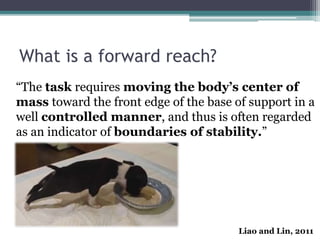
“The task requires moving the body’s center of
mass toward the front edge of the base of support in a
well controlled manner, and thus is often regarded
as an indicator of boundaries of stability.”
Liao and Lin, 2011
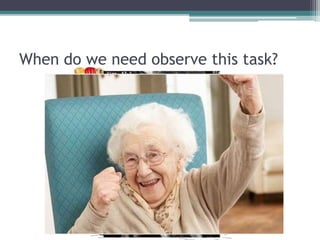
When do we need observe this task?
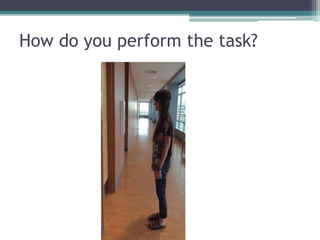
How do you perform the task?
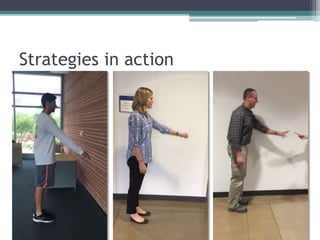
Strategies in action
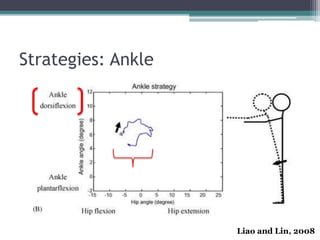
Strategies: Ankle
Liao and Lin, 2008
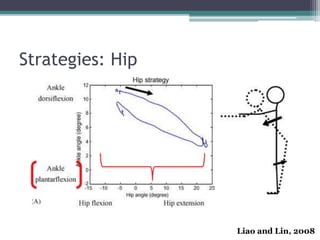
Strategies: Hip
Liao and Lin, 2008
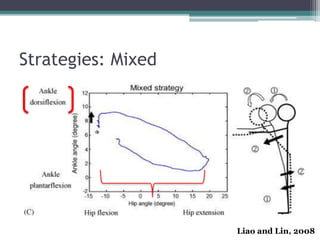
Strategies: Mixed
Liao and Lin, 2008
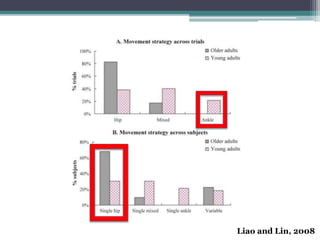
Liao and Lin, 2008
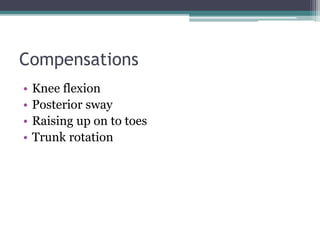
Compensations
• Knee flexion
• Posterior sway
• Raising up on to toes
• Trunk rotation
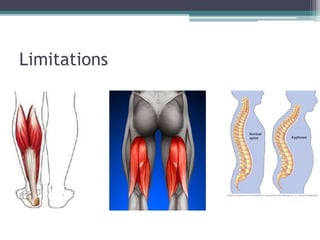
Limitations
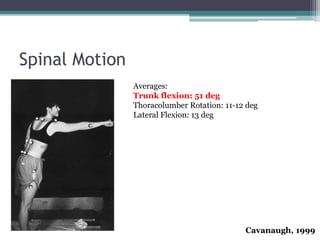
Spinal Motion
Cavanaugh, 1999
Averages:
Trunk flexion: 51 deg
Thoracolumber Rotation: 11-12 deg
Lateral Flexion: 13 deg
Compensations
• Stepping strategy
• Widening the BOS
• Leaning against support
• Counterbalance
Limitation
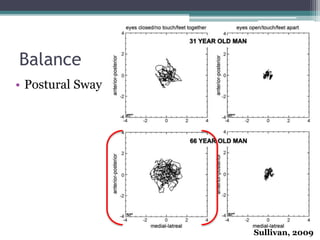
Balance
• Postural Sway
Sullivan, 2009
Strength
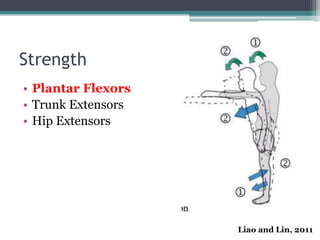
• Plantar Flexors
• Trunk Extensors
• Hip Extensors
Liao and Lin, 2011
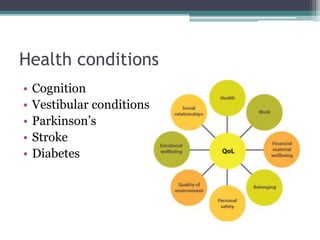
Health conditions
• Cognition
• Vestibular conditions
• Parkinson’s
• Stroke
• Diabetes
Clinical Correlate: Parkinson’s
• Shorter distances compared to age matched
controls
▫ On average 6 inches shorter
• Reduced mean A/P and M/L accelerations
▫ Due to increased muscle tone and hypokinesia
• Increased use of hip strategy
▫ Due to the decreased movement in the A/P plane
Hassman, 2014
Why does it
matter?

Task Determinates of a Forward Reach

Editor's Notes

  • #2 Rachel Hi everyone, Jill and I are here to talk about our task, the forward reach. We will define what it is, which is harder than you think, common strategies used to achieve this task as well as compensations used and why these occur. And finally some common pathologies you’ll in clinic that affect this task.
  • #3 Jill When we first got the task of forward reach we had a hard time differentiating it from the functional reach test that we all know and love. How could there be a right or wrong way to do a forward reach? So, we decided to break it down to its simplest form and research the most common ways people complete the task. *After all there is no wrong way to perform the task as long as you stay up right.
  • #4 Rachel We found this definition that best encompasses the task to us…The task requires moving the body’s center of mass toward the front edge of the base of support in a well controlled manner, and thus is often regarded as an indicator of boundary of stability
  • #5 Rachel Really this applies to everyone! According to rehab measures the forward reach is a particularly useful observation in these specific populations (Greiatrics, parkinson’s, stroke, vestibular and SCI) because they can have deficient in “boundaries of stability”. So how do you perform the task? High fall risk
  • #6 Jill There are many ways to perform a forward reach but in our simplified version, you typically: standing up tall, widening the base of support, flexing the shoulder and straightening the elbow and bending forward at the hips with your knees straight and lean your trunk forward to put your arm in an optimal position. Sounds simple enough, right?
  • #7 Rachel We ask three people to perform a forward reach with minimal instruction Why are these so different?
  • #8 Rachel As you just saw, people take many different routes to perform the same reach task. A study by Liao broke this into 3 different strategies. First, we will take about the ankle strategy which is defined as beginning the reach with ankle DF and with total hip flexion less than 15 degrees. The amount of Hip flexion is denoted by the bracket along the ‘x’ axis. This strategy is typically seen in a younger population, such as Mike.
  • #9 Jill Next, is a hip strategy. This is defined as the ankle moving into plantar flexion causing the hips to move posteriorly. The star represents the starting position. You can see they immediately move into PF and have a large amount of hip extension, This is commonly seen is older adults and apparently Allie *Hip flexion: The angular excursion from the initial angle to the peak anterior rotation of the body, and was defined as the angle between the femur axis and pelvis *hip ext (hip posterior sway): Range of posterior displacement of the hip center
  • #10 Jill And finally we have a mixed strategy. This happens when the task begins with ankle DF, which you can see by the immediate increase on the y axis, but the range of hip flexion is larger than 15 degrees, which makes it a mix where both joints are in use to accomplish the goal.
  • #11 Rachel Liao also looked at how many different strategies people used when asked to do 3 separate reaches. I want to point your attention to the grey bar, which is older adult. It was interesting to see that most older adults stick to one type of strategy and it was overwhelming the hip one. And not a single older adult used the ankle strategy. Why could something like this happen?
  • #12 Jill Moving onto possible compensations, of which there are many. We decided to group them together based on factors that they have in common. During the forward reach a patient may: Flexing the knees (HS) Posterior sway (gastroc) Going up on to toes (gastroc) Trunk rotation (kyphosis) What is the common factor…
  • #13 Rachel The common limitation is flexibility! This could include tight gastrocs, hamstrings or contractures which could prevent the appropriate amount of dorsiflexion needed to adopt an ankle strategy. This is where we would see people going up on their toes or going into a posterior sway while reaching forward. Also the appropriate amount of spinal mobility needs to be present to reach further distances Flexibility/contracture Going up on to toes (gastroc) Trunk rotation (kyphosis)
  • #14 Rachel We specifically looked at spinal motion since it is a common observation we will see in clinic. Cavanaugh and colleagues looked at 3 spinal motions used during a standard forward reach. Trunk flexion was the most critical! Clinically this is important because the older population tend to have greater thoracic kyphosis and less trunk mobility in general. And can be effected by certain disease processes? (you don’t need to keep this, I just like for linking PD)
  • #15 Rachel Fear/balance: Stepping Wider BOS Leaning against a wall or counter Counterbalance/weight shifting
  • #16 Jill Fear is what these have in common As we all age or have certain disease conditions we may loose proprioception, have diminished visual acuity, or have decreased inner ear function causing us to feel unsteady. For our patients there may be a history of falls, causing them to be fearful in everyday activities.
  • #17 Rachel One thing we want to specifically point out is Postural sway and how this could effect balance. In the study by Sullivan, unsurprisingly, they found that older adults had increased postural sway during static balance which is important for a forward reach. Sullivan noted that changes in our vestibular, visual, auditory, and somatosensory systems are factors that increase our postural sway as we age.
  • #18 Rachel Another key component of maintaining balance is strength. Most older adults tend to use a hip rather than an ankle strategy. To achieve an ankle strategy, sufficient backward rotation torque must be generated by trunk and lower limb muscles, especially plantar flexors. This helps balances out the trunk’s anterior moment Unfortunately, as we age, our PF strength decreases.
  • #19 Jill Many populations can have changes in the way they perform a forward reach. Some common populations are listed above A study by Sullivan found that patients with dementia did not use environmental and sensory cues as much aged matched controls leading to increase postural sway at rest. Another population heavily effected are patients with parkinson’s….
  • #20 Jill do this Who on average reached 6 inches less than their age match controls. Hassman found this to be due to reduced acceleration because of increased tone and hypokinesia both leading to reduced motor response. Those with parkinson’s also demonstrated increased use of the hip strategy…
  • #21 Jill So why does it matter? Rachel and Jill Things we do throughout the day opening doors reaching in the fridge handshake grocery shopping Clinically we will be seeing patients that have deficits that may prevent them from being able to safely perform a forward reach