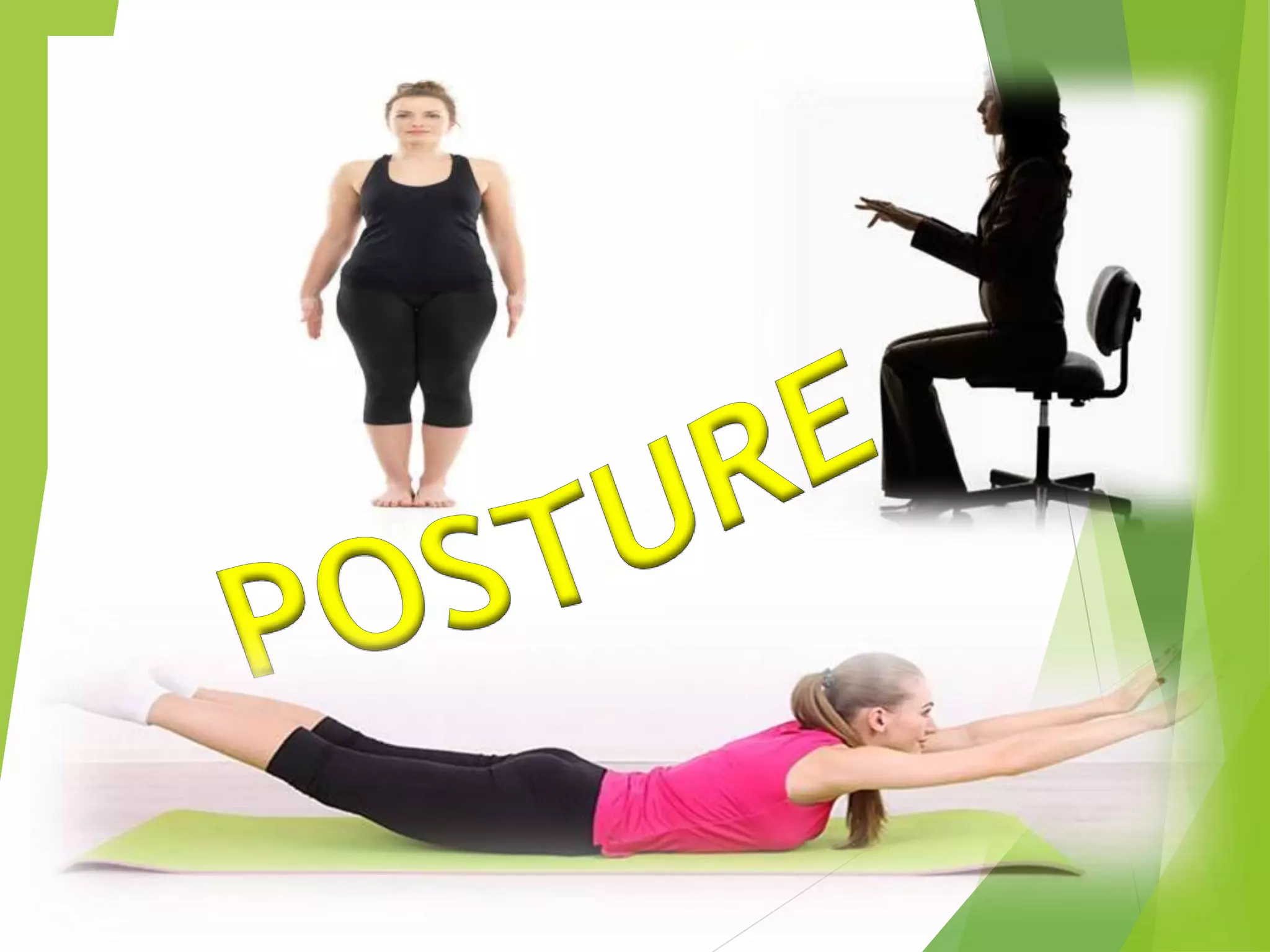
Posture is the body position
where you hold your body
upright and keeping balanced
gravityy while standing, sitting
or lying down .
It should there fore be regarded as
position assumed by the body before
it makes its next move.
.It distributes our body
weight evenly on both
legs.
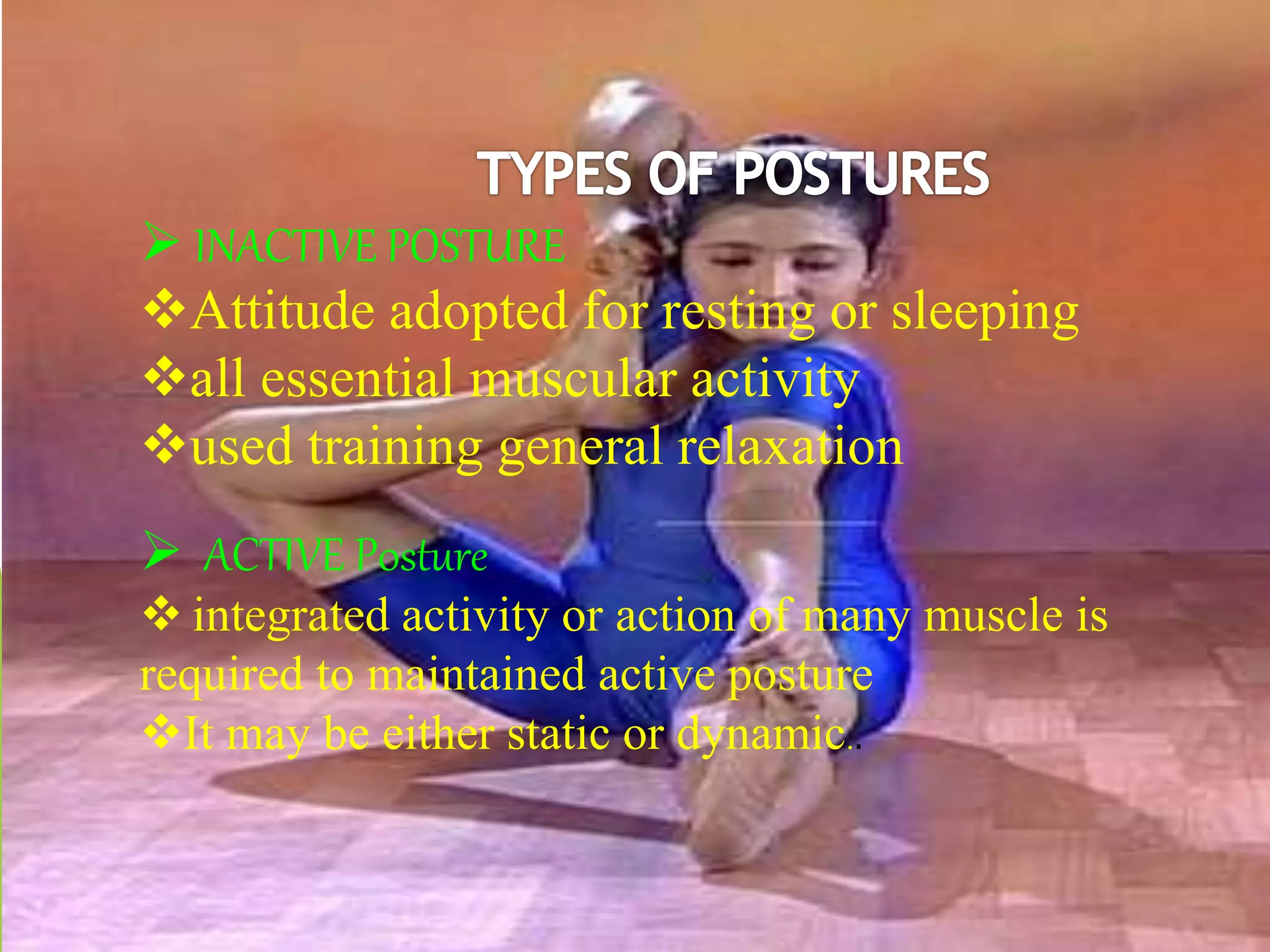
 INACTIVE POSTURE
Attitude adopted for resting or sleeping
all essential muscular activity
used training general relaxation
 ACTIVE P0sture
 integrated activity or action of many muscle is
required to maintained active posture
It may be either static or dynamic..
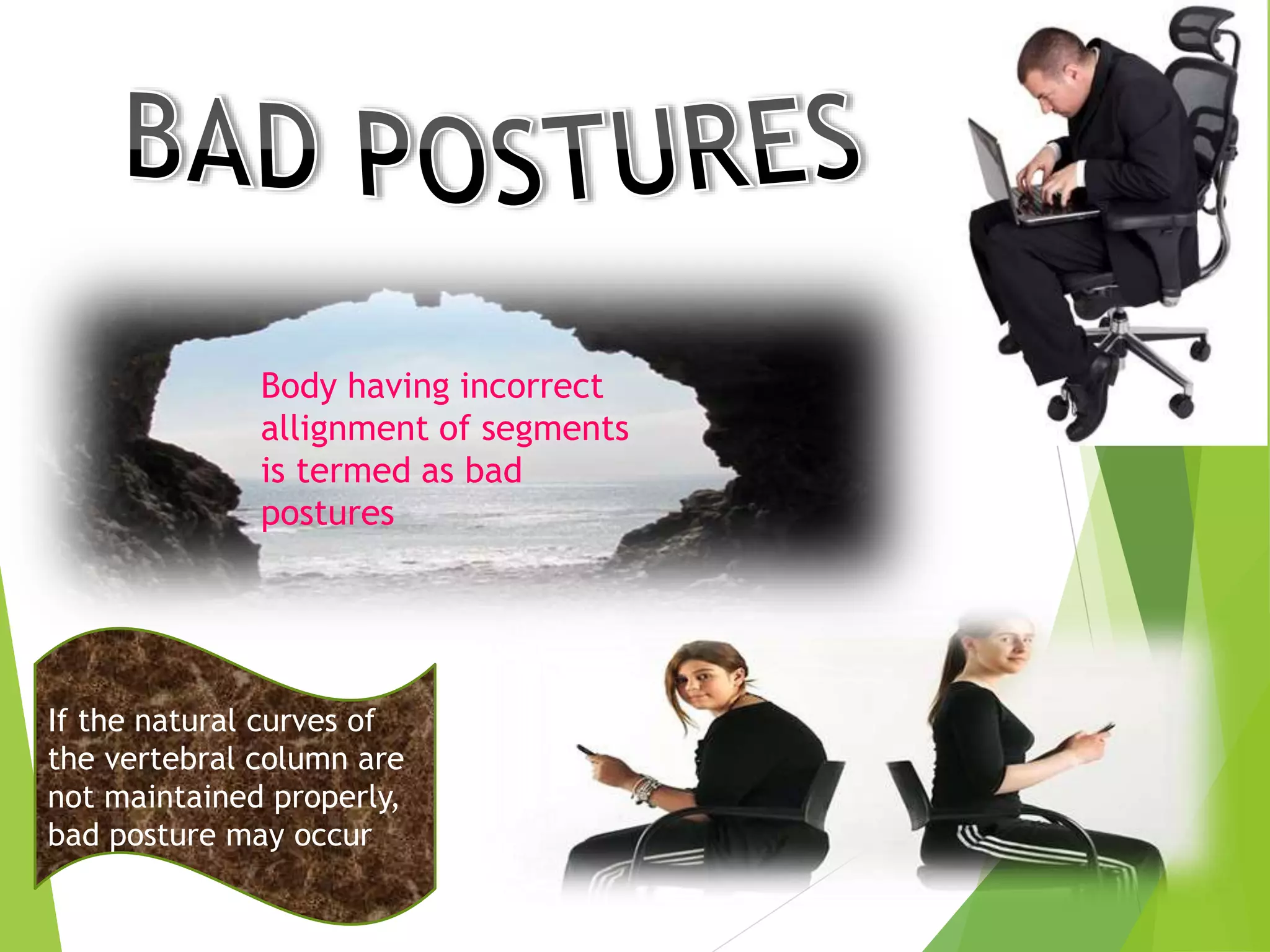
Body having incorrect
allignment of segments
is termed as bad
postures
If the natural curves of
the vertebral column are
not maintained properly,
bad posture may occur
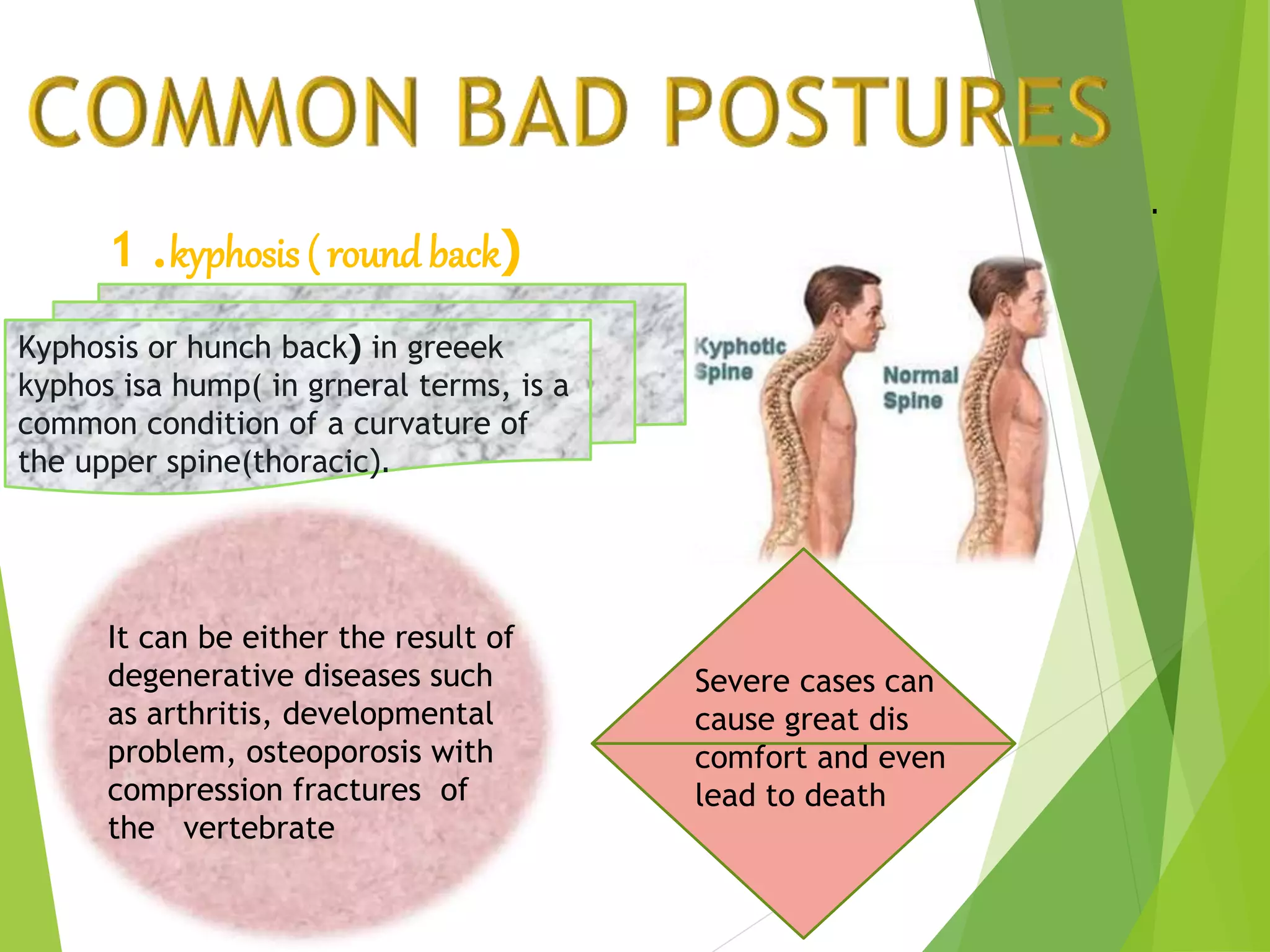
Kyphosis or hunch back( in greeek
kyphos isa hump( in grneral terms, is a
common condition of a curvature of
the upper spine(thoracic(.
1 .kyphosis ( round back(
.
It can be either the result of
degenerative diseases such
as arthritis, developmental
problem, osteoporosis with
compression fractures of
the vertebrate
Severe cases can
cause great dis
comfort and even
lead to death
Short eye sight,hard of breathing, weak muscles,
quick development of the study, malnutrition andf
sickness, insufficient exercises, bone diseases like
rickets, carrying heavy loads on shoulders, unsuitable
furnitures, habit of doing work by leaning forward etc.
 If specific precautions are not followed
‘kyphosis ’may happen .
 Teacher and parent should pay special
attention as precaution.
 From childhood itself, they shoulkd be given
appropriate idea for correct way of sitting,
standing and walking for keeping their posture
balanced .
 The proper exercises are notonly for
maintaining good health but but also for
maintaining good health but also for
controlling postural deformities like
‘kyphosis ’.
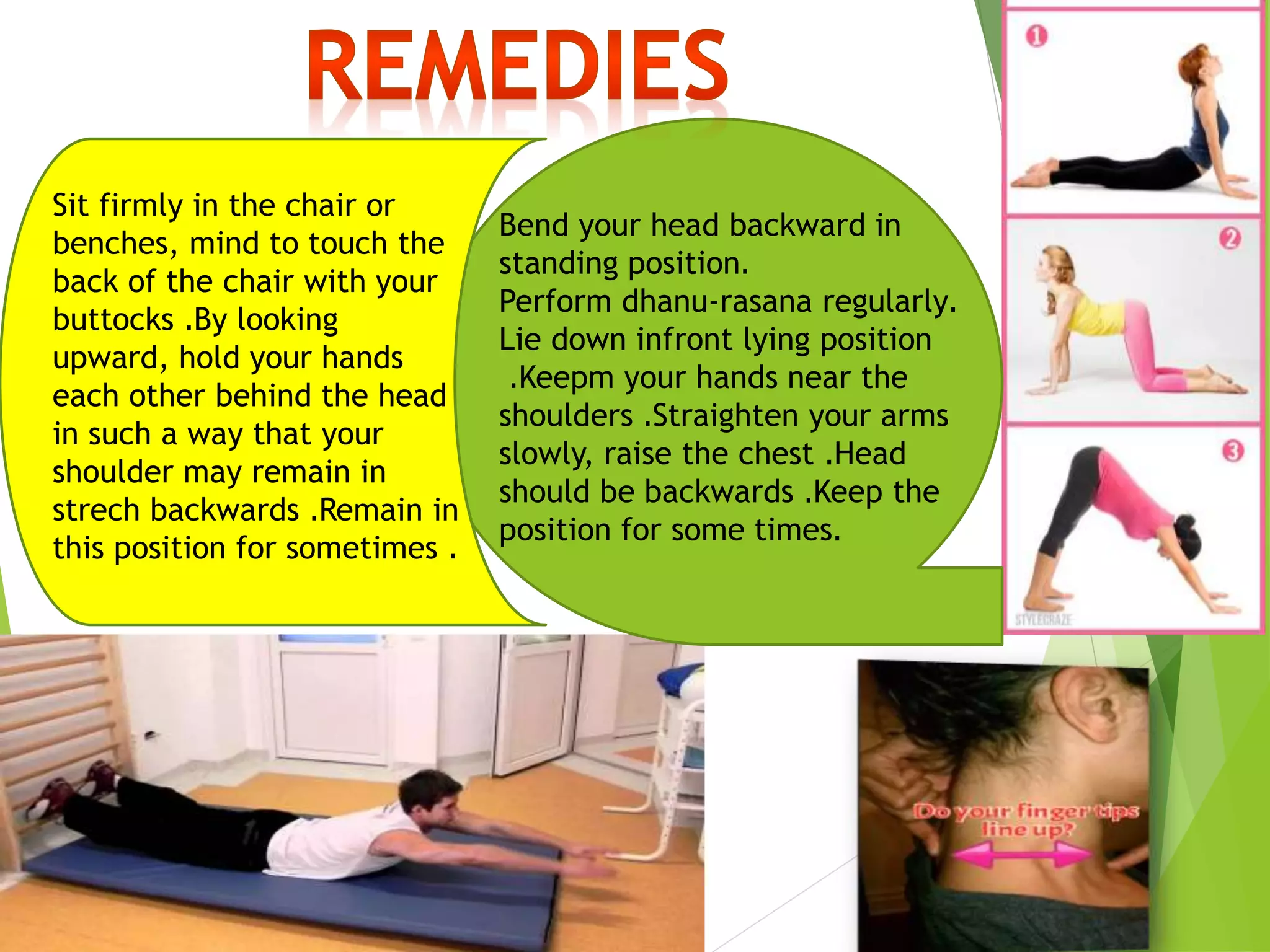
Bend your head backward in
standing position.
Perform dhanu-rasana regularly.
Lie down infront lying position
.Keepm your hands near the
shoulders .Straighten your arms
slowly, raise the chest .Head
should be backwards .Keep the
position for some times.
Sit firmly in the chair or
benches, mind to touch the
back of the chair with your
buttocks .By looking
upward, hold your hands
each other behind the head
in such a way that your
shoulder may remain in
strech backwards .Remain in
this position for sometimes .
 Swimming
 Hanging with ball or pull ups
 Calisthenics
 Exercise on shoulder wheel and breathing
exercises
Scoliosis is a medical condition in which a person’s spine
is curved from side to side shaped like ‘S’.
It is an abnormal lateral curvature of spine.
The condition can be categorized based on curvature of
spinal column, with relation to the central axis.
1. Dextro scoliosis; with the convexity on the right.
2. Levo scoliosis- with the convexity of the left
3. Roto scoliosis- used in conjunction with dextro levo
scoliosis.
Scoliosis may be because of a lot of reasons like
partial deafness, unhealthy condition , malnutrition,
disease in the joints , rickets , uneven and disturbed
weight balance.
Habit of balanced diet should be followed.
Try to avoid walking with carrying weight in one hand for
long time.
Strengthening exercises should be performed.
 Bending exercises should be performed in opposite side of scoliosis
affected curve.
 Hold the horizontal bar with your hands and swing your body to the
left and right side.
Flat foot or fallen arches is a medical condition
in which the arches of the foot collapses with
the entire sole of the foot coming into complete
or near complete contact with the ground.
Going barefoot, particularly over terrain such as a beach where
muscles are given a good workout is good for all but the most
extremely flat footed.
 Weak muscles
 Quick increase in body weight
 Wearing improper shoes
 Carrying heavy weight for a longer period
• The shoes should be of proper shape and size.
• Don’t walk bare feet for a long duration
• Obesity should be avoided
• Don’t force babies to walk at very early stage.
• Carrying heavy weight in early childhood should be avoided.
• High heeled shoes should be avoided.
Posture and different bad postures

Posture and different bad postures

  • 2.
    Posture is thebody position where you hold your body upright and keeping balanced gravityy while standing, sitting or lying down . It should there fore be regarded as position assumed by the body before it makes its next move. .It distributes our body weight evenly on both legs.
  • 3.
     INACTIVE POSTURE Attitudeadopted for resting or sleeping all essential muscular activity used training general relaxation  ACTIVE P0sture  integrated activity or action of many muscle is required to maintained active posture It may be either static or dynamic..
  • 4.
    Body having incorrect allignmentof segments is termed as bad postures If the natural curves of the vertebral column are not maintained properly, bad posture may occur
  • 5.
    Kyphosis or hunchback( in greeek kyphos isa hump( in grneral terms, is a common condition of a curvature of the upper spine(thoracic(. 1 .kyphosis ( round back( . It can be either the result of degenerative diseases such as arthritis, developmental problem, osteoporosis with compression fractures of the vertebrate Severe cases can cause great dis comfort and even lead to death
  • 6.
    Short eye sight,hardof breathing, weak muscles, quick development of the study, malnutrition andf sickness, insufficient exercises, bone diseases like rickets, carrying heavy loads on shoulders, unsuitable furnitures, habit of doing work by leaning forward etc.
  • 7.
     If specificprecautions are not followed ‘kyphosis ’may happen .  Teacher and parent should pay special attention as precaution.  From childhood itself, they shoulkd be given appropriate idea for correct way of sitting, standing and walking for keeping their posture balanced .  The proper exercises are notonly for maintaining good health but but also for maintaining good health but also for controlling postural deformities like ‘kyphosis ’.
  • 8.
    Bend your headbackward in standing position. Perform dhanu-rasana regularly. Lie down infront lying position .Keepm your hands near the shoulders .Straighten your arms slowly, raise the chest .Head should be backwards .Keep the position for some times. Sit firmly in the chair or benches, mind to touch the back of the chair with your buttocks .By looking upward, hold your hands each other behind the head in such a way that your shoulder may remain in strech backwards .Remain in this position for sometimes .
  • 9.
     Swimming  Hangingwith ball or pull ups  Calisthenics  Exercise on shoulder wheel and breathing exercises
  • 10.
    Scoliosis is amedical condition in which a person’s spine is curved from side to side shaped like ‘S’. It is an abnormal lateral curvature of spine. The condition can be categorized based on curvature of spinal column, with relation to the central axis. 1. Dextro scoliosis; with the convexity on the right. 2. Levo scoliosis- with the convexity of the left 3. Roto scoliosis- used in conjunction with dextro levo scoliosis.
  • 11.
    Scoliosis may bebecause of a lot of reasons like partial deafness, unhealthy condition , malnutrition, disease in the joints , rickets , uneven and disturbed weight balance. Habit of balanced diet should be followed. Try to avoid walking with carrying weight in one hand for long time. Strengthening exercises should be performed.
  • 12.
     Bending exercisesshould be performed in opposite side of scoliosis affected curve.  Hold the horizontal bar with your hands and swing your body to the left and right side.
  • 13.
    Flat foot orfallen arches is a medical condition in which the arches of the foot collapses with the entire sole of the foot coming into complete or near complete contact with the ground.
  • 14.
    Going barefoot, particularlyover terrain such as a beach where muscles are given a good workout is good for all but the most extremely flat footed.  Weak muscles  Quick increase in body weight  Wearing improper shoes  Carrying heavy weight for a longer period
  • 15.
    • The shoesshould be of proper shape and size. • Don’t walk bare feet for a long duration • Obesity should be avoided • Don’t force babies to walk at very early stage. • Carrying heavy weight in early childhood should be avoided. • High heeled shoes should be avoided.