‘‘BASICS OF TARGETED DRUG DELIVERY’’
Presented by
ARAF MAHEFUZABIBI
HIDAYAT
M.Pharm in
Pharmaceutics,(PhD).
INTRODUCTION
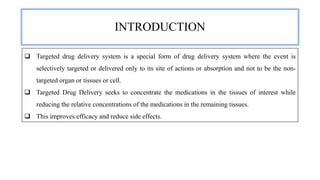
 Targeted drug delivery system is a special form of drug delivery system where the event is
selectively targeted or delivered only to its site of actions or absorption and not to be the non-
targeted organ or tissues or cell.
 Targeted Drug Delivery seeks to concentrate the medications in the tissues of interest while
reducing the relative concentrations of the medications in the remaining tissues.
 This improves efficacy and reduce side effects.
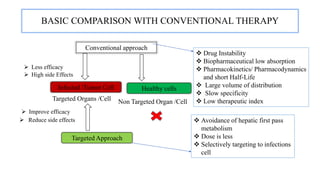
BASIC COMPARISON WITH CONVENTIONAL THERAPY
Conventional approach
Infected /Tumor Cell Healthy cells
Targeted Organs /Cell Non Targeted Organ /Cell
Targeted Approach
 Less efficacy
 High side Effects
 Improve efficacy
 Reduce side effects
 Drug Instability
 Biopharmaceutical low absorption
 Pharmacokinetics/ Pharmacodynamics
and short Half-Life
 Large volume of distribution
 Slow specificity
 Low therapeutic index
 Avoidance of hepatic first pass
metabolism
 Dose is less
 Selectively targeting to infections
cell
ADVANTAGES
 Simplified drug administration protocol
 Reduced toxicity
 Lowering of dose
 Avoidance of hepatic first pass metabolism
 Enhancement of absorption of targeted molecules such as peptide and particulate
 No peaks and valleys plasma concentration
 Selective targeting to infections cells that compared to normal cells.
DISADVANTAGES
 Rapid clearance of targeted systems.
 Immune reactions against the intravenous administration carrier systems.
 Insufficient localization of targeted systems into tumor cell.
 Requires highly sophisticated Technology.
 Requires the skill for manufacturing, storage and administration
 Drug deposition at the target site may produce toxicity symptoms.
 Difficult to maintain the stability of dosage form E.g: Resealed erythrocytes have to be stored at
4° C.
 Difficult to predict /fix the dosage regiment
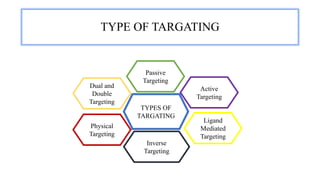
TYPE OF TARGATING
TYPES OF
TARGATING
Active
Targeting
Dual and
Double
Targeting
Passive
Targeting
Physical
Targeting
Ligand
Mediated
Targeting
Inverse
Targeting
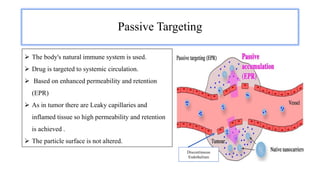
Passive Targeting
 The body's natural immune system is used.
 Drug is targeted to systemic circulation.
 Based on enhanced permeability and retention
(EPR)
 As in tumor there are Leaky capillaries and
inflamed tissue so high permeability and retention
is achieved .
 The particle surface is not altered.
Discontinuous
Endothelium
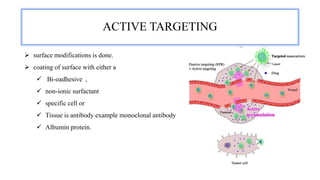
ACTIVE TARGETING
 surface modifications is done.
 coating of surface with either a
 Bi-oadhesive ,
 non-ionic surfactant
 specific cell or
 Tissue is antibody example monoclonal antibody
 Albumin protein.
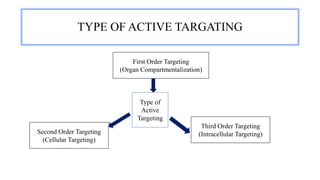
TYPE OF ACTIVE TARGATING
Second Order Targeting
(Cellular Targeting)
Third Order Targeting
(Intracellular Targeting)
First Order Targeting
(Organ Compartmentalization)
Type of
Active
Targeting
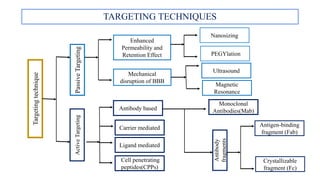
TARGETING TECHNIQUES
Targeting
technique
Passive
Targeting
Active
Targeting
Enhanced
Permeability and
Retention Effect
Mechanical
disruption of BBB
Antibody based
Carrier mediated
Ligand mediated
Cell penetrating
peptides(CPPs)
Antibody
fragments
Crystallizable
fragment (Fc)
Antigen-binding
fragment (Fab)
Ultrasound
PEGYlation
Nanosizing
Magnetic
Resonance
Monoclonal
Antibodies(Mab)
INVERSE TARGETING
In this type of targeting attempts are made to avoid passive uptake of colloidal
carrier by RES( Reticulo Endothelial Systems) and hence the process is referred
to as inverse targeting
To achieve inverse targeting, RES normal functions is suppressed by Pre injecting
large amount of blank colloidal carrier of macromolecules like dextran Sulphate.
This approach leads to saturations of RES, and separation of defence mechanism.
 This type of targeting is a effective approach to target drug(s)to Non-RES organ
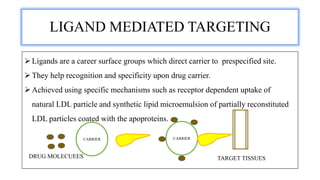
LIGAND MEDIATED TARGETING
Ligands are a career surface groups which direct carrier to prespecified site.
They help recognition and specificity upon drug carrier.
Achieved using specific mechanisms such as receptor dependent uptake of
natural LDL particle and synthetic lipid microemulsion of partially reconstituted
LDL particles coated with the apoproteins.
DRUG MOLECUEES
CARRIER CARRIER
TARGET TISSUES
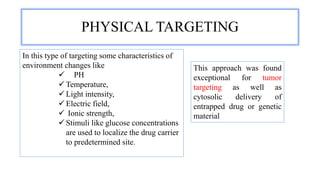
PHYSICAL TARGETING
In this type of targeting some characteristics of
environment changes like
 PH
 Temperature,
 Light intensity,
 Electric field,
 Ionic strength,
 Stimuli like glucose concentrations
are used to localize the drug carrier
to predetermined site.
This approach was found
exceptional for tumor
targeting as well as
cytosolic delivery of
entrapped drug or genetic
material
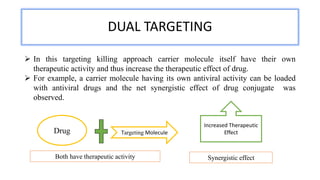
DUAL TARGETING
 In this targeting killing approach carrier molecule itself have their own
therapeutic activity and thus increase the therapeutic effect of drug.
 For example, a carrier molecule having its own antiviral activity can be loaded
with antiviral drugs and the net synergistic effect of drug conjugate was
observed.
Drug Targeting Molecule
Increased Therapeutic
Effect
Both have therapeutic activity Synergistic effect
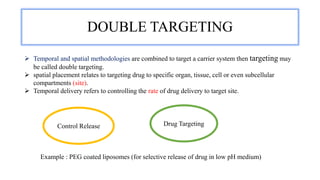
DOUBLE TARGETING
 Temporal and spatial methodologies are combined to target a carrier system then targeting may
be called double targeting.
 spatial placement relates to targeting drug to specific organ, tissue, cell or even subcellular
compartments (site).
 Temporal delivery refers to controlling the rate of drug delivery to target site.
Control Release Drug Targeting
Example : PEG coated liposomes (for selective release of drug in low pH medium)
16

TARGATED DRUG DELIVERY SYSTEM.

  • 1.
    ‘‘BASICS OF TARGETEDDRUG DELIVERY’’ Presented by ARAF MAHEFUZABIBI HIDAYAT M.Pharm in Pharmaceutics,(PhD).
  • 2.
    INTRODUCTION  Targeted drugdelivery system is a special form of drug delivery system where the event is selectively targeted or delivered only to its site of actions or absorption and not to be the non- targeted organ or tissues or cell.  Targeted Drug Delivery seeks to concentrate the medications in the tissues of interest while reducing the relative concentrations of the medications in the remaining tissues.  This improves efficacy and reduce side effects.
  • 3.
    BASIC COMPARISON WITHCONVENTIONAL THERAPY Conventional approach Infected /Tumor Cell Healthy cells Targeted Organs /Cell Non Targeted Organ /Cell Targeted Approach  Less efficacy  High side Effects  Improve efficacy  Reduce side effects  Drug Instability  Biopharmaceutical low absorption  Pharmacokinetics/ Pharmacodynamics and short Half-Life  Large volume of distribution  Slow specificity  Low therapeutic index  Avoidance of hepatic first pass metabolism  Dose is less  Selectively targeting to infections cell
  • 4.
    ADVANTAGES  Simplified drugadministration protocol  Reduced toxicity  Lowering of dose  Avoidance of hepatic first pass metabolism  Enhancement of absorption of targeted molecules such as peptide and particulate  No peaks and valleys plasma concentration  Selective targeting to infections cells that compared to normal cells.
  • 5.
    DISADVANTAGES  Rapid clearanceof targeted systems.  Immune reactions against the intravenous administration carrier systems.  Insufficient localization of targeted systems into tumor cell.  Requires highly sophisticated Technology.  Requires the skill for manufacturing, storage and administration  Drug deposition at the target site may produce toxicity symptoms.  Difficult to maintain the stability of dosage form E.g: Resealed erythrocytes have to be stored at 4° C.  Difficult to predict /fix the dosage regiment
  • 6.
    TYPE OF TARGATING TYPESOF TARGATING Active Targeting Dual and Double Targeting Passive Targeting Physical Targeting Ligand Mediated Targeting Inverse Targeting
  • 7.
    Passive Targeting  Thebody's natural immune system is used.  Drug is targeted to systemic circulation.  Based on enhanced permeability and retention (EPR)  As in tumor there are Leaky capillaries and inflamed tissue so high permeability and retention is achieved .  The particle surface is not altered. Discontinuous Endothelium
  • 8.
    ACTIVE TARGETING  surfacemodifications is done.  coating of surface with either a  Bi-oadhesive ,  non-ionic surfactant  specific cell or  Tissue is antibody example monoclonal antibody  Albumin protein.
  • 9.
    TYPE OF ACTIVETARGATING Second Order Targeting (Cellular Targeting) Third Order Targeting (Intracellular Targeting) First Order Targeting (Organ Compartmentalization) Type of Active Targeting
  • 10.
    TARGETING TECHNIQUES Targeting technique Passive Targeting Active Targeting Enhanced Permeability and RetentionEffect Mechanical disruption of BBB Antibody based Carrier mediated Ligand mediated Cell penetrating peptides(CPPs) Antibody fragments Crystallizable fragment (Fc) Antigen-binding fragment (Fab) Ultrasound PEGYlation Nanosizing Magnetic Resonance Monoclonal Antibodies(Mab)
  • 11.
    INVERSE TARGETING In thistype of targeting attempts are made to avoid passive uptake of colloidal carrier by RES( Reticulo Endothelial Systems) and hence the process is referred to as inverse targeting To achieve inverse targeting, RES normal functions is suppressed by Pre injecting large amount of blank colloidal carrier of macromolecules like dextran Sulphate. This approach leads to saturations of RES, and separation of defence mechanism.  This type of targeting is a effective approach to target drug(s)to Non-RES organ
  • 12.
    LIGAND MEDIATED TARGETING Ligandsare a career surface groups which direct carrier to prespecified site. They help recognition and specificity upon drug carrier. Achieved using specific mechanisms such as receptor dependent uptake of natural LDL particle and synthetic lipid microemulsion of partially reconstituted LDL particles coated with the apoproteins. DRUG MOLECUEES CARRIER CARRIER TARGET TISSUES
  • 13.
    PHYSICAL TARGETING In thistype of targeting some characteristics of environment changes like  PH  Temperature,  Light intensity,  Electric field,  Ionic strength,  Stimuli like glucose concentrations are used to localize the drug carrier to predetermined site. This approach was found exceptional for tumor targeting as well as cytosolic delivery of entrapped drug or genetic material
  • 14.
    DUAL TARGETING  Inthis targeting killing approach carrier molecule itself have their own therapeutic activity and thus increase the therapeutic effect of drug.  For example, a carrier molecule having its own antiviral activity can be loaded with antiviral drugs and the net synergistic effect of drug conjugate was observed. Drug Targeting Molecule Increased Therapeutic Effect Both have therapeutic activity Synergistic effect
  • 15.
    DOUBLE TARGETING  Temporaland spatial methodologies are combined to target a carrier system then targeting may be called double targeting.  spatial placement relates to targeting drug to specific organ, tissue, cell or even subcellular compartments (site).  Temporal delivery refers to controlling the rate of drug delivery to target site. Control Release Drug Targeting Example : PEG coated liposomes (for selective release of drug in low pH medium)
  • 16.