Advanced Biopharmaceutics & Pharmacokinetics Unit-1
Bio- Biological System Pharmaceutics- Dosage Form
Biopharmaceutics :- It is defined as the study of factors influencing the rate and amount of drug
that reaches the systemic circulation and the use of this information to optimise the therapeutic
efficacy of drug products.
Bioavailability :- It is defined as the rate and extent of drug absorption
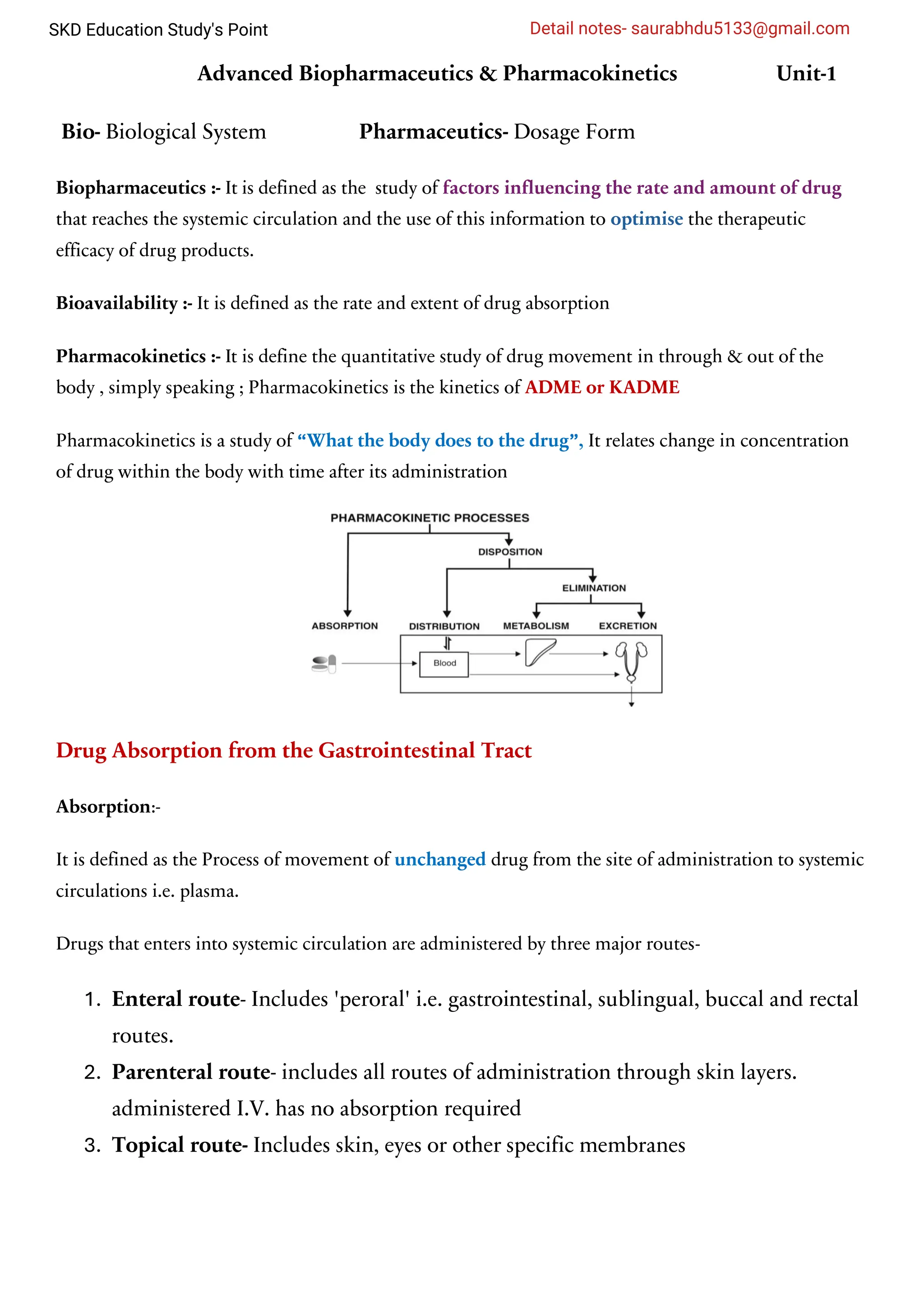
Pharmacokinetics :- It is define the quantitative study of drug movement in through & out of the
body , simply speaking ; Pharmacokinetics is the kinetics of ADME or KADME
Pharmacokinetics is a study of “What the body does to the drug”, It relates change in concentration
of drug within the body with time after its administration
Drug Absorption from the Gastrointestinal Tract
Absorption:-
It is defined as the Process of movement of unchanged drug from the site of administration to systemic
circulations i.e. plasma.
Drugs that enters into systemic circulation are administered by three major routes-
1. Enteral route- Includes 'peroral' i.e. gastrointestinal, sublingual, buccal and rectal
routes.
2. Parenteral route- includes all routes of administration through skin layers.
administered I.V. has no absorption required
3. Topical route- Includes skin, eyes or other specific membranes
SKD Education Study's Point Detail notes- saurabhdu5133@gmail.com
Mechanism of Drug Absorption
The three broad categories of drug transport mechanism involved in absorption are:-
1. Transcellular/ intracellular transport
2. Paracellular / intracellular transport
3. Vesicular Transport
Trancellular / Intracellular transport- Most common Pathway of drug transport
It is defined as the passage of drug across the GI epithelium
1-Passive Transports Processes
These transport processes do not require energy other than that of molecular motion to pass through
the lipid bilayer.
Passive transport process can be further classified into following types-
a) Passive diffusion
b) Pore transport
c) Ion-Pair Transport
d) Faciliated or Mediated –diffusion
Passive Diffusion
It is a non-ionic diffusion
More than 90% of drugs absorbed by this mechanism.
Drugs must have molecular weight between 100-400 Daltons.
Passive diffusion follows first order kinetics.
Driving force is the concentration gradient or electrochemical gradient.
Since passive diffusion is energy independent so also called as downhill transport.
Passive diffusion follows First order kinetics [GPAT-2015]
Passive diffusion is best expressed by Fick's first law of diffusion, which states that the drug molecules
diffuse from a region of higher concentration to one of lower concentration until equilibrium is
attained and that the rate of diffusion is directly proportional to the concentration gradient across
the membrane.
Mathematically Fick's law of diffusion is expressed by
where,
dQ/dt = rate of drug diffusion (amount/time).
D = diffusion coefficient of the drug through the membrane (area/time).
A = surface area of the absorbing membrane for drug diffusion (area).
Km/w = Partition coefficient of the drug between the lipoidal membrane and the aqueous GI Fluids
(no units)
(CGIT- C) = Difference in the concentration of drug in the GI fluids and plasma (amount/volume)
h = Thickness of membrane (length)
Due to sink conditions (CGIT >> C) the concentration of drug in plasma C is very small in comparison
to CGIT
Pore Transport
Also, called as convective transport, bulk flow or filtration
Driving force in this process is osmotic differences or hydrostatic pressure
Water flux that promotes such a transport is called as solvent drag.
Drugs which are polar in nature and have less molecular weight (100 Daltons or less than that) low
molecular size (smaller than the diameter of the pore).
Chain-like or linear compounds of molecular weight up to 400 Daltons can be absorbed by filtration.
Ion Pair Transport
Quaternary ammonium compounds and sulphonic acids, ionizes under all pH conditions, and
absorbed by this mechanism. ,There is low o/w Partition coefficient value
Such agent penetrate the membrane by forming reversible neutral complexes with endogenous
ions of the GIT like mucin
Such neutral complexes have both the required lipophilicity as well as aquous solubility for passive
diffusion such phenomenon is called as ion-pair transport
E.g. Propranolol a basic drug that form an ion pair with oleic acid
Drugs are permeated in following order - Unionized > Anions > Cations
Carrier-Mediated Transport
Carries are proteins which is unchanged, non-polar.
Carries have no directionality, works with same efficiency in both directions.
Transport process is structure specific.
❖ Characteristics of carrier-mediated transport are
➢ Carrier proteins are soluble in the lipid of the membrane because their exterior surfaces are
always uncharged (non-polar).
➢ Capacity-limited process can be adequately described by mixed order kinetics, also called as
Michaelis-Menten, saturation or non-linear kinetics.
E.g. Vitamins like B1, B2 and B12
Facilitated Diffusion is also a carrier mediated transport, works against Concentration gradient
(Downhill transport).
Driving forces concentration gradient, does not require energy.
e.g. Entry of glucose into RBC, intestinal absorption of vitamin B₁ and B2 and GI absorption of
Vitamin B12
2-Active Transport
Drug transport from lower concentration to higher concentration gradient. Against concentration
gradient
Requires energy in the form of ATP. Also known as uphill transport.
1.Primary active transport-
There is direct ATP requirement.
Process transfers only one ion/molecule and in one direction and hence called as uniporter.
E.g. Absorption of glucose.
1.1 ion transporters- are responsible for transporting ions in or out of cells. A classics example of ATP-
driven ion pump is proton pump.
It is of two types-
a) Organic anion transporter- aids absorptions of drugs such as pravastatin's and atorvastatin.
b) Organic cation transporter- aids absorptions of drugs such as diphenhydramine.
1.2 ABC (ATP Binding Cassette) transporters- Are responsible for transporting small foreign
molecules.
2.Secondary active transport-
Does not requires direct ATP as energy.
It is of two types
i) Symport (co-transport)- Involves movement of both the molecules in same direction.
E.g. Na+ -glucose symporter , H+ -coupled peptide transporter (B-Lactam antibiotics)
ii) Antiport (Counter transport)- Involves movement of molecules in opposite direction.
E.g. Explusion of H+ ions using Na+ gradient in the kidney.
Paracellular /Intracellular
It is defined as the transport of drugs through the junctions between the Gl epithelial cells.
The two Paracellular transport mechanisms involved in drug absorption are:-
1- Permeation through tight junction of epithelial cell
2- Persorption
1- Permeation through tight junction of epithelial cell
Occurs through an openings
E.g. Insulin and cardiac glycoside taken by this mechanism
2- Persorption
Permation of drug through temporary opening formed by shedding of two neighbouring
epithelial cell into lumen
Vesicular or Corpuscular Transport (Endocytosis)- Energy dependent Process
It is a minor transport mechanism.
It involves engulfing extracellular materials in a segment of cel membrane to form a saccule or
vesicles, hence also called as corpuscular or vesicular transport.
-It is of two types-
Phagocytosis- Need Energy
Cell eating (adsorptive uptake of solid particulates).e.g. Vitamins A,D,E,K & Insulin.
Pinocytosis- Do not required energy
Cell drinking (uptake of fluid solute). e.g. Sabin polio vaccine, botulism toxins.
For detail notes connect with me in telegram group
gmail- saurabhdu5133@gmailcom

Advanced Biopharmaceutics notes for M.Pharm 2nd semester Unit-1 .pdf , M.Pharm, Pharmacy

  • 1.
    Advanced Biopharmaceutics &Pharmacokinetics Unit-1 Bio- Biological System Pharmaceutics- Dosage Form Biopharmaceutics :- It is defined as the study of factors influencing the rate and amount of drug that reaches the systemic circulation and the use of this information to optimise the therapeutic efficacy of drug products. Bioavailability :- It is defined as the rate and extent of drug absorption Pharmacokinetics :- It is define the quantitative study of drug movement in through & out of the body , simply speaking ; Pharmacokinetics is the kinetics of ADME or KADME Pharmacokinetics is a study of “What the body does to the drug”, It relates change in concentration of drug within the body with time after its administration Drug Absorption from the Gastrointestinal Tract Absorption:- It is defined as the Process of movement of unchanged drug from the site of administration to systemic circulations i.e. plasma. Drugs that enters into systemic circulation are administered by three major routes- 1. Enteral route- Includes 'peroral' i.e. gastrointestinal, sublingual, buccal and rectal routes. 2. Parenteral route- includes all routes of administration through skin layers. administered I.V. has no absorption required 3. Topical route- Includes skin, eyes or other specific membranes SKD Education Study's Point Detail notes- saurabhdu5133@gmail.com
  • 2.
    Mechanism of DrugAbsorption The three broad categories of drug transport mechanism involved in absorption are:- 1. Transcellular/ intracellular transport 2. Paracellular / intracellular transport 3. Vesicular Transport Trancellular / Intracellular transport- Most common Pathway of drug transport It is defined as the passage of drug across the GI epithelium 1-Passive Transports Processes These transport processes do not require energy other than that of molecular motion to pass through the lipid bilayer. Passive transport process can be further classified into following types- a) Passive diffusion b) Pore transport c) Ion-Pair Transport d) Faciliated or Mediated –diffusion Passive Diffusion It is a non-ionic diffusion More than 90% of drugs absorbed by this mechanism. Drugs must have molecular weight between 100-400 Daltons. Passive diffusion follows first order kinetics. Driving force is the concentration gradient or electrochemical gradient. Since passive diffusion is energy independent so also called as downhill transport.
  • 3.
    Passive diffusion followsFirst order kinetics [GPAT-2015] Passive diffusion is best expressed by Fick's first law of diffusion, which states that the drug molecules diffuse from a region of higher concentration to one of lower concentration until equilibrium is attained and that the rate of diffusion is directly proportional to the concentration gradient across the membrane. Mathematically Fick's law of diffusion is expressed by where, dQ/dt = rate of drug diffusion (amount/time). D = diffusion coefficient of the drug through the membrane (area/time). A = surface area of the absorbing membrane for drug diffusion (area). Km/w = Partition coefficient of the drug between the lipoidal membrane and the aqueous GI Fluids (no units) (CGIT- C) = Difference in the concentration of drug in the GI fluids and plasma (amount/volume) h = Thickness of membrane (length) Due to sink conditions (CGIT >> C) the concentration of drug in plasma C is very small in comparison to CGIT Pore Transport Also, called as convective transport, bulk flow or filtration Driving force in this process is osmotic differences or hydrostatic pressure
  • 4.
    Water flux thatpromotes such a transport is called as solvent drag. Drugs which are polar in nature and have less molecular weight (100 Daltons or less than that) low molecular size (smaller than the diameter of the pore). Chain-like or linear compounds of molecular weight up to 400 Daltons can be absorbed by filtration. Ion Pair Transport Quaternary ammonium compounds and sulphonic acids, ionizes under all pH conditions, and absorbed by this mechanism. ,There is low o/w Partition coefficient value Such agent penetrate the membrane by forming reversible neutral complexes with endogenous ions of the GIT like mucin Such neutral complexes have both the required lipophilicity as well as aquous solubility for passive diffusion such phenomenon is called as ion-pair transport E.g. Propranolol a basic drug that form an ion pair with oleic acid Drugs are permeated in following order - Unionized > Anions > Cations Carrier-Mediated Transport Carries are proteins which is unchanged, non-polar. Carries have no directionality, works with same efficiency in both directions. Transport process is structure specific.
  • 5.
    ❖ Characteristics ofcarrier-mediated transport are ➢ Carrier proteins are soluble in the lipid of the membrane because their exterior surfaces are always uncharged (non-polar). ➢ Capacity-limited process can be adequately described by mixed order kinetics, also called as Michaelis-Menten, saturation or non-linear kinetics. E.g. Vitamins like B1, B2 and B12 Facilitated Diffusion is also a carrier mediated transport, works against Concentration gradient (Downhill transport). Driving forces concentration gradient, does not require energy. e.g. Entry of glucose into RBC, intestinal absorption of vitamin B₁ and B2 and GI absorption of Vitamin B12 2-Active Transport Drug transport from lower concentration to higher concentration gradient. Against concentration gradient Requires energy in the form of ATP. Also known as uphill transport.
  • 6.
    1.Primary active transport- Thereis direct ATP requirement. Process transfers only one ion/molecule and in one direction and hence called as uniporter. E.g. Absorption of glucose. 1.1 ion transporters- are responsible for transporting ions in or out of cells. A classics example of ATP- driven ion pump is proton pump. It is of two types- a) Organic anion transporter- aids absorptions of drugs such as pravastatin's and atorvastatin. b) Organic cation transporter- aids absorptions of drugs such as diphenhydramine. 1.2 ABC (ATP Binding Cassette) transporters- Are responsible for transporting small foreign molecules. 2.Secondary active transport- Does not requires direct ATP as energy. It is of two types i) Symport (co-transport)- Involves movement of both the molecules in same direction. E.g. Na+ -glucose symporter , H+ -coupled peptide transporter (B-Lactam antibiotics) ii) Antiport (Counter transport)- Involves movement of molecules in opposite direction. E.g. Explusion of H+ ions using Na+ gradient in the kidney. Paracellular /Intracellular It is defined as the transport of drugs through the junctions between the Gl epithelial cells. The two Paracellular transport mechanisms involved in drug absorption are:- 1- Permeation through tight junction of epithelial cell 2- Persorption 1- Permeation through tight junction of epithelial cell Occurs through an openings E.g. Insulin and cardiac glycoside taken by this mechanism 2- Persorption Permation of drug through temporary opening formed by shedding of two neighbouring epithelial cell into lumen Vesicular or Corpuscular Transport (Endocytosis)- Energy dependent Process It is a minor transport mechanism.
  • 7.
    It involves engulfingextracellular materials in a segment of cel membrane to form a saccule or vesicles, hence also called as corpuscular or vesicular transport. -It is of two types- Phagocytosis- Need Energy Cell eating (adsorptive uptake of solid particulates).e.g. Vitamins A,D,E,K & Insulin. Pinocytosis- Do not required energy Cell drinking (uptake of fluid solute). e.g. Sabin polio vaccine, botulism toxins. For detail notes connect with me in telegram group gmail- saurabhdu5133@gmailcom