TARGETED THERAPY
Presented by: Dr.Sushma sathya
Moderated by: Dr.Vandana
Introduction
• A targeted therapy is defined as process of attacking a
biologically important process central to a hallmark of cancer or
disease.
(i) Some block the action of certain enzymes, proteins or other
molecules involved in growth of cancer cells
(ii) some types help the immune system to kill cancer cells; and
(iii) most targeted drugs are small-molecule drugs or monoclonal
antibodies.
• Blocks the growth of cancer cells by interfering with specific
targeted molecules.
• Targeted therapies act on specific molecular targets, were designed
to interact with their target, and are often cytostatic (block
proliferation), while standard conventional chemotherapy is
designed to kill rapidly dividing tumor cells, may also affect dividing
normal cells, and is cytotoxic (kill tumor cells).
• Unlike traditional chemotherapy, which kills both cancer cells and
healthy cells, targeted therapy drugs are designed to attack specific
molecules that are involved in cancer cell growth and survival
• Interfere with specific targeted molecules needed for
carcinogenesis and tumour growth rather than interfering with all
rapidly dividing cells
Targeted therapy in cancer cells is based on the inhibition of crucial
enzymes/pathways in a cancer cell, for which two definitions can be
formulated:
• Firstly, high activity of a pathway indicates that it may be essential
“to drive the tumor” and its inhibition stops growth of (or
sometimes kills) the cancer cell.
• Secondly, a low activity indicates that the activity may be rate-
limiting and essential [according to Weber a ‘key’ enzyme] for
growth, and therefore its inhibition may kill the cancer cell . In this
case, the enzyme may be considered as the “engine”.
A Paradigm
Shift
Types of targeted therapies
1. Hormonal
2. Signal-transduction inhibitors (e.g. TKIs)
3. Gene-expression modulators
4. Apoptosis inducers
5. Angiogenesis inhibitors
6. Immunotherapies
7. Toxin-delivery molecules (targeted chemotherapy)
8. Gene therapy
Growth factor and
growth factor
receptor Inhibitors
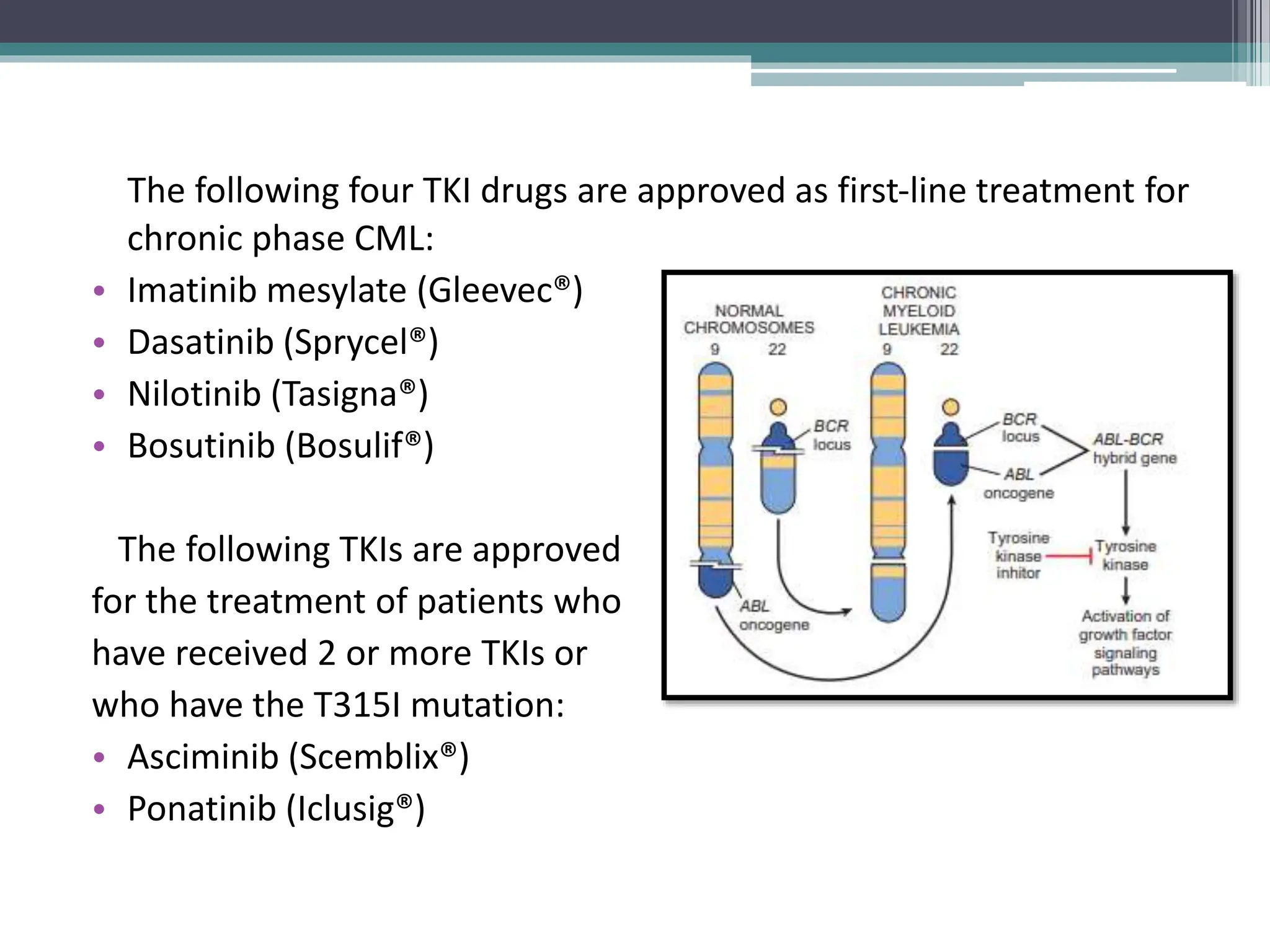
Signal-transduction inhibitors (e.g. TKIs)
The following four TKI drugs are approved as first-line treatment for
chronic phase CML:
• Imatinib mesylate (Gleevec®)
• Dasatinib (Sprycel®)
• Nilotinib (Tasigna®)
• Bosutinib (Bosulif®)
The following TKIs are approved
for the treatment of patients who
have received 2 or more TKIs or
who have the T315I mutation:
• Asciminib (Scemblix®)
• Ponatinib (Iclusig®)
Gene-expression modulators
Cell cycle regulators
The role of RB in
regulating the G1-S
checkpoint of the cell
cycle.
The role of p53
in maintaining
the integrity of
the genome.
Apoptosis
Inducers
Hormonal therapy
The structures of HER2
ECD and its complex with
Pertuzumab and
Trastuzumab fragment
Gene therapy
Ploting of genetic
alterations in a lung
cancer paient
AND MORE…..
Targeted
therapy in
Diabetes
Mellitus
Targeted therapy
in Dermatology
DRUGS IN TARGETED THERAPY
Challenges of targeted therapy
Targeted therapy also has some challenges, including:
• Resistance: Cancer cells can develop resistance to targeted therapy
drugs over time.
• This means that the cancer cells can become resistant to the drug
and continue to grow and spread.
• Cost: Targeted therapy drugs can be very expensive.
• Limited availability: Some targeted therapy drugs are only available
for certain types of cancer.
Future of targeted therapy
• Researchers are constantly developing new targeted therapy drugs
and new ways to use targeted therapy drugs to treat cancer.
• Targeted therapy is a rapidly evolving field, and it is likely to play an
increasingly important role in cancer treatment in the future.
Conclusion
• Targeted therapy is a promising new approach to cancer treatment.
• It offers several benefits over traditional chemotherapy, including
more targeted killing of cancer cells, fewer side effects, and
improved survival rates.
• However, targeted therapy also has some challenges, such as
resistance, cost, and limited availability.
• Researchers are constantly developing new targeted therapy drugs
and new ways to use targeted therapy drugs to treat cancer.
• Targeted therapy is a rapidly evolving field, and it is likely to play an
increasingly important role in cancer treatment in the future.
References
• Kumar, V., Abbas, A. K., Aster, J. C., & Perkins, J. A. (2018). Robbins pathologic basis of disease (Tenth
edition.). South asia : Elsevier.
• Sharma, H.L. and Sharma, K.K .,Sharma & Sharma's Principles of Pharmacology,.{1st edition},{2017}, Paras
Medical Publisher
• Zhong L, Li Y, Xiong L, Wang W, Wu M, Yuan T, Yang W, Tian C, Miao Z, Wang T, Yang S. Small molecules in
targeted cancer therapy: advances, challenges, and future perspectives. Signal Transduct Target Ther. 2021
May 31;6(1):201. doi: 10.1038/s41392-021-00572-w. PMID: 34054126; PMCID: PMC8165101.
• Yamaoka T, Ohba M, Ohmori T. Molecular-Targeted Therapies for Epidermal Growth Factor Receptor and
Its Resistance Mechanisms. Int J Mol Sci. 2017 Nov 15;18(11):2420. doi: 10.3390/ijms18112420. PMID:
29140271; PMCID: PMC5713388.
• https://www.lls.org/leukemia/chronic-myeloid-leukemia/treatment/tyrosine-kinase-inhibitor-tki-
therapy#:~:text=Tyrosine%20kinase%20inhibitors%20(TKIs)%20are,less%20damage%20to%20normal%20
cells.
• Greengard EG. Molecularly Targeted Therapy for Neuroblastoma. Children (Basel). 2018 Oct 15;5(10):142.
doi: 10.3390/children5100142. PMID: 30326621; PMCID: PMC6210520.
Targeted therapy-final.pptx

Targeted therapy-final.pptx

  • 1.
    TARGETED THERAPY Presented by:Dr.Sushma sathya Moderated by: Dr.Vandana
  • 2.
    Introduction • A targetedtherapy is defined as process of attacking a biologically important process central to a hallmark of cancer or disease. (i) Some block the action of certain enzymes, proteins or other molecules involved in growth of cancer cells (ii) some types help the immune system to kill cancer cells; and (iii) most targeted drugs are small-molecule drugs or monoclonal antibodies. • Blocks the growth of cancer cells by interfering with specific targeted molecules.
  • 3.
    • Targeted therapiesact on specific molecular targets, were designed to interact with their target, and are often cytostatic (block proliferation), while standard conventional chemotherapy is designed to kill rapidly dividing tumor cells, may also affect dividing normal cells, and is cytotoxic (kill tumor cells). • Unlike traditional chemotherapy, which kills both cancer cells and healthy cells, targeted therapy drugs are designed to attack specific molecules that are involved in cancer cell growth and survival • Interfere with specific targeted molecules needed for carcinogenesis and tumour growth rather than interfering with all rapidly dividing cells
  • 4.
    Targeted therapy incancer cells is based on the inhibition of crucial enzymes/pathways in a cancer cell, for which two definitions can be formulated: • Firstly, high activity of a pathway indicates that it may be essential “to drive the tumor” and its inhibition stops growth of (or sometimes kills) the cancer cell. • Secondly, a low activity indicates that the activity may be rate- limiting and essential [according to Weber a ‘key’ enzyme] for growth, and therefore its inhibition may kill the cancer cell . In this case, the enzyme may be considered as the “engine”.
  • 5.
  • 6.
    Types of targetedtherapies 1. Hormonal 2. Signal-transduction inhibitors (e.g. TKIs) 3. Gene-expression modulators 4. Apoptosis inducers 5. Angiogenesis inhibitors 6. Immunotherapies 7. Toxin-delivery molecules (targeted chemotherapy) 8. Gene therapy
  • 7.
    Growth factor and growthfactor receptor Inhibitors
  • 11.
  • 13.
    The following fourTKI drugs are approved as first-line treatment for chronic phase CML: • Imatinib mesylate (Gleevec®) • Dasatinib (Sprycel®) • Nilotinib (Tasigna®) • Bosutinib (Bosulif®) The following TKIs are approved for the treatment of patients who have received 2 or more TKIs or who have the T315I mutation: • Asciminib (Scemblix®) • Ponatinib (Iclusig®)
  • 14.
  • 17.
  • 18.
    The role ofRB in regulating the G1-S checkpoint of the cell cycle.
  • 19.
    The role ofp53 in maintaining the integrity of the genome.
  • 21.
  • 23.
    Hormonal therapy The structuresof HER2 ECD and its complex with Pertuzumab and Trastuzumab fragment
  • 24.
  • 26.
    Ploting of genetic alterationsin a lung cancer paient
  • 27.
  • 31.
  • 32.
  • 33.
  • 37.
    Challenges of targetedtherapy Targeted therapy also has some challenges, including: • Resistance: Cancer cells can develop resistance to targeted therapy drugs over time. • This means that the cancer cells can become resistant to the drug and continue to grow and spread. • Cost: Targeted therapy drugs can be very expensive. • Limited availability: Some targeted therapy drugs are only available for certain types of cancer.
  • 38.
    Future of targetedtherapy • Researchers are constantly developing new targeted therapy drugs and new ways to use targeted therapy drugs to treat cancer. • Targeted therapy is a rapidly evolving field, and it is likely to play an increasingly important role in cancer treatment in the future.
  • 39.
    Conclusion • Targeted therapyis a promising new approach to cancer treatment. • It offers several benefits over traditional chemotherapy, including more targeted killing of cancer cells, fewer side effects, and improved survival rates. • However, targeted therapy also has some challenges, such as resistance, cost, and limited availability. • Researchers are constantly developing new targeted therapy drugs and new ways to use targeted therapy drugs to treat cancer. • Targeted therapy is a rapidly evolving field, and it is likely to play an increasingly important role in cancer treatment in the future.
  • 41.
    References • Kumar, V.,Abbas, A. K., Aster, J. C., & Perkins, J. A. (2018). Robbins pathologic basis of disease (Tenth edition.). South asia : Elsevier. • Sharma, H.L. and Sharma, K.K .,Sharma & Sharma's Principles of Pharmacology,.{1st edition},{2017}, Paras Medical Publisher • Zhong L, Li Y, Xiong L, Wang W, Wu M, Yuan T, Yang W, Tian C, Miao Z, Wang T, Yang S. Small molecules in targeted cancer therapy: advances, challenges, and future perspectives. Signal Transduct Target Ther. 2021 May 31;6(1):201. doi: 10.1038/s41392-021-00572-w. PMID: 34054126; PMCID: PMC8165101. • Yamaoka T, Ohba M, Ohmori T. Molecular-Targeted Therapies for Epidermal Growth Factor Receptor and Its Resistance Mechanisms. Int J Mol Sci. 2017 Nov 15;18(11):2420. doi: 10.3390/ijms18112420. PMID: 29140271; PMCID: PMC5713388. • https://www.lls.org/leukemia/chronic-myeloid-leukemia/treatment/tyrosine-kinase-inhibitor-tki- therapy#:~:text=Tyrosine%20kinase%20inhibitors%20(TKIs)%20are,less%20damage%20to%20normal%20 cells. • Greengard EG. Molecularly Targeted Therapy for Neuroblastoma. Children (Basel). 2018 Oct 15;5(10):142. doi: 10.3390/children5100142. PMID: 30326621; PMCID: PMC6210520.