Tarbela Dam Project
Group Members Jabran Umer Muhammad Faisal Ashraf Muhammad Adil Muhammad Abdul Rehman
Contents History Objectives Project Duration Project Constrain Project Cost Project life cycle Financing Tunnels Spillways Power Generation Construction Sequence Problems after construction Benefits
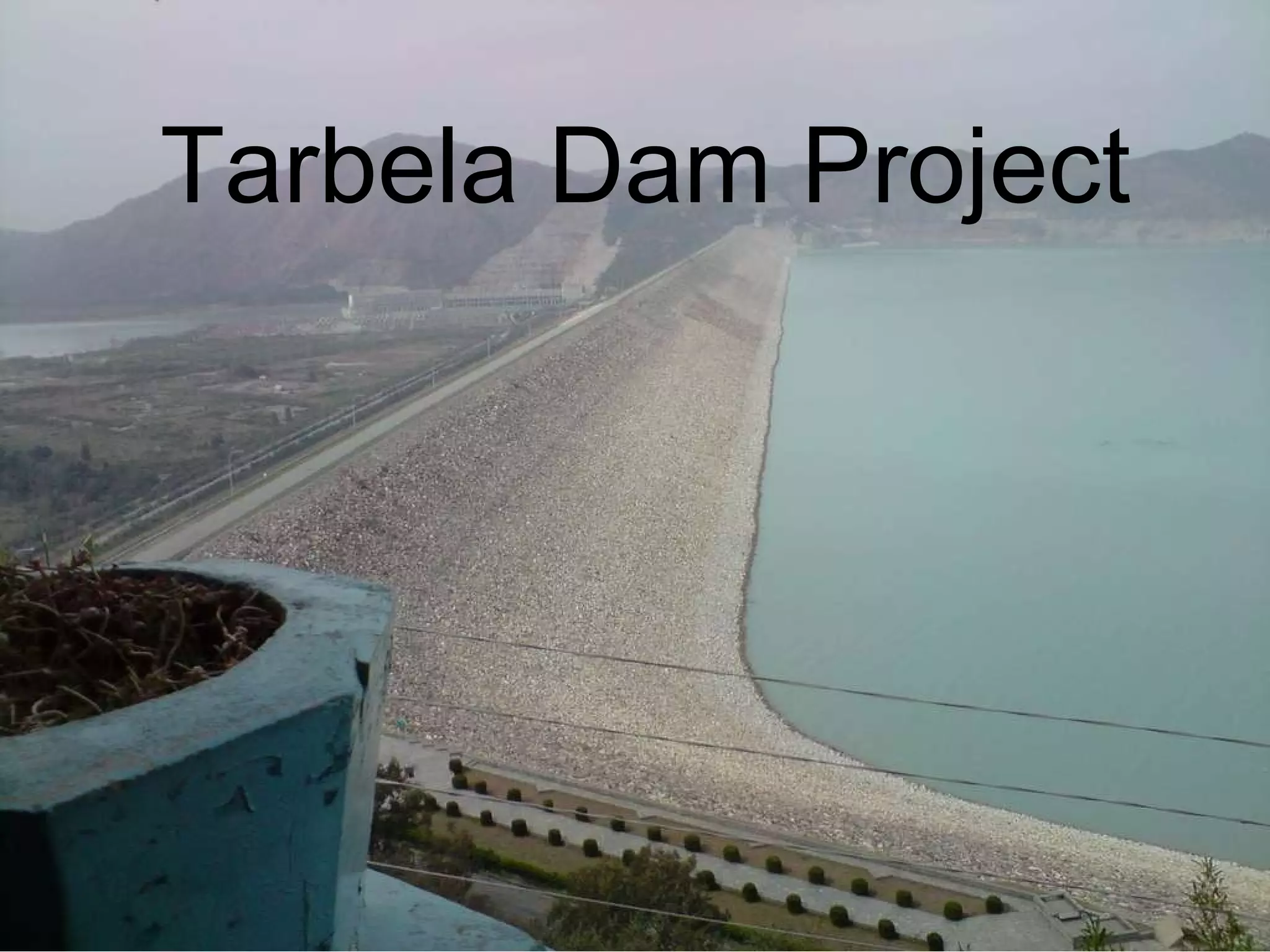
History In February 1960, Tippetts-Abbett-McCarthy-Stratton of USA commonly known as TAMS, were appointed the project consultants, and were entrusted the task of investigations, preparation of detailed designs and contract documents for Tarbela Dam Project and also the supervision of construction work during its execution. The   project consists of 9000 feet (2,743 meters) long, 470 feet (143 meters) high main dam. A power house 3478 MW five number tunnels, two spillways, auxiliary and service spillways.
Objectives Power Generation Irrigation Diverting three eastern rivers (Ravi, Sutlej, Beas) by India.
Project Duration Started in 1968 Initial test filling 1974 Estimated completion 7.25 year’s Actual completion time 8.3  years(approximately 1 year later)
Project Constrain Cost  2.63 billion Scope Power generation and irrigation Time 8.3 year’s
Project Cost The total cost of project including power units (1-14) amount to US $ 2.63 billion.
Project life cycle Defining  Primary objective is storage of water to overcome the effect of diverting the three eastern rivers (Ravi, Beas and Sutlej) and to increase the agricultural production.
Project life cycle Planning & Execution The project was planned to have following things essentially  A major earth and rock filled dam. Two auxiliary earth and rock fill dam. Two spillways. Four outlet tunnels with 13.7m diameters. Power station. Cost of project US $ 2.63 billion.
Project life cycle Delivery Detailed O&M procedures were made in 1975 Started Operating in April 1976.
Financing Tarbela Development Fund (TDF) in1968 loans available from the Indus basin Development Fund and new bilateral loan agreements signed with the several countries including Australia, Canada, France, Italy, New Zealand, the United Kingdom, the United States of America and Germany Further extension of power house sponsored by  Oil Producing and Exporting Countries (OPEC)
Tunnels Total number of Tunnels 4 Length half mile Tunnel 1, 2, 3 for power generation and tunnel 4 for irrigation
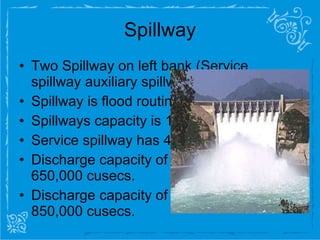
Spillway Two Spillway on left bank (Service spillway auxiliary spillway) Spillway is flood routing structure Spillways capacity is 1500,000 cusecs  Service spillway has 44% of total capacity Discharge capacity of service spillway is 650,000 cusecs. Discharge capacity of auxiliary spillway is 850,000 cusecs.
Power Generation Four power units of 175 MW installed on each of the tunnels 1, 2, and 3. The project has thus been enhanced from 2100 MW, as originally planned to 3478 MW.
Construction Sequence A contract signed for construction of civil work of Tarbela Dam Project between WAPDA and Tarbela Joint venture (TJV) including three Italian and three French heavy construction contractors.
Problems after construction Appearance of sink holes and cracks in the impervious blanket of the bed of river. Excessive seepage through the foundation. Erosion of the hills.
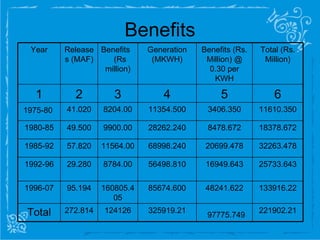
Benefits Total (Rs. Million) Benefits (Rs. Million) @ 0.30 per KWH Generation   (MKWH) Benefits  (Rs million) Releases (MAF) Year 6 5 4 3 2 1 11610.350 3406.350 11354.500 8204.00 41.020 1975-80   18378.672 8478.672 28262.240 9900.00 49.500 1980-85 32263.478 20699.478 68998.240 11564.00 57.820 1985-92 25733.643 16949.643 56498.810 8784.00 29.280 1992-96 133916.22 48241.622 85674.600 160805.405 95.194 1996-07 221902.21 97775.749 325919.21 124126 272.814 Total
 

Tarbela dam project97 2003

  • 1.
  • 2.
    Group Members JabranUmer Muhammad Faisal Ashraf Muhammad Adil Muhammad Abdul Rehman
  • 3.
    Contents History ObjectivesProject Duration Project Constrain Project Cost Project life cycle Financing Tunnels Spillways Power Generation Construction Sequence Problems after construction Benefits
  • 4.
    History In February1960, Tippetts-Abbett-McCarthy-Stratton of USA commonly known as TAMS, were appointed the project consultants, and were entrusted the task of investigations, preparation of detailed designs and contract documents for Tarbela Dam Project and also the supervision of construction work during its execution. The project consists of 9000 feet (2,743 meters) long, 470 feet (143 meters) high main dam. A power house 3478 MW five number tunnels, two spillways, auxiliary and service spillways.
  • 5.
    Objectives Power GenerationIrrigation Diverting three eastern rivers (Ravi, Sutlej, Beas) by India.
  • 6.
    Project Duration Startedin 1968 Initial test filling 1974 Estimated completion 7.25 year’s Actual completion time 8.3 years(approximately 1 year later)
  • 7.
    Project Constrain Cost 2.63 billion Scope Power generation and irrigation Time 8.3 year’s
  • 8.
    Project Cost Thetotal cost of project including power units (1-14) amount to US $ 2.63 billion.
  • 9.
    Project life cycleDefining Primary objective is storage of water to overcome the effect of diverting the three eastern rivers (Ravi, Beas and Sutlej) and to increase the agricultural production.
  • 10.
    Project life cyclePlanning & Execution The project was planned to have following things essentially A major earth and rock filled dam. Two auxiliary earth and rock fill dam. Two spillways. Four outlet tunnels with 13.7m diameters. Power station. Cost of project US $ 2.63 billion.
  • 11.
    Project life cycleDelivery Detailed O&M procedures were made in 1975 Started Operating in April 1976.
  • 12.
    Financing Tarbela DevelopmentFund (TDF) in1968 loans available from the Indus basin Development Fund and new bilateral loan agreements signed with the several countries including Australia, Canada, France, Italy, New Zealand, the United Kingdom, the United States of America and Germany Further extension of power house sponsored by Oil Producing and Exporting Countries (OPEC)
  • 13.
    Tunnels Total numberof Tunnels 4 Length half mile Tunnel 1, 2, 3 for power generation and tunnel 4 for irrigation
  • 14.
    Spillway Two Spillwayon left bank (Service spillway auxiliary spillway) Spillway is flood routing structure Spillways capacity is 1500,000 cusecs Service spillway has 44% of total capacity Discharge capacity of service spillway is 650,000 cusecs. Discharge capacity of auxiliary spillway is 850,000 cusecs.
  • 15.
    Power Generation Fourpower units of 175 MW installed on each of the tunnels 1, 2, and 3. The project has thus been enhanced from 2100 MW, as originally planned to 3478 MW.
  • 16.
    Construction Sequence Acontract signed for construction of civil work of Tarbela Dam Project between WAPDA and Tarbela Joint venture (TJV) including three Italian and three French heavy construction contractors.
  • 17.
    Problems after constructionAppearance of sink holes and cracks in the impervious blanket of the bed of river. Excessive seepage through the foundation. Erosion of the hills.
  • 18.
    Benefits Total (Rs.Million) Benefits (Rs. Million) @ 0.30 per KWH Generation (MKWH) Benefits (Rs million) Releases (MAF) Year 6 5 4 3 2 1 11610.350 3406.350 11354.500 8204.00 41.020 1975-80 18378.672 8478.672 28262.240 9900.00 49.500 1980-85 32263.478 20699.478 68998.240 11564.00 57.820 1985-92 25733.643 16949.643 56498.810 8784.00 29.280 1992-96 133916.22 48241.622 85674.600 160805.405 95.194 1996-07 221902.21 97775.749 325919.21 124126 272.814 Total
  • 19.