Economics Of Pakistan
Group Members:
Aqeel Khalil
BBA-12-02
Mir Haris
BBA-12-13
Dams
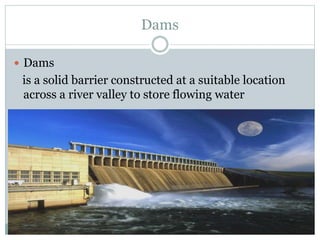
 Dams
is a solid barrier constructed at a suitable location
across a river valley to store flowing water
Storage objectives
Storage of water is utilized for following objectives
 Hydropower
 Irrigation
 Water for domestic consumption
 Drought and flood control
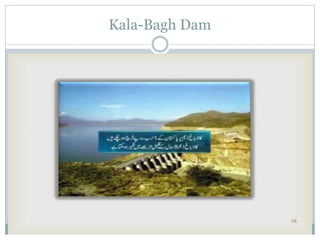
Kala-Bagh Dam
Introduction
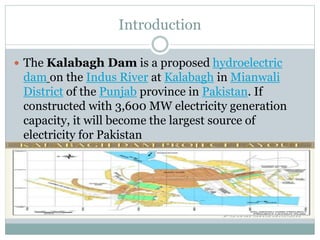
 The Kalabagh Dam is a proposed hydroelectric
dam on the Indus River at Kalabagh in Mianwali
District of the Punjab province in Pakistan. If
constructed with 3,600 MW electricity generation
capacity, it will become the largest source of
electricity for Pakistan
History
 Kalabagh Dam was designed in 1984 with the
assistance of the United nations development
program (UNDP), supervised by the world bank for
the client WAPDA.
 The project was poised in mid 1987
 It was estimated to cost US$ 3.46 billion at 1987
level and was scheduled to be completed in 6 years,
with first generating unit to be commissioned in
1993.
Cont’d
 In 2004, General Pervez Musharraf, President of
Pakistan, announced that he would build the dam in
the larger interest of Pakistan. In 2008, Federal
Minister for Water and Power of Pakistan, Raja
Pervez Ashraf, said that the "Kalabagh Dam would
not be constructed" and the project had been
cancelled’’ He said due to the "opposition from
Khyber Pakhtunkhwa, Sindh and other stakeholders,
the project was no longer feasible".
Apprehensions of KPK
 Drainage of Mardan, Pabbi and Sawabi will be
adversly affected.
 Large population will be displaced .
 While the reservoir will be in the KPK, the dam's
electricity-generating turbines will be just across the
provincial border in Punjab. Therefore, Punjab
would get royalties from the central government
in Islamabad for generating electricity.
Apprehensions of Sindh
 Their share of the Indus water will be curtailed as water
from the Kalabagh will go to irrigate farmlands
in Punjab and Khyber Pakhtunkhwa, at their cost.
Sindhis hold that their rights as the lower riparian have
precedence according to international water distribution
law.
 With the construction of dams, such as Tarbela
Dam across the Indus, Sindhis have seen the once-
mighty Indus turned into a shadow of its former glory
downstream of the Kotri Barrage up to Hyderabad. They
fear that there is not enough water for another large dam
across the Indus
What if Kala-bagh dam not built
 Loss of storae capacity of the existing dams due to
sedimentation would result in shortage of commited
irrigation supplies causing serious even in existing
agriculture production.
 The annual energy generated at Kalabagh is
equivalent to 20 million barrels of oil.
Importance for Pakistan
 Replacing storage lost by sedimentation in existing
reservoirs Mangla, Chashma and Tarbella
 Kalabagh dam would store surplus water in the flood
season and make it available for controlled
utilization during the low flow season.
 Regulation and control of high flood peaks in the
Indus to enable provision of parrenial tubewell
irrigation to the riverain area in sindh.
 Generating a large chunk of hydropower for meeting
the growing demand.
Diamir Bhasha Dam
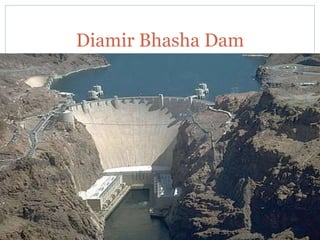
Diamir-Bhasha Dam
Introduction
 Diamer-Bhasha Dam is a gravity dam, in the
preliminary stages of construction, on the River
Indus in Gilgit-Baltistan, Pakistan
 Its foundation stone was laid by Prime Minister
Yusuf Raza Gilani of Pakistan on 18 October 2011.
 Upon completion, Diamer-Bhasha Dam would be the
highest RCC dam in the world.
 The dam site is situated near a place called "Bhasha"
in Gilgit-Baltistan's Diamer District, hence the name.
Basic information
 The project is located on Indus River, about 315 km
upstream of Tarbela Dam.
 165 km downstream of the Northern Area capital
Gilgit
 and 40 km downstream of Chilas
 The proposed dam would have a maximum height of
270 m.
 Impound a reservoir of about 7,500,000 acre feet.
 with live storage of more than 6,400,000 acre feet .
Continuous
 Thus the dam will impound 15% of the annual river
flow.
 The dam project would cover an area of 110 km2 and
extend 100 km upstream of the damsite up to Raikot
Bridge on Karakoram Highway .
Need for the project
 Agriculture is the backbone of Pakistan’s economy.
 Pakistan today is among one of the World’s fastest
growing population, now estimated as over 150 million.
 Due to lack of large river regulation capability through
sizeable storages, the country is already facing serious
shortages in food grains.
 Pakistan could soon become one of the food deficit
countries in the near future.
 The President has taken a very bold initiative by taking
the decision to construct Diamer Basha Dam Project.
Continuous
 The electricity shortfall reached 4,760 megawatt
while the country is generating 13,240 megawatt of
electricity and the current demand is 18,000
megawatt.
 Contribution of 4500 MW power from Diamer Basha
Dam will go a long way in alleviating this situation.
Total Cost
 The cost of the Diamer-Bhahsa dam is $ 13.87 billion with 9
years completion time. Which was $12 billion in 2008.
 A huge amount of Rs 27.824 billion is required for the
acquisition of land and resettlement of the people to be
affected in the wake of the construction of the dam.
 Under the proposed project, Rs 10.76 billion will be spent for
the acquisition of agriculture-barren land, tree and nurseries
and Rs 1.638 billion to be utilised for properties &
infrastructure.
 , Rs 8.8 billion for establishment of nine model villages, Rs
62.119 million for pay & allowances for administrative
arrangements, and Rs.17.7 million for contingent
administrative expenses.
Benefits 
 Availability of about 6,400,000 acre feet (7.89×10⁹
m3) annual surface face water storage for
supplementing irrigation supplies during low flow
periods
 Harnessing of renewable source of clean and cheap
energy through installed capacity of 4500 MW .
 Employment opportunity, particularly to the locals,
during the construction and operation.
 Creation of massive infrastructure leading to overall
socio-economic uplift of the area and standard of
living of people.
Effects 
 No. of villages affected 30
 No. of Houses Affected 2200
 Population affected 22,000
 Agricultural land submerged 1,500 acres (6.1 km2)
 Area under reservoir 25,000 acres
Comparison
 COMPARISON BETWEEN BHASHA AND
KALABAGH DAMS
 KBD is ready to build and will take five to six years to come
on stream compared to twelve years minimum for BD,
possibly 15 years.
 KBD will utilize a big part of the 30 maf annual monsoon
flow; BD is beyond the monsoon range
 KBD will prevent heavy floods by moderating floods of the
five rivers in South Punjab and Sindh, particularly in the
Kacha area between Guddu and Kotri barrages; BD will not.
Cont’d
 KBD, 310 miles of approach road has to be widened and
strengthened to take heavy machinery to the site before
work can start.
 BD, 140 miles of Karakorum highway will have to be
relocated at a higher and more difficult terrain. (these two
roads will cost more than the dam itself)
 KBD will also be subject to seismic disturbances but not as
much as BD which is in a highly active seismic zone.
Cont’d
• BD parameters were altered in an effort to afford better
usage. To give it a completion period close to that of KBD,
the rock-fill design has been changed to roller compacted
concrete. This design shall usher in a new state of the art
technical challenge for engineers.
 Height 680 to 908 feet (KBD 260 feet)
 Storage 8.1 maf (KBD 6.1 maf)
 Implementation 12 years (KBD 6 yrs )
 Cost USD 13.87 Billion (KBD USD 7 Billion)
Thanks

diamir bhasha Dam

  • 1.
    Economics Of Pakistan GroupMembers: Aqeel Khalil BBA-12-02 Mir Haris BBA-12-13
  • 2.
    Dams  Dams is asolid barrier constructed at a suitable location across a river valley to store flowing water
  • 3.
    Storage objectives Storage ofwater is utilized for following objectives  Hydropower  Irrigation  Water for domestic consumption  Drought and flood control
  • 4.
  • 5.
    Introduction  The KalabaghDam is a proposed hydroelectric dam on the Indus River at Kalabagh in Mianwali District of the Punjab province in Pakistan. If constructed with 3,600 MW electricity generation capacity, it will become the largest source of electricity for Pakistan
  • 6.
    History  Kalabagh Damwas designed in 1984 with the assistance of the United nations development program (UNDP), supervised by the world bank for the client WAPDA.  The project was poised in mid 1987  It was estimated to cost US$ 3.46 billion at 1987 level and was scheduled to be completed in 6 years, with first generating unit to be commissioned in 1993.
  • 7.
    Cont’d  In 2004,General Pervez Musharraf, President of Pakistan, announced that he would build the dam in the larger interest of Pakistan. In 2008, Federal Minister for Water and Power of Pakistan, Raja Pervez Ashraf, said that the "Kalabagh Dam would not be constructed" and the project had been cancelled’’ He said due to the "opposition from Khyber Pakhtunkhwa, Sindh and other stakeholders, the project was no longer feasible".
  • 8.
    Apprehensions of KPK Drainage of Mardan, Pabbi and Sawabi will be adversly affected.  Large population will be displaced .  While the reservoir will be in the KPK, the dam's electricity-generating turbines will be just across the provincial border in Punjab. Therefore, Punjab would get royalties from the central government in Islamabad for generating electricity.
  • 9.
    Apprehensions of Sindh Their share of the Indus water will be curtailed as water from the Kalabagh will go to irrigate farmlands in Punjab and Khyber Pakhtunkhwa, at their cost. Sindhis hold that their rights as the lower riparian have precedence according to international water distribution law.  With the construction of dams, such as Tarbela Dam across the Indus, Sindhis have seen the once- mighty Indus turned into a shadow of its former glory downstream of the Kotri Barrage up to Hyderabad. They fear that there is not enough water for another large dam across the Indus
  • 10.
    What if Kala-baghdam not built  Loss of storae capacity of the existing dams due to sedimentation would result in shortage of commited irrigation supplies causing serious even in existing agriculture production.  The annual energy generated at Kalabagh is equivalent to 20 million barrels of oil.
  • 11.
    Importance for Pakistan Replacing storage lost by sedimentation in existing reservoirs Mangla, Chashma and Tarbella  Kalabagh dam would store surplus water in the flood season and make it available for controlled utilization during the low flow season.  Regulation and control of high flood peaks in the Indus to enable provision of parrenial tubewell irrigation to the riverain area in sindh.  Generating a large chunk of hydropower for meeting the growing demand.
  • 12.
  • 13.
    Diamir-Bhasha Dam Introduction  Diamer-BhashaDam is a gravity dam, in the preliminary stages of construction, on the River Indus in Gilgit-Baltistan, Pakistan  Its foundation stone was laid by Prime Minister Yusuf Raza Gilani of Pakistan on 18 October 2011.  Upon completion, Diamer-Bhasha Dam would be the highest RCC dam in the world.  The dam site is situated near a place called "Bhasha" in Gilgit-Baltistan's Diamer District, hence the name.
  • 14.
    Basic information  Theproject is located on Indus River, about 315 km upstream of Tarbela Dam.  165 km downstream of the Northern Area capital Gilgit  and 40 km downstream of Chilas  The proposed dam would have a maximum height of 270 m.  Impound a reservoir of about 7,500,000 acre feet.  with live storage of more than 6,400,000 acre feet .
  • 15.
    Continuous  Thus thedam will impound 15% of the annual river flow.  The dam project would cover an area of 110 km2 and extend 100 km upstream of the damsite up to Raikot Bridge on Karakoram Highway .
  • 16.
    Need for theproject  Agriculture is the backbone of Pakistan’s economy.  Pakistan today is among one of the World’s fastest growing population, now estimated as over 150 million.  Due to lack of large river regulation capability through sizeable storages, the country is already facing serious shortages in food grains.  Pakistan could soon become one of the food deficit countries in the near future.  The President has taken a very bold initiative by taking the decision to construct Diamer Basha Dam Project.
  • 17.
    Continuous  The electricityshortfall reached 4,760 megawatt while the country is generating 13,240 megawatt of electricity and the current demand is 18,000 megawatt.  Contribution of 4500 MW power from Diamer Basha Dam will go a long way in alleviating this situation.
  • 18.
    Total Cost  Thecost of the Diamer-Bhahsa dam is $ 13.87 billion with 9 years completion time. Which was $12 billion in 2008.  A huge amount of Rs 27.824 billion is required for the acquisition of land and resettlement of the people to be affected in the wake of the construction of the dam.  Under the proposed project, Rs 10.76 billion will be spent for the acquisition of agriculture-barren land, tree and nurseries and Rs 1.638 billion to be utilised for properties & infrastructure.  , Rs 8.8 billion for establishment of nine model villages, Rs 62.119 million for pay & allowances for administrative arrangements, and Rs.17.7 million for contingent administrative expenses.
  • 19.
    Benefits   Availabilityof about 6,400,000 acre feet (7.89×10⁹ m3) annual surface face water storage for supplementing irrigation supplies during low flow periods  Harnessing of renewable source of clean and cheap energy through installed capacity of 4500 MW .  Employment opportunity, particularly to the locals, during the construction and operation.  Creation of massive infrastructure leading to overall socio-economic uplift of the area and standard of living of people.
  • 20.
    Effects   No.of villages affected 30  No. of Houses Affected 2200  Population affected 22,000  Agricultural land submerged 1,500 acres (6.1 km2)  Area under reservoir 25,000 acres
  • 21.
    Comparison  COMPARISON BETWEENBHASHA AND KALABAGH DAMS  KBD is ready to build and will take five to six years to come on stream compared to twelve years minimum for BD, possibly 15 years.  KBD will utilize a big part of the 30 maf annual monsoon flow; BD is beyond the monsoon range  KBD will prevent heavy floods by moderating floods of the five rivers in South Punjab and Sindh, particularly in the Kacha area between Guddu and Kotri barrages; BD will not.
  • 22.
    Cont’d  KBD, 310miles of approach road has to be widened and strengthened to take heavy machinery to the site before work can start.  BD, 140 miles of Karakorum highway will have to be relocated at a higher and more difficult terrain. (these two roads will cost more than the dam itself)  KBD will also be subject to seismic disturbances but not as much as BD which is in a highly active seismic zone.
  • 23.
    Cont’d • BD parameterswere altered in an effort to afford better usage. To give it a completion period close to that of KBD, the rock-fill design has been changed to roller compacted concrete. This design shall usher in a new state of the art technical challenge for engineers.  Height 680 to 908 feet (KBD 260 feet)  Storage 8.1 maf (KBD 6.1 maf)  Implementation 12 years (KBD 6 yrs )  Cost USD 13.87 Billion (KBD USD 7 Billion)
  • 24.