Hydropower Development in INDIA…
Prepared by
Prof. S. G. Taji
Dept. of Civil Engineering
S.R.E.S’s Sanjivani College of Engineering,
Kopargaon
What is Hydro-Power????
Prepared by: Prof. Taji S. G.
2
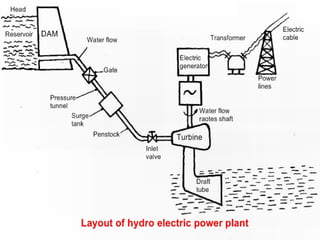
 Hydropower (or hydro energy) is a form of renewable
energy that uses the water stored in dams, as well as
flowing in rivers to create electricity in hydropower plants.
 Like other forms of electricity generation, hydropower uses
a turbine to generate electricity; using the energy of falling
or flowing water to turn the blades.
 The rotating blades spin a generator that converts the
mechanical energy of the spinning turbine into electrical
energy.
 The amount of electricity generated from each power plant
depends on the quantity of the flowing water and the height
from which it falls.
Prepared by: Prof. Taji S. G.
3
History of Development
Prepared by: Prof. Taji S. G.
4
 India has a history of about 110 years of
hydropower.
 The first small hydro project of 130 kW
commissioned in the hills of Darjeeling in
1897 to mark the development of hydropower
in India, almost in pace with the world’s first
hydro-electric station in the United States
 At Present the biggest capacity plant is a run
of river Tehri Dam Hydro project of 2400 MW
in Uttarakhand
Prepared by: Prof. Taji S. G.
5
Current Status & Potential
Prepared by: Prof. Taji S. G.
6
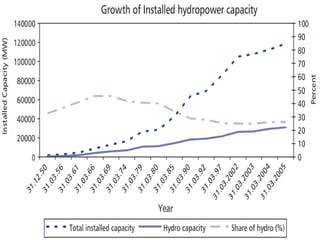
 As on 31st May 2015 , the total installed generating capacity of
Power in India is 2,72,502.95 MW out of which Hydro Power
accounts for merely 15.28% (41632.43 MW). (334 GW in Jan 2018)
 The percentage of Hydro Power has come down from 45% in 1970 to
16% in 2014.
 Today the ratio is about 15:85 which is too less as to have efficient
and balance grid for operation of all types of plants.
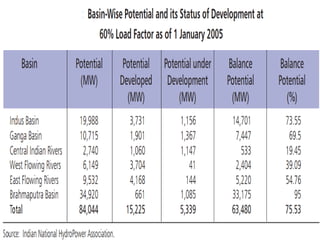
 The total hydroelectric power potential in the country is assessed at
about 150,000 MW, of which Economic Potential works out to
84,044 MW at a Peak Load Factor of 60%
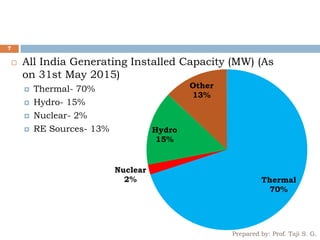
 All India Generating Installed Capacity (MW) (As
on 31st May 2015)
 Thermal- 70%
 Hydro- 15%
 Nuclear- 2%
 RE Sources- 13%
7
Prepared by: Prof. Taji S. G.
Thermal
70%
Nuclear
2%
Hydro
15%
Other
13%
Prepared by: Prof. Taji S. G.
8
 India is endowed with rich hydropower potential;
it ranks 5th in the world in terms of usable
potential.
 This is distributed across six major river
systems:
i. The Indus,
ii. Brahmaputra,
iii.Ganga,
iv. The central Indian river systems, and
v. The east and west flowing river systems of south
India.
 The Indus, Brahmaputra and Ganga together
account for nearly 80% of the total potential.
Prepared by: Prof. Taji S. G.
9
Prepared by: Prof. Taji S. G.
10
 In addition, pumped storage sites with an
aggregate capacity to the tune of 94,000 MW
have also been identified, but only about 5,000
MW have so far been developed.
 The assessment of small hydro (up to 25 MW)
potential has indicated nearly 10,000 MW
distributed over 4,000 sites.
 It is estimated there is still an unidentified
small hydro potential of almost 5,000 MW.
Prepared by: Prof. Taji S. G.
11
 Region wise total hydro power potential
(84044 MW) is as follows:
 North : 30155 MW
 East : 5590 MW
 South : 10763 MW
 West : 5679 MW
 North – East : 31857 MW
Necessity of HP Development
Prepared by: Prof. Taji S. G.
12
 It has been estimated that in order to support a
growth rate of the gross domestic product (GDP)
of around 7% per annum, the rate of growth of
power supply needs to be over 10% annually.
 India is ranks 5th in the world in terms of usable
potential.
 Less than 15% has been developed or taken up for
development
 Thus, hydropower is one of the potential sources for
meeting the growing energy needs of the country.
Necessity of HP Development
Prepared by: Prof. Taji S. G.
13
 Indian rivers carry more than two third of their annual flow
in three monsoon months. Can we afford to waste the bulk
of the Energy of water by letting it flow down the drain
unutilized in the monsoon months?
 We are wasting this huge amount of water flowing continuously
which can be converted to energy.
 Dams and reservoirs are designed to last over hundred
years. Which other type of energy source has such a long
life?
 Hydropower provide us inexpensive energy.
 Therefore, to meet country’s energy demand at a faster pace and
make up for the long time, development of Mega hydropower
projects is essentially required.
Necessity of HP Development
Prepared by: Prof. Taji S. G.
14
 With the continuous extraction of fossil fuels,
the sources are getting depleted fast
 A judicial mix of hydropower in the energy
portfolio can also contribute to energy security,
reduction of greenhouse gas emissions, meeting
the peak demand and also increased flexibility in
grid operation.
 Besides, projects may also be conceived as multi-
purpose ones contributing not only to power but
also to irrigation, flood control, navigation, etc.
Advantages of HP
Prepared by: Prof. Taji S. G.
15
 No fuel requirement
 Flexible – Use whenever you want
 Environment friendly & Non Polluting
 Spontaneous starting, stopping and load
variation ability
 Multipurpose Hydro power projects
 Longer useful plant life
 Lower operational cost
 Low maintenance
Prepared by: Prof. Taji S. G.
16
 High initial cost
 Long gestation period
 Safety
 Environmental Consequences
 Depends upon natural flow of rivers
 Require large area
Disadvantages of HP
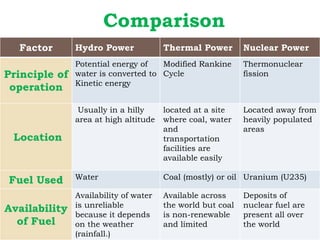
Comparison
17 Factor Hydro Power Thermal Power Nuclear Power
Principle of
operation
Potential energy of
water is converted to
Kinetic energy
Modified Rankine
Cycle
Thermonuclear
fission
Location
Usually in a hilly
area at high altitude
located at a site
where coal, water
and
transportation
facilities are
available easily
Located away from
heavily populated
areas
Fuel Used Water Coal (mostly) or oil Uranium (U235)
Availability
of Fuel
Availability of water
is unreliable
because it depends
on the weather
(rainfall.)
Available across
the world but coal
is non-renewable
and limited
Deposits of
nuclear fuel are
present all over
the world
Prepared by: Prof. Taji S. G.
18
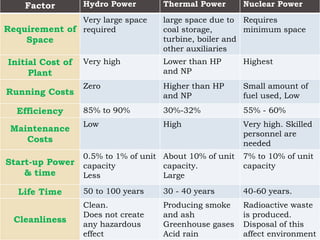
Factor Hydro Power Thermal Power Nuclear Power
Requirement of
Space
Very large space
required
large space due to
coal storage,
turbine, boiler and
other auxiliaries
Requires
minimum space
Initial Cost of
Plant
Very high Lower than HP
and NP
Highest
Running Costs
Zero Higher than HP
and NP
Small amount of
fuel used, Low
Efficiency 85% to 90% 30%-32% 55% - 60%
Maintenance
Costs
Low High Very high. Skilled
personnel are
needed
Start-up Power
& time
0.5% to 1% of unit
capacity
Less
About 10% of unit
capacity.
Large
7% to 10% of unit
capacity
Life Time 50 to 100 years 30 - 40 years 40-60 years.
Cleanliness
Clean.
Does not create
any hazardous
effect
Producing smoke
and ash
Greenhouse gases
Acid rain
Radioactive waste
is produced.
Disposal of this
affect environment
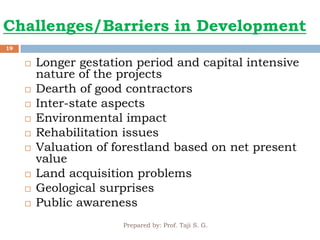
Challenges/Barriers in Development
Prepared by: Prof. Taji S. G.
19
 Longer gestation period and capital intensive
nature of the projects
 Dearth of good contractors
 Inter-state aspects
 Environmental impact
 Rehabilitation issues
 Valuation of forestland based on net present
value
 Land acquisition problems
 Geological surprises
 Public awareness
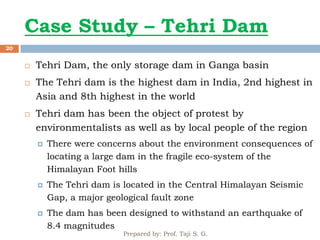
Case Study – Tehri Dam
Prepared by: Prof. Taji S. G.
20
 Tehri Dam, the only storage dam in Ganga basin
 The Tehri dam is the highest dam in India, 2nd highest in
Asia and 8th highest in the world
 Tehri dam has been the object of protest by
environmentalists as well as by local people of the region
 There were concerns about the environment consequences of
locating a large dam in the fragile eco-system of the
Himalayan Foot hills
 The Tehri dam is located in the Central Himalayan Seismic
Gap, a major geological fault zone
 The dam has been designed to withstand an earthquake of
8.4 magnitudes
Prepared by: Prof. Taji S. G.
21
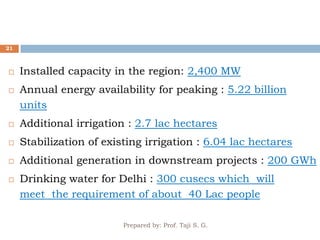
 Installed capacity in the region: 2,400 MW
 Annual energy availability for peaking : 5.22 billion
units
 Additional irrigation : 2.7 lac hectares
 Stabilization of existing irrigation : 6.04 lac hectares
 Additional generation in downstream projects : 200 GWh
 Drinking water for Delhi : 300 cusecs which will
meet the requirement of about 40 Lac people
Place of Hydro-Power in Power
System
Prepared by: Prof. Taji S. G.
22
 Hydropower is the only major source in power mix of
country, which would be major base load sharing source
in the mix.
 However, this is not the case due to:
 Load sharing ought to be maximum when natural river flow is
maximum and vice versa
 Since hydropower can be switched on in matter of minutes, it is
naturally more suited for intermitten operation and hence ideal
for daily peaking purposes. Nuclear and thermal more suited for
seasonal on-off.
 If hydropower is mainly for lighting purpose in rural areas, small
hydro plants can be run for limited hours, if they are stand alone
mode i,.e. off-grid
Prepared by: Prof. Taji S. G.
23
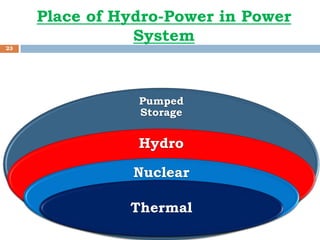
Pumped
Storage
Hydro
Nuclear
Thermal
Place of Hydro-Power in Power
System

Hydropower Development in India

  • 1.
    Hydropower Development inINDIA… Prepared by Prof. S. G. Taji Dept. of Civil Engineering S.R.E.S’s Sanjivani College of Engineering, Kopargaon
  • 2.
    What is Hydro-Power???? Preparedby: Prof. Taji S. G. 2  Hydropower (or hydro energy) is a form of renewable energy that uses the water stored in dams, as well as flowing in rivers to create electricity in hydropower plants.  Like other forms of electricity generation, hydropower uses a turbine to generate electricity; using the energy of falling or flowing water to turn the blades.  The rotating blades spin a generator that converts the mechanical energy of the spinning turbine into electrical energy.  The amount of electricity generated from each power plant depends on the quantity of the flowing water and the height from which it falls.
  • 3.
    Prepared by: Prof.Taji S. G. 3
  • 4.
    History of Development Preparedby: Prof. Taji S. G. 4  India has a history of about 110 years of hydropower.  The first small hydro project of 130 kW commissioned in the hills of Darjeeling in 1897 to mark the development of hydropower in India, almost in pace with the world’s first hydro-electric station in the United States  At Present the biggest capacity plant is a run of river Tehri Dam Hydro project of 2400 MW in Uttarakhand
  • 5.
    Prepared by: Prof.Taji S. G. 5
  • 6.
    Current Status &Potential Prepared by: Prof. Taji S. G. 6  As on 31st May 2015 , the total installed generating capacity of Power in India is 2,72,502.95 MW out of which Hydro Power accounts for merely 15.28% (41632.43 MW). (334 GW in Jan 2018)  The percentage of Hydro Power has come down from 45% in 1970 to 16% in 2014.  Today the ratio is about 15:85 which is too less as to have efficient and balance grid for operation of all types of plants.  The total hydroelectric power potential in the country is assessed at about 150,000 MW, of which Economic Potential works out to 84,044 MW at a Peak Load Factor of 60%
  • 7.
     All IndiaGenerating Installed Capacity (MW) (As on 31st May 2015)  Thermal- 70%  Hydro- 15%  Nuclear- 2%  RE Sources- 13% 7 Prepared by: Prof. Taji S. G. Thermal 70% Nuclear 2% Hydro 15% Other 13%
  • 8.
    Prepared by: Prof.Taji S. G. 8  India is endowed with rich hydropower potential; it ranks 5th in the world in terms of usable potential.  This is distributed across six major river systems: i. The Indus, ii. Brahmaputra, iii.Ganga, iv. The central Indian river systems, and v. The east and west flowing river systems of south India.  The Indus, Brahmaputra and Ganga together account for nearly 80% of the total potential.
  • 9.
    Prepared by: Prof.Taji S. G. 9
  • 10.
    Prepared by: Prof.Taji S. G. 10  In addition, pumped storage sites with an aggregate capacity to the tune of 94,000 MW have also been identified, but only about 5,000 MW have so far been developed.  The assessment of small hydro (up to 25 MW) potential has indicated nearly 10,000 MW distributed over 4,000 sites.  It is estimated there is still an unidentified small hydro potential of almost 5,000 MW.
  • 11.
    Prepared by: Prof.Taji S. G. 11  Region wise total hydro power potential (84044 MW) is as follows:  North : 30155 MW  East : 5590 MW  South : 10763 MW  West : 5679 MW  North – East : 31857 MW
  • 12.
    Necessity of HPDevelopment Prepared by: Prof. Taji S. G. 12  It has been estimated that in order to support a growth rate of the gross domestic product (GDP) of around 7% per annum, the rate of growth of power supply needs to be over 10% annually.  India is ranks 5th in the world in terms of usable potential.  Less than 15% has been developed or taken up for development  Thus, hydropower is one of the potential sources for meeting the growing energy needs of the country.
  • 13.
    Necessity of HPDevelopment Prepared by: Prof. Taji S. G. 13  Indian rivers carry more than two third of their annual flow in three monsoon months. Can we afford to waste the bulk of the Energy of water by letting it flow down the drain unutilized in the monsoon months?  We are wasting this huge amount of water flowing continuously which can be converted to energy.  Dams and reservoirs are designed to last over hundred years. Which other type of energy source has such a long life?  Hydropower provide us inexpensive energy.  Therefore, to meet country’s energy demand at a faster pace and make up for the long time, development of Mega hydropower projects is essentially required.
  • 14.
    Necessity of HPDevelopment Prepared by: Prof. Taji S. G. 14  With the continuous extraction of fossil fuels, the sources are getting depleted fast  A judicial mix of hydropower in the energy portfolio can also contribute to energy security, reduction of greenhouse gas emissions, meeting the peak demand and also increased flexibility in grid operation.  Besides, projects may also be conceived as multi- purpose ones contributing not only to power but also to irrigation, flood control, navigation, etc.
  • 15.
    Advantages of HP Preparedby: Prof. Taji S. G. 15  No fuel requirement  Flexible – Use whenever you want  Environment friendly & Non Polluting  Spontaneous starting, stopping and load variation ability  Multipurpose Hydro power projects  Longer useful plant life  Lower operational cost  Low maintenance
  • 16.
    Prepared by: Prof.Taji S. G. 16  High initial cost  Long gestation period  Safety  Environmental Consequences  Depends upon natural flow of rivers  Require large area Disadvantages of HP
  • 17.
    Comparison 17 Factor HydroPower Thermal Power Nuclear Power Principle of operation Potential energy of water is converted to Kinetic energy Modified Rankine Cycle Thermonuclear fission Location Usually in a hilly area at high altitude located at a site where coal, water and transportation facilities are available easily Located away from heavily populated areas Fuel Used Water Coal (mostly) or oil Uranium (U235) Availability of Fuel Availability of water is unreliable because it depends on the weather (rainfall.) Available across the world but coal is non-renewable and limited Deposits of nuclear fuel are present all over the world
  • 18.
    Prepared by: Prof.Taji S. G. 18 Factor Hydro Power Thermal Power Nuclear Power Requirement of Space Very large space required large space due to coal storage, turbine, boiler and other auxiliaries Requires minimum space Initial Cost of Plant Very high Lower than HP and NP Highest Running Costs Zero Higher than HP and NP Small amount of fuel used, Low Efficiency 85% to 90% 30%-32% 55% - 60% Maintenance Costs Low High Very high. Skilled personnel are needed Start-up Power & time 0.5% to 1% of unit capacity Less About 10% of unit capacity. Large 7% to 10% of unit capacity Life Time 50 to 100 years 30 - 40 years 40-60 years. Cleanliness Clean. Does not create any hazardous effect Producing smoke and ash Greenhouse gases Acid rain Radioactive waste is produced. Disposal of this affect environment
  • 19.
    Challenges/Barriers in Development Preparedby: Prof. Taji S. G. 19  Longer gestation period and capital intensive nature of the projects  Dearth of good contractors  Inter-state aspects  Environmental impact  Rehabilitation issues  Valuation of forestland based on net present value  Land acquisition problems  Geological surprises  Public awareness
  • 20.
    Case Study –Tehri Dam Prepared by: Prof. Taji S. G. 20  Tehri Dam, the only storage dam in Ganga basin  The Tehri dam is the highest dam in India, 2nd highest in Asia and 8th highest in the world  Tehri dam has been the object of protest by environmentalists as well as by local people of the region  There were concerns about the environment consequences of locating a large dam in the fragile eco-system of the Himalayan Foot hills  The Tehri dam is located in the Central Himalayan Seismic Gap, a major geological fault zone  The dam has been designed to withstand an earthquake of 8.4 magnitudes
  • 21.
    Prepared by: Prof.Taji S. G. 21  Installed capacity in the region: 2,400 MW  Annual energy availability for peaking : 5.22 billion units  Additional irrigation : 2.7 lac hectares  Stabilization of existing irrigation : 6.04 lac hectares  Additional generation in downstream projects : 200 GWh  Drinking water for Delhi : 300 cusecs which will meet the requirement of about 40 Lac people
  • 22.
    Place of Hydro-Powerin Power System Prepared by: Prof. Taji S. G. 22  Hydropower is the only major source in power mix of country, which would be major base load sharing source in the mix.  However, this is not the case due to:  Load sharing ought to be maximum when natural river flow is maximum and vice versa  Since hydropower can be switched on in matter of minutes, it is naturally more suited for intermitten operation and hence ideal for daily peaking purposes. Nuclear and thermal more suited for seasonal on-off.  If hydropower is mainly for lighting purpose in rural areas, small hydro plants can be run for limited hours, if they are stand alone mode i,.e. off-grid
  • 23.
    Prepared by: Prof.Taji S. G. 23 Pumped Storage Hydro Nuclear Thermal Place of Hydro-Power in Power System