Understanding Weather,  Climate, & the Seasons Tara Wasserstein
What is Weather? The state of the atmosphere at a particular time and place. Temperature, humidity, wind velocity, precipitation, and barometric pressure.  Occurs in the troposphere, or lower atmosphere; driven by energy from the Sun and rotation of the Earth.  Average weather conditions of a region over time are used to define a region's climate.
What is Climate? General weather conditions of a certain region, including temperature, air pressure, humidity, precipitation, sunshine, cloudiness, and winds. Climate is most affected by latitude, tilt of the Earth's axis, movements of the Earth's wind belts, difference in temperatures of land and sea, and topography.
What are Seasons? One of four natural divisions of the year—spring, summer, autumn, and winter—in temperate zones. Each has its own characteristic weather and lasts approximately three months.  Change in seasons is brought about by the shift in the angle at which the Sun's rays strike the Earth as the Earth orbits the sun.
Measuring Temperature Temperature can be measured with the use of a thermometer. Readings can be in Kelvin and Celsius, but are done most commonly in Fahrenheit.  Temperature determines how hot or cold gases and liquids are.
Interrelationships Climate is determined by the weather patterns in a specific area. Certain climates only exhibit some of the seasons based on their location on the Earth.
Types of Climates There are 5 general types of climates: Tropical - high temperatures, year-round rain Dry - little rain, vast daily temperature range Temperate - warm dry summers, cool wet winters Cold - low precipitation, seasonal temps vary Polar - permanent ice, temperatures below freezing There exist several subgroups of climates, including: Tropical moist, wet-dry tropical, dry tropical Dry midlatitude, Mediterranean, moist continental Boreal forest, tundra, highland
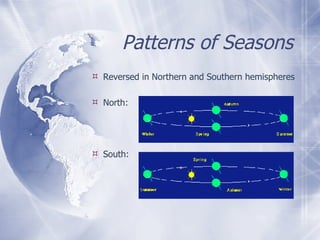
Patterns of Seasons Reversed in Northern and Southern hemispheres North: South:
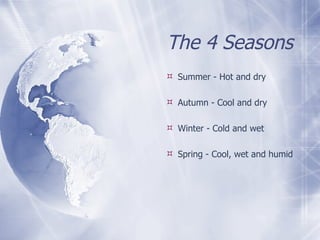
The 4 Seasons Summer - Hot and dry Autumn - Cool and dry Winter - Cold and wet Spring - Cool, wet and humid
References http://csep10.phys.utk.edu/astr161/lect/time/seasons.html http://www.dictionary.com http://www.blueplanetbiomes.org/climate.htm

Tara Wasserstein Powerpoint Ed5012

  • 1.
    Understanding Weather, Climate, & the Seasons Tara Wasserstein
  • 2.
    What is Weather?The state of the atmosphere at a particular time and place. Temperature, humidity, wind velocity, precipitation, and barometric pressure. Occurs in the troposphere, or lower atmosphere; driven by energy from the Sun and rotation of the Earth. Average weather conditions of a region over time are used to define a region's climate.
  • 3.
    What is Climate?General weather conditions of a certain region, including temperature, air pressure, humidity, precipitation, sunshine, cloudiness, and winds. Climate is most affected by latitude, tilt of the Earth's axis, movements of the Earth's wind belts, difference in temperatures of land and sea, and topography.
  • 4.
    What are Seasons?One of four natural divisions of the year—spring, summer, autumn, and winter—in temperate zones. Each has its own characteristic weather and lasts approximately three months. Change in seasons is brought about by the shift in the angle at which the Sun's rays strike the Earth as the Earth orbits the sun.
  • 5.
    Measuring Temperature Temperaturecan be measured with the use of a thermometer. Readings can be in Kelvin and Celsius, but are done most commonly in Fahrenheit. Temperature determines how hot or cold gases and liquids are.
  • 6.
    Interrelationships Climate isdetermined by the weather patterns in a specific area. Certain climates only exhibit some of the seasons based on their location on the Earth.
  • 7.
    Types of ClimatesThere are 5 general types of climates: Tropical - high temperatures, year-round rain Dry - little rain, vast daily temperature range Temperate - warm dry summers, cool wet winters Cold - low precipitation, seasonal temps vary Polar - permanent ice, temperatures below freezing There exist several subgroups of climates, including: Tropical moist, wet-dry tropical, dry tropical Dry midlatitude, Mediterranean, moist continental Boreal forest, tundra, highland
  • 8.
    Patterns of SeasonsReversed in Northern and Southern hemispheres North: South:
  • 9.
    The 4 SeasonsSummer - Hot and dry Autumn - Cool and dry Winter - Cold and wet Spring - Cool, wet and humid
  • 10.