Some computational aspects of stochastic phase-field
                     models

                                    Omar Lakkis

              Mathematics – University of Sussex – Brighton, England UK


                            based on joint work with
                     M.Katsoulakis, G.Kossioris & M.Romito
                              17 November 2009
               3rd
               Workshop
               On
               Random
               Dynamical
               Systems
 O Lakkis (Sussex)           computational stochastic phase-field   Bielefeld, 18 November 2009   1 / 62
Outline

1   Motivation

2   Background

3   White noise

4   Numerical method

5   Convergence

6   Benchmarking

7   Conclusions

8   References


      O Lakkis (Sussex)   computational stochastic phase-field   Bielefeld, 18 November 2009   2 / 62
Motivation
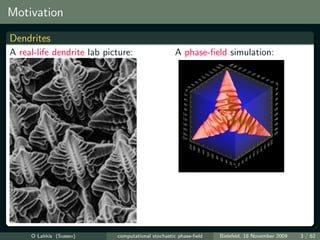
Dendrites
A real-life dendrite lab picture:                  A phase-field simulation:


     O Lakkis (Sussex)      computational stochastic phase-field   Bielefeld, 18 November 2009   3 / 62
Dendrites
Computed dendrites without ther-                A computed dendrite with thermal
mal noise [Nestler et al., 2005]                noise [Nestler et al., 2005]


     O Lakkis (Sussex)   computational stochastic phase-field   Bielefeld, 18 November 2009   4 / 62
Deterministic Phase Field
following [Chen, 1994]


Phase transition in solidification process

        α ∂t u − ∆u + (u3 − u)/ = σw                           (“interface” motion)
                          c∂t w − ∆w = −∂t u                   (diffusion in bulk) ,

where
                               
                               ≈ 1
                                                                            solid phase,
 u : order parameter/phase field ∈ (−1 + δ , 1 − δ ) ,                        interface (region)
                               
                                ≈ −1                                         liquid phase.
                               

w : temperature in liquid/solid bulk


      O Lakkis (Sussex)       computational stochastic phase-field   Bielefeld, 18 November 2009   5 / 62
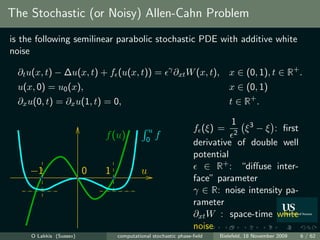
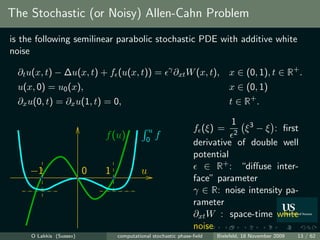
The Stochastic (or Noisy) Allen-Cahn Problem
is the following semilinear parabolic stochastic PDE with additive white
noise

  ∂t u(x, t) − ∆u(x, t) + f (u(x, t)) =               γ
                                                          ∂xt W (x, t),      x ∈ (0, 1), t ∈ R+ .
  u(x, 0) = u0 (x),                                                          x ∈ (0, 1)
  ∂x u(0, t) = ∂x u(1, t) = 0,                                               t ∈ R+ .

                                                                          1
                                             u                  f (ξ) = 2 ξ 3 − ξ : first
                             f (u)          0
                                                 f
                                                                derivative of double well
                                                                potential
     −1                  0   1            u                        ∈ R+ : “diffuse inter-
                                                                face” parameter
                                                                γ ∈ R: noise intensity pa-
                                                                rameter
                                                                ∂xt W : space-time white
                                                                noise
     O Lakkis (Sussex)           computational stochastic phase-field      Bielefeld, 18 November 2009   6 / 62
Why do we care?
about the (deterministic) Allen–Cahn


                                              1
                           ∂t u − ∆u +         2
                                                   u3 − u = 0


      Phase-separation models in metallurgy [Allen and Cahn, 1979].
      Simplest model of more complicated class [Cahn and Hilliard, 1958].
      Cubic nonlinearity approximation of “harder” (logarithmic) potential.
      Double obstacle can replace cubic by other.
      Phase-field models of phase separation and geometric motions
      [Rubinstein et al., 1989], [Evans et al., 1992], [Chen, 1994],
      [de Mottoni and Schatzman, 1995], . . . ;
      Metastability, exponentially slow motion in d = 1,
      [Carr and Pego, 1989], [Fusco and Hale, 1989],
      [Bronsard and Kohn, 1990];
      O Lakkis (Sussex)        computational stochastic phase-field   Bielefeld, 18 November 2009   7 / 62
Why do we care?
about the stochastic Allen–Cahn


                                          1
                          ∂t u − ∆u +      2
                                               u3 − u =               γ
                                                                          ∂xt W


     Noise = stabilizing/destabilizing mechanism [Brassesco et al., 1995],
     [Funaki, 1995].
     Stochastic 1d: Basic existence theory [Faris and Jona-Lasinio, 1982].
     Stochastic MCF of interfaces colored space-time/time-only noises
     possible [Souganidis and Yip, 2004], [Funaki, 1999],
     [Dirr et al., 2001].
     Rigorous mathematical setting to noise-induced dendrites.


      O Lakkis (Sussex)         computational stochastic phase-field         Bielefeld, 18 November 2009   8 / 62
Why do we care?
Modeling and computation with stochastic Allen–Cahn


Stochastic Allen–Cahn (aka Ginzburg–Landau) with noise in materials
science:
    Modeling in phenomenological/lattice approximation, noise = unknown
             meso/micro-scopic fluctuation with known statistics effect in
             macroscopic scale [Halperin and Hoffman, 1977],
             [Katsoulakis and Szepessy, 2006, cf.];
  Simulation noise as ad-hoc nucleation/instability inducing mechanism
             [Warren and Boettinger, 1995, Nestler et al., 2005, e.g.,];
Numerics for d = 1 SDE approach [Shardlow, 2000], spectral methods
             [Liu, 2003], interface nucleation/annihilation [Lythe, 1998,
             Fatkullin and Vanden-Eijnden, 2004].
Numerics for d ≥ 2 ?


      O Lakkis (Sussex)       computational stochastic phase-field   Bielefeld, 18 November 2009   9 / 62
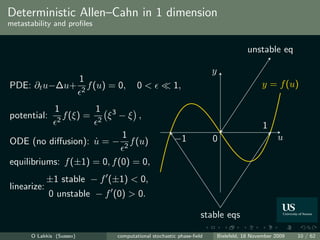
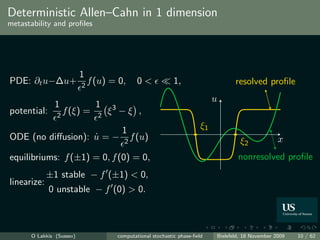
Deterministic Allen–Cahn in 1 dimension
metastability and profiles


                                                                                            unstable eq

                                                                            y
                          1
PDE: ∂t u−∆u+                 f (u) = 0,      0<             1,                                   y = f (u)
                          2

               1                1
potential:     2
                   f (ξ) =      2
                                    ξ3 − ξ ,
                                                                                                  1
                                       1                     −1             0                           u
ODE (no diffusion): u = −
                   ˙                    2
                                            f (u)

equilibriums: f (±1) = 0, f (0) = 0,
             ±1 stable − f (±1) < 0,
linearize:
             0 unstable − f (0) > 0.

                                                                        stable eqs

      O Lakkis (Sussex)               computational stochastic phase-field       Bielefeld, 18 November 2009   10 / 62
Deterministic Allen–Cahn in 1 dimension
metastability and profiles


                          1
PDE: ∂t u−∆u+             2
                              f (u) = 0,        0<             1,                     resolved profile
                                                                               u
               1                1   3
potential:     2
                   f (ξ) =      2
                                    ξ −ξ ,

                                         1                                ξ1
ODE (no diffusion): u = −
                   ˙                      2
                                            f (u)                                       ξ2             x
equilibriums: f (±1) = 0, f (0) = 0,                                                   nonresolved profile
             ±1 stable − f (±1) < 0,
linearize:
             0 unstable − f (0) > 0.


      O Lakkis (Sussex)                 computational stochastic phase-field    Bielefeld, 18 November 2009   10 / 62
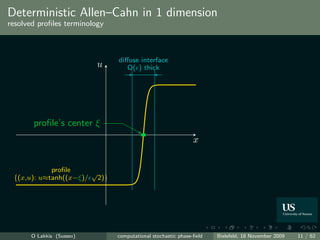
Deterministic Allen–Cahn in 1 dimension
resolved profiles terminology


                               diffuse interface
                          u       O( ) thick


       profile’s center ξ
                                                              x


            profile    √
 {(x,u): u≈tanh((x−ξ)/ 2)}


      O Lakkis (Sussex)        computational stochastic phase-field   Bielefeld, 18 November 2009   11 / 62
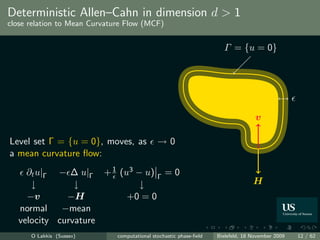
Deterministic Allen–Cahn in dimension d > 1
close relation to Mean Curvature Flow (MCF)


                                                                      Γ = {u = 0}


                                                                                   v

Level set Γ = {u = 0}, moves, as              →0
a mean curvature flow:
    ∂t u|Γ − ∆ u|Γ + 1 (u3 − u) Γ = 0
     ↓         ↓            ↓                                                     H
    −v       −H          +0 = 0
  normal    −mean
  velocity curvature
      O Lakkis (Sussex)       computational stochastic phase-field   Bielefeld, 18 November 2009   12 / 62
The Stochastic (or Noisy) Allen-Cahn Problem
is the following semilinear parabolic stochastic PDE with additive white
noise

  ∂t u(x, t) − ∆u(x, t) + f (u(x, t)) =               γ
                                                          ∂xt W (x, t),    x ∈ (0, 1), t ∈ R+ .
  u(x, 0) = u0 (x),                                                        x ∈ (0, 1)
  ∂x u(0, t) = ∂x u(1, t) = 0,                                             t ∈ R+ .

                                                                          1
                                             u                  f (ξ) = 2 ξ 3 − ξ : first
                             f (u)          0
                                                 f
                                                                derivative of double well
                                                                potential
     −1                  0   1            u                        ∈ R+ : “diffuse inter-
                                                                face” parameter
                                                                γ ∈ R: noise intensity pa-
                                                                rameter
                                                                ∂xt W : space-time white
                                                                noise
     O Lakkis (Sussex)           computational stochastic phase-field   Bielefeld, 18 November 2009   13 / 62
White noise ∂xt W : an informal definition


    Informally: white noise is mixed derivative of (2 dimensional)
    Brownian sheet W = Wx,t .
    Brownian sheet W : extension of 1-dim Brownian motion to
    multi-dim, built on Ω.
    Solutions of PDE understood as mild solution
    Notation for ∂xt W
         ∞       1                                 ∞       1
                     f (x, t) dW (x, t) :=                     f (x, t)∂xt W (x, t) dx dt,
     0       0                                 0       0
    stochastic integral [Walsh, 1986].


    O Lakkis (Sussex)              computational stochastic phase-field    Bielefeld, 18 November 2009   14 / 62
White noise 101


   ∀A ∈ Borel(R2 )          dW (x, t) =: W (A) ∈ N (0, |A|) , I.e, W (A) is a
                        A
   0-mean Gaussian random variable with variance = |A|.
   A ∩ B = ∅ ⇒ W (A),W (B) independent and
   W (A ∪ B) = W (A) + W (B).
                                                                          t       x
   Brownian sheet: Wx,t = W ([0, t] × [0, x]) =                                       dW (x, t).
                                                                      0       0
   Basic yet crucial property:
                                         2
   E        f (x, t) dW (x, t)                =E                    f (x, t)2 dx dt , ∀f ∈ L2 .
        I D                                               I   D
              √
   (Aka dW = dx dt.)


    O Lakkis (Sussex)         computational stochastic phase-field      Bielefeld, 18 November 2009   15 / 62
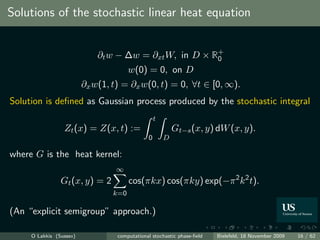
Solutions of the stochastic linear heat equation


                             ∂t w − ∆w = ∂xt W, in D × R+
                                                        0
                                       w(0) = 0, on D
                         ∂x w(1, t) = ∂x w(0, t) = 0, ∀t ∈ [0, ∞).
Solution is defined as Gaussian process produced by the stochastic integral
                                                  t
                 Zt (x) = Z(x, t) :=                      Gt−s (x, y) dW (x, y).
                                              0       D

where G is the heat kernel:
                                  ∞
                Gt (x, y) = 2          cos(πkx) cos(πky) exp(−π 2 k 2 t).
                                 k=0

(An “explicit semigroup” approach.)

     O Lakkis (Sussex)            computational stochastic phase-field   Bielefeld, 18 November 2009   16 / 62
Solutions of the stochastic Allen–Cahn problem


                                                   γ
∂t u(x, t) − ∆u(x, t) + f (u(x, t)) =                  ∂xt W (x, t), for x ∈ D = [0, 1], t ∈ [0, ∞
                              u(x, 0) = u0 (x), ∀x ∈ D
                         ∂x u(0, t) = ∂x u(1, t) = 0, ∀t ∈ R+ .

Defined as the continuous solution of integral equation
                                      t
                   u(x, t) = −                 Gt−s (x, y)f (u(y, s)) dy ds
                                  0        D
                                                                       γ
                             +            Gt (x, y)u0 (y) dy +             Zt (x).
                                  D

Unique continuous integral solution exists in 1d provided the initial
condition u0 fulfills boundary conditions.

     O Lakkis (Sussex)           computational stochastic phase-field       Bielefeld, 18 November 2009   17 / 62
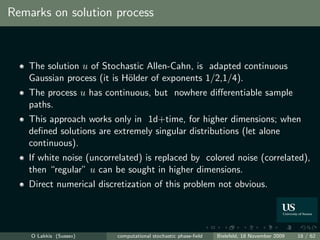
Remarks on solution process


   The solution u of Stochastic Allen-Cahn, is adapted continuous
   Gaussian process (it is H¨lder of exponents 1/2,1/4).
                            o
   The process u has continuous, but nowhere differentiable sample
   paths.
   This approach works only in 1d+time, for higher dimensions; when
   defined solutions are extremely singular distributions (let alone
   continuous).
   If white noise (uncorrelated) is replaced by colored noise (correlated),
   then “regular” u can be sought in higher dimensions.
   Direct numerical discretization of this problem not obvious.


    O Lakkis (Sussex)    computational stochastic phase-field   Bielefeld, 18 November 2009   18 / 62
Discretization strategy


In two main steps:
1.  Replace white noise ∂xt W by a smoother object: the approximate
                   ¯
   white noise ∂xt W .
                                               ¯
2. Discretize the approximate problem with ∂xt W via a finite element
   scheme for the Allen-Cahn equation.
Inspired by [Allen et al., 1998], [Yan, 2005].


     O Lakkis (Sussex)      computational stochastic phase-field   Bielefeld, 18 November 2009   19 / 62
Approximate White Noise (AWN)


Fix a final time T > 0 and consider uniform space and time partitions

in space:     D = [0, 1], Dm := (xm−1 , xm ), xm − xm−1 = σ, m ∈ [1 : M ] ,
    in time: I = [0, T ], In := [tn−1 , tn ), tn − tn−1 = ρ, n ∈ [1 : N ] .

Regularization of the white noise is projection on piecewise constants:
                                    1
                         ηm,n :=
                         ¯                       χm (x)ψn (t) dW (x, t).
                                   σρ    I   D
                                             N     N
                             ¯
                         ∂xt W (x, t) :=                 ηm,n χm (x)ϕn (t).
                                                         ¯
                                             n=1 m=1

χm = 1Dm , ϕn = 1In (characteristic functions).


     O Lakkis (Sussex)             computational stochastic phase-field   Bielefeld, 18 November 2009   20 / 62
Regularity of AWN


                                               N     N
                               ¯
                           ∂xt W (x, t) :=                 ηm,n χm (x)ϕn (t).
                                                           ¯
                                             n=1 m=1

ηm,n are independent N (0, 1/(σρ)) variables and
¯
                                              2                                                       2
   E                            ¯
                      f (x, t) dW (x, t)            ≤E                     f (x, t) dW (x, t)              .
              I   D                                               I    D
                                                                  2
                                 E                 ¯
                                                  dW (x, t)                =T
                                         I   D

                                             ¯              2                    1
                             E           ∂xt W (x, t)           dx dt ≤
                                 I   D                                          σρ


       O Lakkis (Sussex)             computational stochastic phase-field     Bielefeld, 18 November 2009       21 / 62
The regularized problem


                         ∂t u − ∆¯ + f (¯) =
                            ¯    u      u                γ       ¯
                                                             ∂xt W ,
                          ∂x u(t, 0) = ∂x u(t, 1) = 0,
                             ¯            ¯
                                    u(0) = u0 ,
                                    ¯
Admits a “classical” solution. ∀ω ∈ Ω ⇒ corresponding realization of the
          ¯
AWN ∂xt W (ω) ∈ L∞ ([0, T ] × D) (parabolic regularity) ⇒
∂t u(ω) ∈ L2 ([0, T ]; L2 (D)).
   ¯
⇒ variational formulation and thus FEM (or other standard methods) now
possible.
Error estimate schedule:
1. Compare u with u.
           ¯
2. Approximate u by U in a finite element space and compare.
               ¯


     O Lakkis (Sussex)      computational stochastic phase-field    Bielefeld, 18 November 2009   22 / 62
The Finite Element Method


   Parameters (numerical mesh) τ, h > 0 (approximation mesh) ρ, σ.
   Not necessary, but “natural” coupling: τ = ρ = h2 = σ 2 .
   Linearized Semi-Implicit Euler

                  U n − U n−1
                              , Φ + ∂x U n , ∂x Φ + f (U n−1 )U n , Φ
                       τ
       = f (U n−1 )U n−1 + f (U n−1 ), Φ + γ ∂xt W , Φ , ∀ Φ ∈ Vh .
                                                  ¯

   Vh is a finite element space of piecewise linear
   [Kessler et al., 2004, Feng and Wu, 2005].


    O Lakkis (Sussex)    computational stochastic phase-field   Bielefeld, 18 November 2009   23 / 62
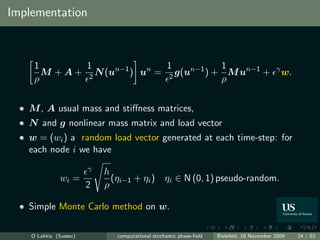
Implementation


     1         1                1           1
       M + A + 2 N (un−1 ) un = 2 g(un−1 ) + M un−1 +                                       γ
                                                                                                w.
     ρ                                      ρ


   M , A usual mass and stiffness matrices,
   N and g nonlinear mass matrix and load vector
   w = (wi ) a random load vector generated at each time-step: for
   each node i we have
                        γ   h
               wi =           (ηi−1 + ηi ) ηi ∈ N (0, 1) pseudo-random.
                        2   ρ

   Simple Monte Carlo method on w.

    O Lakkis (Sussex)          computational stochastic phase-field   Bielefeld, 18 November 2009     24 / 62
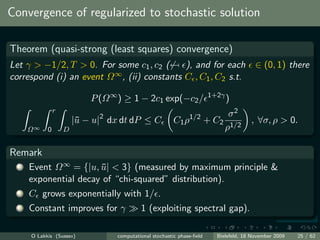
Convergence of regularized to stochastic solution

Theorem (quasi-strong (least squares) convergence)
Let γ > −1/2, T > 0. For some c1 , c2 (← ), and for each                                 ∈ (0, 1) there
correspond (i) an event Ω ∞ , (ii) constants C , C1 , C2 s.t.

                            P (Ω ∞ ) ≥ 1 − 2c1 exp(−c2 /                1+2γ
                                                                               )
                r
                                                                                σ2
                        |¯ − u|2 dx dt dP ≤ C
                         u                               C1 ρ1/2 + C2                  , ∀σ, ρ > 0.
      Ω∞    0       D                                                          ρ1/2

Remark
  1   Event Ω ∞ = {|u, u| < 3} (measured by maximum principle &
                       ¯
      exponential decay of “chi-squared” distribution).
  2   C grows exponentially with 1/ .
  3   Constant improves for γ              1 (exploiting spectral gap).

      O Lakkis (Sussex)           computational stochastic phase-field     Bielefeld, 18 November 2009   25 / 62
Maximum principle in probability sense

Lemma
Suppose γ > −1/2. Given T , there exist c1 , c2 , δ0 > 0 such that if
 u0 L∞ (D) ≤ 1 + δ0 then

                                                                                      1+2γ
            P       sup       (u, u)(t)
                                  ¯       L∞ (D)     >3        ≤ c1 exp(−c2 /                ).
                   t∈[0,T ]


Remark
  1   The constant 3 is for convenience, can be replaced by 1 + δ1 , if
      needed, by adjusting c1 , c2 and δ0 .
  2   This result is used to determine the event Ω ∞ for convergence to
      hold.
  3   Because, nonlinearity is not globally Lipschitz.

      O Lakkis (Sussex)             computational stochastic phase-field   Bielefeld, 18 November 2009   26 / 62
Small noise resolution (for γ big: weak intensity)


Theorem (small noise)
Let q solution of deterministic the Allen–Cahn problem

                      ∂t q − ∆q + f (q) = 0,                    q(0) = u0 , on D.

Then ∀ T > 0 : ∃ K1 (T ) > 0,                  0 (T )   >0

                                          3
  P        sup u − q
               ¯            L2 (D)   ≤
       [0,T ]
                                                                  T /(σρ)−1
                                           K1 (T )      6−2γ                              K1 (T )     6−2γ
                     ≥1− 1+                                                    exp −
                                             2                                              2

 for all     ∈ (0,   0 ),   γ > 3 and ρ, σ > 0.


      O Lakkis (Sussex)                  computational stochastic phase-field   Bielefeld, 18 November 2009   27 / 62
Spectrum estimate


Theorem ([Chen, 1994], [de Mottoni and Schatzman, 1995])
Let q be the (classical) solution of the problem

                         ∂t q − ∆q + f (q) = 0,              q(0) = u0 , on D

Key to argument in convergence for weak noise is the use of spectral
estimate for q: There exists a constant λ0 > 0 independent of such that
for any ∈ (0, 1] we have
                         2                                            2
              ∂x φ       L2 (D)   + f (q)φ, φ ≥ −λ0 φ                 L2 (D) ,   ∀φ H1 (D).


     O Lakkis (Sussex)               computational stochastic phase-field   Bielefeld, 18 November 2009   28 / 62
X(0, T ; L2 (D)) bounds for AWN

Lemma
∀K > 0


  P      sup              ¯
                      ∂xt W (t)            ≤K
                                  L2 (D)
       t∈[0,T ]
                                                                       1/(2σ)−1                            +
                                       T                K2                               K2
                                  ≥ 1−               1+    ρ                       exp −    ρ
                                       ρ                2                                2


                      T
                              ¯       2
  and P                   ∂xt W (t)   L2 (D)
                                               ≤ K2
                  0
                                                                            1/(2ρσ)−1
                                                      K2                                              K2
                                               ≥1− 1+                                     exp −
                                                      2                                               2

      O Lakkis (Sussex)               computational stochastic phase-field    Bielefeld, 18 November 2009   29 / 62
Convergence of FEM


Taking τ = ρ = h2 = σ 2 to simplify, we have

                                   |¯(tn ) − U n |2 dx dP ≤ C(T, )h.
                                    u
                          Ω∞   D


Remark
  1   compare w.r.t. deterministic case,
  2   impossible to take E, but only                Ω∞ ,    due to rare events.


      O Lakkis (Sussex)             computational stochastic phase-field   Bielefeld, 18 November 2009   30 / 62
Regularity of u
              ¯


Theorem (Regularity of u)
                       ¯

                                        |∂t u|2 dx dt ≤ c1 ρ−1/2 + c2 σ −1
                                            ¯
                          Ω∞   Im   D

                                    |∆¯|2 dx ≤ c3 ρ−3/2 + c4 σ −1 ρ−1 .
                                      u
                          Ω∞    D
For   Ω∞   an event of high probability.

Remark
Expected loss of regularity, as σ, ρ → 0.


      O Lakkis (Sussex)              computational stochastic phase-field   Bielefeld, 18 November 2009   31 / 62
Numerical experiments


 1   Computations for = 0.04, 0.02, 0.01 and γ = 1.0, 0.5, 0.2, 0.0, −0.2
     (γ < 0 though not discussed in theory can be interesting in practice).
 2   Run a Monte-Carlo simulation for each set of parameters (2500
     samples).
 3   Meshsize h < .
 4   Timestep τ = c0 h2 ≈    2.


     O Lakkis (Sussex)      computational stochastic phase-field   Bielefeld, 18 November 2009   32 / 62
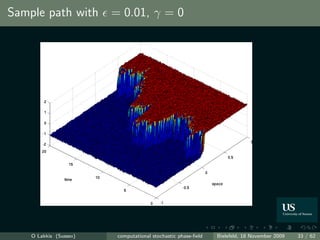
Sample path with = 0.01, γ = 0


    O Lakkis (Sussex)   computational stochastic phase-field   Bielefeld, 18 November 2009   33 / 62
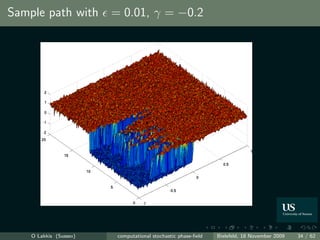
Sample path with = 0.01, γ = −0.2


    O Lakkis (Sussex)   computational stochastic phase-field   Bielefeld, 18 November 2009   34 / 62
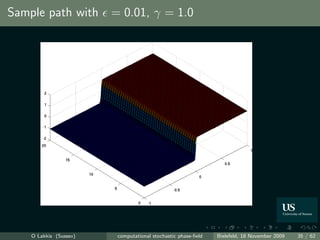
Sample path with = 0.01, γ = 1.0


    O Lakkis (Sussex)   computational stochastic phase-field   Bielefeld, 18 November 2009   35 / 62
How to the benchmark our computations?

Benchmarking = “comparing with known solutions” Very few known
“exact result”.
Theorem ( [Funaki, 1995, Brassesco et al., 1995])
The interface motion is asymptotically, as                      → 0, a (1d) Brownian motion,


               lim P          sup         ˜          ˜
                                          ut − q(x − ξt )                     >δ        = 0,
                →0       t≤   −1−2γ T                               L2 (D)


for δ > 0.

Remark
    q is an instanton for the deterministic Allen-Cahn equation
     ˜
     ξt solves a SODE representing the motion of the interface
    ut (x) is an appropriate rescaling of u(x, t).
    ˜

     O Lakkis (Sussex)              computational stochastic phase-field      Bielefeld, 18 November 2009   36 / 62
Benchmarking
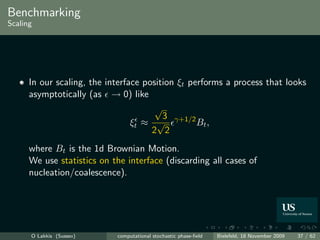
Scaling


      In our scaling, the interface position ξt performs a process that looks
      asymptotically (as → 0) like
                                       √
                                         3
                                 ξt ≈ √ γ+1/2 Bt ,
                                      2 2
      where Bt is the 1d Brownian Motion.
      We use statistics on the interface (discarding all cases of
      nucleation/coalescence).


      O Lakkis (Sussex)     computational stochastic phase-field   Bielefeld, 18 November 2009   37 / 62
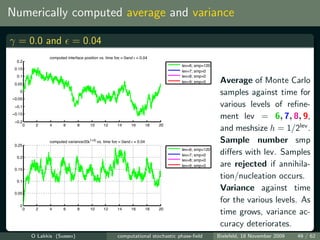
Numerically computed average and variance

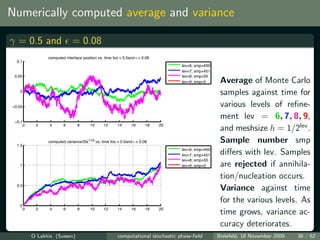
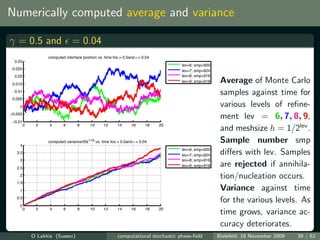
γ = 0.5 and = 0.08
                  computed interface position vs. time for = 0.5and ε = 0.08
                                                         γ
  0.1
                                                                                    lev=6; smp=450
                                                                                    lev=7; smp=451
 0.05                                                                               lev=8; smp=55
                                                                                    lev=9; smp=0      Average of Monte Carlo
   0
                                                                                                      samples against time for
−0.05                                                                                                 various levels of refine-
                                                                                                      ment lev = 6, 7, 8, 9,
 −0.1
        0    2     4      6       8       10      12      14      16      18   20
                                                                                                      and meshsize h = 1/2lev .
  1.5
                  computed variance/20ε1+2γ vs. time forγ = 0.5and ε = 0.08                           Sample number smp
                                                                                    lev=6; smp=450
                                                                                    lev=7; smp=451    differs with lev. Samples
                                                                                    lev=8; smp=55
   1                                                                                lev=9; smp=0      are rejected if annihila-
                                                                                                      tion/nucleation occurs.
  0.5
                                                                                                      Variance against time
                                                                                                      for the various levels. As
   0
        0    2     4      6       8       10      12      14      16      18   20
                                                                                                      time grows, variance ac-
                                                                                                      curacy deteriorates.
            O Lakkis (Sussex)                             computational stochastic phase-field        Bielefeld, 18 November 2009   38 / 62
Numerically computed average and variance

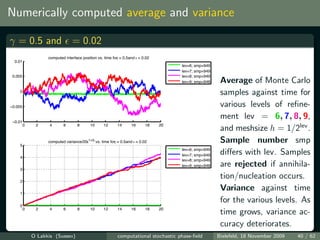
γ = 0.5 and = 0.04
                   computed interface position vs. time for = 0.5and ε = 0.04
                                                          γ
  0.03
                                                                                     lev=6; smp=920
 0.025                                                                               lev=7; smp=924
  0.02                                                                               lev=8; smp=918

 0.015
                                                                                     lev=9; smp=918    Average of Monte Carlo
  0.01
                                                                                                       samples against time for
 0.005
    0                                                                                                  various levels of refine-
−0.005
                                                                                                       ment lev = 6, 7, 8, 9,
 −0.01
         0    2     4      6       8       10      12      14      16      18   20
                                                                                                       and meshsize h = 1/2lev .
    4
                   computed variance/20ε1+2γ vs. time forγ = 0.5and ε = 0.04                           Sample number smp
                                                                                     lev=6; smp=920
   3.5
                                                                                     lev=7; smp=924    differs with lev. Samples
    3                                                                                lev=8; smp=918
   2.5
                                                                                     lev=9; smp=918    are rejected if annihila-
    2                                                                                                  tion/nucleation occurs.
   1.5
    1                                                                                                  Variance against time
   0.5
                                                                                                       for the various levels. As
    0
         0    2     4      6       8       10      12      14      16      18   20
                                                                                                       time grows, variance ac-
                                                                                                       curacy deteriorates.
             O Lakkis (Sussex)                             computational stochastic phase-field        Bielefeld, 18 November 2009   39 / 62
Numerically computed average and variance

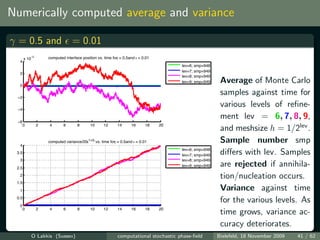
γ = 0.5 and = 0.02
                   computed interface position vs. time for = 0.5and ε = 0.02
                                                          γ
  0.01
                                                                                     lev=6; smp=949
                                                                                     lev=7; smp=949
 0.005                                                                               lev=8; smp=949
                                                                                     lev=9; smp=948    Average of Monte Carlo
    0
                                                                                                       samples against time for
−0.005                                                                                                 various levels of refine-
                                                                                                       ment lev = 6, 7, 8, 9,
 −0.01
         0    2     4      6       8       10      12      14      16      18   20
                                                                                                       and meshsize h = 1/2lev .
    5
                   computed variance/20ε1+2γ vs. time forγ = 0.5and ε = 0.02                           Sample number smp
                                                                                     lev=6; smp=949
    4
                                                                                     lev=7; smp=949    differs with lev. Samples
                                                                                     lev=8; smp=949

    3
                                                                                     lev=9; smp=948    are rejected if annihila-
    2
                                                                                                       tion/nucleation occurs.
    1
                                                                                                       Variance against time
                                                                                                       for the various levels. As
    0
         0    2     4      6       8       10      12      14      16      18   20
                                                                                                       time grows, variance ac-
                                                                                                       curacy deteriorates.
             O Lakkis (Sussex)                             computational stochastic phase-field        Bielefeld, 18 November 2009   40 / 62
Numerically computed average and variance

γ = 0.5 and = 0.01
           −3
       x 10         computed interface position vs. time for = 0.5and ε = 0.01
                                                           γ
  4
                                                                                      lev=6; smp=948
                                                                                      lev=7; smp=949
  2
                                                                                      lev=8; smp=949

  0
                                                                                      lev=9; smp=949    Average of Monte Carlo
 −2
                                                                                                        samples against time for
 −4
                                                                                                        various levels of refine-
                                                                                                        ment lev = 6, 7, 8, 9,
 −6
       0        2    4      6       8       10      12      14      16      18   20
                                                                                                        and meshsize h = 1/2lev .
  4
                    computed variance/20ε1+2γ vs. time forγ = 0.5and ε = 0.01                           Sample number smp
                                                                                      lev=6; smp=948
 3.5
                                                                                      lev=7; smp=949    differs with lev. Samples
  3                                                                                   lev=8; smp=949
 2.5
                                                                                      lev=9; smp=949    are rejected if annihila-
  2                                                                                                     tion/nucleation occurs.
 1.5
  1                                                                                                     Variance against time
 0.5
                                                                                                        for the various levels. As
  0
       0        2    4      6       8       10      12      14      16      18   20
                                                                                                        time grows, variance ac-
                                                                                                        curacy deteriorates.
              O Lakkis (Sussex)                             computational stochastic phase-field        Bielefeld, 18 November 2009   41 / 62
Simulations vs. theory

log(var[Uh ] /ti ) vs. log plot for γ = 0.5 at various times ti = t0 10i
         i

                              log(ε)−log(σ(t)2/t) and log(ε)*(1+2*γ) for γ=0.5
  −2
           ref. slope=1+2*γ
           time 0.00152587
  −3       time 0.0152587
           time 0.152587
           time 1.52587
           time 15.2587
  −4


  −5                                                                                          Theoretical          slope
                                                                                              (predicted              by
  −6
                                                                                              [Funaki, 1995]         and
  −7                                                                                          [Brassesco et al., 1995])
                                                                                              is 1 + 2γ.
  −8
                                                                                              Plotted in orange refer-
  −9                                                                                          ence line
                                                                                              As      → 0 slope im-
 −10
   −5              −4.5              −4                    −3.5                  −3   −2.5
                                                                                              proves.
                                                                                              Meshsize h = 1/512.
        O Lakkis (Sussex)                           computational stochastic phase-field      Bielefeld, 18 November 2009   42 / 62
Numerically computed average and variance

γ = 0.2 and = 0.08
                   computed interface position vs. time for = 0.2and ε = 0.08
                                                          γ
  0.4
                                                                                     lev=6; smp=19
  0.3
                                                                                     lev=7; smp=0
  0.2                                                                                lev=8; smp=0
  0.1
                                                                                     lev=9; smp=0     Average of Monte Carlo
   0
                                                                                                      samples against time for
 −0.1
 −0.2                                                                                                 various levels of refine-
 −0.3
                                                                                                      ment lev = 6, 7, 8, 9,
 −0.4
        0    2     4       6       8       10      12      14      16      18   20
                                                                                                      and meshsize h = 1/2lev .
  0.5
                   computed variance/20ε1+2γ vs. time forγ = 0.2and ε = 0.08                          Sample number smp
                                                                                     lev=6; smp=19
  0.4
                                                                                     lev=7; smp=0     differs with lev. Samples
                                                                                     lev=8; smp=0

  0.3
                                                                                     lev=9; smp=0     are rejected if annihila-
  0.2
                                                                                                      tion/nucleation occurs.
  0.1
                                                                                                      Variance against time
                                                                                                      for the various levels. As
   0
        0    2     4       6       8       10      12      14      16      18   20
                                                                                                      time grows, variance ac-
                                                                                                      curacy deteriorates.
            O Lakkis (Sussex)                             computational stochastic phase-field        Bielefeld, 18 November 2009   43 / 62
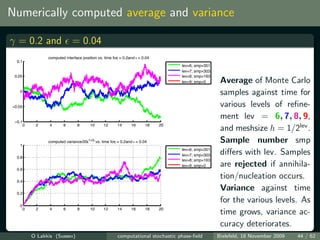
Numerically computed average and variance

γ = 0.2 and = 0.04
                  computed interface position vs. time for = 0.2and ε = 0.04
                                                         γ
  0.1
                                                                                    lev=6; smp=351
                                                                                    lev=7; smp=303
 0.05                                                                               lev=8; smp=163
                                                                                    lev=9; smp=0      Average of Monte Carlo
   0
                                                                                                      samples against time for
−0.05                                                                                                 various levels of refine-
                                                                                                      ment lev = 6, 7, 8, 9,
 −0.1
        0    2     4      6       8       10      12      14      16      18   20
                                                                                                      and meshsize h = 1/2lev .
   1
                  computed variance/20ε1+2γ vs. time forγ = 0.2and ε = 0.04                           Sample number smp
                                                                                    lev=6; smp=351
  0.8
                                                                                    lev=7; smp=303    differs with lev. Samples
                                                                                    lev=8; smp=163

  0.6
                                                                                    lev=9; smp=0      are rejected if annihila-
  0.4
                                                                                                      tion/nucleation occurs.
  0.2
                                                                                                      Variance against time
                                                                                                      for the various levels. As
   0
        0    2     4      6       8       10      12      14      16      18   20
                                                                                                      time grows, variance ac-
                                                                                                      curacy deteriorates.
            O Lakkis (Sussex)                             computational stochastic phase-field        Bielefeld, 18 November 2009   44 / 62
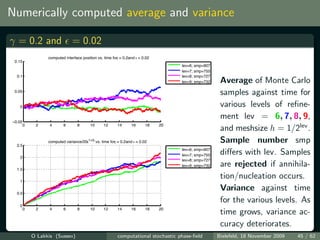
Numerically computed average and variance

γ = 0.2 and = 0.02
                  computed interface position vs. time for = 0.2and ε = 0.02
                                                         γ
 0.15
                                                                                    lev=6; smp=907
                                                                                    lev=7; smp=755
  0.1                                                                               lev=8; smp=727
                                                                                    lev=9; smp=732    Average of Monte Carlo
 0.05
                                                                                                      samples against time for
   0                                                                                                  various levels of refine-
                                                                                                      ment lev = 6, 7, 8, 9,
−0.05
        0    2     4      6       8       10      12      14      16      18   20
                                                                                                      and meshsize h = 1/2lev .
  2.5
                  computed variance/20ε1+2γ vs. time forγ = 0.2and ε = 0.02                           Sample number smp
                                                                                    lev=6; smp=907
   2
                                                                                    lev=7; smp=755    differs with lev. Samples
                                                                                    lev=8; smp=727

  1.5
                                                                                    lev=9; smp=732    are rejected if annihila-
   1
                                                                                                      tion/nucleation occurs.
  0.5
                                                                                                      Variance against time
                                                                                                      for the various levels. As
   0
        0    2     4      6       8       10      12      14      16      18   20
                                                                                                      time grows, variance ac-
                                                                                                      curacy deteriorates.
            O Lakkis (Sussex)                             computational stochastic phase-field        Bielefeld, 18 November 2009   45 / 62
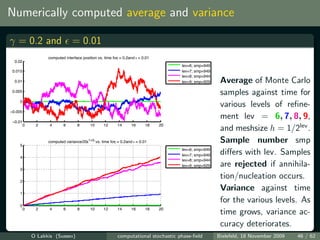
Numerically computed average and variance

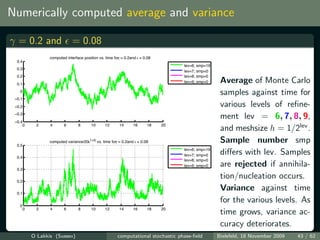
γ = 0.2 and = 0.01
                   computed interface position vs. time for = 0.2and ε = 0.01
                                                          γ
  0.02
                                                                                     lev=6; smp=949
 0.015                                                                               lev=7; smp=949
                                                                                     lev=8; smp=944
  0.01                                                                               lev=9; smp=929    Average of Monte Carlo
 0.005
                                                                                                       samples against time for
    0
                                                                                                       various levels of refine-
−0.005
                                                                                                       ment lev = 6, 7, 8, 9,
 −0.01
         0    2     4      6       8       10      12      14      16      18   20
                                                                                                       and meshsize h = 1/2lev .
    5
                   computed variance/20ε1+2γ vs. time forγ = 0.2and ε = 0.01                           Sample number smp
                                                                                     lev=6; smp=949
    4
                                                                                     lev=7; smp=949    differs with lev. Samples
                                                                                     lev=8; smp=944

    3
                                                                                     lev=9; smp=929    are rejected if annihila-
    2
                                                                                                       tion/nucleation occurs.
    1
                                                                                                       Variance against time
                                                                                                       for the various levels. As
    0
         0    2     4      6       8       10      12      14      16      18   20
                                                                                                       time grows, variance ac-
                                                                                                       curacy deteriorates.
             O Lakkis (Sussex)                             computational stochastic phase-field        Bielefeld, 18 November 2009   46 / 62
Simulations vs. theory

log(var[Uh ] /ti ) vs. log plot for γ = 0.2 at various times ti = t0 10i
         i

                              log(ε)−log(σ(t)2/t) and log(ε)*(1+2*γ) for γ=0.2
  0
           ref. slope=1+2*γ
           time 0.00152587
           time 0.0152587
  −1       time 0.152587
           time 1.52587
           time 15.2587

  −2


                                                                                              Theoretical          slope
  −3
                                                                                              (predicted              by
  −4
                                                                                              [Funaki, 1995]         and
                                                                                              [Brassesco et al., 1995])
  −5                                                                                          is 1 + 2γ.
                                                                                              Plotted in orange refer-
  −6
                                                                                              ence line
                                                                                              As      → 0 slope im-
  −7
   −5              −4.5              −4                    −3.5                  −3   −2.5
                                                                                              proves.
                                                                                              Meshsize h = 1/512.
        O Lakkis (Sussex)                           computational stochastic phase-field      Bielefeld, 18 November 2009   47 / 62
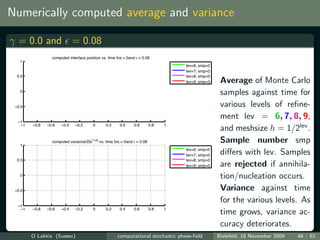
Numerically computed average and variance

γ = 0.0 and = 0.08
                 computed interface position vs. time for = 0and ε = 0.08
                                                        γ
   1
                                                                                     lev=6; smp=0
                                                                                     lev=7; smp=0
  0.5                                                                                lev=8; smp=0
                                                                                     lev=9; smp=0    Average of Monte Carlo
   0
                                                                                                     samples against time for
 −0.5                                                                                                various levels of refine-
                                                                                                     ment lev = 6, 7, 8, 9,
  −1
   −1   −0.8   −0.6   −0.4    −0.2      0       0.2     0.4     0.6        0.8   1
                                                                                                     and meshsize h = 1/2lev .
   1
                 computed variance/20ε1+2γ vs. time forγ = 0and ε = 0.08                             Sample number smp
                                                                                     lev=6; smp=0
                                                                                     lev=7; smp=0    differs with lev. Samples
  0.5                                                                                lev=8; smp=0
                                                                                     lev=9; smp=0    are rejected if annihila-
   0                                                                                                 tion/nucleation occurs.
 −0.5                                                                                                Variance against time
                                                                                                     for the various levels. As
  −1
   −1   −0.8   −0.6   −0.4    −0.2      0       0.2     0.4     0.6        0.8   1
                                                                                                     time grows, variance ac-
                                                                                                     curacy deteriorates.
        O Lakkis (Sussex)                             computational stochastic phase-field           Bielefeld, 18 November 2009   48 / 62
Numerically computed average and variance

γ = 0.0 and = 0.04
                   computed interface position vs. time for = 0and ε = 0.04
                                                          γ
  0.2
                                                                                       lev=6; smp=120
 0.15
                                                                                       lev=7; smp=0
  0.1                                                                                  lev=8; smp=0
 0.05
                                                                                       lev=9; smp=0      Average of Monte Carlo
   0
                                                                                                         samples against time for
−0.05
 −0.1                                                                                                    various levels of refine-
−0.15
                                                                                                         ment lev = 6, 7, 8, 9,
 −0.2
        0    2     4      6       8       10      12      14      16         18   20
                                                                                                         and meshsize h = 1/2lev .
 0.25
                   computed variance/20ε1+2γ vs. time forγ = 0and ε = 0.04                               Sample number smp
                                                                                       lev=6; smp=120
  0.2
                                                                                       lev=7; smp=0      differs with lev. Samples
                                                                                       lev=8; smp=0

 0.15
                                                                                       lev=9; smp=0      are rejected if annihila-
  0.1
                                                                                                         tion/nucleation occurs.
 0.05
                                                                                                         Variance against time
                                                                                                         for the various levels. As
   0
        0    2     4      6       8       10      12      14      16         18   20
                                                                                                         time grows, variance ac-
                                                                                                         curacy deteriorates.
            O Lakkis (Sussex)                             computational stochastic phase-field           Bielefeld, 18 November 2009   49 / 62
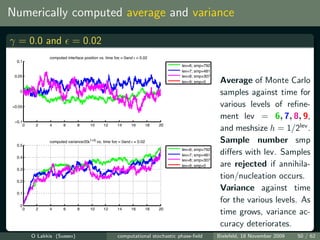
Numerically computed average and variance

γ = 0.0 and = 0.02
                   computed interface position vs. time for = 0and ε = 0.02
                                                          γ
  0.1
                                                                                       lev=6; smp=792
                                                                                       lev=7; smp=481
 0.05                                                                                  lev=8; smp=307
                                                                                       lev=9; smp=0      Average of Monte Carlo
   0
                                                                                                         samples against time for
−0.05                                                                                                    various levels of refine-
                                                                                                         ment lev = 6, 7, 8, 9,
 −0.1
        0    2     4      6       8       10      12      14      16         18   20
                                                                                                         and meshsize h = 1/2lev .
  0.5
                   computed variance/20ε1+2γ vs. time forγ = 0and ε = 0.02                               Sample number smp
                                                                                       lev=6; smp=792
  0.4
                                                                                       lev=7; smp=481    differs with lev. Samples
                                                                                       lev=8; smp=307

  0.3
                                                                                       lev=9; smp=0      are rejected if annihila-
  0.2
                                                                                                         tion/nucleation occurs.
  0.1
                                                                                                         Variance against time
                                                                                                         for the various levels. As
   0
        0    2     4      6       8       10      12      14      16         18   20
                                                                                                         time grows, variance ac-
                                                                                                         curacy deteriorates.
            O Lakkis (Sussex)                             computational stochastic phase-field           Bielefeld, 18 November 2009   50 / 62
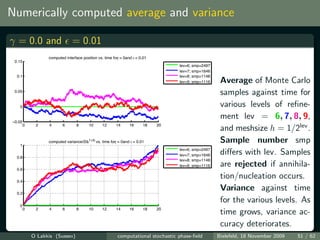
Numerically computed average and variance

γ = 0.0 and = 0.01
                  computed interface position vs. time for = 0and ε = 0.01
                                                         γ
 0.15
                                                                                  lev=6; smp=2497
                                                                                  lev=7; smp=1646
  0.1                                                                             lev=8; smp=1148
                                                                                  lev=9; smp=1116    Average of Monte Carlo
 0.05
                                                                                                     samples against time for
   0                                                                                                 various levels of refine-
                                                                                                     ment lev = 6, 7, 8, 9,
−0.05
        0    2    4      6       8       10     12      14      16      18   20
                                                                                                     and meshsize h = 1/2lev .
   1
                  computed variance/20ε1+2γ vs. time forγ = 0and ε = 0.01                            Sample number smp
                                                                                  lev=6; smp=2497
  0.8
                                                                                  lev=7; smp=1646    differs with lev. Samples
                                                                                  lev=8; smp=1148

  0.6
                                                                                  lev=9; smp=1116    are rejected if annihila-
  0.4
                                                                                                     tion/nucleation occurs.
  0.2
                                                                                                     Variance against time
                                                                                                     for the various levels. As
   0
        0    2    4      6       8       10     12      14      16      18   20
                                                                                                     time grows, variance ac-
                                                                                                     curacy deteriorates.
            O Lakkis (Sussex)                            computational stochastic phase-field        Bielefeld, 18 November 2009   51 / 62
Simulations vs. theory

log(var[Uh ] /ti ) vs. log plot for γ = 0.0 at various times ti = t0 10i
         i

                              log(ε)−log(σ(t)2/t) and log(ε)*(1+2*γ) for γ=0
   0
           ref. slope=1+2*γ
           time 0.00152587
 −0.5
           time 0.0152587
           time 0.152587
  −1       time 1.52587
           time 15.2587

 −1.5


  −2
                                                                                             Theoretical          slope
                                                                                             (predicted              by
 −2.5
                                                                                             [Funaki, 1995]         and
  −3
                                                                                             [Brassesco et al., 1995])
 −3.5
                                                                                             is 1 + 2γ.
  −4                                                                                         Plotted in orange refer-
 −4.5
                                                                                             ence line
                                                                                             As      → 0 slope im-
  −5
   −5              −4.5             −4                    −3.5                 −3    −2.5
                                                                                             proves.
                                                                                             Meshsize h = 1/512.
        O Lakkis (Sussex)                          computational stochastic phase-field      Bielefeld, 18 November 2009   52 / 62
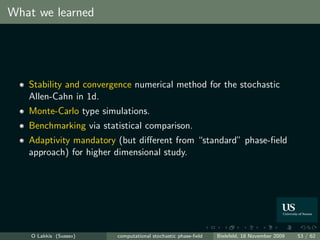
What we learned


   Stability and convergence numerical method for the stochastic
   Allen-Cahn in 1d.
   Monte-Carlo type simulations.
   Benchmarking via statistical comparison.
   Adaptivity mandatory (but different from “standard” phase-field
   approach) for higher dimensional study.


    O Lakkis (Sussex)   computational stochastic phase-field   Bielefeld, 18 November 2009   53 / 62
What we’re trying to learn


Current investigation [Kossioris et al., 2009]
     finite     “exact” solutions
     multiple interface convergence
     structure of the stochastic solution
     colored noise in d > 1
     adaptivity


     O Lakkis (Sussex)        computational stochastic phase-field   Bielefeld, 18 November 2009   54 / 62
What still needs to be learned


    Extension to Cahn-Hilliard type equations, Phase-Field, Dendrites.
    Other stochastic applications
    Chaos Expansion
    Kolmogorov (Fokker-Plank) equations
    Sparse methods


    O Lakkis (Sussex)     computational stochastic phase-field   Bielefeld, 18 November 2009   55 / 62
References I


   Allen, E. J., Novosel, S. J., and Zhang, Z. (1998).
   Finite element and difference approximation of some linear stochastic
   partial differential equations.
   Stochastics Stochastics Rep., 64(1-2):117–142.
   Allen, S. M. and Cahn, J. (1979).
   A macroscopic theory for antiphase boundary motion and its
   application to antiphase domain coarsening.
   Acta Metal. Mater., 27(6):1085–1095.
   Brassesco, S., De Masi, A., and Presutti, E. (1995).
   Brownian fluctuations of the interface in the D = 1 Ginzburg-Landau
   equation with noise.
   Ann. Inst. H. Poincar´ Probab. Statist., 31(1):81–118.
                        e


    O Lakkis (Sussex)    computational stochastic phase-field   Bielefeld, 18 November 2009   56 / 62
References II

   Bronsard, L. and Kohn, R. V. (1990).
   On the slowness of phase boundary motion in one space dimension.
   Comm. Pure Appl. Math., 43(8):983–997.
   Cahn, J. W. and Hilliard, J. E. (1958).
   Free energy of a nonuniform system. I. Interfacial free energy.
   Journal of Chemical Physics, 28(2):258–267.
   Carr, J. and Pego, R. L. (1989).
   Metastable patterns in solutions of ut = 2 uxx − f (u).
   Comm. Pure Appl. Math., 42(5):523–576.
   Chen, X. (1994).
   Spectrum for the Allen-Cahn, Cahn-Hilliard, and phase-field equations
   for generic interfaces.
   Comm. Partial Differential Equations, 19(7-8):1371–1395.

    O Lakkis (Sussex)     computational stochastic phase-field   Bielefeld, 18 November 2009   57 / 62
References III


   de Mottoni, P. and Schatzman, M. (1995).
   Geometrical evolution of developed interfaces.
   Trans. Amer. Math. Soc., 347(5):1533–1589.
   Dirr, N., Luckhaus, S., and Novaga, M. (2001).
   A stochastic selection principle in case of fattening for curvature flow.
   Calc. Var. Partial Differential Equations, 13(4):405–425.
   Evans, L. C., Soner, H. M., and Souganidis, P. E. (1992).
   Phase transitions and generalized motion by mean curvature.
   Comm. Pure Appl. Math., 45(9):1097–1123.
   Faris, W. G. and Jona-Lasinio, G. (1982).
   Large fluctuations for a nonlinear heat equation with noise.
   J. Phys. A, 15:3025–3055.


    O Lakkis (Sussex)     computational stochastic phase-field   Bielefeld, 18 November 2009   58 / 62
References IV


   Fatkullin, I. and Vanden-Eijnden, E. (2004).
   Coarsening by di usion-annihilation in a bistable system driven by
   noise.
   Preprint, Courant Institute, New York University, New York, NY
   10012.
   Feng, X. and Wu, H.-j. (2005).
   A posteriori error estimates and an adaptive finite element method for
   the Allen-Cahn equation and the mean curvature flow.
   Journal of Scientific Computing, 24(2):121–146.
   Funaki, T. (1995).
   The scaling limit for a stochastic PDE and the separation of phases.
   Probab. Theory Relat. Fields, 102:221–288.


    O Lakkis (Sussex)    computational stochastic phase-field   Bielefeld, 18 November 2009   59 / 62
References V


   Funaki, T. (1999).
   Singular limit for stochastic reaction-diffusion equation and generation
   of random interfaces.
   Acta Math. Sin. (Engl. Ser.), 15(3):407–438.
   Fusco, G. and Hale, J. K. (1989).
   Slow-motion manifolds, dormant instability, and singular
   perturbations.
   J. Dynam. Differential Equations, 1(1):75–94.
   Katsoulakis, M. A. and Szepessy, A. (2006).
   Stochastic hydrodynamical limits of particle systems.
   Commun. Math. Sci., 4(3):513–549.


    O Lakkis (Sussex)    computational stochastic phase-field   Bielefeld, 18 November 2009   60 / 62
References VI


   Kessler, D., Nochetto, R. H., and Schmidt, A. (2004).
   A posteriori error control for the Allen-Cahn problem: Circumventing
   Gronwall’s inequality.
   M2AN Math. Model. Numer. Anal., 38(1):129–142.
   Kossioris, G., Lakkis, O., and Romito, M. (In preparation 2009).
   Interface dynamics for the stochastic Allen–Cahn model: asymptotics
   and computations.
   Technical report.
   Liu, D. (2003).
   Convergence of the spectral method for stochastic Ginzburg-Landau
   equation driven by space-time white noise.
   Commun. Math. Sci., 1(2):361–375.


    O Lakkis (Sussex)    computational stochastic phase-field   Bielefeld, 18 November 2009   61 / 62
References VII

   Lythe, G. (1998).
   Stochastic PDEs: domain formation in dynamic transitions.
   In Proceedings of the VIII Reuni´n de F´
                                   o        ısica Estad´
                                                       ıstica, FISES ’97,
   volume 4, pages 55—63. Anales de F´  ısica, Monograf´ RSEF.
                                                          ıas
   Nestler, B., Danilov, D., and Galenko, P. (2005).
   Crystal growth of pure substances: phase-field simulations in
   comparison with analytical and experimental results.
   J. Comput. Phys., 207(1):221–239.
   Rubinstein, J., Sternberg, P., and Keller, J. B. (1989).
   Fast reaction, slow diffusion, and curve shortening.
   SIAM J. Appl. Math., 49(1):116–133.
   Shardlow, T. (2000).
   Stochastic perturbations of the Allen-Cahn equation.
   Electron. J. Differential Equations, pages No. 47, 19 pp. (electronic).

    O Lakkis (Sussex)     computational stochastic phase-field   Bielefeld, 18 November 2009   62 / 62
References VIII


   Souganidis, P. E. and Yip, N. K. (2004).
   Uniqueness of motion by mean curvature perturbed by stochastic
   noise.
   Ann. Inst. H. Poincar´ Anal. Non Lin´aire, 21(1):1–23.
                        e              e
   Walsh, J. B. (1986).
   An introduction to stochastic partial differential equations.
      ´
   In Ecole d’´t´ de probabilit´s de Saint-Flour, XIV—1984, volume 1180
              ee               e
   of Lecture Notes in Math., pages 265–439. Springer, Berlin.
   Warren, J. and Boettinger, W. (1995).
   Prediction of dendritic growth and microsegregation in a binary alloy
   using the phase-field method.
   Acta Metall. Mater., 43(2):689–703.


    O Lakkis (Sussex)    computational stochastic phase-field   Bielefeld, 18 November 2009   63 / 62
References IX


   Yan, Y. (2005).
   Galerkin finite element methods for stochastic parabolic partial
   differential equations.
   SIAM J. Numer. Anal., 43(4):1363–1384 (electronic).


    O Lakkis (Sussex)    computational stochastic phase-field   Bielefeld, 18 November 2009   64 / 62

computational stochastic phase-field

  • 1.
    Some computational aspectsof stochastic phase-field models Omar Lakkis Mathematics – University of Sussex – Brighton, England UK based on joint work with M.Katsoulakis, G.Kossioris & M.Romito 17 November 2009 3rd Workshop On Random Dynamical Systems O Lakkis (Sussex) computational stochastic phase-field Bielefeld, 18 November 2009 1 / 62
  • 2.
    Outline 1 Motivation 2 Background 3 White noise 4 Numerical method 5 Convergence 6 Benchmarking 7 Conclusions 8 References O Lakkis (Sussex) computational stochastic phase-field Bielefeld, 18 November 2009 2 / 62
  • 3.
    Motivation Dendrites A real-life dendritelab picture: A phase-field simulation: O Lakkis (Sussex) computational stochastic phase-field Bielefeld, 18 November 2009 3 / 62
  • 4.
    Dendrites Computed dendrites withoutther- A computed dendrite with thermal mal noise [Nestler et al., 2005] noise [Nestler et al., 2005] O Lakkis (Sussex) computational stochastic phase-field Bielefeld, 18 November 2009 4 / 62
  • 5.
    Deterministic Phase Field following[Chen, 1994] Phase transition in solidification process α ∂t u − ∆u + (u3 − u)/ = σw (“interface” motion) c∂t w − ∆w = −∂t u (diffusion in bulk) , where  ≈ 1  solid phase, u : order parameter/phase field ∈ (−1 + δ , 1 − δ ) , interface (region)  ≈ −1 liquid phase.  w : temperature in liquid/solid bulk O Lakkis (Sussex) computational stochastic phase-field Bielefeld, 18 November 2009 5 / 62
  • 6.
    The Stochastic (orNoisy) Allen-Cahn Problem is the following semilinear parabolic stochastic PDE with additive white noise ∂t u(x, t) − ∆u(x, t) + f (u(x, t)) = γ ∂xt W (x, t), x ∈ (0, 1), t ∈ R+ . u(x, 0) = u0 (x), x ∈ (0, 1) ∂x u(0, t) = ∂x u(1, t) = 0, t ∈ R+ . 1 u f (ξ) = 2 ξ 3 − ξ : first f (u) 0 f derivative of double well potential −1 0 1 u ∈ R+ : “diffuse inter- face” parameter γ ∈ R: noise intensity pa- rameter ∂xt W : space-time white noise O Lakkis (Sussex) computational stochastic phase-field Bielefeld, 18 November 2009 6 / 62
  • 7.
    Why do wecare? about the (deterministic) Allen–Cahn 1 ∂t u − ∆u + 2 u3 − u = 0 Phase-separation models in metallurgy [Allen and Cahn, 1979]. Simplest model of more complicated class [Cahn and Hilliard, 1958]. Cubic nonlinearity approximation of “harder” (logarithmic) potential. Double obstacle can replace cubic by other. Phase-field models of phase separation and geometric motions [Rubinstein et al., 1989], [Evans et al., 1992], [Chen, 1994], [de Mottoni and Schatzman, 1995], . . . ; Metastability, exponentially slow motion in d = 1, [Carr and Pego, 1989], [Fusco and Hale, 1989], [Bronsard and Kohn, 1990]; O Lakkis (Sussex) computational stochastic phase-field Bielefeld, 18 November 2009 7 / 62
  • 8.
    Why do wecare? about the stochastic Allen–Cahn 1 ∂t u − ∆u + 2 u3 − u = γ ∂xt W Noise = stabilizing/destabilizing mechanism [Brassesco et al., 1995], [Funaki, 1995]. Stochastic 1d: Basic existence theory [Faris and Jona-Lasinio, 1982]. Stochastic MCF of interfaces colored space-time/time-only noises possible [Souganidis and Yip, 2004], [Funaki, 1999], [Dirr et al., 2001]. Rigorous mathematical setting to noise-induced dendrites. O Lakkis (Sussex) computational stochastic phase-field Bielefeld, 18 November 2009 8 / 62
  • 9.
    Why do wecare? Modeling and computation with stochastic Allen–Cahn Stochastic Allen–Cahn (aka Ginzburg–Landau) with noise in materials science: Modeling in phenomenological/lattice approximation, noise = unknown meso/micro-scopic fluctuation with known statistics effect in macroscopic scale [Halperin and Hoffman, 1977], [Katsoulakis and Szepessy, 2006, cf.]; Simulation noise as ad-hoc nucleation/instability inducing mechanism [Warren and Boettinger, 1995, Nestler et al., 2005, e.g.,]; Numerics for d = 1 SDE approach [Shardlow, 2000], spectral methods [Liu, 2003], interface nucleation/annihilation [Lythe, 1998, Fatkullin and Vanden-Eijnden, 2004]. Numerics for d ≥ 2 ? O Lakkis (Sussex) computational stochastic phase-field Bielefeld, 18 November 2009 9 / 62
  • 10.
    Deterministic Allen–Cahn in1 dimension metastability and profiles unstable eq y 1 PDE: ∂t u−∆u+ f (u) = 0, 0< 1, y = f (u) 2 1 1 potential: 2 f (ξ) = 2 ξ3 − ξ , 1 1 −1 0 u ODE (no diffusion): u = − ˙ 2 f (u) equilibriums: f (±1) = 0, f (0) = 0, ±1 stable − f (±1) < 0, linearize: 0 unstable − f (0) > 0. stable eqs O Lakkis (Sussex) computational stochastic phase-field Bielefeld, 18 November 2009 10 / 62
  • 11.
    Deterministic Allen–Cahn in1 dimension metastability and profiles 1 PDE: ∂t u−∆u+ 2 f (u) = 0, 0< 1, resolved profile u 1 1 3 potential: 2 f (ξ) = 2 ξ −ξ , 1 ξ1 ODE (no diffusion): u = − ˙ 2 f (u) ξ2 x equilibriums: f (±1) = 0, f (0) = 0, nonresolved profile ±1 stable − f (±1) < 0, linearize: 0 unstable − f (0) > 0. O Lakkis (Sussex) computational stochastic phase-field Bielefeld, 18 November 2009 10 / 62
  • 12.
    Deterministic Allen–Cahn in1 dimension resolved profiles terminology diffuse interface u O( ) thick profile’s center ξ x profile √ {(x,u): u≈tanh((x−ξ)/ 2)} O Lakkis (Sussex) computational stochastic phase-field Bielefeld, 18 November 2009 11 / 62
  • 13.
    Deterministic Allen–Cahn indimension d > 1 close relation to Mean Curvature Flow (MCF) Γ = {u = 0} v Level set Γ = {u = 0}, moves, as →0 a mean curvature flow: ∂t u|Γ − ∆ u|Γ + 1 (u3 − u) Γ = 0 ↓ ↓ ↓ H −v −H +0 = 0 normal −mean velocity curvature O Lakkis (Sussex) computational stochastic phase-field Bielefeld, 18 November 2009 12 / 62
  • 14.
    The Stochastic (orNoisy) Allen-Cahn Problem is the following semilinear parabolic stochastic PDE with additive white noise ∂t u(x, t) − ∆u(x, t) + f (u(x, t)) = γ ∂xt W (x, t), x ∈ (0, 1), t ∈ R+ . u(x, 0) = u0 (x), x ∈ (0, 1) ∂x u(0, t) = ∂x u(1, t) = 0, t ∈ R+ . 1 u f (ξ) = 2 ξ 3 − ξ : first f (u) 0 f derivative of double well potential −1 0 1 u ∈ R+ : “diffuse inter- face” parameter γ ∈ R: noise intensity pa- rameter ∂xt W : space-time white noise O Lakkis (Sussex) computational stochastic phase-field Bielefeld, 18 November 2009 13 / 62
  • 15.
    White noise ∂xtW : an informal definition Informally: white noise is mixed derivative of (2 dimensional) Brownian sheet W = Wx,t . Brownian sheet W : extension of 1-dim Brownian motion to multi-dim, built on Ω. Solutions of PDE understood as mild solution Notation for ∂xt W ∞ 1 ∞ 1 f (x, t) dW (x, t) := f (x, t)∂xt W (x, t) dx dt, 0 0 0 0 stochastic integral [Walsh, 1986]. O Lakkis (Sussex) computational stochastic phase-field Bielefeld, 18 November 2009 14 / 62
  • 16.
    White noise 101 ∀A ∈ Borel(R2 ) dW (x, t) =: W (A) ∈ N (0, |A|) , I.e, W (A) is a A 0-mean Gaussian random variable with variance = |A|. A ∩ B = ∅ ⇒ W (A),W (B) independent and W (A ∪ B) = W (A) + W (B). t x Brownian sheet: Wx,t = W ([0, t] × [0, x]) = dW (x, t). 0 0 Basic yet crucial property: 2 E f (x, t) dW (x, t) =E f (x, t)2 dx dt , ∀f ∈ L2 . I D I D √ (Aka dW = dx dt.) O Lakkis (Sussex) computational stochastic phase-field Bielefeld, 18 November 2009 15 / 62
  • 17.
    Solutions of thestochastic linear heat equation ∂t w − ∆w = ∂xt W, in D × R+ 0 w(0) = 0, on D ∂x w(1, t) = ∂x w(0, t) = 0, ∀t ∈ [0, ∞). Solution is defined as Gaussian process produced by the stochastic integral t Zt (x) = Z(x, t) := Gt−s (x, y) dW (x, y). 0 D where G is the heat kernel: ∞ Gt (x, y) = 2 cos(πkx) cos(πky) exp(−π 2 k 2 t). k=0 (An “explicit semigroup” approach.) O Lakkis (Sussex) computational stochastic phase-field Bielefeld, 18 November 2009 16 / 62
  • 18.
    Solutions of thestochastic Allen–Cahn problem γ ∂t u(x, t) − ∆u(x, t) + f (u(x, t)) = ∂xt W (x, t), for x ∈ D = [0, 1], t ∈ [0, ∞ u(x, 0) = u0 (x), ∀x ∈ D ∂x u(0, t) = ∂x u(1, t) = 0, ∀t ∈ R+ . Defined as the continuous solution of integral equation t u(x, t) = − Gt−s (x, y)f (u(y, s)) dy ds 0 D γ + Gt (x, y)u0 (y) dy + Zt (x). D Unique continuous integral solution exists in 1d provided the initial condition u0 fulfills boundary conditions. O Lakkis (Sussex) computational stochastic phase-field Bielefeld, 18 November 2009 17 / 62
  • 19.
    Remarks on solutionprocess The solution u of Stochastic Allen-Cahn, is adapted continuous Gaussian process (it is H¨lder of exponents 1/2,1/4). o The process u has continuous, but nowhere differentiable sample paths. This approach works only in 1d+time, for higher dimensions; when defined solutions are extremely singular distributions (let alone continuous). If white noise (uncorrelated) is replaced by colored noise (correlated), then “regular” u can be sought in higher dimensions. Direct numerical discretization of this problem not obvious. O Lakkis (Sussex) computational stochastic phase-field Bielefeld, 18 November 2009 18 / 62
  • 20.
    Discretization strategy In twomain steps: 1. Replace white noise ∂xt W by a smoother object: the approximate ¯ white noise ∂xt W . ¯ 2. Discretize the approximate problem with ∂xt W via a finite element scheme for the Allen-Cahn equation. Inspired by [Allen et al., 1998], [Yan, 2005]. O Lakkis (Sussex) computational stochastic phase-field Bielefeld, 18 November 2009 19 / 62
  • 21.
    Approximate White Noise(AWN) Fix a final time T > 0 and consider uniform space and time partitions in space: D = [0, 1], Dm := (xm−1 , xm ), xm − xm−1 = σ, m ∈ [1 : M ] , in time: I = [0, T ], In := [tn−1 , tn ), tn − tn−1 = ρ, n ∈ [1 : N ] . Regularization of the white noise is projection on piecewise constants: 1 ηm,n := ¯ χm (x)ψn (t) dW (x, t). σρ I D N N ¯ ∂xt W (x, t) := ηm,n χm (x)ϕn (t). ¯ n=1 m=1 χm = 1Dm , ϕn = 1In (characteristic functions). O Lakkis (Sussex) computational stochastic phase-field Bielefeld, 18 November 2009 20 / 62
  • 22.
    Regularity of AWN N N ¯ ∂xt W (x, t) := ηm,n χm (x)ϕn (t). ¯ n=1 m=1 ηm,n are independent N (0, 1/(σρ)) variables and ¯ 2 2 E ¯ f (x, t) dW (x, t) ≤E f (x, t) dW (x, t) . I D I D 2 E ¯ dW (x, t) =T I D ¯ 2 1 E ∂xt W (x, t) dx dt ≤ I D σρ O Lakkis (Sussex) computational stochastic phase-field Bielefeld, 18 November 2009 21 / 62
  • 23.
    The regularized problem ∂t u − ∆¯ + f (¯) = ¯ u u γ ¯ ∂xt W , ∂x u(t, 0) = ∂x u(t, 1) = 0, ¯ ¯ u(0) = u0 , ¯ Admits a “classical” solution. ∀ω ∈ Ω ⇒ corresponding realization of the ¯ AWN ∂xt W (ω) ∈ L∞ ([0, T ] × D) (parabolic regularity) ⇒ ∂t u(ω) ∈ L2 ([0, T ]; L2 (D)). ¯ ⇒ variational formulation and thus FEM (or other standard methods) now possible. Error estimate schedule: 1. Compare u with u. ¯ 2. Approximate u by U in a finite element space and compare. ¯ O Lakkis (Sussex) computational stochastic phase-field Bielefeld, 18 November 2009 22 / 62
  • 24.
    The Finite ElementMethod Parameters (numerical mesh) τ, h > 0 (approximation mesh) ρ, σ. Not necessary, but “natural” coupling: τ = ρ = h2 = σ 2 . Linearized Semi-Implicit Euler U n − U n−1 , Φ + ∂x U n , ∂x Φ + f (U n−1 )U n , Φ τ = f (U n−1 )U n−1 + f (U n−1 ), Φ + γ ∂xt W , Φ , ∀ Φ ∈ Vh . ¯ Vh is a finite element space of piecewise linear [Kessler et al., 2004, Feng and Wu, 2005]. O Lakkis (Sussex) computational stochastic phase-field Bielefeld, 18 November 2009 23 / 62
  • 25.
    Implementation 1 1 1 1 M + A + 2 N (un−1 ) un = 2 g(un−1 ) + M un−1 + γ w. ρ ρ M , A usual mass and stiffness matrices, N and g nonlinear mass matrix and load vector w = (wi ) a random load vector generated at each time-step: for each node i we have γ h wi = (ηi−1 + ηi ) ηi ∈ N (0, 1) pseudo-random. 2 ρ Simple Monte Carlo method on w. O Lakkis (Sussex) computational stochastic phase-field Bielefeld, 18 November 2009 24 / 62
  • 26.
    Convergence of regularizedto stochastic solution Theorem (quasi-strong (least squares) convergence) Let γ > −1/2, T > 0. For some c1 , c2 (← ), and for each ∈ (0, 1) there correspond (i) an event Ω ∞ , (ii) constants C , C1 , C2 s.t. P (Ω ∞ ) ≥ 1 − 2c1 exp(−c2 / 1+2γ ) r σ2 |¯ − u|2 dx dt dP ≤ C u C1 ρ1/2 + C2 , ∀σ, ρ > 0. Ω∞ 0 D ρ1/2 Remark 1 Event Ω ∞ = {|u, u| < 3} (measured by maximum principle & ¯ exponential decay of “chi-squared” distribution). 2 C grows exponentially with 1/ . 3 Constant improves for γ 1 (exploiting spectral gap). O Lakkis (Sussex) computational stochastic phase-field Bielefeld, 18 November 2009 25 / 62
  • 27.
    Maximum principle inprobability sense Lemma Suppose γ > −1/2. Given T , there exist c1 , c2 , δ0 > 0 such that if u0 L∞ (D) ≤ 1 + δ0 then 1+2γ P sup (u, u)(t) ¯ L∞ (D) >3 ≤ c1 exp(−c2 / ). t∈[0,T ] Remark 1 The constant 3 is for convenience, can be replaced by 1 + δ1 , if needed, by adjusting c1 , c2 and δ0 . 2 This result is used to determine the event Ω ∞ for convergence to hold. 3 Because, nonlinearity is not globally Lipschitz. O Lakkis (Sussex) computational stochastic phase-field Bielefeld, 18 November 2009 26 / 62
  • 28.
    Small noise resolution(for γ big: weak intensity) Theorem (small noise) Let q solution of deterministic the Allen–Cahn problem ∂t q − ∆q + f (q) = 0, q(0) = u0 , on D. Then ∀ T > 0 : ∃ K1 (T ) > 0, 0 (T ) >0 3 P sup u − q ¯ L2 (D) ≤ [0,T ] T /(σρ)−1 K1 (T ) 6−2γ K1 (T ) 6−2γ ≥1− 1+ exp − 2 2 for all ∈ (0, 0 ), γ > 3 and ρ, σ > 0. O Lakkis (Sussex) computational stochastic phase-field Bielefeld, 18 November 2009 27 / 62
  • 29.
    Spectrum estimate Theorem ([Chen,1994], [de Mottoni and Schatzman, 1995]) Let q be the (classical) solution of the problem ∂t q − ∆q + f (q) = 0, q(0) = u0 , on D Key to argument in convergence for weak noise is the use of spectral estimate for q: There exists a constant λ0 > 0 independent of such that for any ∈ (0, 1] we have 2 2 ∂x φ L2 (D) + f (q)φ, φ ≥ −λ0 φ L2 (D) , ∀φ H1 (D). O Lakkis (Sussex) computational stochastic phase-field Bielefeld, 18 November 2009 28 / 62
  • 30.
    X(0, T ;L2 (D)) bounds for AWN Lemma ∀K > 0 P sup ¯ ∂xt W (t) ≤K L2 (D) t∈[0,T ] 1/(2σ)−1 + T K2 K2 ≥ 1− 1+ ρ exp − ρ ρ 2 2 T ¯ 2 and P ∂xt W (t) L2 (D) ≤ K2 0 1/(2ρσ)−1 K2 K2 ≥1− 1+ exp − 2 2 O Lakkis (Sussex) computational stochastic phase-field Bielefeld, 18 November 2009 29 / 62
  • 31.
    Convergence of FEM Takingτ = ρ = h2 = σ 2 to simplify, we have |¯(tn ) − U n |2 dx dP ≤ C(T, )h. u Ω∞ D Remark 1 compare w.r.t. deterministic case, 2 impossible to take E, but only Ω∞ , due to rare events. O Lakkis (Sussex) computational stochastic phase-field Bielefeld, 18 November 2009 30 / 62
  • 32.
    Regularity of u ¯ Theorem (Regularity of u) ¯ |∂t u|2 dx dt ≤ c1 ρ−1/2 + c2 σ −1 ¯ Ω∞ Im D |∆¯|2 dx ≤ c3 ρ−3/2 + c4 σ −1 ρ−1 . u Ω∞ D For Ω∞ an event of high probability. Remark Expected loss of regularity, as σ, ρ → 0. O Lakkis (Sussex) computational stochastic phase-field Bielefeld, 18 November 2009 31 / 62
  • 33.
    Numerical experiments 1 Computations for = 0.04, 0.02, 0.01 and γ = 1.0, 0.5, 0.2, 0.0, −0.2 (γ < 0 though not discussed in theory can be interesting in practice). 2 Run a Monte-Carlo simulation for each set of parameters (2500 samples). 3 Meshsize h < . 4 Timestep τ = c0 h2 ≈ 2. O Lakkis (Sussex) computational stochastic phase-field Bielefeld, 18 November 2009 32 / 62
  • 34.
    Sample path with= 0.01, γ = 0 O Lakkis (Sussex) computational stochastic phase-field Bielefeld, 18 November 2009 33 / 62
  • 35.
    Sample path with= 0.01, γ = −0.2 O Lakkis (Sussex) computational stochastic phase-field Bielefeld, 18 November 2009 34 / 62
  • 36.
    Sample path with= 0.01, γ = 1.0 O Lakkis (Sussex) computational stochastic phase-field Bielefeld, 18 November 2009 35 / 62
  • 37.
    How to thebenchmark our computations? Benchmarking = “comparing with known solutions” Very few known “exact result”. Theorem ( [Funaki, 1995, Brassesco et al., 1995]) The interface motion is asymptotically, as → 0, a (1d) Brownian motion, lim P sup ˜ ˜ ut − q(x − ξt ) >δ = 0, →0 t≤ −1−2γ T L2 (D) for δ > 0. Remark q is an instanton for the deterministic Allen-Cahn equation ˜ ξt solves a SODE representing the motion of the interface ut (x) is an appropriate rescaling of u(x, t). ˜ O Lakkis (Sussex) computational stochastic phase-field Bielefeld, 18 November 2009 36 / 62
  • 38.
    Benchmarking Scaling In our scaling, the interface position ξt performs a process that looks asymptotically (as → 0) like √ 3 ξt ≈ √ γ+1/2 Bt , 2 2 where Bt is the 1d Brownian Motion. We use statistics on the interface (discarding all cases of nucleation/coalescence). O Lakkis (Sussex) computational stochastic phase-field Bielefeld, 18 November 2009 37 / 62
  • 39.
    Numerically computed averageand variance γ = 0.5 and = 0.08 computed interface position vs. time for = 0.5and ε = 0.08 γ 0.1 lev=6; smp=450 lev=7; smp=451 0.05 lev=8; smp=55 lev=9; smp=0 Average of Monte Carlo 0 samples against time for −0.05 various levels of refine- ment lev = 6, 7, 8, 9, −0.1 0 2 4 6 8 10 12 14 16 18 20 and meshsize h = 1/2lev . 1.5 computed variance/20ε1+2γ vs. time forγ = 0.5and ε = 0.08 Sample number smp lev=6; smp=450 lev=7; smp=451 differs with lev. Samples lev=8; smp=55 1 lev=9; smp=0 are rejected if annihila- tion/nucleation occurs. 0.5 Variance against time for the various levels. As 0 0 2 4 6 8 10 12 14 16 18 20 time grows, variance ac- curacy deteriorates. O Lakkis (Sussex) computational stochastic phase-field Bielefeld, 18 November 2009 38 / 62
  • 40.
    Numerically computed averageand variance γ = 0.5 and = 0.04 computed interface position vs. time for = 0.5and ε = 0.04 γ 0.03 lev=6; smp=920 0.025 lev=7; smp=924 0.02 lev=8; smp=918 0.015 lev=9; smp=918 Average of Monte Carlo 0.01 samples against time for 0.005 0 various levels of refine- −0.005 ment lev = 6, 7, 8, 9, −0.01 0 2 4 6 8 10 12 14 16 18 20 and meshsize h = 1/2lev . 4 computed variance/20ε1+2γ vs. time forγ = 0.5and ε = 0.04 Sample number smp lev=6; smp=920 3.5 lev=7; smp=924 differs with lev. Samples 3 lev=8; smp=918 2.5 lev=9; smp=918 are rejected if annihila- 2 tion/nucleation occurs. 1.5 1 Variance against time 0.5 for the various levels. As 0 0 2 4 6 8 10 12 14 16 18 20 time grows, variance ac- curacy deteriorates. O Lakkis (Sussex) computational stochastic phase-field Bielefeld, 18 November 2009 39 / 62
  • 41.
    Numerically computed averageand variance γ = 0.5 and = 0.02 computed interface position vs. time for = 0.5and ε = 0.02 γ 0.01 lev=6; smp=949 lev=7; smp=949 0.005 lev=8; smp=949 lev=9; smp=948 Average of Monte Carlo 0 samples against time for −0.005 various levels of refine- ment lev = 6, 7, 8, 9, −0.01 0 2 4 6 8 10 12 14 16 18 20 and meshsize h = 1/2lev . 5 computed variance/20ε1+2γ vs. time forγ = 0.5and ε = 0.02 Sample number smp lev=6; smp=949 4 lev=7; smp=949 differs with lev. Samples lev=8; smp=949 3 lev=9; smp=948 are rejected if annihila- 2 tion/nucleation occurs. 1 Variance against time for the various levels. As 0 0 2 4 6 8 10 12 14 16 18 20 time grows, variance ac- curacy deteriorates. O Lakkis (Sussex) computational stochastic phase-field Bielefeld, 18 November 2009 40 / 62
  • 42.
    Numerically computed averageand variance γ = 0.5 and = 0.01 −3 x 10 computed interface position vs. time for = 0.5and ε = 0.01 γ 4 lev=6; smp=948 lev=7; smp=949 2 lev=8; smp=949 0 lev=9; smp=949 Average of Monte Carlo −2 samples against time for −4 various levels of refine- ment lev = 6, 7, 8, 9, −6 0 2 4 6 8 10 12 14 16 18 20 and meshsize h = 1/2lev . 4 computed variance/20ε1+2γ vs. time forγ = 0.5and ε = 0.01 Sample number smp lev=6; smp=948 3.5 lev=7; smp=949 differs with lev. Samples 3 lev=8; smp=949 2.5 lev=9; smp=949 are rejected if annihila- 2 tion/nucleation occurs. 1.5 1 Variance against time 0.5 for the various levels. As 0 0 2 4 6 8 10 12 14 16 18 20 time grows, variance ac- curacy deteriorates. O Lakkis (Sussex) computational stochastic phase-field Bielefeld, 18 November 2009 41 / 62
  • 43.
    Simulations vs. theory log(var[Uh] /ti ) vs. log plot for γ = 0.5 at various times ti = t0 10i i log(ε)−log(σ(t)2/t) and log(ε)*(1+2*γ) for γ=0.5 −2 ref. slope=1+2*γ time 0.00152587 −3 time 0.0152587 time 0.152587 time 1.52587 time 15.2587 −4 −5 Theoretical slope (predicted by −6 [Funaki, 1995] and −7 [Brassesco et al., 1995]) is 1 + 2γ. −8 Plotted in orange refer- −9 ence line As → 0 slope im- −10 −5 −4.5 −4 −3.5 −3 −2.5 proves. Meshsize h = 1/512. O Lakkis (Sussex) computational stochastic phase-field Bielefeld, 18 November 2009 42 / 62
  • 44.
    Numerically computed averageand variance γ = 0.2 and = 0.08 computed interface position vs. time for = 0.2and ε = 0.08 γ 0.4 lev=6; smp=19 0.3 lev=7; smp=0 0.2 lev=8; smp=0 0.1 lev=9; smp=0 Average of Monte Carlo 0 samples against time for −0.1 −0.2 various levels of refine- −0.3 ment lev = 6, 7, 8, 9, −0.4 0 2 4 6 8 10 12 14 16 18 20 and meshsize h = 1/2lev . 0.5 computed variance/20ε1+2γ vs. time forγ = 0.2and ε = 0.08 Sample number smp lev=6; smp=19 0.4 lev=7; smp=0 differs with lev. Samples lev=8; smp=0 0.3 lev=9; smp=0 are rejected if annihila- 0.2 tion/nucleation occurs. 0.1 Variance against time for the various levels. As 0 0 2 4 6 8 10 12 14 16 18 20 time grows, variance ac- curacy deteriorates. O Lakkis (Sussex) computational stochastic phase-field Bielefeld, 18 November 2009 43 / 62
  • 45.
    Numerically computed averageand variance γ = 0.2 and = 0.04 computed interface position vs. time for = 0.2and ε = 0.04 γ 0.1 lev=6; smp=351 lev=7; smp=303 0.05 lev=8; smp=163 lev=9; smp=0 Average of Monte Carlo 0 samples against time for −0.05 various levels of refine- ment lev = 6, 7, 8, 9, −0.1 0 2 4 6 8 10 12 14 16 18 20 and meshsize h = 1/2lev . 1 computed variance/20ε1+2γ vs. time forγ = 0.2and ε = 0.04 Sample number smp lev=6; smp=351 0.8 lev=7; smp=303 differs with lev. Samples lev=8; smp=163 0.6 lev=9; smp=0 are rejected if annihila- 0.4 tion/nucleation occurs. 0.2 Variance against time for the various levels. As 0 0 2 4 6 8 10 12 14 16 18 20 time grows, variance ac- curacy deteriorates. O Lakkis (Sussex) computational stochastic phase-field Bielefeld, 18 November 2009 44 / 62
  • 46.
    Numerically computed averageand variance γ = 0.2 and = 0.02 computed interface position vs. time for = 0.2and ε = 0.02 γ 0.15 lev=6; smp=907 lev=7; smp=755 0.1 lev=8; smp=727 lev=9; smp=732 Average of Monte Carlo 0.05 samples against time for 0 various levels of refine- ment lev = 6, 7, 8, 9, −0.05 0 2 4 6 8 10 12 14 16 18 20 and meshsize h = 1/2lev . 2.5 computed variance/20ε1+2γ vs. time forγ = 0.2and ε = 0.02 Sample number smp lev=6; smp=907 2 lev=7; smp=755 differs with lev. Samples lev=8; smp=727 1.5 lev=9; smp=732 are rejected if annihila- 1 tion/nucleation occurs. 0.5 Variance against time for the various levels. As 0 0 2 4 6 8 10 12 14 16 18 20 time grows, variance ac- curacy deteriorates. O Lakkis (Sussex) computational stochastic phase-field Bielefeld, 18 November 2009 45 / 62
  • 47.
    Numerically computed averageand variance γ = 0.2 and = 0.01 computed interface position vs. time for = 0.2and ε = 0.01 γ 0.02 lev=6; smp=949 0.015 lev=7; smp=949 lev=8; smp=944 0.01 lev=9; smp=929 Average of Monte Carlo 0.005 samples against time for 0 various levels of refine- −0.005 ment lev = 6, 7, 8, 9, −0.01 0 2 4 6 8 10 12 14 16 18 20 and meshsize h = 1/2lev . 5 computed variance/20ε1+2γ vs. time forγ = 0.2and ε = 0.01 Sample number smp lev=6; smp=949 4 lev=7; smp=949 differs with lev. Samples lev=8; smp=944 3 lev=9; smp=929 are rejected if annihila- 2 tion/nucleation occurs. 1 Variance against time for the various levels. As 0 0 2 4 6 8 10 12 14 16 18 20 time grows, variance ac- curacy deteriorates. O Lakkis (Sussex) computational stochastic phase-field Bielefeld, 18 November 2009 46 / 62
  • 48.
    Simulations vs. theory log(var[Uh] /ti ) vs. log plot for γ = 0.2 at various times ti = t0 10i i log(ε)−log(σ(t)2/t) and log(ε)*(1+2*γ) for γ=0.2 0 ref. slope=1+2*γ time 0.00152587 time 0.0152587 −1 time 0.152587 time 1.52587 time 15.2587 −2 Theoretical slope −3 (predicted by −4 [Funaki, 1995] and [Brassesco et al., 1995]) −5 is 1 + 2γ. Plotted in orange refer- −6 ence line As → 0 slope im- −7 −5 −4.5 −4 −3.5 −3 −2.5 proves. Meshsize h = 1/512. O Lakkis (Sussex) computational stochastic phase-field Bielefeld, 18 November 2009 47 / 62
  • 49.
    Numerically computed averageand variance γ = 0.0 and = 0.08 computed interface position vs. time for = 0and ε = 0.08 γ 1 lev=6; smp=0 lev=7; smp=0 0.5 lev=8; smp=0 lev=9; smp=0 Average of Monte Carlo 0 samples against time for −0.5 various levels of refine- ment lev = 6, 7, 8, 9, −1 −1 −0.8 −0.6 −0.4 −0.2 0 0.2 0.4 0.6 0.8 1 and meshsize h = 1/2lev . 1 computed variance/20ε1+2γ vs. time forγ = 0and ε = 0.08 Sample number smp lev=6; smp=0 lev=7; smp=0 differs with lev. Samples 0.5 lev=8; smp=0 lev=9; smp=0 are rejected if annihila- 0 tion/nucleation occurs. −0.5 Variance against time for the various levels. As −1 −1 −0.8 −0.6 −0.4 −0.2 0 0.2 0.4 0.6 0.8 1 time grows, variance ac- curacy deteriorates. O Lakkis (Sussex) computational stochastic phase-field Bielefeld, 18 November 2009 48 / 62
  • 50.
    Numerically computed averageand variance γ = 0.0 and = 0.04 computed interface position vs. time for = 0and ε = 0.04 γ 0.2 lev=6; smp=120 0.15 lev=7; smp=0 0.1 lev=8; smp=0 0.05 lev=9; smp=0 Average of Monte Carlo 0 samples against time for −0.05 −0.1 various levels of refine- −0.15 ment lev = 6, 7, 8, 9, −0.2 0 2 4 6 8 10 12 14 16 18 20 and meshsize h = 1/2lev . 0.25 computed variance/20ε1+2γ vs. time forγ = 0and ε = 0.04 Sample number smp lev=6; smp=120 0.2 lev=7; smp=0 differs with lev. Samples lev=8; smp=0 0.15 lev=9; smp=0 are rejected if annihila- 0.1 tion/nucleation occurs. 0.05 Variance against time for the various levels. As 0 0 2 4 6 8 10 12 14 16 18 20 time grows, variance ac- curacy deteriorates. O Lakkis (Sussex) computational stochastic phase-field Bielefeld, 18 November 2009 49 / 62
  • 51.
    Numerically computed averageand variance γ = 0.0 and = 0.02 computed interface position vs. time for = 0and ε = 0.02 γ 0.1 lev=6; smp=792 lev=7; smp=481 0.05 lev=8; smp=307 lev=9; smp=0 Average of Monte Carlo 0 samples against time for −0.05 various levels of refine- ment lev = 6, 7, 8, 9, −0.1 0 2 4 6 8 10 12 14 16 18 20 and meshsize h = 1/2lev . 0.5 computed variance/20ε1+2γ vs. time forγ = 0and ε = 0.02 Sample number smp lev=6; smp=792 0.4 lev=7; smp=481 differs with lev. Samples lev=8; smp=307 0.3 lev=9; smp=0 are rejected if annihila- 0.2 tion/nucleation occurs. 0.1 Variance against time for the various levels. As 0 0 2 4 6 8 10 12 14 16 18 20 time grows, variance ac- curacy deteriorates. O Lakkis (Sussex) computational stochastic phase-field Bielefeld, 18 November 2009 50 / 62
  • 52.
    Numerically computed averageand variance γ = 0.0 and = 0.01 computed interface position vs. time for = 0and ε = 0.01 γ 0.15 lev=6; smp=2497 lev=7; smp=1646 0.1 lev=8; smp=1148 lev=9; smp=1116 Average of Monte Carlo 0.05 samples against time for 0 various levels of refine- ment lev = 6, 7, 8, 9, −0.05 0 2 4 6 8 10 12 14 16 18 20 and meshsize h = 1/2lev . 1 computed variance/20ε1+2γ vs. time forγ = 0and ε = 0.01 Sample number smp lev=6; smp=2497 0.8 lev=7; smp=1646 differs with lev. Samples lev=8; smp=1148 0.6 lev=9; smp=1116 are rejected if annihila- 0.4 tion/nucleation occurs. 0.2 Variance against time for the various levels. As 0 0 2 4 6 8 10 12 14 16 18 20 time grows, variance ac- curacy deteriorates. O Lakkis (Sussex) computational stochastic phase-field Bielefeld, 18 November 2009 51 / 62
  • 53.
    Simulations vs. theory log(var[Uh] /ti ) vs. log plot for γ = 0.0 at various times ti = t0 10i i log(ε)−log(σ(t)2/t) and log(ε)*(1+2*γ) for γ=0 0 ref. slope=1+2*γ time 0.00152587 −0.5 time 0.0152587 time 0.152587 −1 time 1.52587 time 15.2587 −1.5 −2 Theoretical slope (predicted by −2.5 [Funaki, 1995] and −3 [Brassesco et al., 1995]) −3.5 is 1 + 2γ. −4 Plotted in orange refer- −4.5 ence line As → 0 slope im- −5 −5 −4.5 −4 −3.5 −3 −2.5 proves. Meshsize h = 1/512. O Lakkis (Sussex) computational stochastic phase-field Bielefeld, 18 November 2009 52 / 62
  • 54.
    What we learned Stability and convergence numerical method for the stochastic Allen-Cahn in 1d. Monte-Carlo type simulations. Benchmarking via statistical comparison. Adaptivity mandatory (but different from “standard” phase-field approach) for higher dimensional study. O Lakkis (Sussex) computational stochastic phase-field Bielefeld, 18 November 2009 53 / 62
  • 55.
    What we’re tryingto learn Current investigation [Kossioris et al., 2009] finite “exact” solutions multiple interface convergence structure of the stochastic solution colored noise in d > 1 adaptivity O Lakkis (Sussex) computational stochastic phase-field Bielefeld, 18 November 2009 54 / 62
  • 56.
    What still needsto be learned Extension to Cahn-Hilliard type equations, Phase-Field, Dendrites. Other stochastic applications Chaos Expansion Kolmogorov (Fokker-Plank) equations Sparse methods O Lakkis (Sussex) computational stochastic phase-field Bielefeld, 18 November 2009 55 / 62
  • 57.
    References I Allen, E. J., Novosel, S. J., and Zhang, Z. (1998). Finite element and difference approximation of some linear stochastic partial differential equations. Stochastics Stochastics Rep., 64(1-2):117–142. Allen, S. M. and Cahn, J. (1979). A macroscopic theory for antiphase boundary motion and its application to antiphase domain coarsening. Acta Metal. Mater., 27(6):1085–1095. Brassesco, S., De Masi, A., and Presutti, E. (1995). Brownian fluctuations of the interface in the D = 1 Ginzburg-Landau equation with noise. Ann. Inst. H. Poincar´ Probab. Statist., 31(1):81–118. e O Lakkis (Sussex) computational stochastic phase-field Bielefeld, 18 November 2009 56 / 62
  • 58.
    References II Bronsard, L. and Kohn, R. V. (1990). On the slowness of phase boundary motion in one space dimension. Comm. Pure Appl. Math., 43(8):983–997. Cahn, J. W. and Hilliard, J. E. (1958). Free energy of a nonuniform system. I. Interfacial free energy. Journal of Chemical Physics, 28(2):258–267. Carr, J. and Pego, R. L. (1989). Metastable patterns in solutions of ut = 2 uxx − f (u). Comm. Pure Appl. Math., 42(5):523–576. Chen, X. (1994). Spectrum for the Allen-Cahn, Cahn-Hilliard, and phase-field equations for generic interfaces. Comm. Partial Differential Equations, 19(7-8):1371–1395. O Lakkis (Sussex) computational stochastic phase-field Bielefeld, 18 November 2009 57 / 62
  • 59.
    References III de Mottoni, P. and Schatzman, M. (1995). Geometrical evolution of developed interfaces. Trans. Amer. Math. Soc., 347(5):1533–1589. Dirr, N., Luckhaus, S., and Novaga, M. (2001). A stochastic selection principle in case of fattening for curvature flow. Calc. Var. Partial Differential Equations, 13(4):405–425. Evans, L. C., Soner, H. M., and Souganidis, P. E. (1992). Phase transitions and generalized motion by mean curvature. Comm. Pure Appl. Math., 45(9):1097–1123. Faris, W. G. and Jona-Lasinio, G. (1982). Large fluctuations for a nonlinear heat equation with noise. J. Phys. A, 15:3025–3055. O Lakkis (Sussex) computational stochastic phase-field Bielefeld, 18 November 2009 58 / 62
  • 60.
    References IV Fatkullin, I. and Vanden-Eijnden, E. (2004). Coarsening by di usion-annihilation in a bistable system driven by noise. Preprint, Courant Institute, New York University, New York, NY 10012. Feng, X. and Wu, H.-j. (2005). A posteriori error estimates and an adaptive finite element method for the Allen-Cahn equation and the mean curvature flow. Journal of Scientific Computing, 24(2):121–146. Funaki, T. (1995). The scaling limit for a stochastic PDE and the separation of phases. Probab. Theory Relat. Fields, 102:221–288. O Lakkis (Sussex) computational stochastic phase-field Bielefeld, 18 November 2009 59 / 62
  • 61.
    References V Funaki, T. (1999). Singular limit for stochastic reaction-diffusion equation and generation of random interfaces. Acta Math. Sin. (Engl. Ser.), 15(3):407–438. Fusco, G. and Hale, J. K. (1989). Slow-motion manifolds, dormant instability, and singular perturbations. J. Dynam. Differential Equations, 1(1):75–94. Katsoulakis, M. A. and Szepessy, A. (2006). Stochastic hydrodynamical limits of particle systems. Commun. Math. Sci., 4(3):513–549. O Lakkis (Sussex) computational stochastic phase-field Bielefeld, 18 November 2009 60 / 62
  • 62.
    References VI Kessler, D., Nochetto, R. H., and Schmidt, A. (2004). A posteriori error control for the Allen-Cahn problem: Circumventing Gronwall’s inequality. M2AN Math. Model. Numer. Anal., 38(1):129–142. Kossioris, G., Lakkis, O., and Romito, M. (In preparation 2009). Interface dynamics for the stochastic Allen–Cahn model: asymptotics and computations. Technical report. Liu, D. (2003). Convergence of the spectral method for stochastic Ginzburg-Landau equation driven by space-time white noise. Commun. Math. Sci., 1(2):361–375. O Lakkis (Sussex) computational stochastic phase-field Bielefeld, 18 November 2009 61 / 62
  • 63.
    References VII Lythe, G. (1998). Stochastic PDEs: domain formation in dynamic transitions. In Proceedings of the VIII Reuni´n de F´ o ısica Estad´ ıstica, FISES ’97, volume 4, pages 55—63. Anales de F´ ısica, Monograf´ RSEF. ıas Nestler, B., Danilov, D., and Galenko, P. (2005). Crystal growth of pure substances: phase-field simulations in comparison with analytical and experimental results. J. Comput. Phys., 207(1):221–239. Rubinstein, J., Sternberg, P., and Keller, J. B. (1989). Fast reaction, slow diffusion, and curve shortening. SIAM J. Appl. Math., 49(1):116–133. Shardlow, T. (2000). Stochastic perturbations of the Allen-Cahn equation. Electron. J. Differential Equations, pages No. 47, 19 pp. (electronic). O Lakkis (Sussex) computational stochastic phase-field Bielefeld, 18 November 2009 62 / 62
  • 64.
    References VIII Souganidis, P. E. and Yip, N. K. (2004). Uniqueness of motion by mean curvature perturbed by stochastic noise. Ann. Inst. H. Poincar´ Anal. Non Lin´aire, 21(1):1–23. e e Walsh, J. B. (1986). An introduction to stochastic partial differential equations. ´ In Ecole d’´t´ de probabilit´s de Saint-Flour, XIV—1984, volume 1180 ee e of Lecture Notes in Math., pages 265–439. Springer, Berlin. Warren, J. and Boettinger, W. (1995). Prediction of dendritic growth and microsegregation in a binary alloy using the phase-field method. Acta Metall. Mater., 43(2):689–703. O Lakkis (Sussex) computational stochastic phase-field Bielefeld, 18 November 2009 63 / 62
  • 65.
    References IX Yan, Y. (2005). Galerkin finite element methods for stochastic parabolic partial differential equations. SIAM J. Numer. Anal., 43(4):1363–1384 (electronic). O Lakkis (Sussex) computational stochastic phase-field Bielefeld, 18 November 2009 64 / 62