TAGUCHI METHOD
Overview & Applications.
• NAME: Krishna Sandeep Dhondge.
• Reg id: 2019BPR016 ( A17 )
• Production Engineering Department.
• After the Second World War, allied forces observed some of the major
drawbacks of the Japanese telephone system, that is, extremely poor
quality and unsuitability for long-term communication purposes. To
overcome these drawbacks, an improved system was required, for this
the allied command recommended establishing research facilities to
develop a state-of-the-art communication system. At that time, the
electrical communication laboratories (ECL) were came on the stage
with Dr. Genichi Taguchi in charge of improving the R&D productivity
and enhancing product quality.
• It was observed that the ratio of the time and money expended on
engineering experimentation and testing is very high than the efforts
given to the process of creative brainstorming to minimize the
expenditure of resources. He noticed that the process of inspection,
screening and salvaging cannot improve poor quality. The inspection
process is done to check the quality but it can’t increase the quality by
itself. Therefore, he believed that quality concepts should be based
upon, and developed around, the philosophy of prevention.
• Taguchi to develop new optimizing methods of the
processes of engineering experimentation. He believed that
the best way to improve quality was to design and build it
into the product. He quoted that , “Cost is more important
than quality but quality is the best way to reduce cost.”
• He developed the techniques which are now known as Taguchi
methods (TM). His main contribution lies not in the mathematical
formulation of the design of experiments, but rather in the
accompanying philosophy. Taguchi method is different from the
traditional techniques because of Taguchi’s concepts of design. By his
methods, he developed Robust Manufacturing systems that are
insensitive to daily or seasonal variations of environment, wears or
other noise factors. His philosophy had far reaching consequences, yet
it is founded on three very simple concepts
What is the Taguchi Method?
• The Taguchi method (TM) is a problem-solving technique to help improve
process performance, to increase efficiency and productivity. The Taguchi
method is centred around reducing potential variations in a process
through design of experiments.
• objective of using this methodology is to produce high-quality products
with low costs to the manufacturer. Reducing variations in processes
through the robust design of experiments.
• Genichi Taguchi a Japanese engineer, developed the system to identify
variances before they occur to increase the reliability of goods.
Philosophy of the Taguchi Method
• There are three philosophies the Taguchi method
is based around:
• Quality Designed into Product: Quality is
designed into a process not inspected after. What
process most affects the product?
• Minimise Deviation from Target: Design product
so immune to uncontrollable environmental
factors.
• Quality Function of Deviation: Measure losses
system-wide from a product of poor quality.
• Taguchi method, we assume that we are designing an
engineering system—it might be a machine that
performs some intended function or it might be a
production process. We use the knowledge of
fundamental about the system and process
parameters for efficient experimentation. We can skip
all the extra effort that might have gone in to
investigating interactions. By this, we can decrease
the number of factors. Taguchi categorize the factors
in two sets:
1. Control factors, which are under our control.
2. Noise factors, which are not under our control, except
during experiments in the laboratories.
Main Factors in Taguchi Method
• Taguchi looked to improve product design while lowering costs, he
explained that the framework can be viewed in three main
components:
• Systems Design: Focuses on the primary aspects that are necessary
to produce the required product. It can include the best
combination of materials and processes.
• Parameter Design: Involves the most suitable set of rules that
govern the established design elements. Defining the components
in each parameter makes it easy to minimise the variation from a
product. The Taguchi approach empathises this stage because it is
often overlooked during industrial design practice.
• Tolerance Design: Look at the factors that play a significant role in
product quality. It then identifies tolerance limits that provide the
variation required in the design.
• He developed the techniques which are now
known as Taguchi methods (TM). His main
contribution lies not in the mathematical
formulation of the design of experiments, but
rather in the accompanying philosophy.
Taguchi method is different from the traditional
techniques because of Taguchi’s concepts of
design. By his methods, he developed Robust
Manufacturing systems that are insensitive to
daily or seasonal variations of environment,
wears or other noise factors. His philosophy
had far reaching consequences, yet it is
founded on three very simple concepts
• Taguchi’s approach complements the following two
important areas:
• Taguchi constructed a special set of orthogonal arrays
(OA) to lay out his experiments. Taguchi prepared a new
set of standard OAs which could be used for a number of
experimental situations.
• He also devised a standard method for analysis of the
results.
• As mentioned, the full factorial design requires many
experiments to be carried out. It becomes laborious and
complex, if the number of factors increases. To
overcome this problem, Taguchi suggested a specially
designed method called the use of orthogonal array.
story of Sony
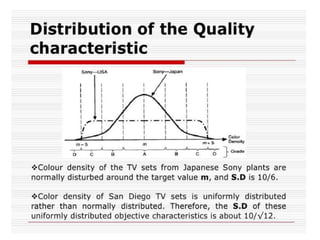
• Sony and two of their television production facilities, one in the USA, the
other in Japan. The color density of the televisions manufactured by Sony-
USA were uniformly distributed and fell within the tolerance limits, m ± 5 (
where m is the target for color density), while the televisions from Sony-
Japan followed a normal distribution, more televisions were on target but
about 0.3% fell outside of the tolerance limits.
• color density distributions are illustrated in Figure 1. The differences in
customer perceptions of quality resulted from Sony-USA paying attention
only to meeting the tolerances whereas in Sony-Japan, the focus was on
meeting the target and minimizing the variance around that target. If we
assign a grade to each television based on its color density then we see
that Sony Japan produced many more Grade A sets and fewer Grade C
sets in comparison to Sony-USA.
Applications of Taguchi method
• Taguchi method is used whenever the settings of interest
parameters are necessary, not only for manufacturing
processes. Therefore, the Taguchi approach is used in
many domains such as environmental sciences ,agricultural
sciences , physics , statistics , management and business ,
medicine and in chemical processes as well
• Taguchi-based DOE methodology provides a systematic
and efficient mathematical approach to understand
complex process of fermentative H2 production and
substrate degradation for the optimization of the near
optimum design parameters, only with a few well-defined
experimental sets
Advantages and disadvantages of Taguchi
method
• The foundation of the DOE in Taguchi method (TM) is orthogonal array
design that is very simple method for analysing the outputs. His work
was controversial and criticized by some researchers for being
inefficient and ineffective in some cases. But still the simplicity of
Taguchi method increased its use in manufacturing industries
• The key step of the TM is to increasing the quality level with less
affecting the cost factor. TM provides the optimal settings for the
processes which can improve quality, and these settings attained from
TM are also insensitive to the variation of noise factors.
• Another advantage of the Taguchi method is that it emphasizes a mean
performance characteristic value close to the target value rather than a
value within certain specification limits, thus improving the product
quality.
• It is probably unfortunate that the important concepts
advocated by Taguchi have been overshadowed by
controversy associated with his approach to modelling
and data analysis. There have been several research
papers and books which explain, review, or raise
questions on the Taguchi’s ideas
• Another limitation is that the Taguchi methods are offline.
So in the case of dynamically changing processes for
example a simulation study, the TM is not appropriate.
And also, the Taguchi method is most effectively applied
at the designing stage of a product development
Conclusion
• Industries are in the need of the method of
conducting experiments which optimize
processes and increase the quality of products.
Same is desired in chemical industrial processes
also. For this, design of experiments is the basic
step of quality improvement via optimized
processes.
Thank You

taguchi_method_2019BPR016.pptx

  • 1.
    TAGUCHI METHOD Overview &Applications. • NAME: Krishna Sandeep Dhondge. • Reg id: 2019BPR016 ( A17 ) • Production Engineering Department.
  • 2.
    • After theSecond World War, allied forces observed some of the major drawbacks of the Japanese telephone system, that is, extremely poor quality and unsuitability for long-term communication purposes. To overcome these drawbacks, an improved system was required, for this the allied command recommended establishing research facilities to develop a state-of-the-art communication system. At that time, the electrical communication laboratories (ECL) were came on the stage with Dr. Genichi Taguchi in charge of improving the R&D productivity and enhancing product quality. • It was observed that the ratio of the time and money expended on engineering experimentation and testing is very high than the efforts given to the process of creative brainstorming to minimize the expenditure of resources. He noticed that the process of inspection, screening and salvaging cannot improve poor quality. The inspection process is done to check the quality but it can’t increase the quality by itself. Therefore, he believed that quality concepts should be based upon, and developed around, the philosophy of prevention.
  • 3.
    • Taguchi todevelop new optimizing methods of the processes of engineering experimentation. He believed that the best way to improve quality was to design and build it into the product. He quoted that , “Cost is more important than quality but quality is the best way to reduce cost.” • He developed the techniques which are now known as Taguchi methods (TM). His main contribution lies not in the mathematical formulation of the design of experiments, but rather in the accompanying philosophy. Taguchi method is different from the traditional techniques because of Taguchi’s concepts of design. By his methods, he developed Robust Manufacturing systems that are insensitive to daily or seasonal variations of environment, wears or other noise factors. His philosophy had far reaching consequences, yet it is founded on three very simple concepts
  • 4.
    What is theTaguchi Method? • The Taguchi method (TM) is a problem-solving technique to help improve process performance, to increase efficiency and productivity. The Taguchi method is centred around reducing potential variations in a process through design of experiments. • objective of using this methodology is to produce high-quality products with low costs to the manufacturer. Reducing variations in processes through the robust design of experiments. • Genichi Taguchi a Japanese engineer, developed the system to identify variances before they occur to increase the reliability of goods.
  • 5.
    Philosophy of theTaguchi Method • There are three philosophies the Taguchi method is based around: • Quality Designed into Product: Quality is designed into a process not inspected after. What process most affects the product? • Minimise Deviation from Target: Design product so immune to uncontrollable environmental factors. • Quality Function of Deviation: Measure losses system-wide from a product of poor quality.
  • 6.
    • Taguchi method,we assume that we are designing an engineering system—it might be a machine that performs some intended function or it might be a production process. We use the knowledge of fundamental about the system and process parameters for efficient experimentation. We can skip all the extra effort that might have gone in to investigating interactions. By this, we can decrease the number of factors. Taguchi categorize the factors in two sets: 1. Control factors, which are under our control. 2. Noise factors, which are not under our control, except during experiments in the laboratories.
  • 7.
    Main Factors inTaguchi Method • Taguchi looked to improve product design while lowering costs, he explained that the framework can be viewed in three main components: • Systems Design: Focuses on the primary aspects that are necessary to produce the required product. It can include the best combination of materials and processes. • Parameter Design: Involves the most suitable set of rules that govern the established design elements. Defining the components in each parameter makes it easy to minimise the variation from a product. The Taguchi approach empathises this stage because it is often overlooked during industrial design practice. • Tolerance Design: Look at the factors that play a significant role in product quality. It then identifies tolerance limits that provide the variation required in the design.
  • 8.
    • He developedthe techniques which are now known as Taguchi methods (TM). His main contribution lies not in the mathematical formulation of the design of experiments, but rather in the accompanying philosophy. Taguchi method is different from the traditional techniques because of Taguchi’s concepts of design. By his methods, he developed Robust Manufacturing systems that are insensitive to daily or seasonal variations of environment, wears or other noise factors. His philosophy had far reaching consequences, yet it is founded on three very simple concepts
  • 9.
    • Taguchi’s approachcomplements the following two important areas: • Taguchi constructed a special set of orthogonal arrays (OA) to lay out his experiments. Taguchi prepared a new set of standard OAs which could be used for a number of experimental situations. • He also devised a standard method for analysis of the results. • As mentioned, the full factorial design requires many experiments to be carried out. It becomes laborious and complex, if the number of factors increases. To overcome this problem, Taguchi suggested a specially designed method called the use of orthogonal array.
  • 12.
    story of Sony •Sony and two of their television production facilities, one in the USA, the other in Japan. The color density of the televisions manufactured by Sony- USA were uniformly distributed and fell within the tolerance limits, m ± 5 ( where m is the target for color density), while the televisions from Sony- Japan followed a normal distribution, more televisions were on target but about 0.3% fell outside of the tolerance limits. • color density distributions are illustrated in Figure 1. The differences in customer perceptions of quality resulted from Sony-USA paying attention only to meeting the tolerances whereas in Sony-Japan, the focus was on meeting the target and minimizing the variance around that target. If we assign a grade to each television based on its color density then we see that Sony Japan produced many more Grade A sets and fewer Grade C sets in comparison to Sony-USA.
  • 14.
    Applications of Taguchimethod • Taguchi method is used whenever the settings of interest parameters are necessary, not only for manufacturing processes. Therefore, the Taguchi approach is used in many domains such as environmental sciences ,agricultural sciences , physics , statistics , management and business , medicine and in chemical processes as well • Taguchi-based DOE methodology provides a systematic and efficient mathematical approach to understand complex process of fermentative H2 production and substrate degradation for the optimization of the near optimum design parameters, only with a few well-defined experimental sets
  • 15.
    Advantages and disadvantagesof Taguchi method • The foundation of the DOE in Taguchi method (TM) is orthogonal array design that is very simple method for analysing the outputs. His work was controversial and criticized by some researchers for being inefficient and ineffective in some cases. But still the simplicity of Taguchi method increased its use in manufacturing industries • The key step of the TM is to increasing the quality level with less affecting the cost factor. TM provides the optimal settings for the processes which can improve quality, and these settings attained from TM are also insensitive to the variation of noise factors. • Another advantage of the Taguchi method is that it emphasizes a mean performance characteristic value close to the target value rather than a value within certain specification limits, thus improving the product quality.
  • 16.
    • It isprobably unfortunate that the important concepts advocated by Taguchi have been overshadowed by controversy associated with his approach to modelling and data analysis. There have been several research papers and books which explain, review, or raise questions on the Taguchi’s ideas • Another limitation is that the Taguchi methods are offline. So in the case of dynamically changing processes for example a simulation study, the TM is not appropriate. And also, the Taguchi method is most effectively applied at the designing stage of a product development
  • 17.
    Conclusion • Industries arein the need of the method of conducting experiments which optimize processes and increase the quality of products. Same is desired in chemical industrial processes also. For this, design of experiments is the basic step of quality improvement via optimized processes. Thank You