TAGUCHI LOSS FUNCTION
WHAT IS QUALITY?
Quality means different things to different people
Following Taguchi, the quality of a product is
measured in terms of the total loss to society due to
functional variation and harmful effects. The loss
would be zero for the ideal quality.
TAGUCHI LOSS FUNCTION
It’s a graphical depiction of loss developed by the
Japanese business statistician Genichi Taguchi to
describe a phenomenon affecting the value of
products produced by a company.
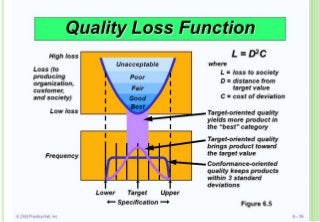
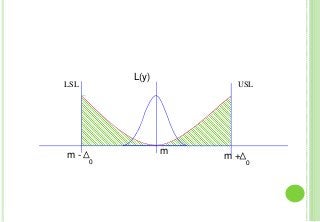
'loss' is depicted by a quality loss function and it
follows a parabolic curve mathematically given by
L = k(y–m)2,
where m is the theoretical 'target value' or 'mean
value' and y is the actual size of the product, k is a
constant and L is the loss. This means that if the
difference between 'actual size' and 'target value' i.e.
(y–m) is large, loss would be more, irrespective of
tolerance specifications.
In Taguchi's view tolerance specifications are given by
engineers and not by customers; what the customer
experiences is 'loss'. This equation is true for a single
product; if 'loss' is to be calculated for multiple
products the loss function is given by
L = k[S2 + y – m)2],
where S2 is the 'variance of product size' and y is the
average product size.
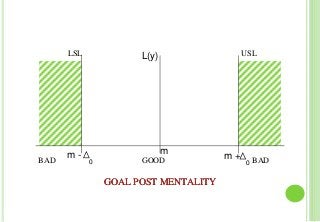
LSL USL
BAD BADGOOD
GOAL POST MENTALITYGOAL POST MENTALITY
0
m -
0
m +
m
L(y)
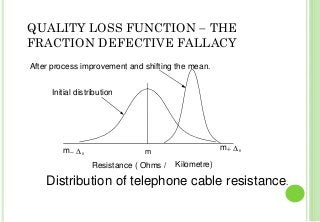
QUALITY LOSS FUNCTION − THE
FRACTION DEFECTIVE FALLACY
m− Δ 0 m
Distribution of telephone cable resistance.
Initial distribution
After process improvement and shifting the mean.
Resistance ( Ohms / Kilometre)
m+ Δ0
LSL USL
0
m -
0
m +
m
L(y)
Average quality loss
Q = k [( m - μ )2 + σ 2 ]
It consists of two components:
Shift of process average (μ) from the target
value (m)
Spread of the process (σ2)
S/N ratios are a log-modified form of Average
quality loss function
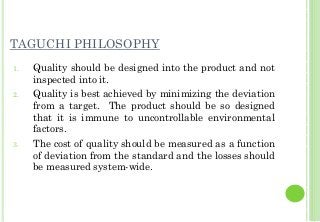
TAGUCHI PHILOSOPHY
1. Quality should be designed into the product and not
inspected into it.
2. Quality is best achieved by minimizing the deviation
from a target. The product should be so designed
that it is immune to uncontrollable environmental
factors.
3. The cost of quality should be measured as a function
of deviation from the standard and the losses should
be measured system-wide.
Maximizing S/N ratio is equivalent to reducing variance
due to various noise factors and hence improves quality
during manufacturing, customer usage and aging and
simultaneously reducing cost substantially.
S/N ratio
Taguchi specified three situations:
Larger the better (for example, agricultural yield);
Smaller the better (for example, carbon dioxide emissions);
On-target, minimum-variation (for example, a mating part in
an assembly).
The first two cases are represented by simple monotonic loss
functions. In the third case, Taguchi adopted a squared-error loss
function for several reasons:
Taguchi’s Specification
USUAL APPROACH TO IMPROVE THE QUALITY OF
A PRODUCT OR PROCESS
Identify various causes, known as noise factors, that
degrade the product (process) performance
variations in raw materials and components, machinery,
workmanship, temperature, humidity, loading, etc.
Eliminate the noise factors one by one
RESULT OF USUAL APPROACH TO IMPROVE THE
QUALITY OF A PRODUCT OR PROCESS
Eliminating noise factors always leads to
increased costs
Reduction in profitability or loss of market
share in the face of global competition
TAGUCHI/ ROBUST DESIGN METHOD
New method of design optimization for
performance, quality, & cost
For existing processes, emphasis is on
parameter design
Smallest, affordable development cost
TAGUCHI/ ROBUST DESIGN METHOD
All engineering designs involve setting values
of a large number of decision variables.
Common approach is to study one variable at
a time or by trial and error
Either long and expensive time span for completing
the design / premature termination of the design
process
TAGUCHI/ ROBUST DESIGN METHOD
MATHEMATICAL TOOL
Orthogonal arrays to study large number of
decision variables with a small number of
experiments
NEW MEASURE OF QUALITY
Signal to noise (s/n) ratio to predict the quality from the
customer perspective
ANALYSIS OF RESULTS
1. To establish the best or the optimum condition for a
product or a process.
2. To estimate the contribution of individual factors.
3. To estimate the response under the optimum
conditions.
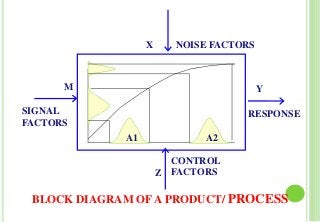
RESPONSE
NOISE FACTORS
CONTROL
FACTORS
SIGNAL
FACTORS
M
X
Y
BLOCK DIAGRAM OF A PRODUCT/ PROCESS
Z
A1 A2
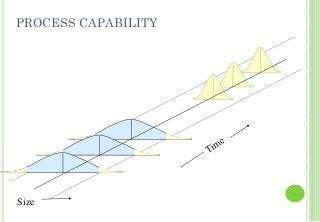
PROCESS CAPABILITY
Size
TAGUCHI/ ROBUST DESIGN METHOD
Many cos. Big or small, high-tech and low-
tech have found the method valuable
High quality at a low competitive price while
maintaining profit margin
THE NEW APPROACH –ITS APPEAL AND
LIMITATIONS
Upfront improvement of quality by design
and process development.
Measurement of quality in terms of
deviation from the target (loss function).
Problem solution by team approach and
brainstorming.
THE NEW APPROACH –ITS APPEAL AND
LIMITATIONS (CONT.)
Consistency in experimental design and analysis.
Reduction of time and cost of experiments.
Design of robustness into product/process.
Reduction of variation without removing its
causes.
Reduction of product warranty and service costs
by addressing them with the loss function.
Overview of ISO 9001
and ISO 14001
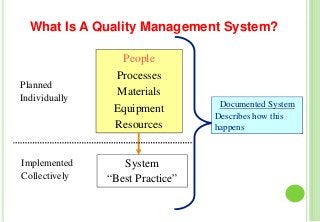
What Is A Quality Management System?
People
Processes
Materials
Equipment
Resources
Planned
Individually
System
“Best Practice”
Implemented
Collectively
Documented System
Describes how this
happens
Why Document?
• Communication Tool
• Manage Change
• Aids consistency
• Record of Best Practice
• Enables Effective Audit
• ISO 9001 Pre-requisite
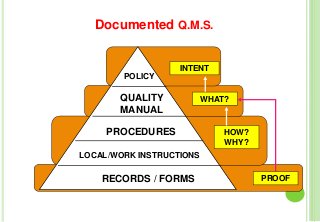
Documented Q.M.S.
POLICY
QUALITY
MANUAL
PROCEDURES
LOCAL/WORK INSTRUCTIONS
RECORDS / FORMS
INTENT
WHAT?
PROOF
HOW?
WHY?
ISO 9001 AND ISO 14001 IN BRIEF
ISO 9001 and ISO 14001 are among ISO's most well
known standards ever.
They are implemented by more than a million
organizations in some 175 countries.
ISO 9001 helps organizations to implement quality
management.
ISO 14001 helps organizations to implement
environmental management.
QUALITY MANAGEMENT
ISO 9001 is for quality management.
Quality refers to all those features of a product (or
service) which are required by the customer.
Quality management means what the organization
does to
ensure that its products or services satisfy the
customer's quality requirements and
comply with any regulations applicable to those
products or services.
QUALITY MANAGEMENT (CONT.)
Quality management also means what the
organization does to
enhance customer satisfaction, and
achieve continual improvement of its performance.
ENVIRONMENTAL MANAGEMENT
ISO 14001 is for environmental management. This
means what the organization does to:
minimize harmful effects on the environment
caused by its activities,
to conform to applicable regulatory requirements,
and to
achieve continual improvement of its environmental
performance.
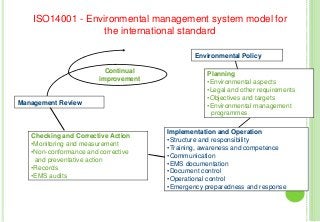
ISO14001 - Environmental management system model for
the international standard
Environmental Policy
Planning
•Environmental aspects
•Legal and other requirements
•Objectives and targets
•Environmental management
programmes
Implementation and Operation
•Structure and responsibility
•Training, awareness and competence
•Communication
•EMS documentation
•Document control
•Operational control
•Emergency preparedness and response
Checking and Corrective Action
•Monitoring and measurement
•Non-conformance and corrective
and preventative action
•Records
•EMS audits
Continual
improvement
Management Review
GENERIC STANDARDS
ISO 9001 and ISO 14001 are generic standards.
Generic means that the same standards can be
applied:
to any organization, large or small, whatever its
product or service,
in any sector of activity, and
whether it is a business enterprise, a public
administration, or a government department.
GENERIC STANDARDS (CONT.)
Generic also signifies that
no matter what the organization's scope of activity
if it wants to establish a quality management
system, ISO 9001 gives the essential features
or if it wants to establish an environmental
management system, ISO 14001 gives the essential
features.
MANAGEMENT SYSTEMS
Management system means what the organization
does to manage its processes, or activities in order
that
its products or services meet the organization’s
objectives, such as
satisfying the customer's quality requirements,
complying to regulations, or
meeting environmental objectives
MANAGEMENT SYSTEMS
To be really efficient and effective, the organization
can manage its way of doing things by systemizing
it.
Nothing important is left out.
Everyone is clear about who is responsible for
doing what, when, how, why and where.
Management system standards provide the
organization with an international, state-of-the-art
model to follow.
MANAGEMENT SYSTEMS (CONT.)
Large organizations, or ones with complicated
processes, could not function well without
management systems.
Companies in such fields as aerospace, automobiles,
defence, or health care devices have been operating
management systems for years.
The ISO 9001 and ISO 14001 management system
standards now make these successful practices
available for all organizations.
PROCESSES, NOT PRODUCTS
Both ISO 9001 and ISO 14001 concern the way an
organization goes about its work.
They are not product standards.
They are not service standards.
They are process standards.
They can be used by product manufacturers and
service providers.
PROCESSES, NOT PRODUCTS (CONT.)
Processes affect final products or services.
ISO 9001 gives the requirements for what the
organization must do to manage processes
affecting quality of its products and services.
ISO 14001 gives the requirements for what the
organization must do to manage processes
affecting the impact of its activities on the
environment.
BENEFITS OF ISO 9001 AND ISO 14001
International, expert consensus on state-of-the-art
practices for quality and environmental management.
Common language for dealing with customers and
suppliers worldwide .
Increase efficiency and effectiveness.
Model for continual improvement.
BENEFITS OF ISO 9001 AND ISO 14001
(CONT.)
Model for satisfying customers and other
stakeholders.
Build quality into products and services from design
onwards.
Address environmental concerns of customers and
public, and comply with government regulations.
Integrate with global economy.
BENEFITS OF ISO 9001 AND
ISO 14001 (CONT.)
Sustainable business
Unifying base for industry sectors
Qualify suppliers for global supply chains
Technical support for regulations
BENEFITS OF ISO 9001 AND ISO 14001
(CONT.)
Transfer of good practice to developing countries
Tools for new economic players
Regional integration
Facilitate rise of services
MORE INFORMATION
ISO 9000/ISO 14000 section on ISO Web site:
www.iso.org
ISO Management Systems magazine
www.iso.org/ims
IMS Alerts free electronic newsletter
www.iso.org/imsalerts

Qms & taguchi

  • 1.
  • 2.
    WHAT IS QUALITY? Qualitymeans different things to different people Following Taguchi, the quality of a product is measured in terms of the total loss to society due to functional variation and harmful effects. The loss would be zero for the ideal quality.
  • 3.
    TAGUCHI LOSS FUNCTION It’sa graphical depiction of loss developed by the Japanese business statistician Genichi Taguchi to describe a phenomenon affecting the value of products produced by a company. 'loss' is depicted by a quality loss function and it follows a parabolic curve mathematically given by L = k(y–m)2, where m is the theoretical 'target value' or 'mean value' and y is the actual size of the product, k is a constant and L is the loss. This means that if the difference between 'actual size' and 'target value' i.e. (y–m) is large, loss would be more, irrespective of tolerance specifications.
  • 4.
    In Taguchi's viewtolerance specifications are given by engineers and not by customers; what the customer experiences is 'loss'. This equation is true for a single product; if 'loss' is to be calculated for multiple products the loss function is given by L = k[S2 + y – m)2], where S2 is the 'variance of product size' and y is the average product size.
  • 6.
    LSL USL BAD BADGOOD GOALPOST MENTALITYGOAL POST MENTALITY 0 m - 0 m + m L(y)
  • 7.
    QUALITY LOSS FUNCTION− THE FRACTION DEFECTIVE FALLACY m− Δ 0 m Distribution of telephone cable resistance. Initial distribution After process improvement and shifting the mean. Resistance ( Ohms / Kilometre) m+ Δ0
  • 8.
  • 9.
    Average quality loss Q= k [( m - μ )2 + σ 2 ] It consists of two components: Shift of process average (μ) from the target value (m) Spread of the process (σ2) S/N ratios are a log-modified form of Average quality loss function
  • 10.
    TAGUCHI PHILOSOPHY 1. Qualityshould be designed into the product and not inspected into it. 2. Quality is best achieved by minimizing the deviation from a target. The product should be so designed that it is immune to uncontrollable environmental factors. 3. The cost of quality should be measured as a function of deviation from the standard and the losses should be measured system-wide.
  • 11.
    Maximizing S/N ratiois equivalent to reducing variance due to various noise factors and hence improves quality during manufacturing, customer usage and aging and simultaneously reducing cost substantially. S/N ratio
  • 12.
    Taguchi specified threesituations: Larger the better (for example, agricultural yield); Smaller the better (for example, carbon dioxide emissions); On-target, minimum-variation (for example, a mating part in an assembly). The first two cases are represented by simple monotonic loss functions. In the third case, Taguchi adopted a squared-error loss function for several reasons: Taguchi’s Specification
  • 13.
    USUAL APPROACH TOIMPROVE THE QUALITY OF A PRODUCT OR PROCESS Identify various causes, known as noise factors, that degrade the product (process) performance variations in raw materials and components, machinery, workmanship, temperature, humidity, loading, etc. Eliminate the noise factors one by one
  • 14.
    RESULT OF USUALAPPROACH TO IMPROVE THE QUALITY OF A PRODUCT OR PROCESS Eliminating noise factors always leads to increased costs Reduction in profitability or loss of market share in the face of global competition
  • 15.
    TAGUCHI/ ROBUST DESIGNMETHOD New method of design optimization for performance, quality, & cost For existing processes, emphasis is on parameter design Smallest, affordable development cost
  • 16.
    TAGUCHI/ ROBUST DESIGNMETHOD All engineering designs involve setting values of a large number of decision variables. Common approach is to study one variable at a time or by trial and error Either long and expensive time span for completing the design / premature termination of the design process
  • 17.
    TAGUCHI/ ROBUST DESIGNMETHOD MATHEMATICAL TOOL Orthogonal arrays to study large number of decision variables with a small number of experiments NEW MEASURE OF QUALITY Signal to noise (s/n) ratio to predict the quality from the customer perspective
  • 18.
    ANALYSIS OF RESULTS 1.To establish the best or the optimum condition for a product or a process. 2. To estimate the contribution of individual factors. 3. To estimate the response under the optimum conditions.
  • 19.
  • 20.
  • 21.
    TAGUCHI/ ROBUST DESIGNMETHOD Many cos. Big or small, high-tech and low- tech have found the method valuable High quality at a low competitive price while maintaining profit margin
  • 22.
    THE NEW APPROACH–ITS APPEAL AND LIMITATIONS Upfront improvement of quality by design and process development. Measurement of quality in terms of deviation from the target (loss function). Problem solution by team approach and brainstorming.
  • 23.
    THE NEW APPROACH–ITS APPEAL AND LIMITATIONS (CONT.) Consistency in experimental design and analysis. Reduction of time and cost of experiments. Design of robustness into product/process. Reduction of variation without removing its causes. Reduction of product warranty and service costs by addressing them with the loss function.
  • 24.
    Overview of ISO9001 and ISO 14001
  • 25.
    What Is AQuality Management System? People Processes Materials Equipment Resources Planned Individually System “Best Practice” Implemented Collectively Documented System Describes how this happens
  • 26.
    Why Document? • CommunicationTool • Manage Change • Aids consistency • Record of Best Practice • Enables Effective Audit • ISO 9001 Pre-requisite
  • 27.
  • 28.
    ISO 9001 ANDISO 14001 IN BRIEF ISO 9001 and ISO 14001 are among ISO's most well known standards ever. They are implemented by more than a million organizations in some 175 countries. ISO 9001 helps organizations to implement quality management. ISO 14001 helps organizations to implement environmental management.
  • 29.
    QUALITY MANAGEMENT ISO 9001is for quality management. Quality refers to all those features of a product (or service) which are required by the customer. Quality management means what the organization does to ensure that its products or services satisfy the customer's quality requirements and comply with any regulations applicable to those products or services.
  • 30.
    QUALITY MANAGEMENT (CONT.) Qualitymanagement also means what the organization does to enhance customer satisfaction, and achieve continual improvement of its performance.
  • 31.
    ENVIRONMENTAL MANAGEMENT ISO 14001is for environmental management. This means what the organization does to: minimize harmful effects on the environment caused by its activities, to conform to applicable regulatory requirements, and to achieve continual improvement of its environmental performance.
  • 32.
    ISO14001 - Environmentalmanagement system model for the international standard Environmental Policy Planning •Environmental aspects •Legal and other requirements •Objectives and targets •Environmental management programmes Implementation and Operation •Structure and responsibility •Training, awareness and competence •Communication •EMS documentation •Document control •Operational control •Emergency preparedness and response Checking and Corrective Action •Monitoring and measurement •Non-conformance and corrective and preventative action •Records •EMS audits Continual improvement Management Review
  • 33.
    GENERIC STANDARDS ISO 9001and ISO 14001 are generic standards. Generic means that the same standards can be applied: to any organization, large or small, whatever its product or service, in any sector of activity, and whether it is a business enterprise, a public administration, or a government department.
  • 34.
    GENERIC STANDARDS (CONT.) Genericalso signifies that no matter what the organization's scope of activity if it wants to establish a quality management system, ISO 9001 gives the essential features or if it wants to establish an environmental management system, ISO 14001 gives the essential features.
  • 35.
    MANAGEMENT SYSTEMS Management systemmeans what the organization does to manage its processes, or activities in order that its products or services meet the organization’s objectives, such as satisfying the customer's quality requirements, complying to regulations, or meeting environmental objectives
  • 36.
    MANAGEMENT SYSTEMS To bereally efficient and effective, the organization can manage its way of doing things by systemizing it. Nothing important is left out. Everyone is clear about who is responsible for doing what, when, how, why and where. Management system standards provide the organization with an international, state-of-the-art model to follow.
  • 37.
    MANAGEMENT SYSTEMS (CONT.) Largeorganizations, or ones with complicated processes, could not function well without management systems. Companies in such fields as aerospace, automobiles, defence, or health care devices have been operating management systems for years. The ISO 9001 and ISO 14001 management system standards now make these successful practices available for all organizations.
  • 38.
    PROCESSES, NOT PRODUCTS BothISO 9001 and ISO 14001 concern the way an organization goes about its work. They are not product standards. They are not service standards. They are process standards. They can be used by product manufacturers and service providers.
  • 39.
    PROCESSES, NOT PRODUCTS(CONT.) Processes affect final products or services. ISO 9001 gives the requirements for what the organization must do to manage processes affecting quality of its products and services. ISO 14001 gives the requirements for what the organization must do to manage processes affecting the impact of its activities on the environment.
  • 40.
    BENEFITS OF ISO9001 AND ISO 14001 International, expert consensus on state-of-the-art practices for quality and environmental management. Common language for dealing with customers and suppliers worldwide . Increase efficiency and effectiveness. Model for continual improvement.
  • 41.
    BENEFITS OF ISO9001 AND ISO 14001 (CONT.) Model for satisfying customers and other stakeholders. Build quality into products and services from design onwards. Address environmental concerns of customers and public, and comply with government regulations. Integrate with global economy.
  • 42.
    BENEFITS OF ISO9001 AND ISO 14001 (CONT.) Sustainable business Unifying base for industry sectors Qualify suppliers for global supply chains Technical support for regulations
  • 43.
    BENEFITS OF ISO9001 AND ISO 14001 (CONT.) Transfer of good practice to developing countries Tools for new economic players Regional integration Facilitate rise of services
  • 44.
    MORE INFORMATION ISO 9000/ISO14000 section on ISO Web site: www.iso.org ISO Management Systems magazine www.iso.org/ims IMS Alerts free electronic newsletter www.iso.org/imsalerts