Using Tag Questions
• She's very beautiful, isn't she?
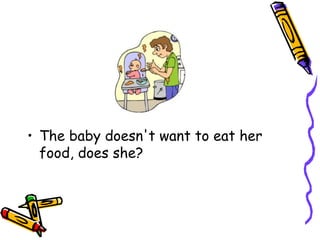
• The baby doesn't want to eat her
food, does she?
She's done something really
interesting to her hair, hasn't she?
TAG QUESTIONS
A tag question is a question
added at the end of a
sentence. Speakers use it to
make sure their information
is correct.
What is a tag question?
• A tag question is a sentence with a
question phrase connected at the
end.
• Example:
It’s windy today, isn’t it?
Sentence part Tag
Tag questions have two purposes:
1. To clarify information
(the speaker expects an answer)
Example:
– We have a test tomorrow, don’t we?
– Mr. Smith is coming to the meeting, isn’t he?
– I’m permitted to park here, aren’t I?
Tag questions have two
purposes:
2. To agree with someone
(the speaker does not expect an
answer)
Example:
• You’re falling asleep, aren’t you?
• The party was a lot of fun, wasn’t it?
• I didn’t win the lottery, did I?
Forming Tag Questions
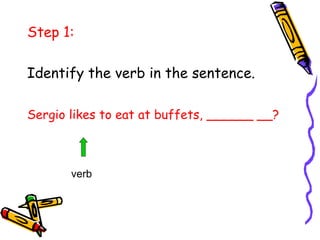
Step 1:
Identify the verb in the sentence.
Sergio likes to eat at buffets, ______ __?
verb
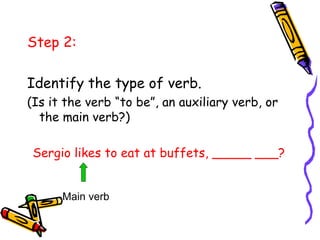
Step 2:
Identify the type of verb.
(Is it the verb “to be”, an auxiliary verb, or
the main verb?)
Sergio likes to eat at buffets, _____ ___?
Main verb
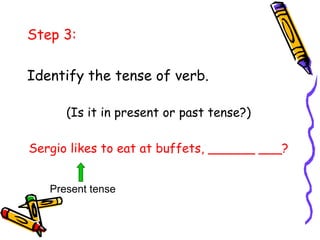
Step 3:
Identify the tense of verb.
(Is it in present or past tense?)
Sergio likes to eat at buffets, ______ ___?
Present tense
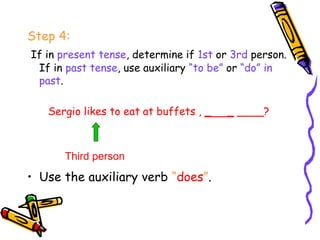
Step 4:
If in present tense, determine if 1st or 3rd person.
If in past tense, use auxiliary “to be” or “do” in
past.
Sergio likes to eat at buffets , _ _ ____?
• Use the auxiliary verb “does”.
Third person
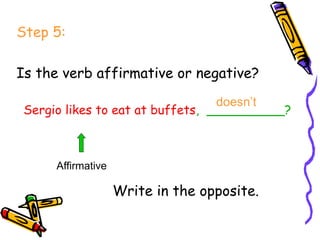
Step 5:
Is the verb affirmative or negative?
Sergio likes to eat at buffets, __________?
Write in the opposite.
Affirmative
doesn’t
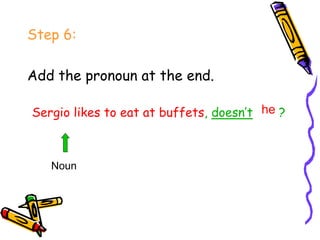
Step 6:
Add the pronoun at the end.
Sergio likes to eat at buffets, doesn’t ?
Noun
he
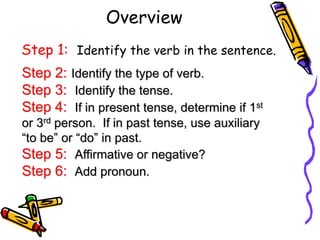
Overview
Step 1: Identify the verb in the sentence.
Step 2: Identify the type of verb.
Step 3: Identify the tense.
Step 4: If in present tense, determine if 1st
or 3rd person. If in past tense, use auxiliary
“to be” or “do” in past.
Step 5: Affirmative or negative?
Step 6: Add pronoun.
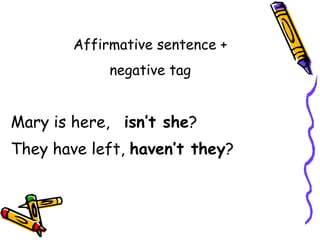
Affirmative sentence +
negative tag
Mary is here, isn’t she?
They have left, haven’t they?
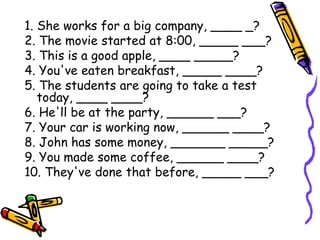
1. She works for a big company, ____ _?
2. The movie started at 8:00, _____ ___?
3. This is a good apple, ____ _____?
4. You've eaten breakfast, _____ ____?
5. The students are going to take a test
today, ____ ____?
6. He'll be at the party, ______ ___?
7. Your car is working now, ______ ____?
8. John has some money, _______ _____?
9. You made some coffee, ______ ____?
10. They've done that before, _____ ___?
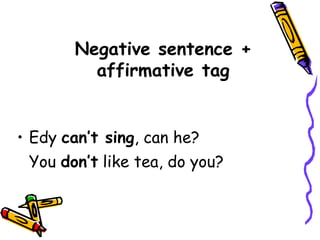
Negative sentence +
affirmative tag
• Edy can’t sing, can he?
You don’t like tea, do you?
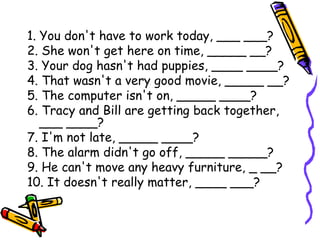
1. You don't have to work today, ___ ___?
2. She won't get here on time, _____ __?
3. Your dog hasn't had puppies, ____ ____?
4. That wasn't a very good movie, _____ __?
5. The computer isn't on, _____ ____?
6. Tracy and Bill are getting back together,
___ ____?
7. I'm not late, _____ ____?
8. The alarm didn't go off, _____ _____?
9. He can't move any heavy furniture, _ __?
10. It doesn't really matter, ____ ___?
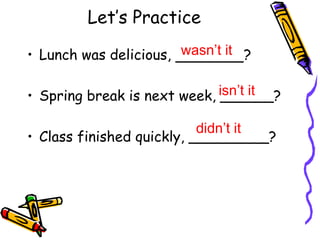
Let’s Practice
• Lunch was delicious, ?
• Spring break is next week, ______?
• Class finished quickly, _________?
wasn’t it
isn’t it
didn’t it
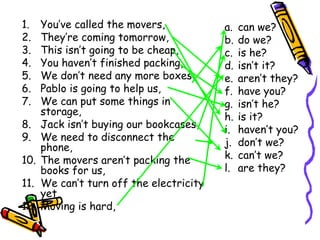
1. You’ve called the movers,
2. They’re coming tomorrow,
3. This isn’t going to be cheap,
4. You haven’t finished packing,
5. We don’t need any more boxes,
6. Pablo is going to help us,
7. We can put some things in
storage,
8. Jack isn’t buying our bookcases,
9. We need to disconnect the
phone,
10. The movers aren’t packing the
books for us,
11. We can’t turn off the electricity
yet,
12. Moving is hard,
a. can we?
b. do we?
c. is he?
d. isn’t it?
e. aren’t they?
f. have you?
g. isn’t he?
h. is it?
i. haven’t you?
j. don’t we?
k. can’t we?
l. are they?
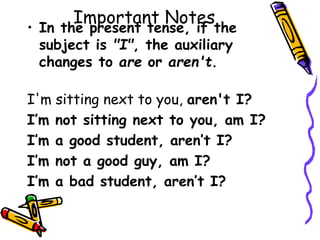
Important Notes
• In the present tense, if the
subject is "I", the auxiliary
changes to are or aren't.
I'm sitting next to you, aren't I?
I’m not sitting next to you, am I?
I’m a good student, aren’t I?
I’m not a good guy, am I?
I’m a bad student, aren’t I?
• With let's, the tag question is shall
we.
• Let's go to the beach, shall we?
• Let’s watch the movie, shall we?
• With an imperative, the tag
question is will you.
• Close the window, will you?
• Pass the salt, will you?
• Open the door, will you?
• We use a positive tag question
after a sentence containing a
negative word such as never,
hardly, nobody.
• Nobody lives in this house, do they?
You've never liked me, have you?
Nobody lived in this house, did they?
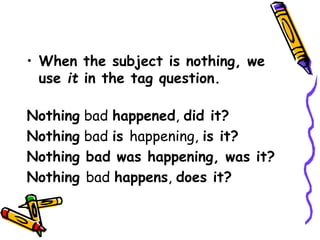
• When the subject is nothing, we
use it in the tag question.
Nothing bad happened, did it?
Nothing bad is happening, is it?
Nothing bad was happening, was it?
Nothing bad happens, does it?
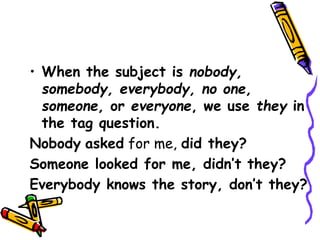
• When the subject is nobody,
somebody, everybody, no one,
someone, or everyone, we use they in
the tag question.
Nobody asked for me, did they?
Someone looked for me, didn’t they?
Everybody knows the story, don’t they?
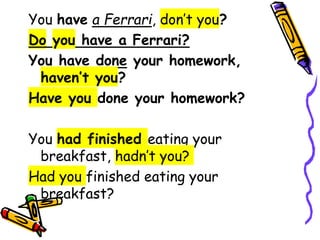
You have a Ferrari, don’t you?
Do you have a Ferrari?
You have done your homework,
haven’t you?
Have you done your homework?
You had finished eating your
breakfast, hadn’t you?
Had you finished eating your
breakfast?
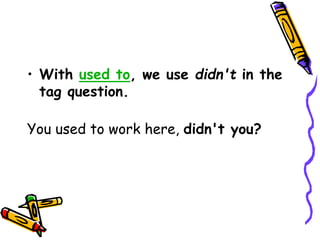
• With used to, we use didn't in the
tag question.
You used to work here, didn't you?
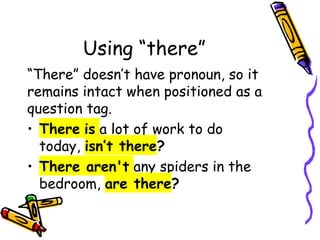
Using “there”
“There” doesn’t have pronoun, so it
remains intact when positioned as a
question tag.
• There is a lot of work to do
today, isn’t there?
• There aren't any spiders in the
bedroom, are there?
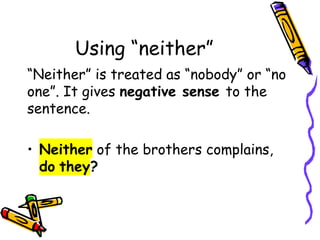
Using “neither”
“Neither” is treated as “nobody” or “no
one”. It gives negative sense to the
sentence.
• Neither of the brothers complains,
do they?
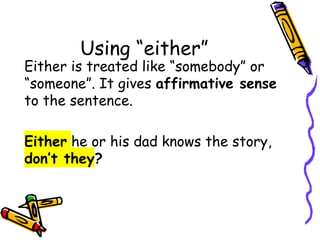
Using “either”
Either is treated like “somebody” or
“someone”. It gives affirmative sense
to the sentence.
Either he or his dad knows the story,
don’t they?
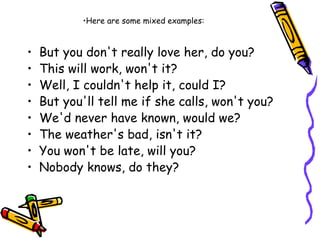
• But you don't really love her, do you?
• This will work, won't it?
• Well, I couldn't help it, could I?
• But you'll tell me if she calls, won't you?
• We'd never have known, would we?
• The weather's bad, isn't it?
• You won't be late, will you?
• Nobody knows, do they?
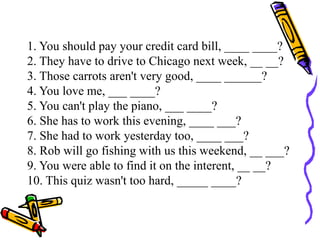
•Here are some mixed examples:
1. You should pay your credit card bill, ____ ____?
2. They have to drive to Chicago next week, __ __?
3. Those carrots aren't very good, ____ ______?
4. You love me, ___ ____?
5. You can't play the piano, ___ ____?
6. She has to work this evening, ____ ___?
7. She had to work yesterday too, ____ ___?
8. Rob will go fishing with us this weekend, __ ___?
9. You were able to find it on the interent, __ __?
10. This quiz wasn't too hard, _____ ____?

questiontagpptpractice1-220915051303-f7b9f0a2 (1).pdf

  • 1.
  • 2.
    • She's verybeautiful, isn't she?
  • 3.
    • The babydoesn't want to eat her food, does she?
  • 4.
    She's done somethingreally interesting to her hair, hasn't she?
  • 5.
    TAG QUESTIONS A tagquestion is a question added at the end of a sentence. Speakers use it to make sure their information is correct.
  • 6.
    What is atag question? • A tag question is a sentence with a question phrase connected at the end. • Example: It’s windy today, isn’t it? Sentence part Tag
  • 7.
    Tag questions havetwo purposes: 1. To clarify information (the speaker expects an answer) Example: – We have a test tomorrow, don’t we? – Mr. Smith is coming to the meeting, isn’t he? – I’m permitted to park here, aren’t I?
  • 8.
    Tag questions havetwo purposes: 2. To agree with someone (the speaker does not expect an answer) Example: • You’re falling asleep, aren’t you? • The party was a lot of fun, wasn’t it? • I didn’t win the lottery, did I?
  • 9.
  • 10.
    Step 1: Identify theverb in the sentence. Sergio likes to eat at buffets, ______ __? verb
  • 11.
    Step 2: Identify thetype of verb. (Is it the verb “to be”, an auxiliary verb, or the main verb?) Sergio likes to eat at buffets, _____ ___? Main verb
  • 12.
    Step 3: Identify thetense of verb. (Is it in present or past tense?) Sergio likes to eat at buffets, ______ ___? Present tense
  • 13.
    Step 4: If inpresent tense, determine if 1st or 3rd person. If in past tense, use auxiliary “to be” or “do” in past. Sergio likes to eat at buffets , _ _ ____? • Use the auxiliary verb “does”. Third person
  • 14.
    Step 5: Is theverb affirmative or negative? Sergio likes to eat at buffets, __________? Write in the opposite. Affirmative doesn’t
  • 15.
    Step 6: Add thepronoun at the end. Sergio likes to eat at buffets, doesn’t ? Noun he
  • 16.
    Overview Step 1: Identifythe verb in the sentence. Step 2: Identify the type of verb. Step 3: Identify the tense. Step 4: If in present tense, determine if 1st or 3rd person. If in past tense, use auxiliary “to be” or “do” in past. Step 5: Affirmative or negative? Step 6: Add pronoun.
  • 17.
    Affirmative sentence + negativetag Mary is here, isn’t she? They have left, haven’t they?
  • 18.
    1. She worksfor a big company, ____ _? 2. The movie started at 8:00, _____ ___? 3. This is a good apple, ____ _____? 4. You've eaten breakfast, _____ ____? 5. The students are going to take a test today, ____ ____? 6. He'll be at the party, ______ ___? 7. Your car is working now, ______ ____? 8. John has some money, _______ _____? 9. You made some coffee, ______ ____? 10. They've done that before, _____ ___?
  • 19.
    Negative sentence + affirmativetag • Edy can’t sing, can he? You don’t like tea, do you?
  • 20.
    1. You don'thave to work today, ___ ___? 2. She won't get here on time, _____ __? 3. Your dog hasn't had puppies, ____ ____? 4. That wasn't a very good movie, _____ __? 5. The computer isn't on, _____ ____? 6. Tracy and Bill are getting back together, ___ ____? 7. I'm not late, _____ ____? 8. The alarm didn't go off, _____ _____? 9. He can't move any heavy furniture, _ __? 10. It doesn't really matter, ____ ___?
  • 21.
    Let’s Practice • Lunchwas delicious, ? • Spring break is next week, ______? • Class finished quickly, _________? wasn’t it isn’t it didn’t it
  • 22.
    1. You’ve calledthe movers, 2. They’re coming tomorrow, 3. This isn’t going to be cheap, 4. You haven’t finished packing, 5. We don’t need any more boxes, 6. Pablo is going to help us, 7. We can put some things in storage, 8. Jack isn’t buying our bookcases, 9. We need to disconnect the phone, 10. The movers aren’t packing the books for us, 11. We can’t turn off the electricity yet, 12. Moving is hard, a. can we? b. do we? c. is he? d. isn’t it? e. aren’t they? f. have you? g. isn’t he? h. is it? i. haven’t you? j. don’t we? k. can’t we? l. are they?
  • 23.
    Important Notes • Inthe present tense, if the subject is "I", the auxiliary changes to are or aren't. I'm sitting next to you, aren't I? I’m not sitting next to you, am I? I’m a good student, aren’t I? I’m not a good guy, am I? I’m a bad student, aren’t I?
  • 24.
    • With let's,the tag question is shall we. • Let's go to the beach, shall we? • Let’s watch the movie, shall we?
  • 25.
    • With animperative, the tag question is will you. • Close the window, will you? • Pass the salt, will you? • Open the door, will you?
  • 26.
    • We usea positive tag question after a sentence containing a negative word such as never, hardly, nobody. • Nobody lives in this house, do they? You've never liked me, have you? Nobody lived in this house, did they?
  • 27.
    • When thesubject is nothing, we use it in the tag question. Nothing bad happened, did it? Nothing bad is happening, is it? Nothing bad was happening, was it? Nothing bad happens, does it?
  • 28.
    • When thesubject is nobody, somebody, everybody, no one, someone, or everyone, we use they in the tag question. Nobody asked for me, did they? Someone looked for me, didn’t they? Everybody knows the story, don’t they?
  • 29.
    You have aFerrari, don’t you? Do you have a Ferrari? You have done your homework, haven’t you? Have you done your homework? You had finished eating your breakfast, hadn’t you? Had you finished eating your breakfast?
  • 30.
    • With usedto, we use didn't in the tag question. You used to work here, didn't you?
  • 31.
    Using “there” “There” doesn’thave pronoun, so it remains intact when positioned as a question tag. • There is a lot of work to do today, isn’t there? • There aren't any spiders in the bedroom, are there?
  • 32.
    Using “neither” “Neither” istreated as “nobody” or “no one”. It gives negative sense to the sentence. • Neither of the brothers complains, do they?
  • 33.
    Using “either” Either istreated like “somebody” or “someone”. It gives affirmative sense to the sentence. Either he or his dad knows the story, don’t they?
  • 34.
    • But youdon't really love her, do you? • This will work, won't it? • Well, I couldn't help it, could I? • But you'll tell me if she calls, won't you? • We'd never have known, would we? • The weather's bad, isn't it? • You won't be late, will you? • Nobody knows, do they? •Here are some mixed examples:
  • 35.
    1. You shouldpay your credit card bill, ____ ____? 2. They have to drive to Chicago next week, __ __? 3. Those carrots aren't very good, ____ ______? 4. You love me, ___ ____? 5. You can't play the piano, ___ ____? 6. She has to work this evening, ____ ___? 7. She had to work yesterday too, ____ ___? 8. Rob will go fishing with us this weekend, __ ___? 9. You were able to find it on the interent, __ __? 10. This quiz wasn't too hard, _____ ____?