Question (a): Describe and differentiate any three types of stance / seogi that you have been learn in your co-curricular course,
Taekwando.
Answer:
TYPES OF
STANCE
Walking
stance
(Gunnun
seogi)

USAGE
Walking stance:
is used when the
mobility is
important.
is mostly used in
taegeuk
Taekwando
patterns.

BRIEFING
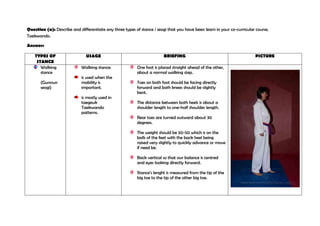
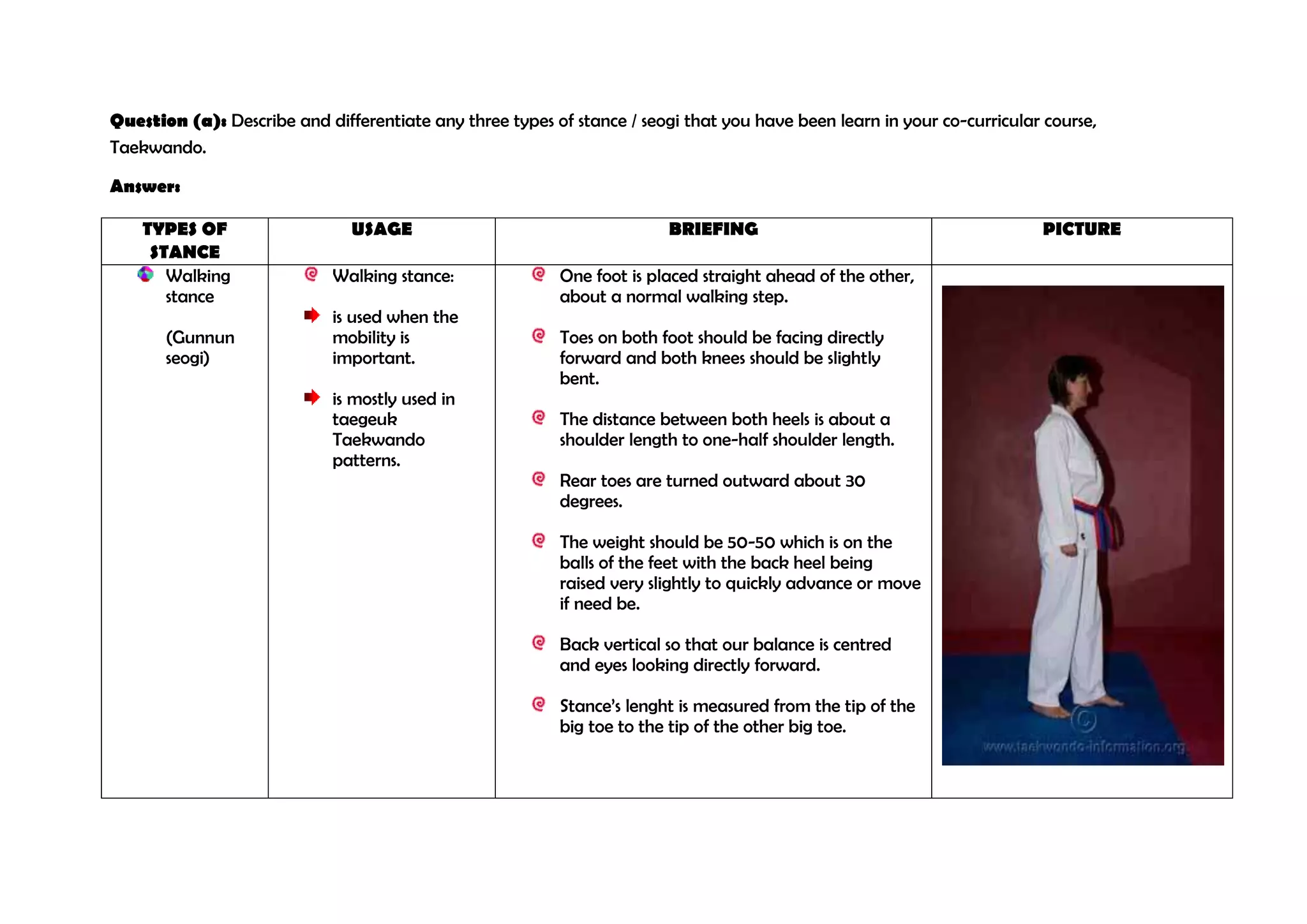
One foot is placed straight ahead of the other,
about a normal walking step.
Toes on both foot should be facing directly
forward and both knees should be slightly
bent.
The distance between both heels is about a
shoulder length to one-half shoulder length.
Rear toes are turned outward about 30
degrees.
The weight should be 50-50 which is on the
balls of the feet with the back heel being
raised very slightly to quickly advance or move
if need be.
Back vertical so that our balance is centred
and eyes looking directly forward.
Stance’s lenght is measured from the tip of the
big toe to the tip of the other big toe.

PICTURE
Forward
stance
(Apkubi
seogi)

Forward stance:

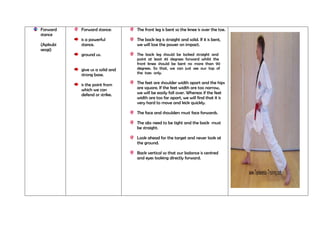
The front leg is bent so the knee is over the toe.

is a powerful
stance.

The back leg is straight and solid. If it is bent,
we will lose the power on impact.

ground us.

The back leg should be locked straight and
point at least 45 degrees forward whilst the
front knee should be bent no more than 90
degrees. So that, we can just see our top of
the toes only.

give us a solid and
strong base.
is the point from
which we can
defend or strike.

The feet are shoulder width apart and the hips
are square. If the feet width are too narrow,
we will be easily fall over. Whereas if the feet
width are too far apart, we will find that it is
very hard to move and kick quickly.
The face and shoulders must face forwards.
The abs need to be tight and the back must
be straight.
Look ahead for the target and never look at
the ground.
Back vertical so that our balance is centred
and eyes looking directly forward.
Back stance

Back stance:

(Dwitkubi
seogi)

is specifically
focused on shifting
weight to the back
leg.
offers much more
control.
Make us easier to
kick off the front
leg.
is a defensive
stance.

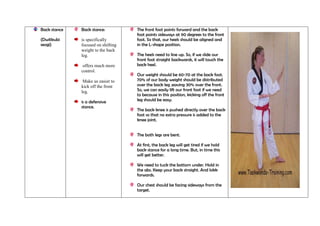
The front foot points forward and the back
foot points sideways at 90 degrees to the front
foot. So that, our heels should be aligned and
in the L-shape position.
The heels need to line up. So, if we slide our
front foot straight backwards, it will touch the
back heel.
Our weight should be 60-70 at the back foot.
70% of our body weight should be distributed
over the back leg ;eaving 30% over the front.
So, we can easily lift our front foot if we need
to because in this position, kicking off the front
leg should be easy.
The back knee is pushed directly over the back
foot so that no extra pressure is added to the
knee joint.
The both legs are bent.
At first, the back leg will get tired if we hold
back stance for a long time. But, in time this
will get better.
We need to tuck the bottom under. Hold in
the abs. Keep your back straight. And lokk
forwards.
Our chest should be facing sideways from the
target.
Question (b): Describe and differentiate any three types of block / makki that you have been learn in your co-curricular course,
Taekwando.
Answer:
TYPES OF
BLOCK
Low block

USAGE
Low block:
might work well
against a turning
kick aimed at the
lower abdomen.
is used to protect
our lower abdomen
and upper leg.
is used to defend
against low attacks
to the torso or legs.

BRIEFING
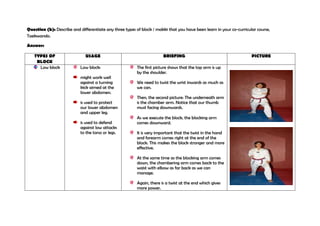
The first picture shows that the top arm is up
by the shoulder.
We need to twist the wrist inwards as much as
we can.
Then, the second picture: The underneath arm
is the chamber arm. Notice that our thumb
must facing downwards.
As we execute the block, the blocking arm
comes downward.
It is very important that the twist in the hand
and forearm comes right at the end of the
block. This makes the block stronger and more
effective.
At the same time as the blocking arm comes
down, the chambering arm comes back to the
waist with elbow as far back as we can
manage.
Again, there is a twist at the end which gives
more power.

PICTURE
High block

High block:
is designed to
defend against
overhead attacks to
the head and
shoulders.
is used to defend
against
Hammerfists, Axe
Kicks and overhead
strikes with blunt
instruments.

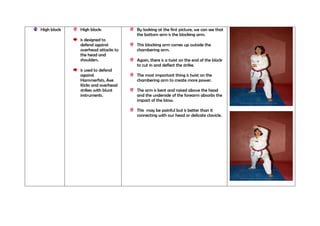
By looking at the first picture, we can see that
the bottom arm is the blocking arm.
This blocking arm comes up outside the
chambering arm.
Again, there is a twist on the end of the block
to cut in and deflect the strike.
The most important thing is twist on the
chambering arm to create more power.
The arm is bent and raised above the head
and the underside of the forearm absorbs the
impact of the blow.
This may be painful but is better than it
connecting with our head or delicate clavicle.
Singleknife hand
block

Single-knife hand
block:
is good for
deflecting a blow
aimed at the body.
Is a good defence to
stop the attack
from the enemy.

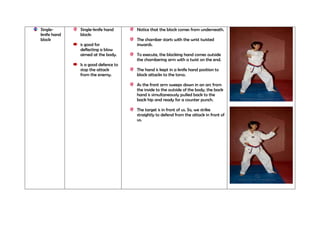
Notice that the block comes from underneath.
The chamber starts with the wrist twisted
inwards.
To execute, the blocking hand comes outside
the chambering arm with a twist on the end.
The hand is kept in a knife hand position to
block attacks to the torso.
As the front arm sweeps down in an arc from
the inside to the outside of the body, the back
hand is simultaneously pulled back to the
back hip and ready for a counter punch.
The target is in front of us. So, we strike
straightly to defend from the attack in front of
us.
Question (c): Describe and differentiate any three types of kick / chagi that you have been learn in your co-curricular course, Taekwando.
Answer:
TYPES OF KICK
Front kick
(Ap chagi)

USAGE
Front kick:
is aiming to strike
through the target
with the ball of foot.
is a powerful kick to
make the enemy
fall down quickly.
is a clear kick that
the body and the
target toward the in
front.

BRIEFING
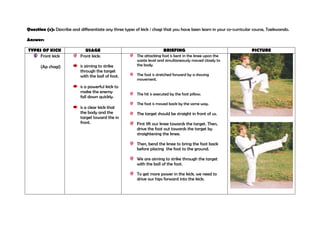
The attacking foot is bent in the knee upon the
waste level and simultaneously moved closely to
the body.
The foot is stretched forward by a shoving
movement.
The hit is executed by the foot pillow.
The foot is moved back by the same way.

The target should be straight in front of us.
First lift our knee towards the target. Then,
drive the foot out towards the target by
straightening the knee.
Then, bend the knee to bring the foot back
before placing the foot to the ground.
We are aiming to strike through the target
with the ball of the foot.
To get more power in the kick, we need to
drive our hips forward into the kick.

PICTURE
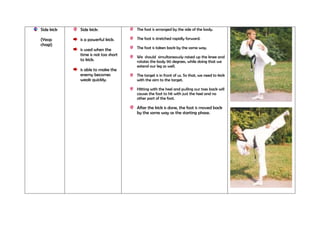
Side kick

Side kick:

The foot is arranged by the side of the body.

(Yeop
chagi)

is a powerful kick.

The foot is stretched rapidly forward.

is used when the
time is not too short
to kick.

The foot is taken back by the same way.

is able to make the
enemy becomes
weak quickly.

We should simultaneously raised up the knee and
rotates the body 90 degrees, while doing that we
extend our leg as well.
The target is in front of us. So that, we need to kick
with the aim to the target.
Hitting with the heel and pulling our toes back will
causes the foot to hit with just the heel and no
other part of the foot.

After the kick is done, the foot is moved back
by the same way as the starting phase.
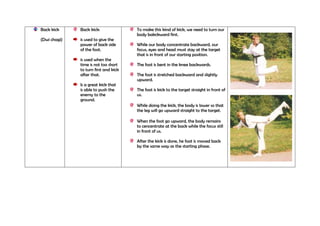
Back kick

Back kick:

(Dwi chagi)

is used to give the
power of back side
of the foot.
is used when the
time is not too short
to turn first and kick
after that.
Is a great kick that
is able to push the
enemy to the
ground.

To make this kind of kick, we need to turn our
body bakckward first.
While our body concentrate backward, our
focus, eyes and head must stay at the target
that is in front of our starting position.
The foot is bent in the knee backwards.
The foot is stretched backward and slightly
upward.
The foot is kick to the target straight in front of
us.
While doing the kick, the body is lower so that
the leg will go upward straight to the target.
When the foot go upward, the body remains
to cencentrate at the back while the focus still
in front of us.
After the kick is done, he foot is moved back
by the same way as the starting phase.

Taekwando assignment

  • 1.
    Question (a): Describeand differentiate any three types of stance / seogi that you have been learn in your co-curricular course, Taekwando. Answer: TYPES OF STANCE Walking stance (Gunnun seogi) USAGE Walking stance: is used when the mobility is important. is mostly used in taegeuk Taekwando patterns. BRIEFING One foot is placed straight ahead of the other, about a normal walking step. Toes on both foot should be facing directly forward and both knees should be slightly bent. The distance between both heels is about a shoulder length to one-half shoulder length. Rear toes are turned outward about 30 degrees. The weight should be 50-50 which is on the balls of the feet with the back heel being raised very slightly to quickly advance or move if need be. Back vertical so that our balance is centred and eyes looking directly forward. Stance’s lenght is measured from the tip of the big toe to the tip of the other big toe. PICTURE
  • 2.
    Forward stance (Apkubi seogi) Forward stance: The frontleg is bent so the knee is over the toe. is a powerful stance. The back leg is straight and solid. If it is bent, we will lose the power on impact. ground us. The back leg should be locked straight and point at least 45 degrees forward whilst the front knee should be bent no more than 90 degrees. So that, we can just see our top of the toes only. give us a solid and strong base. is the point from which we can defend or strike. The feet are shoulder width apart and the hips are square. If the feet width are too narrow, we will be easily fall over. Whereas if the feet width are too far apart, we will find that it is very hard to move and kick quickly. The face and shoulders must face forwards. The abs need to be tight and the back must be straight. Look ahead for the target and never look at the ground. Back vertical so that our balance is centred and eyes looking directly forward.
  • 3.
    Back stance Back stance: (Dwitkubi seogi) isspecifically focused on shifting weight to the back leg. offers much more control. Make us easier to kick off the front leg. is a defensive stance. The front foot points forward and the back foot points sideways at 90 degrees to the front foot. So that, our heels should be aligned and in the L-shape position. The heels need to line up. So, if we slide our front foot straight backwards, it will touch the back heel. Our weight should be 60-70 at the back foot. 70% of our body weight should be distributed over the back leg ;eaving 30% over the front. So, we can easily lift our front foot if we need to because in this position, kicking off the front leg should be easy. The back knee is pushed directly over the back foot so that no extra pressure is added to the knee joint. The both legs are bent. At first, the back leg will get tired if we hold back stance for a long time. But, in time this will get better. We need to tuck the bottom under. Hold in the abs. Keep your back straight. And lokk forwards. Our chest should be facing sideways from the target.
  • 4.
    Question (b): Describeand differentiate any three types of block / makki that you have been learn in your co-curricular course, Taekwando. Answer: TYPES OF BLOCK Low block USAGE Low block: might work well against a turning kick aimed at the lower abdomen. is used to protect our lower abdomen and upper leg. is used to defend against low attacks to the torso or legs. BRIEFING The first picture shows that the top arm is up by the shoulder. We need to twist the wrist inwards as much as we can. Then, the second picture: The underneath arm is the chamber arm. Notice that our thumb must facing downwards. As we execute the block, the blocking arm comes downward. It is very important that the twist in the hand and forearm comes right at the end of the block. This makes the block stronger and more effective. At the same time as the blocking arm comes down, the chambering arm comes back to the waist with elbow as far back as we can manage. Again, there is a twist at the end which gives more power. PICTURE
  • 5.
    High block High block: isdesigned to defend against overhead attacks to the head and shoulders. is used to defend against Hammerfists, Axe Kicks and overhead strikes with blunt instruments. By looking at the first picture, we can see that the bottom arm is the blocking arm. This blocking arm comes up outside the chambering arm. Again, there is a twist on the end of the block to cut in and deflect the strike. The most important thing is twist on the chambering arm to create more power. The arm is bent and raised above the head and the underside of the forearm absorbs the impact of the blow. This may be painful but is better than it connecting with our head or delicate clavicle.
  • 6.
    Singleknife hand block Single-knife hand block: isgood for deflecting a blow aimed at the body. Is a good defence to stop the attack from the enemy. Notice that the block comes from underneath. The chamber starts with the wrist twisted inwards. To execute, the blocking hand comes outside the chambering arm with a twist on the end. The hand is kept in a knife hand position to block attacks to the torso. As the front arm sweeps down in an arc from the inside to the outside of the body, the back hand is simultaneously pulled back to the back hip and ready for a counter punch. The target is in front of us. So, we strike straightly to defend from the attack in front of us.
  • 7.
    Question (c): Describeand differentiate any three types of kick / chagi that you have been learn in your co-curricular course, Taekwando. Answer: TYPES OF KICK Front kick (Ap chagi) USAGE Front kick: is aiming to strike through the target with the ball of foot. is a powerful kick to make the enemy fall down quickly. is a clear kick that the body and the target toward the in front. BRIEFING The attacking foot is bent in the knee upon the waste level and simultaneously moved closely to the body. The foot is stretched forward by a shoving movement. The hit is executed by the foot pillow. The foot is moved back by the same way. The target should be straight in front of us. First lift our knee towards the target. Then, drive the foot out towards the target by straightening the knee. Then, bend the knee to bring the foot back before placing the foot to the ground. We are aiming to strike through the target with the ball of the foot. To get more power in the kick, we need to drive our hips forward into the kick. PICTURE
  • 8.
    Side kick Side kick: Thefoot is arranged by the side of the body. (Yeop chagi) is a powerful kick. The foot is stretched rapidly forward. is used when the time is not too short to kick. The foot is taken back by the same way. is able to make the enemy becomes weak quickly. We should simultaneously raised up the knee and rotates the body 90 degrees, while doing that we extend our leg as well. The target is in front of us. So that, we need to kick with the aim to the target. Hitting with the heel and pulling our toes back will causes the foot to hit with just the heel and no other part of the foot. After the kick is done, the foot is moved back by the same way as the starting phase.
  • 9.
    Back kick Back kick: (Dwichagi) is used to give the power of back side of the foot. is used when the time is not too short to turn first and kick after that. Is a great kick that is able to push the enemy to the ground. To make this kind of kick, we need to turn our body bakckward first. While our body concentrate backward, our focus, eyes and head must stay at the target that is in front of our starting position. The foot is bent in the knee backwards. The foot is stretched backward and slightly upward. The foot is kick to the target straight in front of us. While doing the kick, the body is lower so that the leg will go upward straight to the target. When the foot go upward, the body remains to cencentrate at the back while the focus still in front of us. After the kick is done, he foot is moved back by the same way as the starting phase.