Convince
or
Persuade?
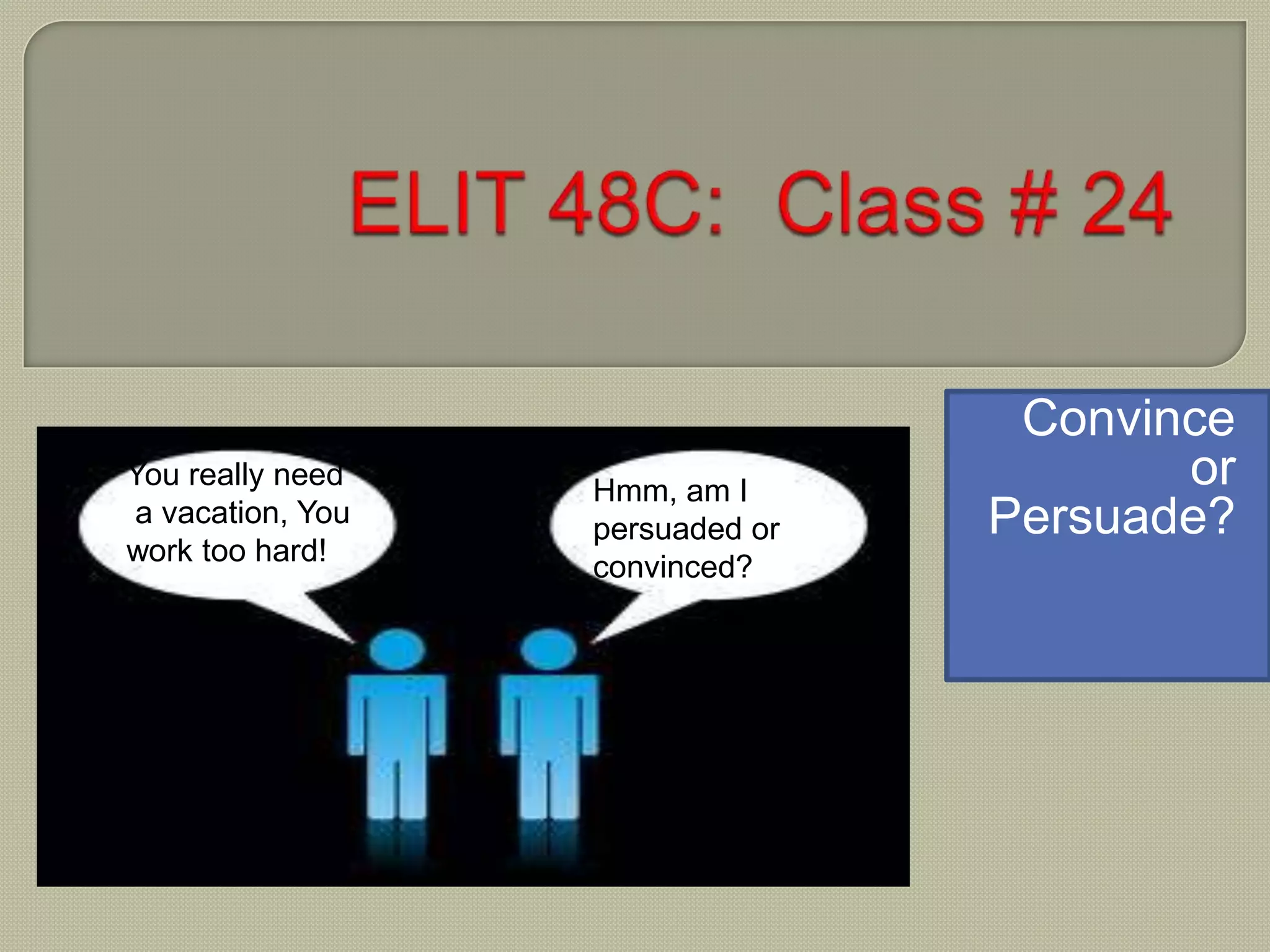
You really need
a vacation, You
work too hard!
Hmm, am I
persuaded or
convinced?
 Strictly speaking, one convinces
a person that something is true
but persuades a person to do
something.
“Pointing out that I was
overworked, my friends persuaded
[not convinced] me to take a vacation.
Now that I'm relaxing on the beach
with my book, I am convinced [not
persuaded] that they were right.”
 Read more: Easily Confused or Misused Words | Infoplease.com
http://www.infoplease.com/ipa/A0200807.html#ixzz2T7jurahi
Chair poetry
Introduction to Essay #1
• Due Friday, May 24th at midnight
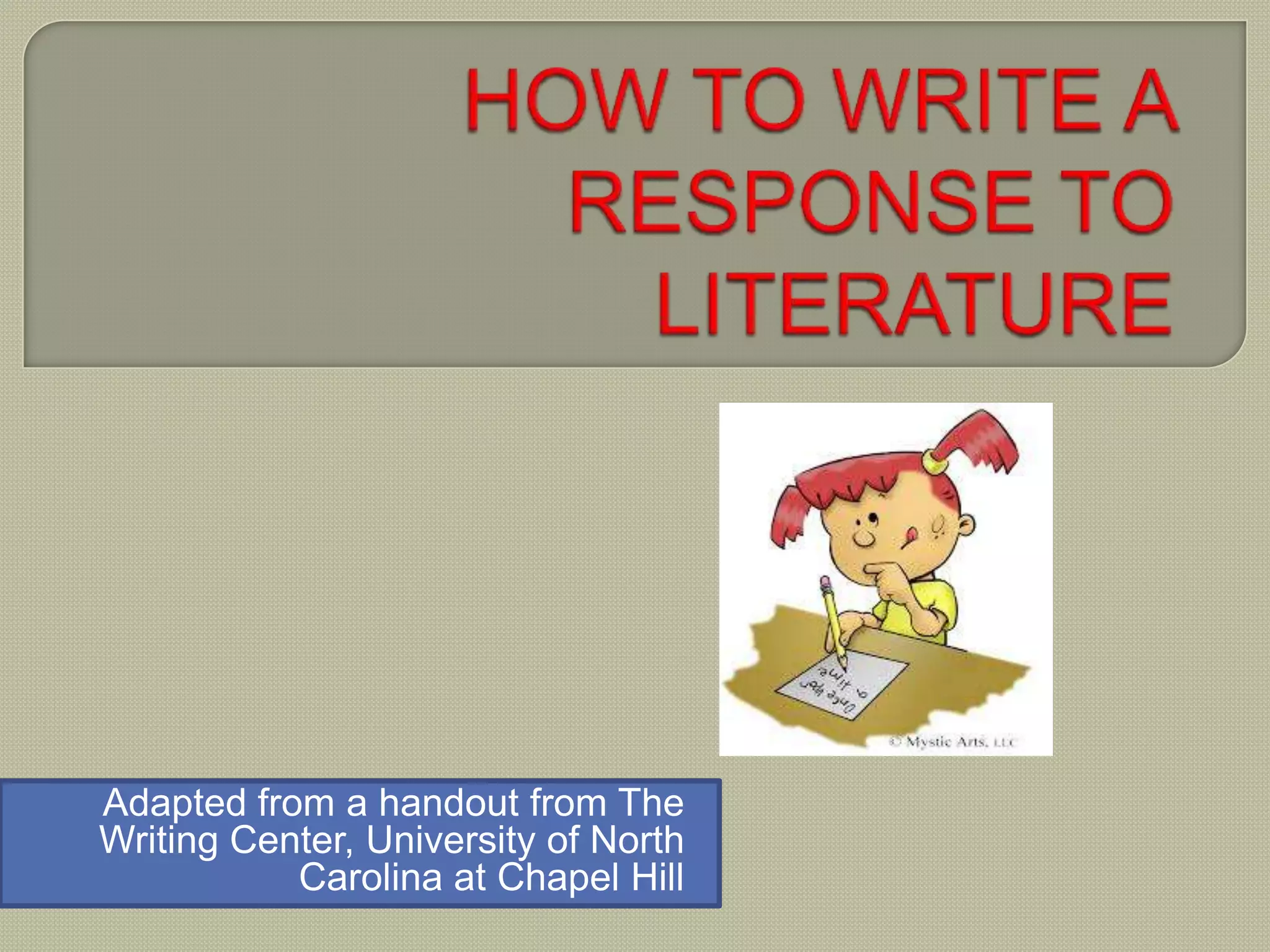
How to write a response to
literature.
Gatsby: Friday, 11:00 am at the
AMC Cupertino. I will be there at
10:30.
 [[Poetry is]...the
record of the best and
happiest moments of
the best and happiest
minds...
 - Shelley
 There are many essay topics to choose from.
On the webpage, click on “Essay Prompts” and then “Essay
#1”
 You will see another list of choices specific to our texts.
Click on any of them to explore topics
 You may write an essay on any of these topics.
 You may write an essay on a topic of your choice.
 You may use fodder from one of your posts.
 The essay is due Friday, May 24th at midnight.
Send it as a word document to palmorekim@fhda.edu
 In this first half of our quarter, we have read and
discussed multiple texts, theories, and opinions on
both literature and literary analysis, and for this
reason, I offer you many choices for your first
essay. In a thesis driven essay of 500 to 750
words, respond to one of the prompts I have
offered or one of your own. You need only the
primary text for this essay, but you may incorporate
other stories, manifestos, or critical theory as
additional support. Remember, you can also draw
on your own experiences and knowledge to
discuss, explain, and analyze your topic.
 All of the action in this play takes place in a single
setting: the home of the murdered man and his wife, who
the reader learns is his killer. The men and women who
enter the home after the crime see totally different
scenes in this same setting, though. What each set of
characters sees is limited by his or her gender. The
women notice certain items—preserved fruit, a sewing
box, an empty bird cage—that the men completely
overlook because they consider the domestic space of
the woman of the house to be worthless in terms of
offering clues about the crime. Write an essay in which
you define and explain the two gendered spaces and
their significance in the development of the plot and the
play’s outcome.
 In a 1915 interview, Cather commented, "No one without a
good ear can write good fiction." In “The Novel Demeuble”
Cather writes, “Whatever is felt upon the page without being
specifically named there—that, it seems to me, is created. It is
the inexplicable presence of the thing not named, of the over-
tone divined by the ear but not heard by it, the verbal
mood, the emotional aura of the fact or the thing or the
deed, that gives high quality to the novel or the drama, as well
as to poetry itself.” What particular passages in My Antonia
show Cather's "good ear" for the sound of language? Which
show her ability to create “the thing not named”? Discuss
how and why these passages capture the moods and themes of
the novel. How do they contribute to the idea of the modernist
novel?
In class, we covered eight ways to
determine character. Do parallel character
sketches of Tom Buchanan and George
Wilson; compare them to show their
similarities.
Adapted from a handout from The
Writing Center, University of North
Carolina at Chapel Hill
A good, valid, and interesting interpretation will do the
following:
avoid the obvious (in other words, it won’t argue a
conclusion that most readers could reach on their
own from a general knowledge of the story)
support its main points with strong textual evidence
from the story and/or secondary sources.
use careful reasoning to explain how that evidence
relates to the main points of the interpretation.
 A good paper begins with the writer having a
solid understanding of the work. Being able to
have the whole text in your head when you begin
thinking through ideas will actually allow you to
write the paper more quickly in the long run.
 Spend some time just thinking about the story.
Flip back through the book and consider what
interests you about this book—what seemed
strange, new, or important?
Be Familiar with the Text
 Even though you have a list of topics from which
to choose, you must develop your own
interpretation.
 Consider how you might approach each topic.
What will your answer to each question show about the
text?
So what? Why will anyone care?
Try this phrase for each prompt to see if you have an
idea: “This book/poem/play/short story shows
______________________. This is important because
______________________.”
 Narrow down your list of
possible topics by identifying
how much evidence or how
many details you could use to
investigate each potential
issue.
 Keep in mind that papers rely
on ample evidence and that
having a lot of details to
choose from can make your
paper easier to write.
 Jot down all the events or
elements of the story that
have some bearing on the
two or three topics that
seem most promising.
 Don’t launch into a topic
without considering all the
options first because you
may end up with a topic
that seemed promising
initially but that only leads
to a dead end.
Select a Topic with Plenty of Evidence
Skim back over the story or poem and
make a more comprehensive list of the
details that relate to your point.
As you make your notes keep track of
page numbers so you can quickly find the
passages again when you need them.
Make an extended list of evidence
 Once you’ve made your expanded list of
evidence, decide which supporting details are the
strongest.
 First, select the facts which bear the closest relation to
your thesis statement.
 Second, choose the pieces of evidence you’ll be able to
say the most about. Readers tend to be more dazzled
with your interpretations of evidence than with a lot of
quotes from the book.
 Select the details that will allow you to show off your own
reasoning skills and allow you to help the reader see the
story in a way he or she may not have seen it before.
Select your evidence
• Now, go back to your working thesis and refine it
so that it reflects your new understanding of your
topic. This step and the previous step (selecting
evidence) are actually best done at the same
time, since selecting your evidence and defining
the focus of your paper depend upon each other.
Refine your thesis
 Once you have a clear thesis, go back to your list of
selected evidence and group all the similar details
together. The ideas that tie these clusters of evidence
together can then become the claims that you’ll make in
your paper.
 Keep in mind that your claims should not only relate to all
the evidence but also clearly support your thesis.
Once you’re satisfied with the way you’ve grouped your
evidence and with the way that your claims relate to your
thesis, you can begin to consider the most logical way to
organize each of those claims.
Organize your evidence
Avoid the temptation to load your paper with evidence from
your story. Each time you use a specific reference to your
story, be sure to explain the significance of that evidence
in your own words.
To get your readers’ interest, draw their attention to elements
of the story that they wouldn’t necessarily notice or
understand on their own.
If you are quoting passages without interpreting them, you’re
not demonstrating your reasoning skills or helping the reader.
In most cases, interpreting your evidence merely involves
putting into your paper what is already in your head.
Interpret your evidence
Don't forget to consider the scope of your
project: This paper is short! What can you
reasonably cover in a paper of that length?
Eliminate wordiness and repetition to
ensure that you have room to make all of
your points.
See me if you are lost or confused!
 Write about literature in present tense
 Avoid using “thing,” “something,” “everything,” and
“anything.”
 Avoid writing in second person.
 Avoid using contractions.
 Cut Wordy Sentences
 Avoid run-on sentences and fragments.
 Check for misused words
 Put commas and periods inside of quotation
marks
 Does the paper follow MLA guidelines?
• For help, click on “MLA Guidelines” and view the “Basic MLA
format” video.
 Is the page length within assigned limits?
 Is the font type and size within the assigned
guidelines?
 Does the Header follow the assignment guidelines?
 Is the professor's name spelled correctly? Kim Palmore
 Is your name spelled correctly?
 Does the paper have a title? Is it a good title? Is the title
in the appropriate location?
 Have you italicized book and movie titles and put
stories, articles, and poems in quotation marks.
Friday: The Great Gatsby
Monday is an advanced skills research
workshop. This is mandatory for the
Honors cohort. Attendance by other
students will yield participation points. We
will meet in the library lobby at 11:25am.
Tuesday, we will have a guest observer.
Be prepared!
 Read “American Literature since 1945” pp. 3-19
 Honors Group: Read Annotated Bibliography
assignment
 Post #24: Begin essay 1 (This is not an optional post):
Write your thesis/argument. Provide textual evidence
that supports your assertion. Include both quotations
and analysis of the text.
 Remember, We will meet in the library lobby at 11:25am
on Monday!
 Remember, we have a guest on Tuesday so come to
class!

Elit 48 c class 24

  • 1.
    Convince or Persuade? You really need avacation, You work too hard! Hmm, am I persuaded or convinced?
  • 2.
     Strictly speaking,one convinces a person that something is true but persuades a person to do something. “Pointing out that I was overworked, my friends persuaded [not convinced] me to take a vacation. Now that I'm relaxing on the beach with my book, I am convinced [not persuaded] that they were right.”  Read more: Easily Confused or Misused Words | Infoplease.com http://www.infoplease.com/ipa/A0200807.html#ixzz2T7jurahi
  • 3.
    Chair poetry Introduction toEssay #1 • Due Friday, May 24th at midnight How to write a response to literature. Gatsby: Friday, 11:00 am at the AMC Cupertino. I will be there at 10:30.
  • 4.
     [[Poetry is]...the recordof the best and happiest moments of the best and happiest minds...  - Shelley
  • 5.
     There aremany essay topics to choose from. On the webpage, click on “Essay Prompts” and then “Essay #1”  You will see another list of choices specific to our texts. Click on any of them to explore topics  You may write an essay on any of these topics.  You may write an essay on a topic of your choice.  You may use fodder from one of your posts.  The essay is due Friday, May 24th at midnight. Send it as a word document to palmorekim@fhda.edu
  • 6.
     In thisfirst half of our quarter, we have read and discussed multiple texts, theories, and opinions on both literature and literary analysis, and for this reason, I offer you many choices for your first essay. In a thesis driven essay of 500 to 750 words, respond to one of the prompts I have offered or one of your own. You need only the primary text for this essay, but you may incorporate other stories, manifestos, or critical theory as additional support. Remember, you can also draw on your own experiences and knowledge to discuss, explain, and analyze your topic.
  • 7.
     All ofthe action in this play takes place in a single setting: the home of the murdered man and his wife, who the reader learns is his killer. The men and women who enter the home after the crime see totally different scenes in this same setting, though. What each set of characters sees is limited by his or her gender. The women notice certain items—preserved fruit, a sewing box, an empty bird cage—that the men completely overlook because they consider the domestic space of the woman of the house to be worthless in terms of offering clues about the crime. Write an essay in which you define and explain the two gendered spaces and their significance in the development of the plot and the play’s outcome.
  • 8.
     In a1915 interview, Cather commented, "No one without a good ear can write good fiction." In “The Novel Demeuble” Cather writes, “Whatever is felt upon the page without being specifically named there—that, it seems to me, is created. It is the inexplicable presence of the thing not named, of the over- tone divined by the ear but not heard by it, the verbal mood, the emotional aura of the fact or the thing or the deed, that gives high quality to the novel or the drama, as well as to poetry itself.” What particular passages in My Antonia show Cather's "good ear" for the sound of language? Which show her ability to create “the thing not named”? Discuss how and why these passages capture the moods and themes of the novel. How do they contribute to the idea of the modernist novel?
  • 9.
    In class, wecovered eight ways to determine character. Do parallel character sketches of Tom Buchanan and George Wilson; compare them to show their similarities.
  • 10.
    Adapted from ahandout from The Writing Center, University of North Carolina at Chapel Hill
  • 11.
    A good, valid,and interesting interpretation will do the following: avoid the obvious (in other words, it won’t argue a conclusion that most readers could reach on their own from a general knowledge of the story) support its main points with strong textual evidence from the story and/or secondary sources. use careful reasoning to explain how that evidence relates to the main points of the interpretation.
  • 12.
     A goodpaper begins with the writer having a solid understanding of the work. Being able to have the whole text in your head when you begin thinking through ideas will actually allow you to write the paper more quickly in the long run.  Spend some time just thinking about the story. Flip back through the book and consider what interests you about this book—what seemed strange, new, or important? Be Familiar with the Text
  • 13.
     Even thoughyou have a list of topics from which to choose, you must develop your own interpretation.  Consider how you might approach each topic. What will your answer to each question show about the text? So what? Why will anyone care? Try this phrase for each prompt to see if you have an idea: “This book/poem/play/short story shows ______________________. This is important because ______________________.”
  • 14.
     Narrow downyour list of possible topics by identifying how much evidence or how many details you could use to investigate each potential issue.  Keep in mind that papers rely on ample evidence and that having a lot of details to choose from can make your paper easier to write.  Jot down all the events or elements of the story that have some bearing on the two or three topics that seem most promising.  Don’t launch into a topic without considering all the options first because you may end up with a topic that seemed promising initially but that only leads to a dead end. Select a Topic with Plenty of Evidence
  • 15.
    Skim back overthe story or poem and make a more comprehensive list of the details that relate to your point. As you make your notes keep track of page numbers so you can quickly find the passages again when you need them. Make an extended list of evidence
  • 16.
     Once you’vemade your expanded list of evidence, decide which supporting details are the strongest.  First, select the facts which bear the closest relation to your thesis statement.  Second, choose the pieces of evidence you’ll be able to say the most about. Readers tend to be more dazzled with your interpretations of evidence than with a lot of quotes from the book.  Select the details that will allow you to show off your own reasoning skills and allow you to help the reader see the story in a way he or she may not have seen it before. Select your evidence
  • 17.
    • Now, goback to your working thesis and refine it so that it reflects your new understanding of your topic. This step and the previous step (selecting evidence) are actually best done at the same time, since selecting your evidence and defining the focus of your paper depend upon each other. Refine your thesis
  • 18.
     Once youhave a clear thesis, go back to your list of selected evidence and group all the similar details together. The ideas that tie these clusters of evidence together can then become the claims that you’ll make in your paper.  Keep in mind that your claims should not only relate to all the evidence but also clearly support your thesis. Once you’re satisfied with the way you’ve grouped your evidence and with the way that your claims relate to your thesis, you can begin to consider the most logical way to organize each of those claims. Organize your evidence
  • 19.
    Avoid the temptationto load your paper with evidence from your story. Each time you use a specific reference to your story, be sure to explain the significance of that evidence in your own words. To get your readers’ interest, draw their attention to elements of the story that they wouldn’t necessarily notice or understand on their own. If you are quoting passages without interpreting them, you’re not demonstrating your reasoning skills or helping the reader. In most cases, interpreting your evidence merely involves putting into your paper what is already in your head. Interpret your evidence
  • 20.
    Don't forget toconsider the scope of your project: This paper is short! What can you reasonably cover in a paper of that length? Eliminate wordiness and repetition to ensure that you have room to make all of your points. See me if you are lost or confused!
  • 21.
     Write aboutliterature in present tense  Avoid using “thing,” “something,” “everything,” and “anything.”  Avoid writing in second person.  Avoid using contractions.  Cut Wordy Sentences  Avoid run-on sentences and fragments.  Check for misused words  Put commas and periods inside of quotation marks
  • 22.
     Does thepaper follow MLA guidelines? • For help, click on “MLA Guidelines” and view the “Basic MLA format” video.  Is the page length within assigned limits?  Is the font type and size within the assigned guidelines?  Does the Header follow the assignment guidelines?  Is the professor's name spelled correctly? Kim Palmore  Is your name spelled correctly?  Does the paper have a title? Is it a good title? Is the title in the appropriate location?  Have you italicized book and movie titles and put stories, articles, and poems in quotation marks.
  • 23.
    Friday: The GreatGatsby Monday is an advanced skills research workshop. This is mandatory for the Honors cohort. Attendance by other students will yield participation points. We will meet in the library lobby at 11:25am. Tuesday, we will have a guest observer. Be prepared!
  • 24.
     Read “AmericanLiterature since 1945” pp. 3-19  Honors Group: Read Annotated Bibliography assignment  Post #24: Begin essay 1 (This is not an optional post): Write your thesis/argument. Provide textual evidence that supports your assertion. Include both quotations and analysis of the text.  Remember, We will meet in the library lobby at 11:25am on Monday!  Remember, we have a guest on Tuesday so come to class!