Malavika Chandran et al Int. Journal of Engineering Research and Applications www.ijera.com
ISSN : 2248-9622, Vol. 4, Issue 4( Version 1), April 2014, pp.130-133
www.ijera.com 130 | P a g e
Effect of Aeration on Seafood Processing Wastewater
Neena Sunny*, Jinu John**, Malavika Chandran**, Rinu Joseph**, Samal
Sasindran**,
* (Department of Civil Engineering, MG University, Kottayam)
** (Department of Civil Engineering, MG University, Kottayam)
ABSTRACT
The main environmental problems of fish industries are high water consumption and high organic matter, oil
and grease, ammonia, nitrogen and salt contents in the waste water. Aeration helps in the oxidation of these
minerals. This paper consequently focuses on how the various constituents of waste water vary with aeration.
Diffused fine bubble aeration was done in a circular tank at various flow rates (3 l/minute,6.2
l/minute.6.4l/minute) at a constant time period of 20 hours using air stones and the percentage reduction in
ammonia, total Kjeldahl nitrogen , BOD,COD and salts were found out . It was found that as flow rate of
aeration increase the percentage removal of above constituents also increased. Optimum removal was possible at
a flow rate of 6.4l/min. BOD, COD, Ammoniacal nitrogen, Kjeldahl nitrogen, were found to be removed by
91.2%, 82.79%,57.76%, 90.6% respectively . Aeration had no effect on salts and lipids .
Keywords: aspirators, CAD, EPDM, Kjeldahl nitrogen, reactors
I. Introduction
Fish industries play an important role in the
social as well as economical development of our
nation. The main environmental problems of fish
industries are high water consumption and high
organic matter, oil and grease, ammonia ,nitrogen
and salt contents un their waste water
Aeration is the intimate exposure of water
and air. It is a way of thoroughly mixing the air and
water so that various reactions can occur between the
components of the air and the components of the
water.
As per the work of Ancheng Luo et al
(2002), aeration can be an effective method in
treating animal manure for removal of nutrients and
odor problems without causing environmental
problems. A laboratory experiment was conducted on
pig manure to study the effect of continuous and
intermittent aeration at an airflow rate of 1l/minute.
It was found that total Kjeldahl nitrogen was
removed by 24% and organic carbon was removed by
26.55% under continuous aeration process, although
the efficiency is not as high as aeration under high
aeration rate adopted by past researchers. Intermittent
aeration at two hour interval shows a lower efficiency
of carbon & TKN removal than continuous aeration.
Ammonia nitrogen was removed by 32.3% . This
reduction is attributed to the ammonia volatization
and microbial assimilation indicated by gain in
nitrogen.
As per a study conducted by Elif Sekman et
al (2002) on effect of aeration rate on leachate
characteristics of landfill. The effect of aeration rate
was investigated by means of leachate quality
(chemical oxygen demand, biological oxygen
demand, total Kjeldahl and ammonia nitrogen) at
four different aeration rates of 0.1, 0.3, 0.6 and 1.0
L/min . After 75 days of operation, COD reduction
was greater than 80% in all of the aerobic reactors
reaching more than 85% at the end of the experiment.
BOD5 removal efficiencies of reactors were
determined to be greater than 95%.
As per the work of TS Jamieson et al (2003),
the introduction of aeration to a pilot scale
constructed wetland model improved the mean NH3-
N removal efficiency from 50.5 to 93.3%.
This paper consequently focuses on how the various
constituents of waste water vary with aeration.
Aeration was done in various flow rates at a time
period of 20 hours and the percentage reduction in
ammonia, total Kjeldahl nitrogen, BOD, COD and
salts were found out.
II. Aeration
Aeration removes or modifies the
constituents of water using two methods - scrubbing
action and oxidation. Scrubbing action is caused
by turbulence which results when the water and air
mix together. The scrubbing action physically
removes gases from solution in the water, allowing
RESEARCH ARTICLE OPEN ACCESS
Malavika Chandran et al Int. Journal of Engineering Research and Applications www.ijera.com
ISSN : 2248-9622, Vol. 4, Issue 4( Version 1), April 2014, pp.130-133
www.ijera.com 131 | P a g e
them to escape into the surrounding air. Carbon
dioxide and hydrogen sulphide are shown being
removed by scrubbing action. Scrubbing action will
remove tastes and odours from water if the problem
is caused by relatively volatile gases & organic
compounds. Oxidation is the other process through
which aeration purifies water. Oxidation is the
addition of oxygen, the removal of hydrogen, or the
removal of electrons from an element or compound.
When air. is mixed with water, some impurities in the
water, such as iron and manganese, become oxidized.
III. Types of aerator
The goal of an aerator is to increase the
surface area of water coming in contact with air so
that more air can react with the water. As air or water
is broken up into smaller drops/bubbles or into thin
sheets, the same volume of either substance has a
larger surface area. Two most common methods of
aeration system used in wastewater treatment plants
involve the use of either Submerged diffusers
(bottom diffused aeration) by introducing oxygen
or air into the wastewater or another approach is by
mechanical agitation (surface aeration) which
agitates the waste water by various means (eg.,
propellers, blades, or brushes) to introduce air from
the atmosphere .There are several criteria to consider
when selecting the right aeration technolgy. Energy
efficiency is one of the most important, followed by
the system’s mixing abilities, with significant
differences between mechanical aerators compared to
diffuser aerators. Generally said, surface-aerated
basins do not achieve the same performance level as
bottom aeration. In bottom diffused aeration oxygen
transfer is through submerged diffusers or other
aerator devices. Oxygen transfer is controlled by
varying the alr supply rate. Diffusers are connected to
a piping system which is supplied with pressurized
air by a blower. Diffusers break up the air by the
displacement of air by the dispersement of bubbles
throughout the aeration tank. For good performance,
the rate of supply of dissolved oxygen should be
equal to the rate of oxygen consumption exerted by
the liquid under any given set of circumstance. While
a number of equipment and operational parameters
interact to influence the efficiency and rate of oxygen
transfer for a given volume of water being aerated,
aeration devices are evaluated on the basis of the
quantity of oxygen transferred per unit of air
introduced to the water for equivalent conditions.
Automated software is available on the web to assist
with drafting of aeration systems in CAD, as well as
calculation softwares help to determine diffuser
requirements for a given waste water.
3.1Coarse bubble (non porous) diffusers
The most common types of non porous
diffusers are fixed orifices (perforated piping,
sprayers, and slotted tubes); valve orifices; and static
tubes. The bubble size of these diffusers is larger than
the porous diffusers thus lowering the oxygen
transfer efficiency. Coarse bubble diffusers with a
check valve design can be the best choice when the
goal is an aeration system that is simple to design and
easy to fabricate and install in a vertical format.
Coarse bubble diffusers with their rubber diaphragm
cap and check valve system has been used for
decades in waste water treatment plants and
municipal facilities. Since the diffusers are plastic
with molded EPDM rubber check valve diaphragms
they are inexpensive and readily available. The
simplicity of diffuser check valve design minimizes
the back flow of wastewater and debris carried with it
into the piping, which can cause potential long term
operational problems. Also since they are vertical
format diffusers, they lend themselves well to
installations using inexpensive Sch. 80 PVC pipe for
aeration headers.
3.2 Fine bubble diffusers
Fine pore diffusion is a subsurface form of
aeration in which air is introduced in the form of very
small bubbles. They are mounted or screwed into the
diffuser geared pipe (air manifold) that may run
along the length or width of the tank or on a short
manifold mounted on a movable pipe (lift
pipe).These diffusers come in various sizes and
shapes such as discs, tubes, domes and plates .Fine
pore diffusers (discs, tubes, domes and plates) are
usually made from ceramics, plastics, or flexible
perforated membranes. Although many materials can
be used to make fine pore diffusers, only these few
are being used due to cost consideration, specific
characteristics, market size and other factors. These
materials are resistant to the chemicals used in waste
water treatment.
3.3 Other diffusion devices:
These include jet aerators which discharge a
mixture of air and liquid through a nozzle near the
tank bottom, aspirators mounted at the basin surface
to supply a mixture of air and water and U tubes
where compressed air is discharged into the down
leg of a deep-vertical-shaft.
IV. Method of aeration adopted
4.1Fine bubble diffusion
Fine bubble diffusers have more oxygen
transfer efficiency than coarse bubble diffusers.
Coarse bubble diffuser are more economical and
requires less maintenance, but have a lower oxygen
Malavika Chandran et al Int. Journal of Engineering Research and Applications www.ijera.com
ISSN : 2248-9622, Vol. 4, Issue 4( Version 1), April 2014, pp.130-133
www.ijera.com 132 | P a g e
transfer efficiency. Air stones were used as diffusers.
They were preferred because,
 Dust and dirt particles up to 30micron can pass
through it
 No air filters are needed.
 Produce uniform fine bubble.
4.2 Aeration tank
Circuar tank was used for aeration. It was
found that the circular tanks are the most energy
efficient. As per Achanta Ramakrishna Rao et al
circular tanks produce maximum energy efficiency
for a given input energy, followed by square tanks,
rectangular tanks of L/W equal to 1.5 and rectangular
tank of L/W equal to 2. This suggests that the circular
tanks perform the most better as far as power
requirements are concerned and hence provide better
economy. Although the square tanks were the best for
quick aeration, they consumed more energy than the
circular tanks.
V. Results & discussions
It was found that as flow rate of aeration
increase the percentage removal of BOD, COD ,
Ammoniacal nitrogen, Kjeldahl nitrogen also
increased. Optimum removal was possible at a flow
rate of 6.4l/min. BOD, COD, Ammoniacal nitrogen,
Kjeldahl nitrogen, were found to be removed by
91.2%, 82.79%, 57.76%, 90.6% respectively .
Aeration had no effect on salts and lipids.
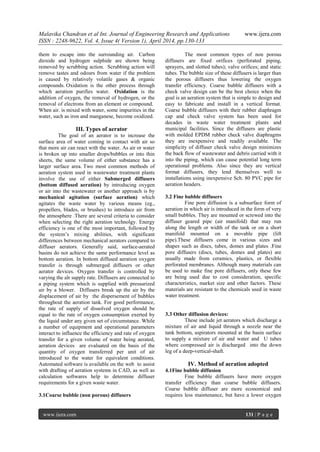
TABLE 1
Percentage decrease of various constituents at different flow rates
Effluent 3(l/min) 6.2(l/min) 6.4(l/min)
NH
3
-N 27.96% 55.93% 57.76%
Kjeldhal nitrogen 55.75% 89.04% 90.61%
Lipids - - -
Salts - - -
BOD 78.20% 89.70% 91.2%
COD 43.90% 81.76% 82.79%
Malavika Chandran et al Int. Journal of Engineering Research and Applications www.ijera.com
ISSN : 2248-9622, Vol. 4, Issue 4( Version 1), April 2014, pp.130-133
www.ijera.com 133 | P a g e
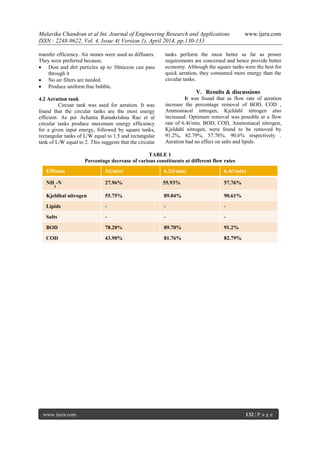
CHART 1
Flowrate vs % decrease in effluent parameters
VI. CONCLUSION
It was found that as flow rate of aeration
increase the percentage removal of BOD, COD,
Ammoniacal nitrogen, Kjeldahl nitrogen also
increased. Optimum removal was possible at a flow
rate of 6.4l/min. BOD, COD, Ammoniacal nitrogen,
Kjeldahl nitrogen, were found to be removed by
91.2%, 82.79%, 57.76%, 90.6% respectively.
Aeration had no effect on salts and lipids .It can be
expected that for a higher air flow rate above 6.4
l/min, more removal of these parameters can be
obtained.
References
[1] Achanta Ramakrishna Rao, Bimlesh
Kumar and Ajay Kumar Patel , Relative
performance of different shaped surface
aeration tanks, 34-40, 2007
[2] Hourard S Peavy, Donald R Roul, George
tchobanoglous,’ Environmental
Engineering’.
[3] S K Garg, ‘Environmental engineering’,
volume 1 & 2, 1999, Khanna Publications,
New Delhi.
[4] DA C Turoet, F M Laur,’Water supply
Engineering’.
[5] Dr.B.C.Punmia,’Water supply
Engineering’ volume 2, 1999, Arihant
Publications, 4 th
edition.
[6] Metcalf & Eddy, Waste water Engineering,
McGraw Hill International Editions.
[7] ‘Standard Methods for the Examination of
water and waste water’, American Public
Health Association.
[8] IS: 10500-1991,’Indian Standard code for
drinking water’,Bureau of Indian standards,
New Delhi.
0.00%
10.00%
20.00%
30.00%
40.00%
50.00%
60.00%
70.00%
80.00%
90.00%
100.00%
BOD TKN COD NH3-N
78.20%
55.75%
43.90%
27.96%
89.70% 89.04%
81.76%
55.93%
91.20% 90.61%
82.79%
57.76%
%removalofeffluentparameters
Effluent parameters in mg/l
% removal of different effluent parameters at
different flow rates
3 l/min
6.2 l/min
6.4 l/min

T044130133

  • 1.
    Malavika Chandran etal Int. Journal of Engineering Research and Applications www.ijera.com ISSN : 2248-9622, Vol. 4, Issue 4( Version 1), April 2014, pp.130-133 www.ijera.com 130 | P a g e Effect of Aeration on Seafood Processing Wastewater Neena Sunny*, Jinu John**, Malavika Chandran**, Rinu Joseph**, Samal Sasindran**, * (Department of Civil Engineering, MG University, Kottayam) ** (Department of Civil Engineering, MG University, Kottayam) ** (Department of Civil Engineering, MG University, Kottayam) ** (Department of Civil Engineering, MG University, Kottayam) ** (Department of Civil Engineering, MG University, Kottayam) ABSTRACT The main environmental problems of fish industries are high water consumption and high organic matter, oil and grease, ammonia, nitrogen and salt contents in the waste water. Aeration helps in the oxidation of these minerals. This paper consequently focuses on how the various constituents of waste water vary with aeration. Diffused fine bubble aeration was done in a circular tank at various flow rates (3 l/minute,6.2 l/minute.6.4l/minute) at a constant time period of 20 hours using air stones and the percentage reduction in ammonia, total Kjeldahl nitrogen , BOD,COD and salts were found out . It was found that as flow rate of aeration increase the percentage removal of above constituents also increased. Optimum removal was possible at a flow rate of 6.4l/min. BOD, COD, Ammoniacal nitrogen, Kjeldahl nitrogen, were found to be removed by 91.2%, 82.79%,57.76%, 90.6% respectively . Aeration had no effect on salts and lipids . Keywords: aspirators, CAD, EPDM, Kjeldahl nitrogen, reactors I. Introduction Fish industries play an important role in the social as well as economical development of our nation. The main environmental problems of fish industries are high water consumption and high organic matter, oil and grease, ammonia ,nitrogen and salt contents un their waste water Aeration is the intimate exposure of water and air. It is a way of thoroughly mixing the air and water so that various reactions can occur between the components of the air and the components of the water. As per the work of Ancheng Luo et al (2002), aeration can be an effective method in treating animal manure for removal of nutrients and odor problems without causing environmental problems. A laboratory experiment was conducted on pig manure to study the effect of continuous and intermittent aeration at an airflow rate of 1l/minute. It was found that total Kjeldahl nitrogen was removed by 24% and organic carbon was removed by 26.55% under continuous aeration process, although the efficiency is not as high as aeration under high aeration rate adopted by past researchers. Intermittent aeration at two hour interval shows a lower efficiency of carbon & TKN removal than continuous aeration. Ammonia nitrogen was removed by 32.3% . This reduction is attributed to the ammonia volatization and microbial assimilation indicated by gain in nitrogen. As per a study conducted by Elif Sekman et al (2002) on effect of aeration rate on leachate characteristics of landfill. The effect of aeration rate was investigated by means of leachate quality (chemical oxygen demand, biological oxygen demand, total Kjeldahl and ammonia nitrogen) at four different aeration rates of 0.1, 0.3, 0.6 and 1.0 L/min . After 75 days of operation, COD reduction was greater than 80% in all of the aerobic reactors reaching more than 85% at the end of the experiment. BOD5 removal efficiencies of reactors were determined to be greater than 95%. As per the work of TS Jamieson et al (2003), the introduction of aeration to a pilot scale constructed wetland model improved the mean NH3- N removal efficiency from 50.5 to 93.3%. This paper consequently focuses on how the various constituents of waste water vary with aeration. Aeration was done in various flow rates at a time period of 20 hours and the percentage reduction in ammonia, total Kjeldahl nitrogen, BOD, COD and salts were found out. II. Aeration Aeration removes or modifies the constituents of water using two methods - scrubbing action and oxidation. Scrubbing action is caused by turbulence which results when the water and air mix together. The scrubbing action physically removes gases from solution in the water, allowing RESEARCH ARTICLE OPEN ACCESS
  • 2.
    Malavika Chandran etal Int. Journal of Engineering Research and Applications www.ijera.com ISSN : 2248-9622, Vol. 4, Issue 4( Version 1), April 2014, pp.130-133 www.ijera.com 131 | P a g e them to escape into the surrounding air. Carbon dioxide and hydrogen sulphide are shown being removed by scrubbing action. Scrubbing action will remove tastes and odours from water if the problem is caused by relatively volatile gases & organic compounds. Oxidation is the other process through which aeration purifies water. Oxidation is the addition of oxygen, the removal of hydrogen, or the removal of electrons from an element or compound. When air. is mixed with water, some impurities in the water, such as iron and manganese, become oxidized. III. Types of aerator The goal of an aerator is to increase the surface area of water coming in contact with air so that more air can react with the water. As air or water is broken up into smaller drops/bubbles or into thin sheets, the same volume of either substance has a larger surface area. Two most common methods of aeration system used in wastewater treatment plants involve the use of either Submerged diffusers (bottom diffused aeration) by introducing oxygen or air into the wastewater or another approach is by mechanical agitation (surface aeration) which agitates the waste water by various means (eg., propellers, blades, or brushes) to introduce air from the atmosphere .There are several criteria to consider when selecting the right aeration technolgy. Energy efficiency is one of the most important, followed by the system’s mixing abilities, with significant differences between mechanical aerators compared to diffuser aerators. Generally said, surface-aerated basins do not achieve the same performance level as bottom aeration. In bottom diffused aeration oxygen transfer is through submerged diffusers or other aerator devices. Oxygen transfer is controlled by varying the alr supply rate. Diffusers are connected to a piping system which is supplied with pressurized air by a blower. Diffusers break up the air by the displacement of air by the dispersement of bubbles throughout the aeration tank. For good performance, the rate of supply of dissolved oxygen should be equal to the rate of oxygen consumption exerted by the liquid under any given set of circumstance. While a number of equipment and operational parameters interact to influence the efficiency and rate of oxygen transfer for a given volume of water being aerated, aeration devices are evaluated on the basis of the quantity of oxygen transferred per unit of air introduced to the water for equivalent conditions. Automated software is available on the web to assist with drafting of aeration systems in CAD, as well as calculation softwares help to determine diffuser requirements for a given waste water. 3.1Coarse bubble (non porous) diffusers The most common types of non porous diffusers are fixed orifices (perforated piping, sprayers, and slotted tubes); valve orifices; and static tubes. The bubble size of these diffusers is larger than the porous diffusers thus lowering the oxygen transfer efficiency. Coarse bubble diffusers with a check valve design can be the best choice when the goal is an aeration system that is simple to design and easy to fabricate and install in a vertical format. Coarse bubble diffusers with their rubber diaphragm cap and check valve system has been used for decades in waste water treatment plants and municipal facilities. Since the diffusers are plastic with molded EPDM rubber check valve diaphragms they are inexpensive and readily available. The simplicity of diffuser check valve design minimizes the back flow of wastewater and debris carried with it into the piping, which can cause potential long term operational problems. Also since they are vertical format diffusers, they lend themselves well to installations using inexpensive Sch. 80 PVC pipe for aeration headers. 3.2 Fine bubble diffusers Fine pore diffusion is a subsurface form of aeration in which air is introduced in the form of very small bubbles. They are mounted or screwed into the diffuser geared pipe (air manifold) that may run along the length or width of the tank or on a short manifold mounted on a movable pipe (lift pipe).These diffusers come in various sizes and shapes such as discs, tubes, domes and plates .Fine pore diffusers (discs, tubes, domes and plates) are usually made from ceramics, plastics, or flexible perforated membranes. Although many materials can be used to make fine pore diffusers, only these few are being used due to cost consideration, specific characteristics, market size and other factors. These materials are resistant to the chemicals used in waste water treatment. 3.3 Other diffusion devices: These include jet aerators which discharge a mixture of air and liquid through a nozzle near the tank bottom, aspirators mounted at the basin surface to supply a mixture of air and water and U tubes where compressed air is discharged into the down leg of a deep-vertical-shaft. IV. Method of aeration adopted 4.1Fine bubble diffusion Fine bubble diffusers have more oxygen transfer efficiency than coarse bubble diffusers. Coarse bubble diffuser are more economical and requires less maintenance, but have a lower oxygen
  • 3.
    Malavika Chandran etal Int. Journal of Engineering Research and Applications www.ijera.com ISSN : 2248-9622, Vol. 4, Issue 4( Version 1), April 2014, pp.130-133 www.ijera.com 132 | P a g e transfer efficiency. Air stones were used as diffusers. They were preferred because,  Dust and dirt particles up to 30micron can pass through it  No air filters are needed.  Produce uniform fine bubble. 4.2 Aeration tank Circuar tank was used for aeration. It was found that the circular tanks are the most energy efficient. As per Achanta Ramakrishna Rao et al circular tanks produce maximum energy efficiency for a given input energy, followed by square tanks, rectangular tanks of L/W equal to 1.5 and rectangular tank of L/W equal to 2. This suggests that the circular tanks perform the most better as far as power requirements are concerned and hence provide better economy. Although the square tanks were the best for quick aeration, they consumed more energy than the circular tanks. V. Results & discussions It was found that as flow rate of aeration increase the percentage removal of BOD, COD , Ammoniacal nitrogen, Kjeldahl nitrogen also increased. Optimum removal was possible at a flow rate of 6.4l/min. BOD, COD, Ammoniacal nitrogen, Kjeldahl nitrogen, were found to be removed by 91.2%, 82.79%, 57.76%, 90.6% respectively . Aeration had no effect on salts and lipids. TABLE 1 Percentage decrease of various constituents at different flow rates Effluent 3(l/min) 6.2(l/min) 6.4(l/min) NH 3 -N 27.96% 55.93% 57.76% Kjeldhal nitrogen 55.75% 89.04% 90.61% Lipids - - - Salts - - - BOD 78.20% 89.70% 91.2% COD 43.90% 81.76% 82.79%
  • 4.
    Malavika Chandran etal Int. Journal of Engineering Research and Applications www.ijera.com ISSN : 2248-9622, Vol. 4, Issue 4( Version 1), April 2014, pp.130-133 www.ijera.com 133 | P a g e CHART 1 Flowrate vs % decrease in effluent parameters VI. CONCLUSION It was found that as flow rate of aeration increase the percentage removal of BOD, COD, Ammoniacal nitrogen, Kjeldahl nitrogen also increased. Optimum removal was possible at a flow rate of 6.4l/min. BOD, COD, Ammoniacal nitrogen, Kjeldahl nitrogen, were found to be removed by 91.2%, 82.79%, 57.76%, 90.6% respectively. Aeration had no effect on salts and lipids .It can be expected that for a higher air flow rate above 6.4 l/min, more removal of these parameters can be obtained. References [1] Achanta Ramakrishna Rao, Bimlesh Kumar and Ajay Kumar Patel , Relative performance of different shaped surface aeration tanks, 34-40, 2007 [2] Hourard S Peavy, Donald R Roul, George tchobanoglous,’ Environmental Engineering’. [3] S K Garg, ‘Environmental engineering’, volume 1 & 2, 1999, Khanna Publications, New Delhi. [4] DA C Turoet, F M Laur,’Water supply Engineering’. [5] Dr.B.C.Punmia,’Water supply Engineering’ volume 2, 1999, Arihant Publications, 4 th edition. [6] Metcalf & Eddy, Waste water Engineering, McGraw Hill International Editions. [7] ‘Standard Methods for the Examination of water and waste water’, American Public Health Association. [8] IS: 10500-1991,’Indian Standard code for drinking water’,Bureau of Indian standards, New Delhi. 0.00% 10.00% 20.00% 30.00% 40.00% 50.00% 60.00% 70.00% 80.00% 90.00% 100.00% BOD TKN COD NH3-N 78.20% 55.75% 43.90% 27.96% 89.70% 89.04% 81.76% 55.93% 91.20% 90.61% 82.79% 57.76% %removalofeffluentparameters Effluent parameters in mg/l % removal of different effluent parameters at different flow rates 3 l/min 6.2 l/min 6.4 l/min