3 1 / 1 0 / 2 0 2 4
1
INFORMATION SYSTEMS
DEVELOPMENT SOLUTIOM
CHAPTER 2
31/10/2024 1
Understanding a problem or opportunity
• Hard system thinking is based on the premise that a problem exists and can be
stated by one or more stakeholders in an objective way
• Defining a problem is sometimes the most important and difficult step.
• In short, a system cannot be defined unless it is possible to clearly describe what
it is supposed to accomplish.
• there are three kinds of questions that need to be asked to ensure we fully
understand a problem situation
• . First, how difficult or well understood is the problem?
• who or what is impacted?
• what are the various viewpoints of the problem?
31/10/2024 1
Cont’d
• Understanding a problem or opportunity is a crucial step in finding a solution or
capitalizing on it. To do so, let's break it down into smaller, manageable parts
• Define the Problem or Opportunity
• Gather Information
• Analyze the Situation
• Frame the Problem or Opportunity
• Evaluate and Prioritize
31/10/2024 1
Developing an information system solution
• Information system development comprises: -
1) Business Planning
2) Information engineering.
3) System development life cycle
4) Rapid action development
31/10/2024 1
Developing an information system solution
1) Business Planning
• Through the Business planning the business organization recognize its business,
mission, objective and functions and how this determines its business process.
• It involves the technical information system plan, Operational informational
system plan, strategic information system plan.
A. Technical information system plan
B. Operational informational system plan
C. Strategic information plan
31/10/2024 1
Developing an information system solution
2. Information engineering
• It is the methodology to build architecture to plan, analysis and design and implement
application for an enterprise.
• This is executed by: - enterprise methodology and business area analysis.
• This comprises of the information architecture, business architecture and technical
architecture
• Enterprise Methodology: - It is a structural approach to help a corporation enterprise on
Information system plan at high level abstraction to model the primary business,
subsystem and application
• Business area analysis: - It is the stage of engineering information. It focuses on
the subset of information architecture. It involves the different business areas,
recruitment and development of the organization. It involves basically two parts:
- recruitment and data mapping.
31/10/2024 1
Cont’d
3. System development life cycle: -
• System development life cycle method consists of the following activities
 Preliminary investigation
 Requirement analysis or system analysis
 Design of system
 Development of software or coding
 System testing
 Implementation
 Maintenance
31/10/2024 1
Cont’d
4. Preliminary investigation/ Rapid action development: -
 Request clarification.
 Feasibility study.
 Request approval
31/10/2024 1
Implementing the information system Solution
• Now that we have a thorough understanding of the problem or opportunity, it's
time to design and implement a solution. Here's a step-by-step guide to
implementing an information system solution:
• Design the Solution
• Select the Technology Stack
• Develop the System
• Deploy the System
• Train and Support Users
• Evaluate and Refine
31/10/2024 1
Implementing the information system Solution
31/10/2024 1
Cont’d
• The Systems Approach
• It is a problem solving technique that uses a systems orientation to define
problems
• Analyzing a problem and formulating a solution involves these interrelated
activities:
• Recognize and define a problem or opportunity using systems thinking.
• Develop and evaluate alternative system solutions.
• Select the solution that best meets your requirements
• Design the selected system solution.
• Implement and evaluate the success of the system
31/10/2024 1
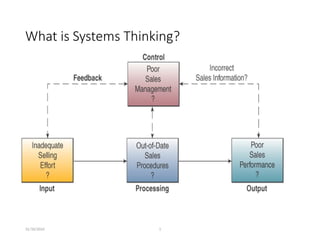
What is Systems Thinking?
31/10/2024 1
Systems Analysis and Design
• It Includes identification of business problems
• There are two most common approaches of system analysis and design.
a) Object-oriented analysis and design
b) Life cycle
• Systems Development Process
1. Systems Investigation: Feasibility study.
May involve consideration of proposals generated by a business/IT planning process
Also includes the preliminary feasibility study of proposed information system
solutions
Feasibility Studies: a preliminary study to determine the Information needs of
prospective users, Resource requirements, Costs, Benefits and Feasibility.
31/10/2024 1
Cont’d
• Operational Feasibility: How well the proposed system will:
• Support the business priorities of the organization
• Solve the identified problem
• Fit with the existing organizational structure
• Economic Feasibility: An assessment of:
• Cost savings
• Increased revenue
• Decreased investment requirements
• Increased profits
• Cost/benefit analysis
• Technical Feasibility: Assessment of:
• Hardware
• Software
• Network
31/10/2024 1
Cont’d
• Human Factors Feasibility: Assess the acceptance level of:
• Employees
• Customers
• Suppliers
• Management support
• Determine the right people for the various new or revised roles
• Legal/Political Feasibility: Assess
• Possible patent or copyright violations
• Software licensing for developer side only
• Governmental restrictions
• Changes to existing reporting structure
31/10/2024 1
2. Systems Analysis: Functional requirements
• An in-depth study of end user information needs
• It produces the functional requirements used as the basis for the design of an
information system
• It typically involves a detailed study of the:
• Information needs of a company and end users
• Activities, resources, and products of one or more of the information systems
currently being used
• Information system capabilities required to meet the information needs of
business stakeholders
• Organizational Analysis: Study of the organization, including…
• Management structure
• People
• Business activities
31/10/2024 1
3. Analysis of the Present System
 Before designing a new system, it is important to study the system to be
improved or replaced.
• Hardware and software
• Network
• People resources used to convert data resources into information products
• System activities of input, processing, output, storage, and control
31/10/2024 1
Cont’d
• Logical Analysis: A logical model is a blueprint of the current system.
• It displays what the current system does, without regard to how it does it
• It allows an analyst to understand the processes, functions, and data
associated with a system without getting bogged down with hardware and
software.
• Functional Requirements: This step of systems analysis is one of the most
difficult.
• Determine what type of information each business activity requires
• Try to determine the information processing capabilities required for each
system activity.
• The goal is to identify what should be done, not how to do it
31/10/2024 1
Systems Design
• It is the process of defining elements of a system like modules, architecture,
components for a system based on the specified requirements
• Systems design focuses on three areas
User interface design
Data design
Process design
• Prototyping: Prototyping is the rapid development and testing of working models.
• An interactive, iterative process used during the design phase
• Makes development faster and easier, especially when end user requirements are
hard to define
• Has enlarged the role of business stakeholders
31/10/2024 1
User Interface Design
• Focuses on supporting the interactions between end users and their computer-
based applications
System Specifications
• Formalizing the design of:
• User interface methods and products
• Database structures
• Processing procedures
• Control procedures
End User Development
 Information system professionals play a consulting role, while uses do their
own application development
31/10/2024 1
4. Implementing New Systems
• The systems implementation stage involves
 Hardware and software acquisition
 Software development
 Testing of programs and procedures
 Conversion of data resources
 Conversion alternatives
 Education/training of end users
Implementation Process
 Acquisition of hardware, software and system
 Software development or modification
 Data conversion
 End user training
 Conversion of implementation
31/10/2024 1
Documentation
• User Documentation
• Sample data entry screens, forms, reports
• System operating instructions
• Systems Documentation
• Method of communication among those developing, implementing, and maintaining
a computer-based system
• Detailed record of the system design
• Training: End users must be trained to operate a new business system or its
implementation will fail
• May involve only activities, such as data entry, or all aspects of system use
• Managers and end users must understand how the new technology impacts business
operations
31/10/2024 1
Major System Conversion Strategies
• Direct Conversion
• The simplest conversion strategy
• The most disruptive to the organization
• Sometimes referred to as the slam dunk or cold-turkey strategy
• Has the highest risk of failure
• Involves turning off the old system and turning on the new one
• Parallel Conversion
• Old and new systems are run simultaneously until everyone is satisfied that:
• The new system functions correctly.
• The old system is no longer needed.
• Conversion to new system can be single cutover or phased cutover
• Has the lowest risk, but the highest cost.
• Can cost 4 times more than using the old system
• Best choice where an automated system is replacing a manual one.
31/10/2024 1
Pilot Conversion
• Scenarios best suited to a pilot conversion:
• Multiple business locations.
• Geographically diverse locations
Phased Conversion
• A phased or gradual conversion:
• Takes advantage of both the direct and parallel approaches
• Minimizes the risks involved.
• Allows the new system to be brought online as logically ordered
functional components
31/10/2024 1
Systems Maintenance
There are four basic categories of system maintenance
• Corrective: fix bugs/virus and logical errors.
• Adaptive: add new functionality.
• Perfective: improve performance.
• Preventive: reduce chances of failure
5. Post-Implementation Review:
• Ensures that the newly implemented system meets the established business
objectives
• Errors must be corrected by the maintenance process
• Includes a periodic review/audit of the system as well as continuous
monitoring

INFORMATION SYSTEMS DEVELOPMENT SOLUTION

  • 1.
    3 1 /1 0 / 2 0 2 4 1 INFORMATION SYSTEMS DEVELOPMENT SOLUTIOM CHAPTER 2
  • 2.
    31/10/2024 1 Understanding aproblem or opportunity • Hard system thinking is based on the premise that a problem exists and can be stated by one or more stakeholders in an objective way • Defining a problem is sometimes the most important and difficult step. • In short, a system cannot be defined unless it is possible to clearly describe what it is supposed to accomplish. • there are three kinds of questions that need to be asked to ensure we fully understand a problem situation • . First, how difficult or well understood is the problem? • who or what is impacted? • what are the various viewpoints of the problem?
  • 3.
    31/10/2024 1 Cont’d • Understandinga problem or opportunity is a crucial step in finding a solution or capitalizing on it. To do so, let's break it down into smaller, manageable parts • Define the Problem or Opportunity • Gather Information • Analyze the Situation • Frame the Problem or Opportunity • Evaluate and Prioritize
  • 4.
    31/10/2024 1 Developing aninformation system solution • Information system development comprises: - 1) Business Planning 2) Information engineering. 3) System development life cycle 4) Rapid action development
  • 5.
    31/10/2024 1 Developing aninformation system solution 1) Business Planning • Through the Business planning the business organization recognize its business, mission, objective and functions and how this determines its business process. • It involves the technical information system plan, Operational informational system plan, strategic information system plan. A. Technical information system plan B. Operational informational system plan C. Strategic information plan
  • 6.
    31/10/2024 1 Developing aninformation system solution 2. Information engineering • It is the methodology to build architecture to plan, analysis and design and implement application for an enterprise. • This is executed by: - enterprise methodology and business area analysis. • This comprises of the information architecture, business architecture and technical architecture • Enterprise Methodology: - It is a structural approach to help a corporation enterprise on Information system plan at high level abstraction to model the primary business, subsystem and application • Business area analysis: - It is the stage of engineering information. It focuses on the subset of information architecture. It involves the different business areas, recruitment and development of the organization. It involves basically two parts: - recruitment and data mapping.
  • 7.
    31/10/2024 1 Cont’d 3. Systemdevelopment life cycle: - • System development life cycle method consists of the following activities  Preliminary investigation  Requirement analysis or system analysis  Design of system  Development of software or coding  System testing  Implementation  Maintenance
  • 8.
    31/10/2024 1 Cont’d 4. Preliminaryinvestigation/ Rapid action development: -  Request clarification.  Feasibility study.  Request approval
  • 9.
    31/10/2024 1 Implementing theinformation system Solution • Now that we have a thorough understanding of the problem or opportunity, it's time to design and implement a solution. Here's a step-by-step guide to implementing an information system solution: • Design the Solution • Select the Technology Stack • Develop the System • Deploy the System • Train and Support Users • Evaluate and Refine
  • 10.
    31/10/2024 1 Implementing theinformation system Solution
  • 11.
    31/10/2024 1 Cont’d • TheSystems Approach • It is a problem solving technique that uses a systems orientation to define problems • Analyzing a problem and formulating a solution involves these interrelated activities: • Recognize and define a problem or opportunity using systems thinking. • Develop and evaluate alternative system solutions. • Select the solution that best meets your requirements • Design the selected system solution. • Implement and evaluate the success of the system
  • 12.
    31/10/2024 1 What isSystems Thinking?
  • 13.
    31/10/2024 1 Systems Analysisand Design • It Includes identification of business problems • There are two most common approaches of system analysis and design. a) Object-oriented analysis and design b) Life cycle • Systems Development Process 1. Systems Investigation: Feasibility study. May involve consideration of proposals generated by a business/IT planning process Also includes the preliminary feasibility study of proposed information system solutions Feasibility Studies: a preliminary study to determine the Information needs of prospective users, Resource requirements, Costs, Benefits and Feasibility.
  • 14.
    31/10/2024 1 Cont’d • OperationalFeasibility: How well the proposed system will: • Support the business priorities of the organization • Solve the identified problem • Fit with the existing organizational structure • Economic Feasibility: An assessment of: • Cost savings • Increased revenue • Decreased investment requirements • Increased profits • Cost/benefit analysis • Technical Feasibility: Assessment of: • Hardware • Software • Network
  • 15.
    31/10/2024 1 Cont’d • HumanFactors Feasibility: Assess the acceptance level of: • Employees • Customers • Suppliers • Management support • Determine the right people for the various new or revised roles • Legal/Political Feasibility: Assess • Possible patent or copyright violations • Software licensing for developer side only • Governmental restrictions • Changes to existing reporting structure
  • 16.
    31/10/2024 1 2. SystemsAnalysis: Functional requirements • An in-depth study of end user information needs • It produces the functional requirements used as the basis for the design of an information system • It typically involves a detailed study of the: • Information needs of a company and end users • Activities, resources, and products of one or more of the information systems currently being used • Information system capabilities required to meet the information needs of business stakeholders • Organizational Analysis: Study of the organization, including… • Management structure • People • Business activities
  • 17.
    31/10/2024 1 3. Analysisof the Present System  Before designing a new system, it is important to study the system to be improved or replaced. • Hardware and software • Network • People resources used to convert data resources into information products • System activities of input, processing, output, storage, and control
  • 18.
    31/10/2024 1 Cont’d • LogicalAnalysis: A logical model is a blueprint of the current system. • It displays what the current system does, without regard to how it does it • It allows an analyst to understand the processes, functions, and data associated with a system without getting bogged down with hardware and software. • Functional Requirements: This step of systems analysis is one of the most difficult. • Determine what type of information each business activity requires • Try to determine the information processing capabilities required for each system activity. • The goal is to identify what should be done, not how to do it
  • 19.
    31/10/2024 1 Systems Design •It is the process of defining elements of a system like modules, architecture, components for a system based on the specified requirements • Systems design focuses on three areas User interface design Data design Process design • Prototyping: Prototyping is the rapid development and testing of working models. • An interactive, iterative process used during the design phase • Makes development faster and easier, especially when end user requirements are hard to define • Has enlarged the role of business stakeholders
  • 20.
    31/10/2024 1 User InterfaceDesign • Focuses on supporting the interactions between end users and their computer- based applications System Specifications • Formalizing the design of: • User interface methods and products • Database structures • Processing procedures • Control procedures End User Development  Information system professionals play a consulting role, while uses do their own application development
  • 21.
    31/10/2024 1 4. ImplementingNew Systems • The systems implementation stage involves  Hardware and software acquisition  Software development  Testing of programs and procedures  Conversion of data resources  Conversion alternatives  Education/training of end users Implementation Process  Acquisition of hardware, software and system  Software development or modification  Data conversion  End user training  Conversion of implementation
  • 22.
    31/10/2024 1 Documentation • UserDocumentation • Sample data entry screens, forms, reports • System operating instructions • Systems Documentation • Method of communication among those developing, implementing, and maintaining a computer-based system • Detailed record of the system design • Training: End users must be trained to operate a new business system or its implementation will fail • May involve only activities, such as data entry, or all aspects of system use • Managers and end users must understand how the new technology impacts business operations
  • 23.
    31/10/2024 1 Major SystemConversion Strategies • Direct Conversion • The simplest conversion strategy • The most disruptive to the organization • Sometimes referred to as the slam dunk or cold-turkey strategy • Has the highest risk of failure • Involves turning off the old system and turning on the new one • Parallel Conversion • Old and new systems are run simultaneously until everyone is satisfied that: • The new system functions correctly. • The old system is no longer needed. • Conversion to new system can be single cutover or phased cutover • Has the lowest risk, but the highest cost. • Can cost 4 times more than using the old system • Best choice where an automated system is replacing a manual one.
  • 24.
    31/10/2024 1 Pilot Conversion •Scenarios best suited to a pilot conversion: • Multiple business locations. • Geographically diverse locations Phased Conversion • A phased or gradual conversion: • Takes advantage of both the direct and parallel approaches • Minimizes the risks involved. • Allows the new system to be brought online as logically ordered functional components
  • 25.
    31/10/2024 1 Systems Maintenance Thereare four basic categories of system maintenance • Corrective: fix bugs/virus and logical errors. • Adaptive: add new functionality. • Perfective: improve performance. • Preventive: reduce chances of failure 5. Post-Implementation Review: • Ensures that the newly implemented system meets the established business objectives • Errors must be corrected by the maintenance process • Includes a periodic review/audit of the system as well as continuous monitoring