STRATAFICATION OF LANGUAGE
SYSTEMIC FUNCTIONAL
LINGUSTICS (SFL)
STRATAFICATION OF LANGUAGE
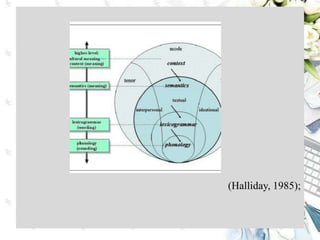
• In systemic functional theory, language is organized as a
multidimensional semiotic space according to (i) the hierarchy
of stratification (semantics, lexicogrammar, and phonology or
graphology); (ii) the metafunctional spectrum of meaning
(ideational: experiential, logical, interpersonal and textual);
and (iii) the cline of instantiation (the cline between potential
and instance).
• Each stratum, language is organized locally according to rank
(clause, group/phrase, word and morpheme), axis
(paradigmatic organization represented by system networks
and syntagmatic organization represented by function
structures) and delicacy (less delicate to more delicate).
(Halliday, 1985);
Semantic
SFL includes, at this level, what is generally known as
'pragmatics.' It has three kinds of meanings (meta-functions with
reference to meanings) again:
1. Experiential:(field) the way we use language to represent our
experiences of the world
2. Interpersonal: relationships (tenor) the way we use language
to interact with others
3. Textual: relation to mode (mode) the way we use language to
organize our spoken or written texts so that they make sense
Lexicogrammar
• Between the content of form pairing of simple semiotic
systems emerged the 'organizational space' referred to as
lexicogrammar.
• It concerns the syntactic organization of words into utterances.
It involves the analysis of utterances in terms of roles: Actor,
Medium, Theme, Moods
• It is Called "Lexico-grammar" to emphasize that it is words
and their combination that makes sentences.
Phonology
Phonology is the branch of linguistics that studies the patterning
of speech sounds in languages. The central term in phonology is
phoneme, which is defined as the smallest meaning
distinguishing sound unit.
References and Recommended Readings
• Celce-Murcia, M., Dörnyei, Z., & Thurrell, S. (1995).
Communicative competence: A pedagogically motivated
model with content specifications. Issues in Applied
linguistics, 6(2), 5-35.
• Slade, D., & Eggins, S. (1997). Analysing casual
conversation. London: Cassell.
• Eggins, S. (1994). An Introduction Systemic Functional
Linguistics. London: Pinter Publisher Ltd.
• Gerot, L and Wignell, P.(1995). Making Sense of Functional
Grammar: An Introductory Book. Sydney: Gerd Stabler.
• Halliday, M.A.K. 1984. Language as Code and Language as
Behaviour: A Systemic Functional Interpretation of the Nature
and Ontogenesis of Dialogue, in R. Fawcett, M.A.K Halliday,
S.M. Lamb and A. Makkai (eds.). The Semiotics of 52
Language and Culture Vol. 1: Language as Social Semiotics.
London: Pinter. 3 – 35.
• Halliday, M.A.K. (1985). An Introduction to Functional
Grammar. London: Edward Arnold.
• Jakobson, R. (1960). Linguistics and poetics. In Style in
language (pp. 350-377). MA: MIT Press.
• Lock, G. (1996). Functional English Grammar: An
introduction for Second Language Teachers.Cambridge:
Cambridge UP
• Matthiessen, C. (1995). Lexicogrammatical cartography:
English systems.Tokyo: Internat. Language Sciences Publ.

SYSTEMIC FUNCTIONAL LINGUISTICS: LANGUAGE STRATAFICATION

  • 1.
    STRATAFICATION OF LANGUAGE SYSTEMICFUNCTIONAL LINGUSTICS (SFL)
  • 2.
    STRATAFICATION OF LANGUAGE •In systemic functional theory, language is organized as a multidimensional semiotic space according to (i) the hierarchy of stratification (semantics, lexicogrammar, and phonology or graphology); (ii) the metafunctional spectrum of meaning (ideational: experiential, logical, interpersonal and textual); and (iii) the cline of instantiation (the cline between potential and instance). • Each stratum, language is organized locally according to rank (clause, group/phrase, word and morpheme), axis (paradigmatic organization represented by system networks and syntagmatic organization represented by function structures) and delicacy (less delicate to more delicate).
  • 3.
  • 4.
    Semantic SFL includes, atthis level, what is generally known as 'pragmatics.' It has three kinds of meanings (meta-functions with reference to meanings) again: 1. Experiential:(field) the way we use language to represent our experiences of the world 2. Interpersonal: relationships (tenor) the way we use language to interact with others 3. Textual: relation to mode (mode) the way we use language to organize our spoken or written texts so that they make sense
  • 5.
    Lexicogrammar • Between thecontent of form pairing of simple semiotic systems emerged the 'organizational space' referred to as lexicogrammar. • It concerns the syntactic organization of words into utterances. It involves the analysis of utterances in terms of roles: Actor, Medium, Theme, Moods • It is Called "Lexico-grammar" to emphasize that it is words and their combination that makes sentences. Phonology Phonology is the branch of linguistics that studies the patterning of speech sounds in languages. The central term in phonology is phoneme, which is defined as the smallest meaning distinguishing sound unit.
  • 6.
    References and RecommendedReadings • Celce-Murcia, M., Dörnyei, Z., & Thurrell, S. (1995). Communicative competence: A pedagogically motivated model with content specifications. Issues in Applied linguistics, 6(2), 5-35. • Slade, D., & Eggins, S. (1997). Analysing casual conversation. London: Cassell. • Eggins, S. (1994). An Introduction Systemic Functional Linguistics. London: Pinter Publisher Ltd. • Gerot, L and Wignell, P.(1995). Making Sense of Functional Grammar: An Introductory Book. Sydney: Gerd Stabler. • Halliday, M.A.K. 1984. Language as Code and Language as Behaviour: A Systemic Functional Interpretation of the Nature and Ontogenesis of Dialogue, in R. Fawcett, M.A.K Halliday, S.M. Lamb and A. Makkai (eds.). The Semiotics of 52 Language and Culture Vol. 1: Language as Social Semiotics. London: Pinter. 3 – 35.
  • 7.
    • Halliday, M.A.K.(1985). An Introduction to Functional Grammar. London: Edward Arnold. • Jakobson, R. (1960). Linguistics and poetics. In Style in language (pp. 350-377). MA: MIT Press. • Lock, G. (1996). Functional English Grammar: An introduction for Second Language Teachers.Cambridge: Cambridge UP • Matthiessen, C. (1995). Lexicogrammatical cartography: English systems.Tokyo: Internat. Language Sciences Publ.