System Development Life Cycle 
(SDLC) 
Presented by: 
Deepanjol Sawra 
1st Semester 
MBA 1010
Contents 
 Definition & Usefulness 
 Phases of SDLC 
 Merits & Demerits 
 Conclusion 
 References
SDLC Definition 
System Development Life Cycle is a process of 
process used by a system analyst to 
develop an information system including 
requirements, validation, training and user 
ownership. 
Computer systems are complex and often 
(especially with the recent rise of Service- 
Oriented Architecture) link multiple 
traditional systems potentially supplied by 
different software vendors.
Phases of SDLC 
 Planning phase 
 Requirement definition phase 
 Design phase 
 Development phase 
 Integration and testing phase 
 Operations and Maintenance phase 
 Implementation and Evaluation
Planning stage 
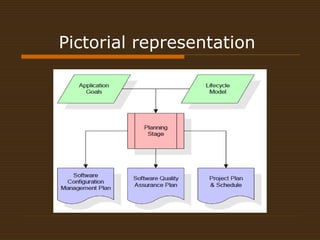
 The planning stage establishes a bird's eye 
view of the intended software product. 
 The most critical section of the project plan 
is a listing of high-level product 
requirements, also referred to as goals. 
 The outputs of the project planning stage 
are the configuration management plan, 
the quality assurance plan, and the project 
plan and schedule.
Pictorial representation
Requirement definition stage 
 The goal of system analysis is to 
determine where the problem is in an 
attempt to fix the system. 
 These requirements define the major 
functions of the intended application, 
operational data areas, reference 
data areas and the initial data areas. 
 Each of these definitions is termed a 
Requirement.
Pictorial representation
Design stage 
 For each requirement, a set of one or more 
design elements will be produced as a 
result of interviews, workshops, and/or 
prototype efforts. 
 Design elements describe the desired 
software features in detail, and generally 
include functional hierarchy diagrams, 
screen layout diagrams, tables of business 
rules, business process diagrams, 
pseudocode, and a complete entity-relationship 
diagram with a full data 
dictionary.
Pictorial representation
Development stage 
 For each design element, a set of one 
or more software artifacts will be 
produced. 
 Appropriate test cases will be 
developed for each set of functionally 
related software artifacts, and an 
online help system will be developed 
to guide users in their interactions 
with the software.
Pictorial representation
Integration and testing stage 
 During the integration and test stage, 
the software artifacts, online help, 
and test data are migrated from the 
development environment to a 
separate test environment. 
 Successful execution of the test suite 
confirms a robust and complete 
migration capability.
Pictorial representation
Operations and Maintenance 
 The deployment of the system 
includes changes and enhancements 
before the decommissioning or sunset 
of the system. 
 As key personnel change positions 
in the organization, new changes will 
be implemented, which will require 
system updates.
Implementation and evaluation 
 During the installation and 
acceptance stage, the software 
artifacts, online help, and initial 
production data are loaded onto the 
production server. 
 Successful execution of the test suite 
is a prerequisite to acceptance of the 
software by the customer.
Pictorial representation
Merits Demerits 
 Control and Monitor 
Large projects. 
 Detailed steps. 
 Evaluate costs and 
completion targets. 
 Documentation. 
 Well defined user input. 
 Ease of maintenance. 
 Development and 
design standards. 
 Increased 
development time. 
 Increased 
development cost. 
 Systems must be 
defined up front. 
 Rigidity. 
 Hard to estimate costs, 
project overruns.
Conclusion 
 The structure imposed by this SDLC is 
specifically designed to maximize the 
probability of a successful software 
development effort. 
 It is critical for the project manager to 
establish and monitor control objectives 
during each SDLC phase while executing 
projects. 
 Control objectives help to provide a clear 
statement of the desired result or purpose 
and should be used throughout the entire 
SDLC process.
References 
 http 
://en.wikipedia.org/wiki/Systems_Development_ http://www.elucidata.org/refs/seglossary.

SDLC

  • 1.
    System Development LifeCycle (SDLC) Presented by: Deepanjol Sawra 1st Semester MBA 1010
  • 2.
    Contents  Definition& Usefulness  Phases of SDLC  Merits & Demerits  Conclusion  References
  • 3.
    SDLC Definition SystemDevelopment Life Cycle is a process of process used by a system analyst to develop an information system including requirements, validation, training and user ownership. Computer systems are complex and often (especially with the recent rise of Service- Oriented Architecture) link multiple traditional systems potentially supplied by different software vendors.
  • 4.
    Phases of SDLC  Planning phase  Requirement definition phase  Design phase  Development phase  Integration and testing phase  Operations and Maintenance phase  Implementation and Evaluation
  • 5.
    Planning stage The planning stage establishes a bird's eye view of the intended software product.  The most critical section of the project plan is a listing of high-level product requirements, also referred to as goals.  The outputs of the project planning stage are the configuration management plan, the quality assurance plan, and the project plan and schedule.
  • 6.
  • 7.
    Requirement definition stage  The goal of system analysis is to determine where the problem is in an attempt to fix the system.  These requirements define the major functions of the intended application, operational data areas, reference data areas and the initial data areas.  Each of these definitions is termed a Requirement.
  • 8.
  • 9.
    Design stage For each requirement, a set of one or more design elements will be produced as a result of interviews, workshops, and/or prototype efforts.  Design elements describe the desired software features in detail, and generally include functional hierarchy diagrams, screen layout diagrams, tables of business rules, business process diagrams, pseudocode, and a complete entity-relationship diagram with a full data dictionary.
  • 10.
  • 11.
    Development stage For each design element, a set of one or more software artifacts will be produced.  Appropriate test cases will be developed for each set of functionally related software artifacts, and an online help system will be developed to guide users in their interactions with the software.
  • 12.
  • 13.
    Integration and testingstage  During the integration and test stage, the software artifacts, online help, and test data are migrated from the development environment to a separate test environment.  Successful execution of the test suite confirms a robust and complete migration capability.
  • 14.
  • 15.
    Operations and Maintenance  The deployment of the system includes changes and enhancements before the decommissioning or sunset of the system.  As key personnel change positions in the organization, new changes will be implemented, which will require system updates.
  • 16.
    Implementation and evaluation  During the installation and acceptance stage, the software artifacts, online help, and initial production data are loaded onto the production server.  Successful execution of the test suite is a prerequisite to acceptance of the software by the customer.
  • 17.
  • 18.
    Merits Demerits Control and Monitor Large projects.  Detailed steps.  Evaluate costs and completion targets.  Documentation.  Well defined user input.  Ease of maintenance.  Development and design standards.  Increased development time.  Increased development cost.  Systems must be defined up front.  Rigidity.  Hard to estimate costs, project overruns.
  • 19.
    Conclusion  Thestructure imposed by this SDLC is specifically designed to maximize the probability of a successful software development effort.  It is critical for the project manager to establish and monitor control objectives during each SDLC phase while executing projects.  Control objectives help to provide a clear statement of the desired result or purpose and should be used throughout the entire SDLC process.
  • 20.
    References  http ://en.wikipedia.org/wiki/Systems_Development_ http://www.elucidata.org/refs/seglossary.