Mobile Devices in Higher Education: 
The answer for future learning? 
Gila Kurtz (Ph.D) 
Instructional Design, Development 
and Evaluation Department 
School of Education 
Syracuse University 
September 2014
Outline: 
 Introduction 
 What is mobile learning? 
 Examples from the field (mainly f2f) 
 Findings from studies 
 What’s next??
???? 
http://www.slideshare.net/gilaku/syracuse-talk
Do you think that mobile devices in 
higher education are the answer for 
future learning? 
Go to: govote.at 
Enter code: 800323 
results
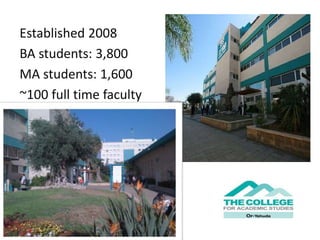
Established 2008 
BA students: 3,800 
MA students: 1,600 
~100 full time faculty
What is mobile learning? 
Any learning which takes place via 
wireless mobile devices such as smart 
phones, PDAs, and tablet PCs where 
these devices are able to move with 
the learners to allow learning anytime, 
anywhere (Naismith et al., 2006; 
Wang, Wu, & Wang, 2009).
BYOD -Bring Your Own Device
fb+ mobile phones - 
presence checking
fb+ mobile phones - 
asking the children 
Integrating a Facebook Group and a Course 
Website: The Effect on Participation and 
Perceptions on Learning 
To be published 
December issue of AJDE (vol. 28 no. 4)
PBL project
Courses’ evaluation
More examples 
• Taking a quiz 
• Sticky & photo sharing 
• Diffusion of innovation theory 
• Google Books Ngram Viewer 
•
Findings from studies 
The Laptop, the Tablet, 
and the Smartphone Attend the Lecture 
Hagit Meishar Tal and Gila Kurtz 
Rosemary, L, Goodyear, P., Grabowski, B., Puntambeker, S., 
Underwood, J. & Winters, I. (Eds.), Handbook on Design in 
Educational Computing. (pp. 279-287) London: Routledge
The Laptop, the Tablet, and the Smartphone Attend the Lecture (1) 
(a) mobile technologies available to students in 
class; 
(b) students’ use of these mobile technologies 
in class; 
(c) students’ perceptions of these uses, i.e., how 
they estimate the contribution or damage of 
the use of these devices during the lecture; 
(d) how intensively lecturers engage students 
via the mobile devices in the students’ 
possession
The Laptop, the Tablet, and the Smartphone Attend the Lecture (2)
The Laptop, the Tablet, and the Smartphone Attend the Lecture (3)
Table 3. Positive and negative effects of using mobile devices in class 
(Range of responses: 1 = none / little, up to 5 = very large extent)
The Laptop, the Tablet, and the Smartphone Attend the Lecture (5)
The Laptop, the Tablet, and the Smartphone Attend the Lecture (5) 
• use of mobile devices in class is all the rage 
among students, serving them identically for 
learning-supportive and distractive purposes 
• “continuous partial attention,” i.e., concurrent 
superficial attention to several incoming 
sources of information (Rose, 2010). 
• These findings hand the higher-education 
system a new challenge—to develop teaching 
strategies that will amplify learning-supportive 
uses and limit distractive ones.
Engaging Students in Class 
through Mobile Technologies – 
Implications for the Learning 
Process and Student Satisfaction
Engaging Students in Class through Mobile Technologies (1) 
• how students are using their mobile devices in 
class and whether lecturers can influence this 
usage to the benefit of learning 
• an intervening research (2 groups, pre-post 
questionnaires) 
• Levels of constructive usage in the 
intervention group were significantly higher 
while less content related distractive usage 
(NOT in distractive communications.
So.. what do you think about my 
presentation??? 
Go to: govote.at 
Enter code: 530892 
results
http://content.mycutegraphics.com/graphics/thankyou/thank-you-sign-in-flower-patch.png 
Gila_k@mla.ac.il

Syracuse talk

  • 1.
    Mobile Devices inHigher Education: The answer for future learning? Gila Kurtz (Ph.D) Instructional Design, Development and Evaluation Department School of Education Syracuse University September 2014
  • 2.
    Outline:  Introduction  What is mobile learning?  Examples from the field (mainly f2f)  Findings from studies  What’s next??
  • 3.
  • 4.
    Do you thinkthat mobile devices in higher education are the answer for future learning? Go to: govote.at Enter code: 800323 results
  • 5.
    Established 2008 BAstudents: 3,800 MA students: 1,600 ~100 full time faculty
  • 10.
    What is mobilelearning? Any learning which takes place via wireless mobile devices such as smart phones, PDAs, and tablet PCs where these devices are able to move with the learners to allow learning anytime, anywhere (Naismith et al., 2006; Wang, Wu, & Wang, 2009).
  • 11.
    BYOD -Bring YourOwn Device
  • 15.
    fb+ mobile phones- presence checking
  • 16.
    fb+ mobile phones- asking the children Integrating a Facebook Group and a Course Website: The Effect on Participation and Perceptions on Learning To be published December issue of AJDE (vol. 28 no. 4)
  • 17.
  • 18.
  • 19.
    More examples •Taking a quiz • Sticky & photo sharing • Diffusion of innovation theory • Google Books Ngram Viewer •
  • 20.
    Findings from studies The Laptop, the Tablet, and the Smartphone Attend the Lecture Hagit Meishar Tal and Gila Kurtz Rosemary, L, Goodyear, P., Grabowski, B., Puntambeker, S., Underwood, J. & Winters, I. (Eds.), Handbook on Design in Educational Computing. (pp. 279-287) London: Routledge
  • 21.
    The Laptop, theTablet, and the Smartphone Attend the Lecture (1) (a) mobile technologies available to students in class; (b) students’ use of these mobile technologies in class; (c) students’ perceptions of these uses, i.e., how they estimate the contribution or damage of the use of these devices during the lecture; (d) how intensively lecturers engage students via the mobile devices in the students’ possession
  • 22.
    The Laptop, theTablet, and the Smartphone Attend the Lecture (2)
  • 23.
    The Laptop, theTablet, and the Smartphone Attend the Lecture (3)
  • 24.
    Table 3. Positiveand negative effects of using mobile devices in class (Range of responses: 1 = none / little, up to 5 = very large extent)
  • 25.
    The Laptop, theTablet, and the Smartphone Attend the Lecture (5)
  • 26.
    The Laptop, theTablet, and the Smartphone Attend the Lecture (5) • use of mobile devices in class is all the rage among students, serving them identically for learning-supportive and distractive purposes • “continuous partial attention,” i.e., concurrent superficial attention to several incoming sources of information (Rose, 2010). • These findings hand the higher-education system a new challenge—to develop teaching strategies that will amplify learning-supportive uses and limit distractive ones.
  • 28.
    Engaging Students inClass through Mobile Technologies – Implications for the Learning Process and Student Satisfaction
  • 29.
    Engaging Students inClass through Mobile Technologies (1) • how students are using their mobile devices in class and whether lecturers can influence this usage to the benefit of learning • an intervening research (2 groups, pre-post questionnaires) • Levels of constructive usage in the intervention group were significantly higher while less content related distractive usage (NOT in distractive communications.
  • 31.
    So.. what doyou think about my presentation??? Go to: govote.at Enter code: 530892 results
  • 32.