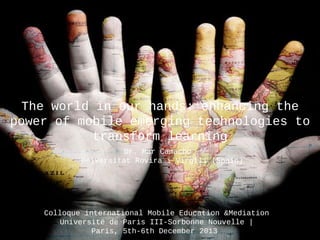
The world in our hands: enhancing the
power of mobile emerging technologies to
transform learning
Dr. Mar Camacho
Universitat Rovira i Virgili (Spain)

Colloque international Mobile Education &Mediation
Université de Paris III-Sorbonne Nouvelle |
Paris, 5th-6th December 2013
emerging technologies
…Are reshaping the nature of education
…Hold great potential for increasing
the access to information as well as
promoting learning.
…Are transforming classrooms into more
engaging, collaborative and productive
learning environments in which
instructions can be customized to
student’s specific needs, interests and
learning styles…
emerging technologies

more personal – networked - fun more interactive – spontaneousshorter in duration - to the point
- for instant use- engaging users
to contribute and share …
At the time that a distinct learning
culture emerges, in which learners take
mobility and context-awareness as
departing point and become more visible
as innovators, creators and producers
they develop new skills, attributes and
literacies enabled by mobile devices
that offer them further possibilities to
extend their learning and link the use
of social media to their own context and
interests.
(Kukulska-Hume, 2010)
Digital natives, but digitally
competent?
More self directed, less top-down
Better arrayed to capture new information
inputs
More reliant on feedback and response
More inclined to collaboration
More open to cross discipline insights
and creating
their own “tagged” taxonomies
More oriented towards people being their
own individual nodes of production

Pew Internet Project, 2012

http://www.flickr.com/photos/29575505@N08/6466580353/
… y diferentes formas de comunicación
The NMC Horizon Report: 2011
m-learning phases
focus on devices 90s

focus on learning outside the classroom

focus on the mobility of the learner
…

is not just the miniaturization and convenience of
portable computing, but is transforming how we
conceptualize and interact with computing and our
environment, communicate, and create and manipulate
information (Cheney, 2010; Pachler, Bachmair, & Cook,
2010).
… is about ubiquitous social connectivity, instant
information access, and enhancing how we view the
world through digital augmentation (Cook, 2010).
… is empowering for learners, who can become content
and context generators within authentic learning
environments (Herrington & Herrington, 2006, 2007)
rather than simply consumers of transmitted content
in classrooms.
Source: @jokay
emerging technologies to
watch

… Within the next12
months
#mobile apps

Defined as the fastest growing
dimension of the mobile space in higher
education right now, with impacts on
virtually every aspect of informal
life,and increasingly, every discipline
in the university.
Top apps functions
• Games
• News/weather
• Maps
• Social networking
• Music
• Entertainment/food
• Banking
• Sports
• Shopping
• Movies

Info updates
Communication
Learn about interests
Destinations
Work tasks
Purchases
Extra info about event
Health
The relevance of Mobile Apps for teaching,
learning
and
creative
inquiry
in
Higher
Education
becomes
evident
when
designing
project-based
workshops,
geo-localization
activities or using storytelling techniques to
explore place and community.
#tablet computing
Higher Education institutions are
seeing them not just as an affordable
solution for one-to-one learning, but also

as a feature-rich tool for field and lab
work, often times replacing far more
expensive and cumbersome devices and
equipment.
#m-URV
• To design and pilot test
the mobile phone
supporting functions to
enhance teacher
development

• To develop short training
courses and workshops,
supporting resources, and
interactive functions
that are appropriate for
the commonly used mobile
phone in the local
context.

• To explore the
institutionalization
mechanism to provide
sustainable content
development
Actions:

• Content creation w/ mobile
devices

• Empower pre-service teacher’s

with training regarding the use
of mobile devices for T and L
(UNESCO, 2012)

• Create training courses

addressed to teachers on the
pedagogical use of mobile
devices.
#m-activities
#geolocalization
#AR & QR
#show & tell w/ a cell
#mstorytelling
#scavenger hunts
#podcasting
www.guardian.co.uk
#challenges

oEconomic pressures and new models of
education are bringing unprecedented
competition to the traditional models
of higher education.
oDigital (and mobile) media literacy
continues its rise in importance as a
key skill in every discipline and
profession.
o3. Institutional barriers present
formidable challenges to moving
forward in a constructive way with
#questions
oHow will institutions respond to
students bringing in their own
mobile multimedia communications
devices? BYOD
oHow can institutions manage the
tension between informal networked
learning and formal institutional
learning?
oWhat types of mobile learning are
appropriate and cost-effective for
colleges, universities and the
workplace?
… and some #conclusions
1.- There is the need to envision the
transformation of teaching and learning
for 21st-century skills and citizenship,
including emerging mobile technologies.
2.- There is a growing emphasis in
higher education on non-traditional
learning models, which is further fueled
by the integration of mobile and emerging
technologies.
3.- Education paradigms are shifting to
include mobile learning, at the time that
there is new emphasis in the classroom on
more challenge-based and active learning.
Merci

mar.camacho@urv.cat |
twitter.com/marett

Mar Camacho, Universitat Rovira i Virgili Faculty (Spain), Visiting scholar at UNESCO HQ in Paris

  • 1.
    The world inour hands: enhancing the power of mobile emerging technologies to transform learning Dr. Mar Camacho Universitat Rovira i Virgili (Spain) Colloque international Mobile Education &Mediation Université de Paris III-Sorbonne Nouvelle | Paris, 5th-6th December 2013
  • 3.
    emerging technologies …Are reshapingthe nature of education …Hold great potential for increasing the access to information as well as promoting learning. …Are transforming classrooms into more engaging, collaborative and productive learning environments in which instructions can be customized to student’s specific needs, interests and learning styles…
  • 4.
    emerging technologies more personal– networked - fun more interactive – spontaneousshorter in duration - to the point - for instant use- engaging users to contribute and share …
  • 6.
    At the timethat a distinct learning culture emerges, in which learners take mobility and context-awareness as departing point and become more visible as innovators, creators and producers they develop new skills, attributes and literacies enabled by mobile devices that offer them further possibilities to extend their learning and link the use of social media to their own context and interests. (Kukulska-Hume, 2010)
  • 7.
    Digital natives, butdigitally competent?
  • 8.
    More self directed,less top-down Better arrayed to capture new information inputs More reliant on feedback and response More inclined to collaboration More open to cross discipline insights and creating their own “tagged” taxonomies More oriented towards people being their own individual nodes of production Pew Internet Project, 2012 http://www.flickr.com/photos/29575505@N08/6466580353/
  • 9.
    … y diferentesformas de comunicación
  • 11.
    The NMC HorizonReport: 2011
  • 12.
    m-learning phases focus ondevices 90s focus on learning outside the classroom focus on the mobility of the learner
  • 13.
    … is not justthe miniaturization and convenience of portable computing, but is transforming how we conceptualize and interact with computing and our environment, communicate, and create and manipulate information (Cheney, 2010; Pachler, Bachmair, & Cook, 2010). … is about ubiquitous social connectivity, instant information access, and enhancing how we view the world through digital augmentation (Cook, 2010). … is empowering for learners, who can become content and context generators within authentic learning environments (Herrington & Herrington, 2006, 2007) rather than simply consumers of transmitted content in classrooms.
  • 14.
  • 17.
    emerging technologies to watch …Within the next12 months
  • 18.
    #mobile apps Defined asthe fastest growing dimension of the mobile space in higher education right now, with impacts on virtually every aspect of informal life,and increasingly, every discipline in the university.
  • 19.
    Top apps functions •Games • News/weather • Maps • Social networking • Music • Entertainment/food • Banking • Sports • Shopping • Movies Info updates Communication Learn about interests Destinations Work tasks Purchases Extra info about event Health
  • 20.
    The relevance ofMobile Apps for teaching, learning and creative inquiry in Higher Education becomes evident when designing project-based workshops, geo-localization activities or using storytelling techniques to explore place and community.
  • 21.
    #tablet computing Higher Educationinstitutions are seeing them not just as an affordable solution for one-to-one learning, but also as a feature-rich tool for field and lab work, often times replacing far more expensive and cumbersome devices and equipment.
  • 22.
  • 23.
    • To designand pilot test the mobile phone supporting functions to enhance teacher development • To develop short training courses and workshops, supporting resources, and interactive functions that are appropriate for the commonly used mobile phone in the local context. • To explore the institutionalization mechanism to provide sustainable content development
  • 24.
    Actions: • Content creationw/ mobile devices • Empower pre-service teacher’s with training regarding the use of mobile devices for T and L (UNESCO, 2012) • Create training courses addressed to teachers on the pedagogical use of mobile devices.
  • 27.
  • 29.
    #geolocalization #AR & QR #show& tell w/ a cell #mstorytelling #scavenger hunts #podcasting
  • 30.
  • 35.
    #challenges oEconomic pressures andnew models of education are bringing unprecedented competition to the traditional models of higher education. oDigital (and mobile) media literacy continues its rise in importance as a key skill in every discipline and profession. o3. Institutional barriers present formidable challenges to moving forward in a constructive way with
  • 36.
    #questions oHow will institutionsrespond to students bringing in their own mobile multimedia communications devices? BYOD oHow can institutions manage the tension between informal networked learning and formal institutional learning? oWhat types of mobile learning are appropriate and cost-effective for colleges, universities and the workplace?
  • 37.
    … and some#conclusions 1.- There is the need to envision the transformation of teaching and learning for 21st-century skills and citizenship, including emerging mobile technologies. 2.- There is a growing emphasis in higher education on non-traditional learning models, which is further fueled by the integration of mobile and emerging technologies. 3.- Education paradigms are shifting to include mobile learning, at the time that there is new emphasis in the classroom on more challenge-based and active learning.
  • 38.

Editor's Notes

  • #9 According to the 2012 Pew Internet Report, students are more self- directed, better arrayed to capture new information inputs, more reliant on feedback and response, more inclined to collaboration, more open to cross discipline insights and creating their own “tagged” taxonomies and more oriented towards people being their own individual nodes of production.
  • #11 Para intentar dar respuesta y adelantarse a las necesidades futuras, EDUCAUSE, org no gubernamental dedicada a la educación superior publica cada año un informe en el que establece las tendencias uqe van a tener un impacto en la educaci´n de los años futuros…….
  • #17 THE IMAGE CONTAINS A LINK TO A VIDEO: http://www.youtube.com/watch?v=NyQK2ZucXJI The NMC Horizon Report > 2012 Higher Education Edition is a collaborative effort between the NMC and the EDUCAUSE Learning Initiative (ELI), an EDUCAUSE Program. This ninth edition describes annual findings from the NMC Horizon Project, a decade-long research project designed to identify and describe emerging technologies likely to have an impact on learning, teaching, and creative inquiry in higher education. Six emerging technologies are identified across three adoption horizons over the next one to five years, as well as key trends and challenges expected to continue over the same period, giving campus leaders and practitioners a valuable guide for strategic technology planning.
  • #31 VIDEO!!!