Running Head: SMARTPHONES IN THE CLASSROOMS 1
DETERMINE THE USE OF SMARTPHONES IN THE CLASSROOM TO ENHANCE STUDENTS
LEARNING THE CONTENT
An Action Research Project
Presented to
The Faculty of the College of Graduate Studies
Lamar University
In Partial Fulfillment
Of the Requirements for the Degree
Education Technology Leadership
by
Artis R. McCoy
December 2013
SMARTPHONES IN THE CLASSROOM 2
ABSTRACT
DETERMINE THE USE OF SMARTPHONES IN THE CLASSROOM
By
Artis R. McCoy
The idea to research the use of smartphones in the classroom to enhance students learning
the content came to me upon the bequest of my research professor to decide on a research
topic. However, I had thought well before how smartphones are so demonized in the schools.
So, I decided to investigate the idea on my campus; a middle school in southeast Texas, a small
urban industrial area. The campus is a Title 1 campus, with a large population of economic
disadvantaged students, diverse population (majority of which is Hispanic). This study
confronts the problem of not using smartphones in the classroom and can smartphones
enhance the instruction and learning process while used in the classroom.
Subjects were two groups who utilized cell phones to complete task and an assessment at
the end of instruction; the control group did not use smartphones during instruction and also
not used on the assessment. Well, the data revealed when comparing the two smartphone
using groups to the control group showed the groups using the devices had a higher mean
(average) but wide standard deviation. The study does show positive smartphone outcomes.
SMARTPHONES IN THE CLASSROOM 3
Determine the Use of Smartphones In the Classroom to Enhance Students
Learning the Content
Introduction
This study utilizes three groups of students; two groups which are the sample pool and a
third group as the control group. The intent of the project is to determine if the use of
smartphones in the classroom enhance students learning the content. To determine this;
surveys, interviews, and assessments will be used.
The campus which I will conduct this action research, is a middle school located in south-
east Texas, a small urban industrial area. The area has a very diversified population, with
sixty per-cent Hispanic, thirty per-cent African American, seven per-cent Vietnamese and
three per-cent White. The campus ethnicity is relatively the same as the area, while the
campus is identified as a Title 1 campus with a large population of economic disadvantaged
students. The grade levels of this campus are sixth through eight grade.
Challenges
(1) Smartphones are not viewed in a positive way, (2) phones can be confiscated and
(3) keeping the subjects on task. Many campuses have so demonized the devices as to
SMARTPHONES IN THE CLASSROOM 4
where they are considered as something negative. The campus in which I will conduct this
action research is a middle school located in southeast Texas, in a small urban industrial
area. This area has a very diversified population, with sixty per-cent Hispanic, thirty per-
cent, African American, seven per-cent Vietnamese and three per-cent White. The campus
ethnicity is relatively the same as the area, while the campus is identified as a Title 1 campus
with a large population of economic disadvantaged students. The grade levels for this campus
are sixth through eight grade. On this campus smartphones are not viewed in a positive way,
especially when they are in the possession of students. When phones are confiscated, students
must pay fifteen dollars for their return. Another challenge to this study involves keeping the
subjects on task.
Problem Statement
This study confronts the problem of not being able to use smartphones in the classroom.
Smartphones arrived in the year 2007, and though they have been received and embraced by
many institutions in their work places; that is not the case in the educational classroom. So
these kinds of studies are needed to perhaps expose the more positive benefits for classroom
use. The action research project that this study involves, requires all participants to have their
personal smartphone. Participants must have permission by parents and administrators to use
SMARTPHONES IN THE CLASSROOM 5
the device in the classroom. Students must be willing participants and be given permission
(parents) to download free applications if necessary. This action research project wants to
determine the use of smartphones in the classroom to enhance students learning. Since
the advent of smartphone (2007), phone usage and capabilities have grown immensely.
However smartphone usage in the classroom is moving at a delayed pace.
Significance of Study
The project will provide a base for teachers (educators) who want to challenge their teaching
methods; can also be thought of as a platform to flip the classroom. This study will also add to
the knowledge base for the implementation of smartphones in the classroom. Another benefit
could mean providing a positive impression of the device’s usage in the classroom.
Literature Review
No matter whom we ask, almost all will admit that smartphones are impacting their lives, in
some way or form. But, for educators there is this love-hate relationship in their response con-
cerning smartphones. Jennifer Carey (2012) says when we combine the modern smartphone
with wireless internet access and the remarkable number of cheap and free apps now available,
we find that they are truly amazing pocket-sized learning devices. Whether educators like
them, or hate them, the reality is that cellphones are going to become pervasive in our class-
SMARTPHONES IN THE CLASSROOM 6
rooms, if they aren’t already. Educators have an obligation to find ways to implement and
incorporate new technologies and media in the classroom; change the conversation about
smartphones from the negative to positive. Middleton, Woodcock, and Nortcliff (2012)
found that students who own smartphones are largely unaware of their potential to
support learning and in general, do not install smartphone application for that purpose.
They are, however, interested in and open to the potential as they become familiar with the
possibilities for a range of purposes. Herring (2009) discusses how smartphones were used
to collect video, image and audio data for creating digital narratives or stories for use as
curriculum resources. It was established by Cochrane and Bateman (2007-2009) that the
choice of smartphone is critical to students in the acceptance of its use as a function of
both the social acceptance and the smartphone’s ability to address the user’s specific
requirements. Participants were asked to state which smartphone they owned by completing
an open text field. Of the 188 owning smartphones, 88 declared using applications for
learning purposes, and 76% of the remaining 100 responded positively to the question
“would you consider using an application if it benefitted your studies”? However, 4%
disagreed, while the remaining 20% were neutral.
Subjects
SMARTPHONES IN THE CLASSROOM 7
The target population will consist of seventh grade social studies students of a school
district in Jefferson County, Texas. A high percentage of these students are described as
disadvantaged. The campus is considered a Title 1 campus made up of the following demo-
graphics; approximately sixty-five per-cent Hispanic, twenty-five per-cent African
American, seven per-cent Vietnamese, and three per-cent White. There are approximately
300 seventh grade social studies students; 90 of those will be subjects. Sixty of the subjects
will be Pre AP students. The other 30 subjects will belong to the control group. The Advanced
Placement cluster will help negate sample biases; students will be similar in their ability.
Students are also conveniently accessible. This sample number is also a manageable amount
when surveying and for questionnaires. Members of the sample pool will be pre-surveyed
regarding smartphone use in the classroom. Sample population may be impacted by the results
of the survey.
Procedures
The purpose of the project is to determine will the use of smartphones in the classroom
enhance students learning the content. Social Studies teachers were surveyed prior to
implementation and intervention, concerning their knowledge of policy and their attitude
about smartphones in the classroom as a learning tool. The subjects will participate in a social
studies lesson (to be determined) that will require the use of smartphones. Two classes (7th
SMARTPHONES IN THE CLASSROOM 8
grade) of students (subjects) will perform tasks using their phones to complete a particular
section of the lesson(s). These will number in each class approximately 30 subjects each. A
third group numbering also approximately 30 subjects will be by design the control group.
Although this group will participate in the same lesson(s), they will not be permitted to use
smartphones while engaged in the lesson. Subjects involved in the research lesson(s) will
complete an assessment based on the content of the lesson(s). Three social studies
teachers will be involved; they will deliver the lesson(s) to each group. Teachers will also be
involve in the assessment phase. The intervention will begin during the fall of 2013, first
or second six weeks, and the project should be completed by the third six weeks end.
Data Collection
Data collection is an integral and important aspect of the action research plan (project).
Teachers were surveyed prior to implementation of the research project. The data or
results of these surveys will be provided in the form of charts. Assessment of all subjects
who participated well be performed during the second six weeks in which the lesson will be
presented. The assessment will be in the form of a written test where subjects will provide
short answers(must be an instrument that eliminates guessing). Subjects will be blocked,
so I may be able to assess the same day following the lesson. Student’s results will be
SMARTPHONES IN THE CLASSROOM 9
provided in the form of a chart with raw data for each individual student. The chart
will provided numerical scores, mean, and standard deviation.
Terms
Smartphone: A mobile phone that offers more advanced computing ability and connectivity
than a contemporary basic feature phone.
Pre AP: (advanced placement classes): Placement or course that leads to advance placement
courses in high school.
Title 1: Provides financial assistance to local educational agencies for the education of
children of low income families.
Action Research: Is a systematic process of solving educational problems and making
improvements.
Findings
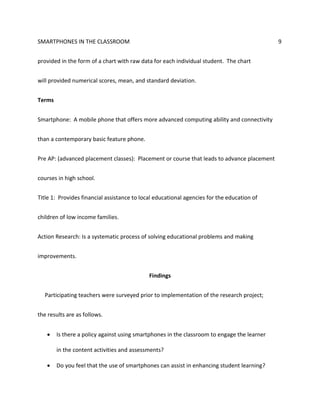
Participating teachers were surveyed prior to implementation of the research project;
the results are as follows.
 Is there a policy against using smartphones in the classroom to engage the learner
in the content activities and assessments?
 Do you feel that the use of smartphones can assist in enhancing student learning?
SMARTPHONES IN THE CLASSROOM 10
 Have you thought about using smartphones in the classroom as a learning device?
 Would you participate in a study addressing the use of smartphones in the
classroom?
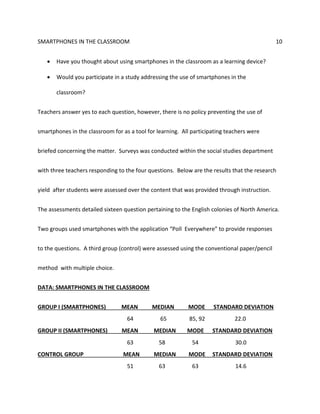
Teachers answer yes to each question, however, there is no policy preventing the use of
smartphones in the classroom for as a tool for learning. All participating teachers were
briefed concerning the matter. Surveys was conducted within the social studies department
with three teachers responding to the four questions. Below are the results that the research
yield after students were assessed over the content that was provided through instruction.
The assessments detailed sixteen question pertaining to the English colonies of North America.
Two groups used smartphones with the application “Poll Everywhere” to provide responses
to the questions. A third group (control) were assessed using the conventional paper/pencil
method with multiple choice.
DATA: SMARTPHONES IN THE CLASSROOM
GROUP I (SMARTPHONES) MEAN MEDIAN MODE STANDARD DEVIATION
64 65 85, 92 22.0
GROUP II (SMARTPHONES) MEAN MEDIAN MODE STANDARD DEVIATION
63 58 54 30.0
CONTROL GROUP MEAN MEDIAN MODE STANDARD DEVIATION
51 63 63 14.6
SMARTPHONES IN THE CLASSROOMS 11
Summary
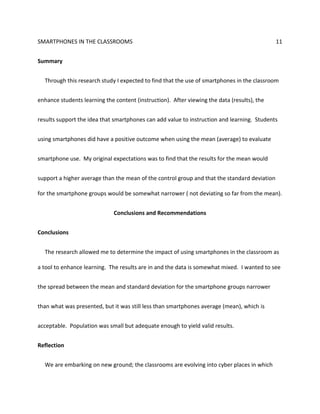
Through this research study I expected to find that the use of smartphones in the classroom
enhance students learning the content (instruction). After viewing the data (results), the
results support the idea that smartphones can add value to instruction and learning. Students
using smartphones did have a positive outcome when using the mean (average) to evaluate
smartphone use. My original expectations was to find that the results for the mean would
support a higher average than the mean of the control group and that the standard deviation
for the smartphone groups would be somewhat narrower ( not deviating so far from the mean).
Conclusions and Recommendations
Conclusions
The research allowed me to determine the impact of using smartphones in the classroom as
a tool to enhance learning. The results are in and the data is somewhat mixed. I wanted to see
the spread between the mean and standard deviation for the smartphone groups narrower
than what was presented, but it was still less than smartphones average (mean), which is
acceptable. Population was small but adequate enough to yield valid results.
Reflection
We are embarking on new ground; the classrooms are evolving into cyber places in which
SMARTPHONES IN THE CLASSROOMS 12
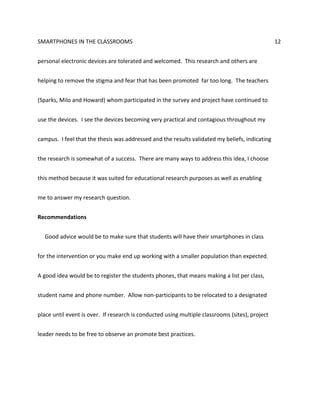
personal electronic devices are tolerated and welcomed. This research and others are
helping to remove the stigma and fear that has been promoted far too long. The teachers
(Sparks, Milo and Howard) whom participated in the survey and project have continued to
use the devices. I see the devices becoming very practical and contagious throughout my
campus. I feel that the thesis was addressed and the results validated my beliefs, indicating
the research is somewhat of a success. There are many ways to address this idea, I choose
this method because it was suited for educational research purposes as well as enabling
me to answer my research question.
Recommendations
Good advice would be to make sure that students will have their smartphones in class
for the intervention or you make end up working with a smaller population than expected.
A good idea would be to register the students phones, that means making a list per class,
student name and phone number. Allow non-participants to be relocated to a designated
place until event is over. If research is conducted using multiple classrooms (sites), project
leader needs to be free to observe an promote best practices.
SMARTPHONES IN THE CLASSROOM 13
Concluding Remarks
Although there appears to be a positive outcome when using smartphones in the class-
room as oppose to not using them, the data is inconclusive without more research. There
are still other factors and variables to consider that may or may not be at play. Educators
must also continue to expose themselves to the many new applications that can be
downloaded onto smartphones, and continue to experiment.
SMARTPHONES IN THE CLASSROOM 14
References
Carey, J. (2012). Teaching with smartphones. The How of 21st Century Teaching, Voices,
Web Tools that Deepen Learning, p6.
Cochrane, T. and Bateman, R. (2010b) Reflections on 3 years of m-learning implementation
(2007-2009). IADIS 2010 Mobile Learning Conference, Porto, Portugal.
Herrington, A (2009) Using a smartphone to create digital teaching episodes as resources
in adult education. In: Herrington, J., Herrington, A., Mantei, J., Olney, I. and Ferry. B
(eds.) New technologies, new pedagogies: Mobile learning in higher education. Wollongong:
Faculty of Education, University of Wollongong. [Online] Last accessed 28 September 2011.
Online at: http://ro.uow.edu.au/newtech/
Nortcliffe, A., Middleton, A. and Woodcock, B. (2011) Evaluating the use of audio smartphone
apps for higher education learning. Audio Engineering Society 130th Conference,
May 2011, London, UK.
DETERMINE THE USE OF SMARTPHONES IN THE CLASSROOM TO ENHANCE STUDENTS LEARNING THE CONTENT

DETERMINE THE USE OF SMARTPHONES IN THE CLASSROOM TO ENHANCE STUDENTS LEARNING THE CONTENT

  • 1.
    Running Head: SMARTPHONESIN THE CLASSROOMS 1 DETERMINE THE USE OF SMARTPHONES IN THE CLASSROOM TO ENHANCE STUDENTS LEARNING THE CONTENT An Action Research Project Presented to The Faculty of the College of Graduate Studies Lamar University In Partial Fulfillment Of the Requirements for the Degree Education Technology Leadership by Artis R. McCoy December 2013
  • 2.
    SMARTPHONES IN THECLASSROOM 2 ABSTRACT DETERMINE THE USE OF SMARTPHONES IN THE CLASSROOM By Artis R. McCoy The idea to research the use of smartphones in the classroom to enhance students learning the content came to me upon the bequest of my research professor to decide on a research topic. However, I had thought well before how smartphones are so demonized in the schools. So, I decided to investigate the idea on my campus; a middle school in southeast Texas, a small urban industrial area. The campus is a Title 1 campus, with a large population of economic disadvantaged students, diverse population (majority of which is Hispanic). This study confronts the problem of not using smartphones in the classroom and can smartphones enhance the instruction and learning process while used in the classroom. Subjects were two groups who utilized cell phones to complete task and an assessment at the end of instruction; the control group did not use smartphones during instruction and also not used on the assessment. Well, the data revealed when comparing the two smartphone using groups to the control group showed the groups using the devices had a higher mean (average) but wide standard deviation. The study does show positive smartphone outcomes.
  • 3.
    SMARTPHONES IN THECLASSROOM 3 Determine the Use of Smartphones In the Classroom to Enhance Students Learning the Content Introduction This study utilizes three groups of students; two groups which are the sample pool and a third group as the control group. The intent of the project is to determine if the use of smartphones in the classroom enhance students learning the content. To determine this; surveys, interviews, and assessments will be used. The campus which I will conduct this action research, is a middle school located in south- east Texas, a small urban industrial area. The area has a very diversified population, with sixty per-cent Hispanic, thirty per-cent African American, seven per-cent Vietnamese and three per-cent White. The campus ethnicity is relatively the same as the area, while the campus is identified as a Title 1 campus with a large population of economic disadvantaged students. The grade levels of this campus are sixth through eight grade. Challenges (1) Smartphones are not viewed in a positive way, (2) phones can be confiscated and (3) keeping the subjects on task. Many campuses have so demonized the devices as to
  • 4.
    SMARTPHONES IN THECLASSROOM 4 where they are considered as something negative. The campus in which I will conduct this action research is a middle school located in southeast Texas, in a small urban industrial area. This area has a very diversified population, with sixty per-cent Hispanic, thirty per- cent, African American, seven per-cent Vietnamese and three per-cent White. The campus ethnicity is relatively the same as the area, while the campus is identified as a Title 1 campus with a large population of economic disadvantaged students. The grade levels for this campus are sixth through eight grade. On this campus smartphones are not viewed in a positive way, especially when they are in the possession of students. When phones are confiscated, students must pay fifteen dollars for their return. Another challenge to this study involves keeping the subjects on task. Problem Statement This study confronts the problem of not being able to use smartphones in the classroom. Smartphones arrived in the year 2007, and though they have been received and embraced by many institutions in their work places; that is not the case in the educational classroom. So these kinds of studies are needed to perhaps expose the more positive benefits for classroom use. The action research project that this study involves, requires all participants to have their personal smartphone. Participants must have permission by parents and administrators to use
  • 5.
    SMARTPHONES IN THECLASSROOM 5 the device in the classroom. Students must be willing participants and be given permission (parents) to download free applications if necessary. This action research project wants to determine the use of smartphones in the classroom to enhance students learning. Since the advent of smartphone (2007), phone usage and capabilities have grown immensely. However smartphone usage in the classroom is moving at a delayed pace. Significance of Study The project will provide a base for teachers (educators) who want to challenge their teaching methods; can also be thought of as a platform to flip the classroom. This study will also add to the knowledge base for the implementation of smartphones in the classroom. Another benefit could mean providing a positive impression of the device’s usage in the classroom. Literature Review No matter whom we ask, almost all will admit that smartphones are impacting their lives, in some way or form. But, for educators there is this love-hate relationship in their response con- cerning smartphones. Jennifer Carey (2012) says when we combine the modern smartphone with wireless internet access and the remarkable number of cheap and free apps now available, we find that they are truly amazing pocket-sized learning devices. Whether educators like them, or hate them, the reality is that cellphones are going to become pervasive in our class-
  • 6.
    SMARTPHONES IN THECLASSROOM 6 rooms, if they aren’t already. Educators have an obligation to find ways to implement and incorporate new technologies and media in the classroom; change the conversation about smartphones from the negative to positive. Middleton, Woodcock, and Nortcliff (2012) found that students who own smartphones are largely unaware of their potential to support learning and in general, do not install smartphone application for that purpose. They are, however, interested in and open to the potential as they become familiar with the possibilities for a range of purposes. Herring (2009) discusses how smartphones were used to collect video, image and audio data for creating digital narratives or stories for use as curriculum resources. It was established by Cochrane and Bateman (2007-2009) that the choice of smartphone is critical to students in the acceptance of its use as a function of both the social acceptance and the smartphone’s ability to address the user’s specific requirements. Participants were asked to state which smartphone they owned by completing an open text field. Of the 188 owning smartphones, 88 declared using applications for learning purposes, and 76% of the remaining 100 responded positively to the question “would you consider using an application if it benefitted your studies”? However, 4% disagreed, while the remaining 20% were neutral. Subjects
  • 7.
    SMARTPHONES IN THECLASSROOM 7 The target population will consist of seventh grade social studies students of a school district in Jefferson County, Texas. A high percentage of these students are described as disadvantaged. The campus is considered a Title 1 campus made up of the following demo- graphics; approximately sixty-five per-cent Hispanic, twenty-five per-cent African American, seven per-cent Vietnamese, and three per-cent White. There are approximately 300 seventh grade social studies students; 90 of those will be subjects. Sixty of the subjects will be Pre AP students. The other 30 subjects will belong to the control group. The Advanced Placement cluster will help negate sample biases; students will be similar in their ability. Students are also conveniently accessible. This sample number is also a manageable amount when surveying and for questionnaires. Members of the sample pool will be pre-surveyed regarding smartphone use in the classroom. Sample population may be impacted by the results of the survey. Procedures The purpose of the project is to determine will the use of smartphones in the classroom enhance students learning the content. Social Studies teachers were surveyed prior to implementation and intervention, concerning their knowledge of policy and their attitude about smartphones in the classroom as a learning tool. The subjects will participate in a social studies lesson (to be determined) that will require the use of smartphones. Two classes (7th
  • 8.
    SMARTPHONES IN THECLASSROOM 8 grade) of students (subjects) will perform tasks using their phones to complete a particular section of the lesson(s). These will number in each class approximately 30 subjects each. A third group numbering also approximately 30 subjects will be by design the control group. Although this group will participate in the same lesson(s), they will not be permitted to use smartphones while engaged in the lesson. Subjects involved in the research lesson(s) will complete an assessment based on the content of the lesson(s). Three social studies teachers will be involved; they will deliver the lesson(s) to each group. Teachers will also be involve in the assessment phase. The intervention will begin during the fall of 2013, first or second six weeks, and the project should be completed by the third six weeks end. Data Collection Data collection is an integral and important aspect of the action research plan (project). Teachers were surveyed prior to implementation of the research project. The data or results of these surveys will be provided in the form of charts. Assessment of all subjects who participated well be performed during the second six weeks in which the lesson will be presented. The assessment will be in the form of a written test where subjects will provide short answers(must be an instrument that eliminates guessing). Subjects will be blocked, so I may be able to assess the same day following the lesson. Student’s results will be
  • 9.
    SMARTPHONES IN THECLASSROOM 9 provided in the form of a chart with raw data for each individual student. The chart will provided numerical scores, mean, and standard deviation. Terms Smartphone: A mobile phone that offers more advanced computing ability and connectivity than a contemporary basic feature phone. Pre AP: (advanced placement classes): Placement or course that leads to advance placement courses in high school. Title 1: Provides financial assistance to local educational agencies for the education of children of low income families. Action Research: Is a systematic process of solving educational problems and making improvements. Findings Participating teachers were surveyed prior to implementation of the research project; the results are as follows.  Is there a policy against using smartphones in the classroom to engage the learner in the content activities and assessments?  Do you feel that the use of smartphones can assist in enhancing student learning?
  • 10.
    SMARTPHONES IN THECLASSROOM 10  Have you thought about using smartphones in the classroom as a learning device?  Would you participate in a study addressing the use of smartphones in the classroom? Teachers answer yes to each question, however, there is no policy preventing the use of smartphones in the classroom for as a tool for learning. All participating teachers were briefed concerning the matter. Surveys was conducted within the social studies department with three teachers responding to the four questions. Below are the results that the research yield after students were assessed over the content that was provided through instruction. The assessments detailed sixteen question pertaining to the English colonies of North America. Two groups used smartphones with the application “Poll Everywhere” to provide responses to the questions. A third group (control) were assessed using the conventional paper/pencil method with multiple choice. DATA: SMARTPHONES IN THE CLASSROOM GROUP I (SMARTPHONES) MEAN MEDIAN MODE STANDARD DEVIATION 64 65 85, 92 22.0 GROUP II (SMARTPHONES) MEAN MEDIAN MODE STANDARD DEVIATION 63 58 54 30.0 CONTROL GROUP MEAN MEDIAN MODE STANDARD DEVIATION 51 63 63 14.6
  • 11.
    SMARTPHONES IN THECLASSROOMS 11 Summary Through this research study I expected to find that the use of smartphones in the classroom enhance students learning the content (instruction). After viewing the data (results), the results support the idea that smartphones can add value to instruction and learning. Students using smartphones did have a positive outcome when using the mean (average) to evaluate smartphone use. My original expectations was to find that the results for the mean would support a higher average than the mean of the control group and that the standard deviation for the smartphone groups would be somewhat narrower ( not deviating so far from the mean). Conclusions and Recommendations Conclusions The research allowed me to determine the impact of using smartphones in the classroom as a tool to enhance learning. The results are in and the data is somewhat mixed. I wanted to see the spread between the mean and standard deviation for the smartphone groups narrower than what was presented, but it was still less than smartphones average (mean), which is acceptable. Population was small but adequate enough to yield valid results. Reflection We are embarking on new ground; the classrooms are evolving into cyber places in which
  • 12.
    SMARTPHONES IN THECLASSROOMS 12 personal electronic devices are tolerated and welcomed. This research and others are helping to remove the stigma and fear that has been promoted far too long. The teachers (Sparks, Milo and Howard) whom participated in the survey and project have continued to use the devices. I see the devices becoming very practical and contagious throughout my campus. I feel that the thesis was addressed and the results validated my beliefs, indicating the research is somewhat of a success. There are many ways to address this idea, I choose this method because it was suited for educational research purposes as well as enabling me to answer my research question. Recommendations Good advice would be to make sure that students will have their smartphones in class for the intervention or you make end up working with a smaller population than expected. A good idea would be to register the students phones, that means making a list per class, student name and phone number. Allow non-participants to be relocated to a designated place until event is over. If research is conducted using multiple classrooms (sites), project leader needs to be free to observe an promote best practices.
  • 13.
    SMARTPHONES IN THECLASSROOM 13 Concluding Remarks Although there appears to be a positive outcome when using smartphones in the class- room as oppose to not using them, the data is inconclusive without more research. There are still other factors and variables to consider that may or may not be at play. Educators must also continue to expose themselves to the many new applications that can be downloaded onto smartphones, and continue to experiment.
  • 14.
    SMARTPHONES IN THECLASSROOM 14 References Carey, J. (2012). Teaching with smartphones. The How of 21st Century Teaching, Voices, Web Tools that Deepen Learning, p6. Cochrane, T. and Bateman, R. (2010b) Reflections on 3 years of m-learning implementation (2007-2009). IADIS 2010 Mobile Learning Conference, Porto, Portugal. Herrington, A (2009) Using a smartphone to create digital teaching episodes as resources in adult education. In: Herrington, J., Herrington, A., Mantei, J., Olney, I. and Ferry. B (eds.) New technologies, new pedagogies: Mobile learning in higher education. Wollongong: Faculty of Education, University of Wollongong. [Online] Last accessed 28 September 2011. Online at: http://ro.uow.edu.au/newtech/ Nortcliffe, A., Middleton, A. and Woodcock, B. (2011) Evaluating the use of audio smartphone apps for higher education learning. Audio Engineering Society 130th Conference, May 2011, London, UK.