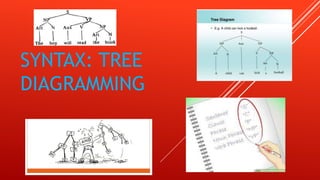
SYNTAX: TREE
DIAGRAMMING
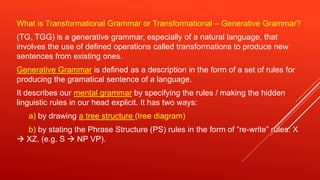
What is Transformational Grammar or Transformational – Generative Grammar?
(TG, TGG) is a generative grammar, especially of a natural language, that
involves the use of defined operations called transformations to produce new
sentences from existing ones.
Generative Grammar is defined as a description in the form of a set of rules for
producing the gramatical sentence of a language.
It describes our mental grammar by specifying the rules / making the hidden
linguistic rules in our head explicit. It has two ways:
a) by drawing a tree structure (tree diagram)
b) by stating the Phrase Structure (PS) rules in the form of “re-write” rules: X
 XZ. (e.g. S  NP VP).
WHAT IS TREE DIAGRAMMING IN
SYNTAX?
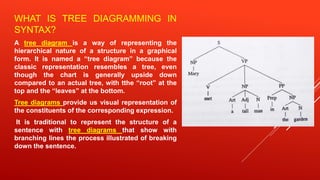
A tree diagram is a way of representing the
hierarchical nature of a structure in a graphical
form. It is named a “tree diagram” because the
classic representation resembles a tree, even
though the chart is generally upside down
compared to an actual tree, with tthe “root” at the
top and the “leaves” at the bottom.
Tree diagrams provide us visual representation of
the constituents of the corresponding expression.
It is traditional to represent the structure of a
sentence with tree diagrams that show with
branching lines the process illustrated of breaking
down the sentence.
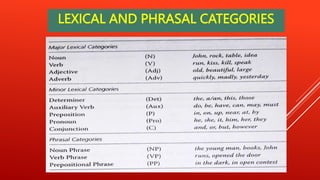
LEXICAL AND PHRASAL CATEGORIES
TYPES OF NPs IN ENGLISH
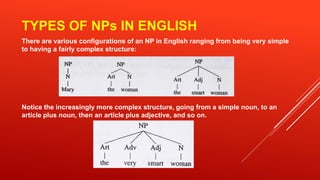
There are various configurations of an NP in English ranging from being very simple
to having a fairly complex structure:
Notice the increasingly more complex structure, going from a simple noun, to an
article plus noun, then an article plus adjective, and so on.
Finally, notice that an NP may be modified by a PP, as in the example the woman at work.
Note that modification takes the form of attaching under the NP node. This will
become quite significant when we discuss PP attachment.
Let us add that VPs can be similarly complex, except nothing ever
comes before the verb.
CONFIGURATIONAL DEFINITIONS
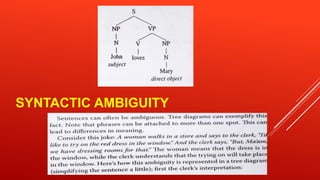
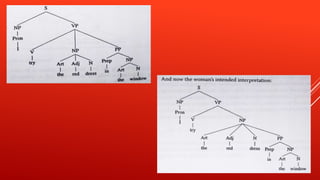
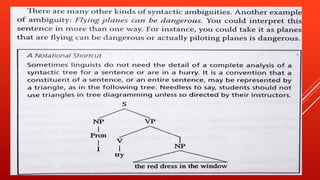
SYNTACTIC AMBIGUITY
PHRASE STRUCTURE RULES
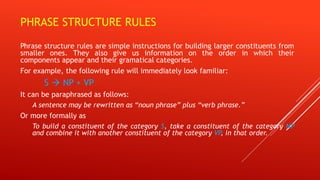
Phrase structure rules are simple instructions for building larger constituents from
smaller ones. They also give us information on the order in which their
components appear and their gramatical categories.
For example, the following rule will immediately look familiar:
S  NP + VP
It can be paraphrased as follows:
A sentence may be rewritten as “noun phrase” plus “verb phrase.”
Or more formally as
To build a constituent of the category S, take a constituent of the category NP
and combine it with another constituent of the category VP, in that order.
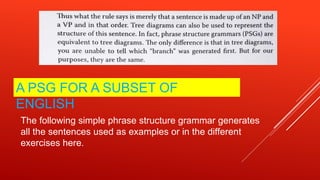
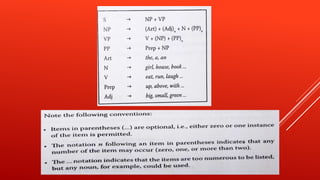
A PSG FOR A SUBSET OF
ENGLISH
The following simple phrase structure grammar generates
all the sentences used as examples or in the different
exercises here.
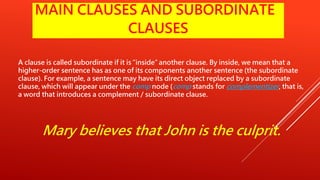
MAIN CLAUSES AND SUBORDINATE
CLAUSES
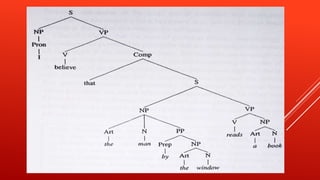
A clause is called subordinate if it is “inside” another clause. By inside, we mean that a
higher-order sentence has as one of its components another sentence (the subordinate
clause). For example, a sentence may have its direct object replaced by a subordinate
clause, which will appear under the comp node (comp stands for complementizer, that is,
a word that introduces a complement / subordinate clause.
Mary believes that John is the culprit.
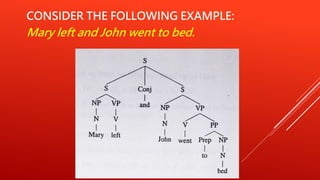
CONSIDER THE FOLLOWING EXAMPLE:
Mary left and John went to bed.
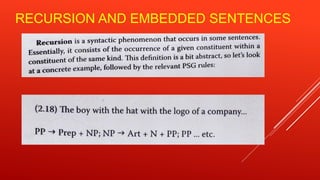
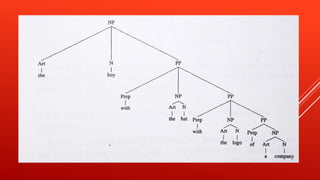
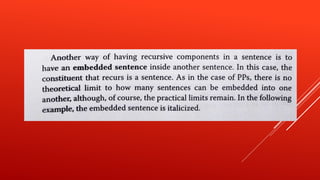
RECURSION AND EMBEDDED SENTENCES
SYNTAX - AN INTRODUCTION TO TREE DIAGRAMMING

SYNTAX - AN INTRODUCTION TO TREE DIAGRAMMING

  • 1.
  • 2.
    What is TransformationalGrammar or Transformational – Generative Grammar? (TG, TGG) is a generative grammar, especially of a natural language, that involves the use of defined operations called transformations to produce new sentences from existing ones. Generative Grammar is defined as a description in the form of a set of rules for producing the gramatical sentence of a language. It describes our mental grammar by specifying the rules / making the hidden linguistic rules in our head explicit. It has two ways: a) by drawing a tree structure (tree diagram) b) by stating the Phrase Structure (PS) rules in the form of “re-write” rules: X  XZ. (e.g. S  NP VP).
  • 3.
    WHAT IS TREEDIAGRAMMING IN SYNTAX? A tree diagram is a way of representing the hierarchical nature of a structure in a graphical form. It is named a “tree diagram” because the classic representation resembles a tree, even though the chart is generally upside down compared to an actual tree, with tthe “root” at the top and the “leaves” at the bottom. Tree diagrams provide us visual representation of the constituents of the corresponding expression. It is traditional to represent the structure of a sentence with tree diagrams that show with branching lines the process illustrated of breaking down the sentence.
  • 4.
  • 5.
    TYPES OF NPsIN ENGLISH There are various configurations of an NP in English ranging from being very simple to having a fairly complex structure: Notice the increasingly more complex structure, going from a simple noun, to an article plus noun, then an article plus adjective, and so on.
  • 6.
    Finally, notice thatan NP may be modified by a PP, as in the example the woman at work. Note that modification takes the form of attaching under the NP node. This will become quite significant when we discuss PP attachment. Let us add that VPs can be similarly complex, except nothing ever comes before the verb.
  • 7.
  • 8.
  • 11.
    PHRASE STRUCTURE RULES Phrasestructure rules are simple instructions for building larger constituents from smaller ones. They also give us information on the order in which their components appear and their gramatical categories. For example, the following rule will immediately look familiar: S  NP + VP It can be paraphrased as follows: A sentence may be rewritten as “noun phrase” plus “verb phrase.” Or more formally as To build a constituent of the category S, take a constituent of the category NP and combine it with another constituent of the category VP, in that order.
  • 12.
    A PSG FORA SUBSET OF ENGLISH The following simple phrase structure grammar generates all the sentences used as examples or in the different exercises here.
  • 14.
    MAIN CLAUSES ANDSUBORDINATE CLAUSES A clause is called subordinate if it is “inside” another clause. By inside, we mean that a higher-order sentence has as one of its components another sentence (the subordinate clause). For example, a sentence may have its direct object replaced by a subordinate clause, which will appear under the comp node (comp stands for complementizer, that is, a word that introduces a complement / subordinate clause. Mary believes that John is the culprit.
  • 16.
    CONSIDER THE FOLLOWINGEXAMPLE: Mary left and John went to bed.
  • 17.