SS Y N C O P E
Syncope
Kingshika Joylin
CRRI’24
For the dept. of oral and maxillofacial surgery
Rajas dental college and hospital, Tirunelveli dt.
in dentistry.
Definition
Transient, self limited loss of consciousness due to acute global impairment of cerebral blood flow.
(Harrison)
AKA ‘vasovagal syncope’ or ‘vasodepressor syncope’
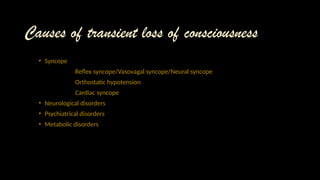
Causes of transient loss of consciousness
• Syncope
Reflex syncope/Vasovagal syncope/Neural syncope
Orthostatic hypotension
Cardiac syncope
• Neurological disorders
• Psychiatrical disorders
• Metabolic disorders
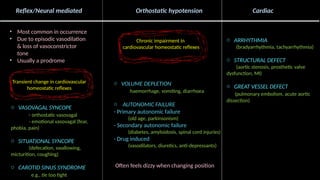
Reflex/Neural mediated Orthostatic hypotension Cardiac
• Most common in occurrence
• Due to episodic vasodilation
& loss of vasoconstrictor
tone
• Usually a prodrome
Transient change in cardiovascular
homeostatic reflexes
o VASOVAGAL SYNCOPE
- orthostatic vasovagal
- emotional vasovagal (fear,
phobia, pain)
o SITUATIONAL SYNCOPE
(defecation, swallowing,
micturition, coughing)
o CAROTID SINUS SYNDROME
e.g., tie too tight
Chronic impairment in
cardiovascular homeostatic reflexes
o VOLUME DEPLETION
haemorrhage, vomiting, diarrhoea
o AUTONOMIC FAILURE
- Primary autonomic failure
(old age, parkinsonism)
- Secondary autonomic failure
(diabetes, amyloidosis, spinal cord injuries)
- Drug induced
(vasodilators, diuretics, anti-depressants)
o ARRHYTHMIA
(bradyarrhythmia, tachyarrhythmia)
o STRUCTURAL DEFECT
(aortic stenosis, prosthetic valve
dysfunction, MI)
o GREAT VESSEL DEFECT
(pulmonary embolism, acute aortic
dissection)
Often feels dizzy when changing position
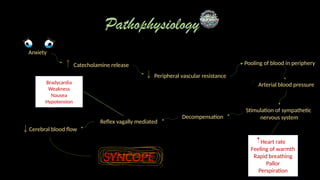
Pathophysiology
Anxiety
Catecholamine release
Peripheral vascular resistance
Pooling of blood in periphery
Stimulation of sympathetic
nervous system
Heart rate
Feeling of warmth
Rapid breathing
Pallor
Perspiration
Decompensation
Reflex vagally mediated
Cerebral blood flow
SYNCOPE
Bradycardia
Weakness
Nausea
Hypotension
Arterial blood pressure
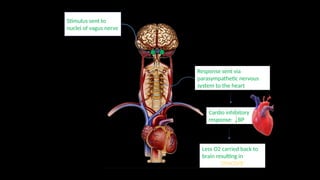
Stimulus sent to
nuclei of vagus nerve
Response sent via
parasympathetic nervous
system to the heart
Cardio inhibitory
response: BP
Less O2 carried back to
brain resulting in
‘SYNCOPE’
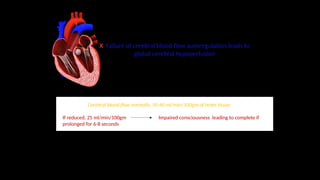
X Failure of cerebral blood flow autoregulation leads to
global cerebral hypoperfusion
Cerebral blood flow normally, 50-60 ml/min/100gm of brain tissue
If reduced, 25 ml/min/100gm Impaired consciousness leading to complete if
prolonged for 6-8 seconds
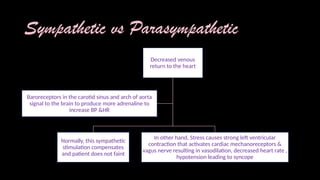
Sympathetic vs Parasympathetic
Decreased venous
return to the heart
Normally, this sympathetic
stimulation compensates
and patient does not faint
In other hand, Stress causes strong left ventricular
contraction that activates cardiac mechanoreceptors &
vagus nerve resulting in vasodilation, decreased heart rate ,
hypotension leading to syncope
Baroreceptors in the carotid sinus and arch of aorta
signal to the brain to produce more adrenaline to
increase BP &HR
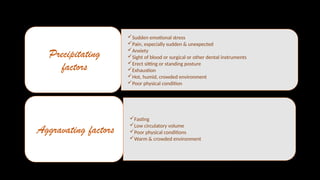
Sudden emotional stress
Pain, especially sudden & unexpected
Anxiety
Sight of blood or surgical or other dental instruments
Erect sitting or standing posture
Exhaustion
Hot, humid, crowded environment
Poor physical condition
Precipitating
factors
Fasting
Low circulatory volume
Poor physical conditions
Warm & crowded environment
Aggravating factors
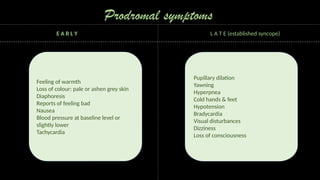
Prodromal symptoms
E A R L Y L A T E (established syncope)
Feeling of warmth
Loss of colour: pale or ashen grey skin
Diaphoresis
Reports of feeling bad
Nausea
Blood pressure at baseline level or
slightly lower
Tachycardia
Pupillary dilation
Yawning
Hyperpnea
Cold hands & feet
Hypotension
Bradycardia
Visual disturbances
Dizziness
Loss of consciousness
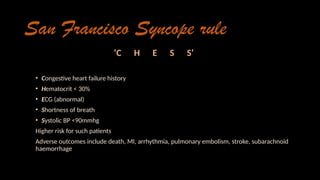
San Francisco Syncope rule
‘C H E S S’
• Congestive heart failure history
• Hematocrit < 30%
• ECG (abnormal)
• Shortness of breath
• Systolic BP <90mmhg
Higher risk for such patients
Adverse outcomes include death, MI, arrhythmia, pulmonary embolism, stroke, subarachnoid
haemorrhage
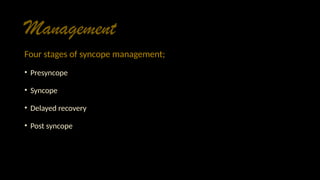
Management
Four stages of syncope management;
• Presyncope
• Syncope
• Delayed recovery
• Post syncope
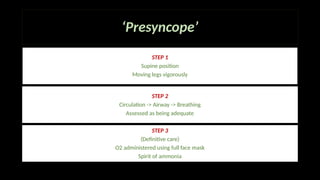
‘Presyncope’
STEP 1
Supine position
Moving legs vigorously
STEP 2
Circulation -> Airway -> Breathing
Assessed as being adequate
STEP 3
(Definitive care)
O2 administered using full face mask
Spirit of ammonia
‘SYNCOPE’
Step 1: POSITION
• Terminate the dental procedure
• Supine position with legs slightly elevated
• Muscle movements helps increase the return of blood from the periphery
‘Trendelenburg position’
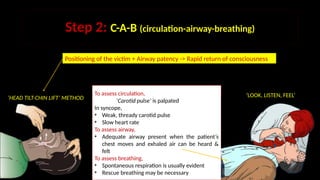
Step 2: C-A-B (circulation-airway-breathing)
To assess circulation,
‘Carotid pulse’ is palpated
In syncope,
• Weak, thready carotid pulse
• Slow heart rate
To assess airway,
• Adequate airway present when the patient’s
chest moves and exhaled air can be heard &
felt
To assess breathing,
• Spontaneous respiration is usually evident
• Rescue breathing may be necessary
‘HEAD TILT-CHIN LIFT’ METHOD
Positioning of the victim + Airway patency -> Rapid return of consciousness
‘LOOK, LISTEN, FEEL’
StepStep 3: Definitive care
• Administration of O2
• Monitoring of vital signs (BP, heart rate, respiratory rate)
• Additional procedures
• Loosening of binding clothes
• Use of a respiratory stimulant, ‘AROMATIC AMMONIA’
• Cold towel placed on the forehead of a patient who is warm & blankets for those who feels cold
• If bradycardia, anticholinergic such as Atropine i.v or i.m
• Stimulus that precipitated the episode (syringe, an instrument or a piece of bloody gauze)
• Frequently, hypoglycemia is involved - Administration of ‘sugar’ in form of orange juice or non diet soft drink
‘Delayed recovery’
• If the patient does not recover in 15-20 mins call for emergency medical services (EMS)
• Perform Basic life support (BLS)
• CAUSES
- Seizure
- Cerebrovascular accident (stroke)
- Transient ischemic attacks (TIA)
- Cardiac dysrhythmias
- Hypoglycaemia
‘Post syncope’
• Not any additional dental treatment
• Body may take 24 hr to settle down
• Should determine the precipitating factors
• Arrangements for adult escort to take patient home
References
• Little and Falace’s Dental management of the medically compromised patient - 9th
edition
• SM Balaji’s Textbook of oral & maxillofacial surgery - 3rd
edition
• Stanley F Malamed’s Medical emergencies in the dental office
• Harrison’s manual of medicine - 19th
edition
Thankyou

Syncope in dentistry.pptx

  • 1.
    SS Y NC O P E Syncope Kingshika Joylin CRRI’24 For the dept. of oral and maxillofacial surgery Rajas dental college and hospital, Tirunelveli dt. in dentistry.
  • 2.
    Definition Transient, self limitedloss of consciousness due to acute global impairment of cerebral blood flow. (Harrison) AKA ‘vasovagal syncope’ or ‘vasodepressor syncope’
  • 3.
    Causes of transientloss of consciousness • Syncope Reflex syncope/Vasovagal syncope/Neural syncope Orthostatic hypotension Cardiac syncope • Neurological disorders • Psychiatrical disorders • Metabolic disorders
  • 4.
    Reflex/Neural mediated Orthostatichypotension Cardiac • Most common in occurrence • Due to episodic vasodilation & loss of vasoconstrictor tone • Usually a prodrome Transient change in cardiovascular homeostatic reflexes o VASOVAGAL SYNCOPE - orthostatic vasovagal - emotional vasovagal (fear, phobia, pain) o SITUATIONAL SYNCOPE (defecation, swallowing, micturition, coughing) o CAROTID SINUS SYNDROME e.g., tie too tight Chronic impairment in cardiovascular homeostatic reflexes o VOLUME DEPLETION haemorrhage, vomiting, diarrhoea o AUTONOMIC FAILURE - Primary autonomic failure (old age, parkinsonism) - Secondary autonomic failure (diabetes, amyloidosis, spinal cord injuries) - Drug induced (vasodilators, diuretics, anti-depressants) o ARRHYTHMIA (bradyarrhythmia, tachyarrhythmia) o STRUCTURAL DEFECT (aortic stenosis, prosthetic valve dysfunction, MI) o GREAT VESSEL DEFECT (pulmonary embolism, acute aortic dissection) Often feels dizzy when changing position
  • 5.
    Pathophysiology Anxiety Catecholamine release Peripheral vascularresistance Pooling of blood in periphery Stimulation of sympathetic nervous system Heart rate Feeling of warmth Rapid breathing Pallor Perspiration Decompensation Reflex vagally mediated Cerebral blood flow SYNCOPE Bradycardia Weakness Nausea Hypotension Arterial blood pressure
  • 6.
    Stimulus sent to nucleiof vagus nerve Response sent via parasympathetic nervous system to the heart Cardio inhibitory response: BP Less O2 carried back to brain resulting in ‘SYNCOPE’
  • 7.
    X Failure ofcerebral blood flow autoregulation leads to global cerebral hypoperfusion Cerebral blood flow normally, 50-60 ml/min/100gm of brain tissue If reduced, 25 ml/min/100gm Impaired consciousness leading to complete if prolonged for 6-8 seconds
  • 8.
    Sympathetic vs Parasympathetic Decreasedvenous return to the heart Normally, this sympathetic stimulation compensates and patient does not faint In other hand, Stress causes strong left ventricular contraction that activates cardiac mechanoreceptors & vagus nerve resulting in vasodilation, decreased heart rate , hypotension leading to syncope Baroreceptors in the carotid sinus and arch of aorta signal to the brain to produce more adrenaline to increase BP &HR
  • 9.
    Sudden emotional stress Pain,especially sudden & unexpected Anxiety Sight of blood or surgical or other dental instruments Erect sitting or standing posture Exhaustion Hot, humid, crowded environment Poor physical condition Precipitating factors Fasting Low circulatory volume Poor physical conditions Warm & crowded environment Aggravating factors
  • 10.
    Prodromal symptoms E AR L Y L A T E (established syncope) Feeling of warmth Loss of colour: pale or ashen grey skin Diaphoresis Reports of feeling bad Nausea Blood pressure at baseline level or slightly lower Tachycardia Pupillary dilation Yawning Hyperpnea Cold hands & feet Hypotension Bradycardia Visual disturbances Dizziness Loss of consciousness
  • 11.
    San Francisco Syncoperule ‘C H E S S’ • Congestive heart failure history • Hematocrit < 30% • ECG (abnormal) • Shortness of breath • Systolic BP <90mmhg Higher risk for such patients Adverse outcomes include death, MI, arrhythmia, pulmonary embolism, stroke, subarachnoid haemorrhage
  • 12.
    Management Four stages ofsyncope management; • Presyncope • Syncope • Delayed recovery • Post syncope
  • 13.
    ‘Presyncope’ STEP 1 Supine position Movinglegs vigorously STEP 2 Circulation -> Airway -> Breathing Assessed as being adequate STEP 3 (Definitive care) O2 administered using full face mask Spirit of ammonia
  • 14.
    ‘SYNCOPE’ Step 1: POSITION •Terminate the dental procedure • Supine position with legs slightly elevated • Muscle movements helps increase the return of blood from the periphery ‘Trendelenburg position’
  • 15.
    Step 2: C-A-B(circulation-airway-breathing) To assess circulation, ‘Carotid pulse’ is palpated In syncope, • Weak, thready carotid pulse • Slow heart rate To assess airway, • Adequate airway present when the patient’s chest moves and exhaled air can be heard & felt To assess breathing, • Spontaneous respiration is usually evident • Rescue breathing may be necessary ‘HEAD TILT-CHIN LIFT’ METHOD Positioning of the victim + Airway patency -> Rapid return of consciousness ‘LOOK, LISTEN, FEEL’
  • 16.
    StepStep 3: Definitivecare • Administration of O2 • Monitoring of vital signs (BP, heart rate, respiratory rate) • Additional procedures
  • 17.
    • Loosening ofbinding clothes • Use of a respiratory stimulant, ‘AROMATIC AMMONIA’ • Cold towel placed on the forehead of a patient who is warm & blankets for those who feels cold • If bradycardia, anticholinergic such as Atropine i.v or i.m • Stimulus that precipitated the episode (syringe, an instrument or a piece of bloody gauze) • Frequently, hypoglycemia is involved - Administration of ‘sugar’ in form of orange juice or non diet soft drink
  • 18.
    ‘Delayed recovery’ • Ifthe patient does not recover in 15-20 mins call for emergency medical services (EMS) • Perform Basic life support (BLS) • CAUSES - Seizure - Cerebrovascular accident (stroke) - Transient ischemic attacks (TIA) - Cardiac dysrhythmias - Hypoglycaemia
  • 19.
    ‘Post syncope’ • Notany additional dental treatment • Body may take 24 hr to settle down • Should determine the precipitating factors • Arrangements for adult escort to take patient home
  • 20.
    References • Little andFalace’s Dental management of the medically compromised patient - 9th edition • SM Balaji’s Textbook of oral & maxillofacial surgery - 3rd edition • Stanley F Malamed’s Medical emergencies in the dental office • Harrison’s manual of medicine - 19th edition
  • 21.