COURSE SYLLABUS


        Prepared by:
    Mevelle L. Asuncion, RN
          Instructor


          Approved by:
  Ellen Gay S. Intong, RN, MANc
                Dean


             June 2011
           First Semester
    Central Mindanao University
         College of Nursing
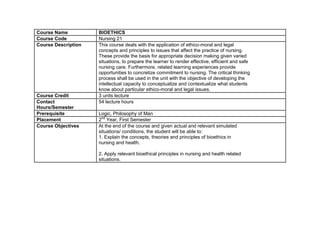
Course Name          BIOETHICS
Course Code          Nursing 21
Course Description   This course deals with the application of ethico-moral and legal
                     concepts and principles to issues that affect the practice of nursing.
                     These provide the basis for appropriate decision making given varied
                     situations, to prepare the learner to render effective, efficient and safe
                     nursing care. Furthermore, related learning experiences provide
                     opportunities to concretize commitment to nursing. The critical thinking
                     process shall be used in the unit with the objective of developing the
                     intellectual capacity to conceptualize and contextualize what students
                     know about particular ethico-moral and legal issues.
Course Credit        3 units lecture
Contact              54 lecture hours
Hours/Semester
Prerequisite         Logic, Philosophy of Man
Placement            2nd Year, First Semester
Course Objectives    At the end of the course and given actual and relevant simulated
                     situations/ conditions, the student will be able to:
                     1. Explain the concepts, theories and principles of bioethics in
                     nursing and health.

                     2. Apply relevant bioethical principles in nursing and health related
                     situations.
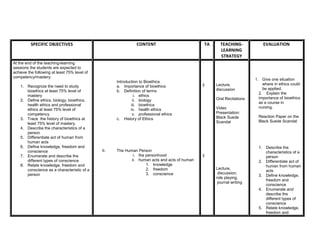
SPECIFIC OBJECTIVES                                  CONTENT                        TA     TEACHING-            EVALUATION
                                                                                                     LEARNING
                                                                                                     STRATEGY
At the end of the teaching-learning
sessions the students are expected to
achieve the following at least 75% level of
competency/mastery:
                                                                                                                      1. Give one situation
                                                    Introduction to Bioethics
                                                                                              3    Lecture,               where in ethics could
    1. Recognize the need to study                  a. Importance of bioethics
                                                                                                   discussion             be applied.
       bioethics at least 75% level of              b. Definition of terms
                                                                                                                        2. Explain the
       mastery                                                i. ethics
                                                                                                   Oral Recitations     importance of bioethics
    2. Define ethics, biology, bioethics,                    ii. biology
                                                                                                                        as a course in
       health ethics and professional                       iii. bioethics
                                                                                                   Video                nursing.
       ethics at least 75% level of                         iv. health ethics
       competency                                            v. professional ethics                Presentation:
                                                                                                   Black Suede          Reaction Paper on the
    3. Trace the history of bioethics at            c. History of Ethics
                                                                                                   Scandal              Black Suede Scandal
       least 75% level of mastery.
    4. Describe the characteristics of a
       person
    5. Differentiate act of human from
       human acts
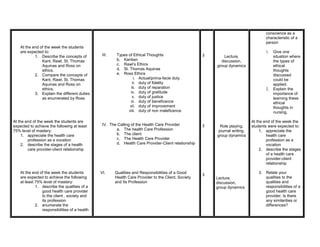
    6. Define knowledge, freedom and                                                                                    1. Describe the
       conscience                             II.   The Human Person                                                       characteristics of a
    7. Enumerate and describe the                           i. the personhood                 3                            person
       different types of conscience                       ii. human acts and acts of human                             2. Differentiate act of
    8. Relate knowledge, freedom and                               1. knowledge                                            human from human
       conscience as a characteristic of a                         2. freedom                      Lecture,
                                                                                                                           acts
       person                                                      3. conscience                    discussion,
                                                                                                                        3. Define knowledge,
                                                                                                   role playing,
                                                                                                                           freedom and
                                                                                                    journal writing
                                                                                                                           conscience
                                                                                                                        4. Enumerate and
                                                                                                                           describe the
                                                                                                                           different types of
                                                                                                                           conscience
                                                                                                                        5. Relate knowledge,
                                                                                                                           freedom and
conscience as a
                                                                                                                                    characteristic of a
                                                                                                                                    person
    At the end of the week the students
    are expected to:                                                                                                                1.   Give one
            1. Describe the concepts of         III.    Types of Ethical Thoughts                    3       Lecture,                    situation where
                Kant, Rawl, St. Thomas                  b. Kantian                                         discussion,                   the types of
                Aquinas and Ross on                     c. Rawl’s Ethics                                 group dynamics                  ethical
                ethics.                                 d. St. Thomas Aquinas                                                            thoughts
            2. Compare the concepts of                  e. Ross Ethics                                                                   discussed
                Kant, Rawl, St. Thomas                            i. Actual/prima-facie duty                                             could be
                Aquinas and Ross on                              ii. duty of fidelity                                                    applied.
                ethics.                                         iii. duty of reparation                                             2.   Explain the
            3. Explain the different duties                    iv. duty of gratitude                                                     importance of
                as enumerated by Ross                            v. duty of justice                                                      learning these
                                                               vi. duty of beneficence                                                   ethical
                                                               vii. duty of improvement                                                  thoughts in
                                                              viii. duty of non maleficence                                              nursing.

At the end of the week the students are                                                                                      At the end of the week the
expected to achieve the following at least      IV. The Calling of the Health Care Provider          3     Role playing,     students were expected to:
75% level of mastery:                                  a. The health Care Profession                      journal writing,        1. appreciate the
     1. appreciate the health care                     b. The client                                     group dynamics              health care
        profession as a vocation                       c. The Health Care Provider                                                   profession as a
     2. describe the stages of a health                d. Health Care Provider-Client relationship                                   vocation
        care provider-client relationship                                                                                         2. describe the stages
                                                                                                                                     of a health care
                                                                                                                                     provider-client
                                                                                                                                     relationship

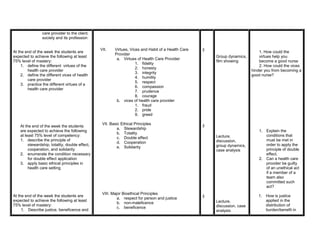
    At the end of the week the students        VI.     Qualities and Responsibilities of a Good                                 3. Relate your
                                                                                                     3
    are expected to achieve the following              Health Care Provider to the Client, Society       Lecture,                  qualities to the
    at least 75% level of mastery:                     and Its Profession                                discussion,               qualities and
             1. describe the qualities of a                                                              group dynamics            responsibilities of a
                good health care provider                                                                                          good health care
                to the client , society and                                                                                        provider. Is there
                its profession                                                                                                     any similarities or
             2. enumerate the                                                                                                      differences?
                responsibilities of a health
care provider to the client,
                 society and its profession


At the end of the week the students are
                                                 VII.    Virtues, Vices and Habit of a Health Care   3                          1. How could the
                                                         Provider
expected to achieve the following at least                                                               Group dynamics,        virtues help you
                                                          a. Virtues of Health Care Provider
75% level of mastery:                                                                                    film showing           become a good nurse
                                                                     1. fidelity
     1. define the different virtues of the                                                                                     2. How could the vices
                                                                     2. honesty
        health care provider                                                                                                hinder you from becoming a
                                                                     3. integrity
     2. define the different vices of health                                                                                good nurse?
                                                                     4. humility
        care provider
                                                                     5. respect
     3. practice the different virtues of a
                                                                     6. compassion
        health care provider
                                                                     7. prudence
                                                                     8. courage
                                                          b. vices of health care provider
                                                                     1. fraud
                                                                     2. pride
                                                                     9. greed

                                                  VII. Basic Ethical Principles
    At the end of the week the students                                                              3
                                                           a. Stewardship
    are expected to achieve the following                                                                                       1. Explain the
                                                           b. Totality
    at least 75% level of competency:                                                                    Lecture,                  conditions that
                                                           c. Double effect
    1. describe the principle of                                                                         discussion,               must be met in
                                                           d. Cooperation
         stewardship, totality, double effect,                                                           group dynamics,           order to apply the
                                                           e. Solidarity
         cooperation, and solidarity                                                                     case analysis             principle of double
    2. enumerate the condition necessary                                                                                           effect.
         for double effect application                                                                                          2. Can a health care
    3. apply basic ethical principles in                                                                                           provider be guilty
         health care setting                                                                                                       of an unethical act
                                                                                                                                   if a member of a
                                                                                                                                   team also
                                                                                                                                   committed such
                                                                                                                                   act?
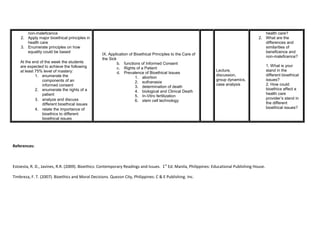
                                                  VIII. Major Bioethical Principles
At the end of the week the students are                                                              3                         1. How is justice
                                                           a. respect for person and justice
expected to achieve the following at least                                                               Lecture,                 applied in the
                                                           b. non-maleficence
75% level of mastery:                                                                                    discussion, case         distribution of
                                                           c. beneficence
     1. Describe justice, beneficence and                                                                analysis                 burden/benefit in
non-maleficence                                                                                                                       health care?
    2. Apply major bioethical principles in                                                                                               2. What are the
       health care                                                                                                                           differences and
    3. Enumerate principles on how                                                                                                           similarities of
       equality could be based                                                                                                               beneficence and
                                                  IX. Application of Bioethical Principles to the Care of
                                                                                                                                             non-maleficence?
                                                  the Sick
    At the end of the week the students                    b. functions of Informed Consent
    are expected to achieve the following                                                                                                        1. What is your
                                                           c. Rights of a Patient
    at least 75% level of mastery:                                                                                Lecture,                       stand in the
                                                           d. Prevalence of Bioethical Issues
             1. enumerate the                                                                                     discussion,                    different bioethical
                                                                     1. abortion
                components of an                                                                                  group dynamics,                issues?
                                                                     2. euthanasia
                informed consent                                                                                  case analysis                  2. How could
                                                                     3. determination of death
             2. enumerate the rights of a                                                                                                        bioethics affect a
                                                                     4. biological and Clinical Death
                patient                                                                                                                          health care
                                                                     5. In-Vitro fertilization
             3. analyze and discuss                                                                                                              provider’s stand in
                                                                     6. stem cell technology
                different bioethical issues                                                                                                      the different
             4. relate the importance of                                                                                                         bioethical issues?
                bioethics to different
                bioethical issues


References:


Estoesta, R. D., Javines, R.R. (2009). Bioethics: Contemporary Readings and Issues. 1st Ed. Manila, Philippines: Educational Publishing House.

Timbreza, F. T. (2007). Bioethics and Moral Decisions. Quezon City, Philippines: C & E Publishing. Inc.
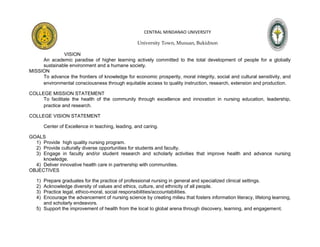
CENTRAL MINDANAO UNIVERSITY

                                                    University Town, Musuan, Bukidnon

              VISION
     An academic paradise of higher learning actively committed to the total development of people for a globally
     sustainable environment and a humane society.
MISSION
     To advance the frontiers of knowledge for economic prosperity, moral integrity, social and cultural sensitivity, and
     environmental consciousness through equitable access to quality instruction, research, extension and production.

COLLEGE MISSION STATEMENT
     To facilitate the health of the community through excellence and innovation in nursing education, leadership,
     practice and research.

COLLEGE VISION STATEMENT

        Center of Excellence in teaching, leading, and caring.

GOALS
  1) Provide high quality nursing program.
  2) Provide culturally diverse opportunities for students and faculty.
  3) Engage in faculty and/or student research and scholarly activities that improve health and advance nursing
     knowledge.
  4) Deliver innovative health care in partnership with communities.
OBJECTIVES

   1) Prepare graduates for the practice of professional nursing in general and specialized clinical settings.
   2) Acknowledge diversity of values and ethics, culture, and ethnicity of all people.
   3) Practice legal, ethico-moral, social responsibilities/accountabilities.
   4) Encourage the advancement of nursing science by creating milieu that fosters information literacy, lifelong learning,
      and scholarly endeavors.
   5) Support the improvement of health from the local to global arena through discovery, learning, and engagement.
6) Conduct research and other scholarly activities to add to the body of specialized knowledge and theory in nursing
   education activities.
7) Contribute to the improvement of nursing education through innovation, and participation in local to global nursing
   education activities.
8) Promote a positive societal view of professional nursing by increasing public awareness of nursing contribution to
   health care.
9) Advocate for the improvement of the health care delivery system through changes in public policy with regard to
   accessibility, effectiveness, and quality of health care

Syllabus bioethics

  • 1.
    COURSE SYLLABUS Prepared by: Mevelle L. Asuncion, RN Instructor Approved by: Ellen Gay S. Intong, RN, MANc Dean June 2011 First Semester Central Mindanao University College of Nursing
  • 2.
    Course Name BIOETHICS Course Code Nursing 21 Course Description This course deals with the application of ethico-moral and legal concepts and principles to issues that affect the practice of nursing. These provide the basis for appropriate decision making given varied situations, to prepare the learner to render effective, efficient and safe nursing care. Furthermore, related learning experiences provide opportunities to concretize commitment to nursing. The critical thinking process shall be used in the unit with the objective of developing the intellectual capacity to conceptualize and contextualize what students know about particular ethico-moral and legal issues. Course Credit 3 units lecture Contact 54 lecture hours Hours/Semester Prerequisite Logic, Philosophy of Man Placement 2nd Year, First Semester Course Objectives At the end of the course and given actual and relevant simulated situations/ conditions, the student will be able to: 1. Explain the concepts, theories and principles of bioethics in nursing and health. 2. Apply relevant bioethical principles in nursing and health related situations.
  • 3.
    SPECIFIC OBJECTIVES CONTENT TA TEACHING- EVALUATION LEARNING STRATEGY At the end of the teaching-learning sessions the students are expected to achieve the following at least 75% level of competency/mastery: 1. Give one situation Introduction to Bioethics 3 Lecture, where in ethics could 1. Recognize the need to study a. Importance of bioethics discussion be applied. bioethics at least 75% level of b. Definition of terms 2. Explain the mastery i. ethics Oral Recitations importance of bioethics 2. Define ethics, biology, bioethics, ii. biology as a course in health ethics and professional iii. bioethics Video nursing. ethics at least 75% level of iv. health ethics competency v. professional ethics Presentation: Black Suede Reaction Paper on the 3. Trace the history of bioethics at c. History of Ethics Scandal Black Suede Scandal least 75% level of mastery. 4. Describe the characteristics of a person 5. Differentiate act of human from human acts 6. Define knowledge, freedom and 1. Describe the conscience II. The Human Person characteristics of a 7. Enumerate and describe the i. the personhood 3 person different types of conscience ii. human acts and acts of human 2. Differentiate act of 8. Relate knowledge, freedom and 1. knowledge human from human conscience as a characteristic of a 2. freedom Lecture, acts person 3. conscience discussion, 3. Define knowledge, role playing, freedom and journal writing conscience 4. Enumerate and describe the different types of conscience 5. Relate knowledge, freedom and
  • 4.
    conscience as a characteristic of a person At the end of the week the students are expected to: 1. Give one 1. Describe the concepts of III. Types of Ethical Thoughts 3 Lecture, situation where Kant, Rawl, St. Thomas b. Kantian discussion, the types of Aquinas and Ross on c. Rawl’s Ethics group dynamics ethical ethics. d. St. Thomas Aquinas thoughts 2. Compare the concepts of e. Ross Ethics discussed Kant, Rawl, St. Thomas i. Actual/prima-facie duty could be Aquinas and Ross on ii. duty of fidelity applied. ethics. iii. duty of reparation 2. Explain the 3. Explain the different duties iv. duty of gratitude importance of as enumerated by Ross v. duty of justice learning these vi. duty of beneficence ethical vii. duty of improvement thoughts in viii. duty of non maleficence nursing. At the end of the week the students are At the end of the week the expected to achieve the following at least IV. The Calling of the Health Care Provider 3 Role playing, students were expected to: 75% level of mastery: a. The health Care Profession journal writing, 1. appreciate the 1. appreciate the health care b. The client group dynamics health care profession as a vocation c. The Health Care Provider profession as a 2. describe the stages of a health d. Health Care Provider-Client relationship vocation care provider-client relationship 2. describe the stages of a health care provider-client relationship At the end of the week the students VI. Qualities and Responsibilities of a Good 3. Relate your 3 are expected to achieve the following Health Care Provider to the Client, Society Lecture, qualities to the at least 75% level of mastery: and Its Profession discussion, qualities and 1. describe the qualities of a group dynamics responsibilities of a good health care provider good health care to the client , society and provider. Is there its profession any similarities or 2. enumerate the differences? responsibilities of a health
  • 5.
    care provider tothe client, society and its profession At the end of the week the students are VII. Virtues, Vices and Habit of a Health Care 3 1. How could the Provider expected to achieve the following at least Group dynamics, virtues help you a. Virtues of Health Care Provider 75% level of mastery: film showing become a good nurse 1. fidelity 1. define the different virtues of the 2. How could the vices 2. honesty health care provider hinder you from becoming a 3. integrity 2. define the different vices of health good nurse? 4. humility care provider 5. respect 3. practice the different virtues of a 6. compassion health care provider 7. prudence 8. courage b. vices of health care provider 1. fraud 2. pride 9. greed VII. Basic Ethical Principles At the end of the week the students 3 a. Stewardship are expected to achieve the following 1. Explain the b. Totality at least 75% level of competency: Lecture, conditions that c. Double effect 1. describe the principle of discussion, must be met in d. Cooperation stewardship, totality, double effect, group dynamics, order to apply the e. Solidarity cooperation, and solidarity case analysis principle of double 2. enumerate the condition necessary effect. for double effect application 2. Can a health care 3. apply basic ethical principles in provider be guilty health care setting of an unethical act if a member of a team also committed such act? VIII. Major Bioethical Principles At the end of the week the students are 3 1. How is justice a. respect for person and justice expected to achieve the following at least Lecture, applied in the b. non-maleficence 75% level of mastery: discussion, case distribution of c. beneficence 1. Describe justice, beneficence and analysis burden/benefit in
  • 6.
    non-maleficence health care? 2. Apply major bioethical principles in 2. What are the health care differences and 3. Enumerate principles on how similarities of equality could be based beneficence and IX. Application of Bioethical Principles to the Care of non-maleficence? the Sick At the end of the week the students b. functions of Informed Consent are expected to achieve the following 1. What is your c. Rights of a Patient at least 75% level of mastery: Lecture, stand in the d. Prevalence of Bioethical Issues 1. enumerate the discussion, different bioethical 1. abortion components of an group dynamics, issues? 2. euthanasia informed consent case analysis 2. How could 3. determination of death 2. enumerate the rights of a bioethics affect a 4. biological and Clinical Death patient health care 5. In-Vitro fertilization 3. analyze and discuss provider’s stand in 6. stem cell technology different bioethical issues the different 4. relate the importance of bioethical issues? bioethics to different bioethical issues References: Estoesta, R. D., Javines, R.R. (2009). Bioethics: Contemporary Readings and Issues. 1st Ed. Manila, Philippines: Educational Publishing House. Timbreza, F. T. (2007). Bioethics and Moral Decisions. Quezon City, Philippines: C & E Publishing. Inc.
  • 7.
    CENTRAL MINDANAO UNIVERSITY University Town, Musuan, Bukidnon VISION An academic paradise of higher learning actively committed to the total development of people for a globally sustainable environment and a humane society. MISSION To advance the frontiers of knowledge for economic prosperity, moral integrity, social and cultural sensitivity, and environmental consciousness through equitable access to quality instruction, research, extension and production. COLLEGE MISSION STATEMENT To facilitate the health of the community through excellence and innovation in nursing education, leadership, practice and research. COLLEGE VISION STATEMENT Center of Excellence in teaching, leading, and caring. GOALS 1) Provide high quality nursing program. 2) Provide culturally diverse opportunities for students and faculty. 3) Engage in faculty and/or student research and scholarly activities that improve health and advance nursing knowledge. 4) Deliver innovative health care in partnership with communities. OBJECTIVES 1) Prepare graduates for the practice of professional nursing in general and specialized clinical settings. 2) Acknowledge diversity of values and ethics, culture, and ethnicity of all people. 3) Practice legal, ethico-moral, social responsibilities/accountabilities. 4) Encourage the advancement of nursing science by creating milieu that fosters information literacy, lifelong learning, and scholarly endeavors. 5) Support the improvement of health from the local to global arena through discovery, learning, and engagement.
  • 8.
    6) Conduct researchand other scholarly activities to add to the body of specialized knowledge and theory in nursing education activities. 7) Contribute to the improvement of nursing education through innovation, and participation in local to global nursing education activities. 8) Promote a positive societal view of professional nursing by increasing public awareness of nursing contribution to health care. 9) Advocate for the improvement of the health care delivery system through changes in public policy with regard to accessibility, effectiveness, and quality of health care