REDEFINITION AND
DETERMINATION OF DEATH
Mevelle L. Asuncion

College of Nursing
Central Mindanao University
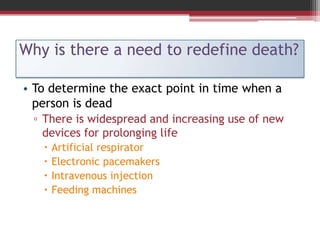
Why is there a need to redefine death?

• To determine the exact point in time when a
  person is dead
 ▫ There is widespread and increasing use of new
   devices for prolonging life
      Artificial respirator
      Electronic pacemakers
      Intravenous injection
      Feeding machines
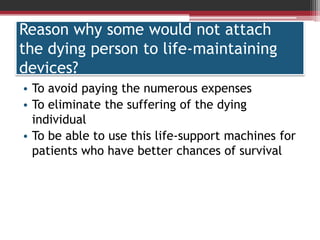
Reason why some would not attach
the dying person to life-maintaining
devices?
• To avoid paying the numerous expenses
• To eliminate the suffering of the dying
  individual
• To be able to use this life-support machines for
  patients who have better chances of survival
Are we prolonging life or prolonging
the dying process?
Why is there a need to redefine death?

• There is a great demand for cadaver organs for
  transplantation.
 ▫   Eyes
 ▫   Heart
 ▫   Kidneys
 ▫   Bone marrow
Definitions of Death
1.   Physiological definition
2.   Religious/ philosophical definition
3.   Brain death definition
4.   Cellular definition
PHYSIOLOGICAL DEFINITION

• When the heart stops beating.
• Traditional definition
RELIGIOUS/PHILOSOPHICAL
• Separation of soul and body
• Soul is viewed as the principle of life

• How do we know that the soul has separated
  from the body?
• when the person stops breathing and the heart
  stop beating
BRAIN DEATH DEFINITION
• Condition in which the brain is completely
  destroyed
• Use of EEG
• Use of ECG
• Absence of receptivity, responsiveness and
  absence of movement or breathing and absence
  of reflexes
CELLULAR DEFINITION
• Disintegration and breakdown of the metabolic
  processes of the body’s substance.
• Cellular level
Medical Context
• Brain death definition
• Organs can be harvested
• Blood circulation may be artificially
  maintained after brain death.
• Informed consent
 ▫ From the donor
 ▫ From the relatives
ATTITUDES TOWARDS DEATH
• Cognitive
  ▫ Acceptance or denial
• Affective
  ▫ Depression
  ▫ Sense of loss
  ▫ fear
• Behavioral
  ▫   Anger
  ▫   Irritability
  ▫   Bargaining
  ▫   Resentment
  ▫   fear
SEVERAL VIEW OF DEATH
• NIKOLAI BERDAEV
 ▫ Only death can give meaning to life
 ▫ Death is an intermission number between the present
   and the hereafter.
• EPICURUS
 ▫ We should not fear death but be happy about death
• MARTIN HEIDEGGER
 ▫ Views death as the completion of life, for unless and
   until one dies, one’s life is not yet complete.
 ▫ Death is an equalizer of men
APPLICATION OF ETHICAL THEORIES
• NATURAL LAW
 ▫ Part of nature
 ▫ When all vital functions of the brain completely
   disappear or stop, extraordinary medical
   measures may not be necessary, but in
   fact, USELESS.
• UTILITARIAN PRINCIPLE
 ▫ Detached the dying patient from all life-
   supporting machines
 ▫ Donations of harvested organs from brain dead
   individuals

Redefinition and determination of death

  • 1.
    REDEFINITION AND DETERMINATION OFDEATH Mevelle L. Asuncion College of Nursing Central Mindanao University
  • 2.
    Why is therea need to redefine death? • To determine the exact point in time when a person is dead ▫ There is widespread and increasing use of new devices for prolonging life  Artificial respirator  Electronic pacemakers  Intravenous injection  Feeding machines
  • 3.
    Reason why somewould not attach the dying person to life-maintaining devices? • To avoid paying the numerous expenses • To eliminate the suffering of the dying individual • To be able to use this life-support machines for patients who have better chances of survival
  • 4.
    Are we prolonginglife or prolonging the dying process?
  • 5.
    Why is therea need to redefine death? • There is a great demand for cadaver organs for transplantation. ▫ Eyes ▫ Heart ▫ Kidneys ▫ Bone marrow
  • 6.
    Definitions of Death 1. Physiological definition 2. Religious/ philosophical definition 3. Brain death definition 4. Cellular definition
  • 7.
    PHYSIOLOGICAL DEFINITION • Whenthe heart stops beating. • Traditional definition
  • 8.
    RELIGIOUS/PHILOSOPHICAL • Separation ofsoul and body • Soul is viewed as the principle of life • How do we know that the soul has separated from the body? • when the person stops breathing and the heart stop beating
  • 9.
    BRAIN DEATH DEFINITION •Condition in which the brain is completely destroyed • Use of EEG • Use of ECG • Absence of receptivity, responsiveness and absence of movement or breathing and absence of reflexes
  • 10.
    CELLULAR DEFINITION • Disintegrationand breakdown of the metabolic processes of the body’s substance. • Cellular level
  • 11.
    Medical Context • Braindeath definition • Organs can be harvested • Blood circulation may be artificially maintained after brain death. • Informed consent ▫ From the donor ▫ From the relatives
  • 12.
    ATTITUDES TOWARDS DEATH •Cognitive ▫ Acceptance or denial • Affective ▫ Depression ▫ Sense of loss ▫ fear • Behavioral ▫ Anger ▫ Irritability ▫ Bargaining ▫ Resentment ▫ fear
  • 13.
    SEVERAL VIEW OFDEATH • NIKOLAI BERDAEV ▫ Only death can give meaning to life ▫ Death is an intermission number between the present and the hereafter. • EPICURUS ▫ We should not fear death but be happy about death • MARTIN HEIDEGGER ▫ Views death as the completion of life, for unless and until one dies, one’s life is not yet complete. ▫ Death is an equalizer of men
  • 14.
    APPLICATION OF ETHICALTHEORIES • NATURAL LAW ▫ Part of nature ▫ When all vital functions of the brain completely disappear or stop, extraordinary medical measures may not be necessary, but in fact, USELESS. • UTILITARIAN PRINCIPLE ▫ Detached the dying patient from all life- supporting machines ▫ Donations of harvested organs from brain dead individuals